
Special Products of Binomials
Special products of binomials are shortcuts for three products that show up all the time. Squaring a sum gives (a + b)^2 = a^2 + 2ab + b^2. Squaring a difference gives (a - b)^2 = a^2 - 2ab + b^2. A sum times a difference gives (a + b)(a - b) = a^2 - b^2. Learn the patterns and you can skip FOIL.
Before this lesson: You should know multiplying binomials, the exponent rules, and combining like terms.
Extra practice: The Algebra 1 Unit 7 Practice Pack (Part 1) has printable problems, answer keys and a cheat sheet for this unit.
Why Special Products Have Patterns
Some binomial products have the same two terms in both binomials. When that happens, the answer always follows a pattern. You can still use FOIL, but the pattern is faster.
Look at (x + 4)^2. It means (x + 4)(x + 4). Draw it as a square with sides x + 4. The square splits into four parts: x^2, two rectangles of 4x, and 16.
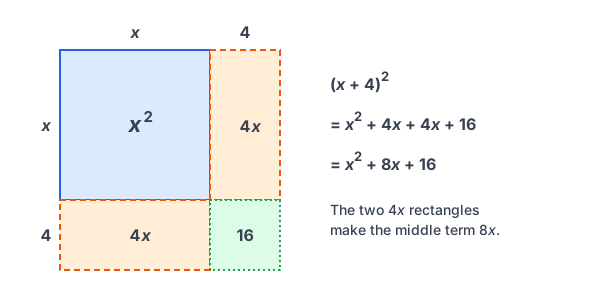
The two middle rectangles are the same size. So the middle term is always 2 times the product of the two terms. That is where the 2 in the pattern comes from.
Special Products of Binomials: The Three Formulas
| Name | Formula | Example |
|---|---|---|
| Square of a sum | (a + b)^2 = a^2 + 2ab + b^2 | (x + 3)^2 = x^2 + 6x + 9 |
| Square of a difference | (a - b)^2 = a^2 - 2ab + b^2 | (x - 3)^2 = x^2 - 6x + 9 |
| Sum and difference | (a + b)(a - b) = a^2 - b^2 | (x + 3)(x - 3) = x^2 - 9 |
In each formula, a is the first term and b is the second term. They can be numbers, variables or terms like 3x.
The first two answers are called perfect square trinomials. A trinomial is a polynomial with three terms. The last answer is called a difference of squares.
Steps
- Check the pattern. Is it a binomial squared? Or the same two terms with a plus sign and a minus sign?
- Name a and b. Include any coefficient, like a = 3x.
- Use the formula that matches.
- Square each whole term. For example, (3x)^2 = 9x^2.
- Check with FOIL or by putting in a number, like x = 1.
Worked Examples
Example 1: Square of a sum
Multiply (x + 6)^2.
Step 1. Match it to the pattern (a + b)^2 = a^2 + 2ab + b^2. Here a = x and b = 6.
(x + 6)^2 = x^2 + 2 \cdot x \cdot 6 + 6^2
Step 2. Substitute into the pattern.
= x^2 + 12x + 6^2
Step 3. Multiply the middle term: 2 \cdot x \cdot 6 = 12x.
= x^2 + 12x + 36
Step 4. Square the last term: 6^2 = 36.
Answer: x^2 + 12x + 36
Check: Use x = 1. The original gives (1 + 6)^2 = 7^2 = 49. The answer gives 1 + 12 + 36 = 49.
Example 2: Square of a difference
Multiply (y - 7)^2.
Step 1. Match it to the pattern (a - b)^2 = a^2 - 2ab + b^2. Here a = y and b = 7.
(y - 7)^2 = y^2 - 2 \cdot y \cdot 7 + 7^2
Step 2. Substitute into the pattern. The middle term gets the minus sign.
= y^2 - 14y + 7^2
Step 3. Multiply the middle term: 2 \cdot y \cdot 7 = 14y.
= y^2 - 14y + 49
Step 4. Square the last term. It is positive, because (-7)^2 = 49 too (see multiplying and dividing integers).
Answer: y^2 - 14y + 49
Example 3: A coefficient in the first term
Multiply (3x + 2)^2.
Step 1. Match it to (a + b)^2 = a^2 + 2ab + b^2. Here a = 3x and b = 2.
(3x + 2)^2 = (3x)^2 + 2 \cdot 3x \cdot 2 + 2^2
Step 2. Substitute into the pattern. Keep 3x in parentheses so the whole term gets squared.
= 9x^2 + 2 \cdot 3x \cdot 2 + 2^2
Step 3. Square the first term, coefficient and all: (3x)^2 = 9x^2 (see exponent rules).
= 9x^2 + 12x + 2^2
Step 4. Multiply the middle term: 2 \cdot 3x \cdot 2 = 12x.
= 9x^2 + 12x + 4
Step 5. Square the last term.
Answer: 9x^2 + 12x + 4
Check: Use FOIL (see multiplying binomials): (3x + 2)(3x + 2) = 9x^2 + 6x + 6x + 4 = 9x^2 + 12x + 4.
Example 4: Sum and difference
Multiply (4x + 5y)(4x - 5y).
Step 1. The two binomials have the same terms, 4x and 5y. One has a plus sign and one has a minus sign. So use (a + b)(a - b) = a^2 - b^2 with a = 4x and b = 5y.
(4x + 5y)(4x - 5y) = (4x)^2 - (5y)^2
Step 2. Substitute into the pattern.
= 16x^2 - (5y)^2
Step 3. Square the first term.
= 16x^2 - 25y^2
Step 4. Square the second term.
Answer: 16x^2 - 25y^2
Check: FOIL shows why there is no middle term. The outer product is 4x(-5y) = -20xy and the inner product is 5y \cdot 4x = 20xy. They add to 0.
Example 5: Word problem
A square garden has sides of x feet. The owner adds 3 feet to each side. Write the new area as a polynomial. How much area was added? Find both when x = 10.
A = (x + 3)^2
Step 1. Each new side is x + 3 feet. The area of a square is side times side (see area of rectangles).
= x^2 + 2 \cdot x \cdot 3 + 3^2
Step 2. Use the square of a sum with a = x and b = 3.
= x^2 + 6x + 3^2
Step 3. Multiply the middle term.
= x^2 + 6x + 9
Step 4. Square the last term.
(x^2 + 6x + 9) - x^2 = 6x + 9
Step 5. The old area was x^2. Subtract it to find the added area.
10^2 + 6(10) + 9 = 100 + 60 + 9 = 169
Step 6. Substitute 10 for x in the new area.
6(10) + 9 = 60 + 9 = 69
Step 7. Substitute 10 for x in the added area.
Answer: The new area is x^2 + 6x + 9 square feet, and 6x + 9 square feet were added. When x = 10, the new area is 169 square feet and 69 square feet were added.
Check: The new garden is 13 feet on a side, and 13^2 = 169.
Common Mistakes
| Mistake | Example of the error | Fix |
|---|---|---|
| Forgetting the middle term | (x + 5)^2 = x^2 + 25 | Square means times itself: x^2 + 10x + 25. |
| Using ab instead of 2ab | (x + 3)^2 = x^2 + 3x + 9 | There are two middle rectangles: x^2 + 6x + 9. |
| Making the last term negative | (x - 4)^2 = x^2 - 8x - 16 | (-4)^2 is positive: x^2 - 8x + 16. |
| Not squaring the coefficient | (3x + 1)^2 = 3x^2 + 6x + 1 | (3x)^2 = 9x^2, so 9x^2 + 6x + 1. |
| Using the pattern when the terms don’t match | (x + 2)(x - 3) = x^2 - 6 | Different numbers, so use FOIL: x^2 - x - 6. |
Using Special Products
Mental math
The patterns also work with plain numbers. Write a number as a sum or difference that is easy to square.
| Problem | Rewrite | Answer |
|---|---|---|
| 41 \cdot 39 | (40 + 1)(40 - 1) = 1600 - 1 | 1{,}599 |
| 51^2 | (50 + 1)^2 = 2500 + 100 + 1 | 2{,}601 |
| 29^2 | (30 - 1)^2 = 900 - 60 + 1 | 841 |
Getting ready to factor
Later in this unit, you will run these patterns backward. If you see x^2 - 49, you will know it came from (x + 7)(x - 7). See factoring the difference of squares. If you see x^2 + 10x + 25, you will know it came from (x + 5)^2. See perfect square trinomials.
For a binomial raised to a higher power, like (x + 1)^3, multiply step by step. See multiplying polynomials.
Practice Problems
- Multiply (x + 8)^2.
- Multiply (m - 3)^2.
- Multiply (x + 9)(x - 9).
- Multiply (2x + 5)^2.
- Multiply (3y - 4)^2.
- Multiply (6a + 1)(6a - 1).
- Multiply (x + 2y)^2.
- Multiply (5x - 2y)(5x + 2y).
- Use a special product to find 32 \cdot 28 without a calculator.
- A square photo has sides of x - 2 inches. Write its area as a polynomial. Then find the area when x = 10.
Show answers
1.
Use (a + b)^2 = a^2 + 2ab + b^2 with a = x and b = 8
x^2 + 2 \cdot x \cdot 8 + 8^2
Substitute.
x^2 + 16x + 8^2
Multiply the middle term.
x^2 + 16x + 64
Square the last term.
2.
Use (a - b)^2 = a^2 - 2ab + b^2 with a = m and b = 3
m^2 - 2 \cdot m \cdot 3 + 3^2
Substitute.
m^2 - 6m + 3^2
Multiply the middle term.
m^2 - 6m + 9
Square the last term.
3.
Use (a + b)(a - b) = a^2 - b^2 with a = x and b = 9
x^2 - 9^2
Substitute.
x^2 - 81
Square 9.
The middle terms cancel.
4.
Use the square of a sum with a = 2x and b = 5
(2x)^2 + 2 \cdot 2x \cdot 5 + 5^2
Substitute.
4x^2 + 2 \cdot 2x \cdot 5 + 5^2
Square the first term.
4x^2 + 20x + 5^2
Multiply the middle term.
4x^2 + 20x + 25
Square the last term.
5.
Use the square of a difference with a = 3y and b = 4
(3y)^2 - 2 \cdot 3y \cdot 4 + 4^2
Substitute.
9y^2 - 2 \cdot 3y \cdot 4 + 4^2
Square the first term.
9y^2 - 24y + 4^2
Multiply the middle term.
9y^2 - 24y + 16
Square the last term.
6.
Use (a + b)(a - b) = a^2 - b^2 with 6a and 1
(6a)^2 - 1^2
Substitute.
36a^2 - 1^2
Square the first term.
36a^2 - 1
Square 1.
7.
Use the square of a sum with a = x and b = 2y
x^2 + 2 \cdot x \cdot 2y + (2y)^2
Substitute.
x^2 + 4xy + (2y)^2
Multiply the middle term.
x^2 + 4xy + 4y^2
Square the last term.
8.
It is a sum times a difference of the same two terms. The order of the binomials doesn’t matter
(5x)^2 - (2y)^2
Substitute into the pattern.
25x^2 - (2y)^2
Square the first term.
25x^2 - 4y^2
Square the second term.
9.
32 \cdot 28 = (30 + 2)(30 - 2)
Write each number as 30 plus or minus 2.
30^2 - 2^2
Use the sum-and-difference pattern.
900 - 4
Square each number.
896
Subtract.
10.
A = (x - 2)^2
The area of a square is side times side.
x^2 - 2 \cdot x \cdot 2 + 2^2
Use the square of a difference.
x^2 - 4x + 2^2
Multiply the middle term.
x^2 - 4x + 4
Square the last term.
10^2 - 4(10) + 4 = 100 - 40 + 4 = 64
Substitute 10 for x.
Check: the photo is 8 inches on a side: 8^2 = 64
The area is 64 square inches.
Want more practice? The Algebra 1 Unit 7 Practice Pack (Part 1) has 37 pages of problems on this and the other lessons in the unit, with step-by-step answers and a cheat sheet.
FAQ
What are the three special products?
They are the square of a sum, (a + b)^2, the square of a difference, (a - b)^2, and a sum times a difference, (a + b)(a - b).
What is the formula for squaring a binomial?
Square the first term, add 2 times the product of the terms, then add the square of the last term: (a + b)^2 = a^2 + 2ab + b^2. For a difference, the middle term is subtracted.
Why does (a + b)(a − b) have no middle term?
The outer product is -ab and the inner product is +ab. They add to 0, so only a^2 - b^2 is left.
Is (a + b)² the same as a² + b²?
No. You must include the middle term 2ab. For example, (2 + 3)^2 = 25, but 2^2 + 3^2 = 13.
Summary
- Square of a sum: (a + b)^2 = a^2 + 2ab + b^2.
- Square of a difference: (a - b)^2 = a^2 - 2ab + b^2. The last term is still positive.
- Sum and difference: (a + b)(a - b) = a^2 - b^2. The middle terms cancel.
- Square the whole term, including its coefficient.
- If the terms don’t match, use FOIL instead.
Previous lesson: Multiplying Polynomials
Next lesson: Factoring Out the Greatest Common Factor
Back to the Algebra 1 Index