
Factoring Out the Greatest Common Factor
Factoring out the GCF means finding the greatest common factor of every term in a polynomial and writing it in front of parentheses. It is the distributive property run backward. For example, 6x^2 + 9x = 3x(2x + 3), because 3x divides both terms. Always look for a GCF first when you factor.
Before this lesson: You should know how to find the greatest common factor of numbers, the distributive property, and the exponent rules.
Extra practice: The Algebra 1 Unit 7 Practice Pack (Part 1) has printable problems, answer keys and a cheat sheet for this unit.
What Factoring Means
To factor means to write something as a product. You already factor numbers: 12 = 4 \cdot 3. Now you will factor polynomials.
When you distribute, you multiply: 3x(2x + 3) = 6x^2 + 9x. When you factor, you go the other way. You start with 6x^2 + 9x and find the 3x(2x + 3) it came from.
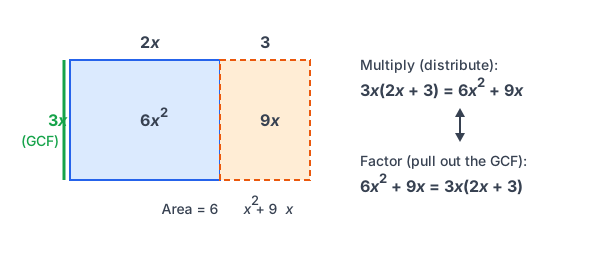
Think of the polynomial as the area of a rectangle. The GCF is one side. The part in parentheses is the other side.
How to Factor Out the GCF
The greatest common factor (GCF) of a polynomial is the largest monomial that divides every term. It has two parts.
| Part of the GCF | How to find it | Example: 12x^3 and 18x^2 |
|---|---|---|
| Number | The GCF of the coefficients | 6 |
| Each variable | The smallest exponent that appears in every term | x^2 |
| Whole GCF | Multiply the two parts | 6x^2 |
So 12x^3 + 18x^2 = 6x^2(2x + 3). To find each term inside, divide by the GCF: \frac{12x^3}{6x^2} = 2x and \frac{18x^2}{6x^2} = 3.
Steps
- Find the GCF of the coefficients.
- For each variable that is in every term, take the smallest exponent.
- Write the GCF in front of a set of parentheses.
- Divide each term by the GCF. Write the answers inside the parentheses.
- Check by distributing. You should get the original polynomial.
Worked Examples
Example 1: A number GCF
Factor 8x + 12.
Step 1. Find the greatest common factor of the coefficients. The factors of 8 are 1, 2, 4, 8, and the factors of 12 are 1, 2, 3, 4, 6, 12. The largest shared factor is 4.
Step 2. Check the variables. Only the first term has an x, so x is not part of the GCF. The GCF is 4.
8x + 12 = 4 \cdot 2x + 4 \cdot 3
Step 3. Divide each term by 4: \frac{8x}{4} = 2x and \frac{12}{4} = 3. Write each term as 4 times its quotient.
= 4(2x + 3)
Step 4. Pull out the 4. This is the distributive property in reverse.
Answer: 4(2x + 3)
Check: Distribute: 4 \cdot 2x + 4 \cdot 3 = 8x + 12.
Example 2: A variable in the GCF
Factor 10x^3 - 15x^2.
Step 1. Find the GCF of the coefficients. The GCF of 10 and 15 is 5.
Step 2. Find the smallest power of x. The powers are x^3 and x^2, so use x^2. The GCF is 5x^2.
10x^3 - 15x^2 = 5x^2 \cdot 2x - 5x^2 \cdot 3
Step 3. Divide each term by 5x^2. Subtract the exponents (see exponent rules): \frac{10x^3}{5x^2} = 2x and \frac{15x^2}{5x^2} = 3.
= 5x^2(2x - 3)
Step 4. Pull out 5x^2.
Answer: 5x^2(2x - 3)
Check: Distribute: 5x^2 \cdot 2x - 5x^2 \cdot 3 = 10x^3 - 15x^2.
Example 3: Two variables and three terms
Factor 12a^3b^2 + 18a^2b^3 - 6a^2b.
Step 1. Find the GCF of the coefficients. The GCF of 12, 18 and 6 is 6.
Step 2. Find the smallest power of each variable. For a: a^3, a^2, a^2, so use a^2. For b: b^2, b^3, b, so use b. The GCF is 6a^2b.
= 6a^2b \cdot 2ab + 6a^2b \cdot 3b^2 - 6a^2b \cdot 1
Step 3. Divide each term by 6a^2b: the quotients are 2ab, 3b^2 and 1.
= 6a^2b(2ab + 3b^2 - 1)
Step 4. Pull out 6a^2b. The last term divided by the GCF is 1. Don’t leave it out. The parentheses must still have three terms.
Answer: 6a^2b(2ab + 3b^2 - 1)
Example 4: A negative leading coefficient
Factor -4x^2 + 20x.
Step 1. The GCF of 4 and 20 is 4, and both terms have at least one x. So the GCF is 4x.
Step 2. The first term is negative, so factor out a negative GCF, -4x. Then the first term inside will be positive.
-4x^2 + 20x = -4x \cdot x + (-4x)(-5)
Step 3. Divide each term by -4x: \frac{-4x^2}{-4x} = x and \frac{20x}{-4x} = -5. Dividing by a negative changes the sign (see multiplying and dividing integers).
= -4x(x - 5)
Step 4. Pull out -4x.
Answer: -4x(x - 5)
Check: Distribute: -4x \cdot x + (-4x)(-5) = -4x^2 + 20x.
Example 5: Word problem
A rectangular patio has an area of 12x^2 + 8x square feet. Its width is 4x feet. Find its length. Then find the length and area when x = 3.
Step 1. Area is width times length. So factor the width, 4x, out of the area. It is also the GCF.
12x^2 + 8x = 4x \cdot 3x + 4x \cdot 2
Step 2. Divide each term by 4x: \frac{12x^2}{4x} = 3x and \frac{8x}{4x} = 2.
= 4x(3x + 2)
Step 3. Pull out 4x.
4(3) = 12
Step 4. The other factor is the length: 3x + 2 feet. Substitute 3 for x in the width.
3(3) + 2 = 11
Step 5. Substitute 3 for x in the length.
12 \cdot 11 = 132
Step 6. Multiply to find the area.
Answer: The length is 3x + 2 feet. When x = 3, the patio is 12 feet by 11 feet, and its area is 132 square feet.
Check: Put x = 3 into the area: 12(3)^2 + 8(3) = 12(9) + 8(3) = 108 + 24 = 132.
Common Mistakes
| Mistake | Example of the error | Fix |
|---|---|---|
| Leaving out the 1 | 6x^2 + 3x = 3x(2x) | \frac{3x}{3x} = 1, so 3x(2x + 1). |
| Not using the greatest factor | 12x + 18 = 2(6x + 9) | 6 and 9 still share 3. Use 6: 6(2x + 3). |
| Using the largest exponent | x^4 + x^2 = x^4(1 + x^2) | Use the smallest exponent: x^2(x^2 + 1). |
| Sign errors with a negative GCF | -3x - 6 = -3(x - 6) | \frac{-6}{-3} = 2, so -3(x + 2). |
| Dividing only some terms | 5x^2 + 10x - 15 = 5(x^2 + 10x - 15) | Divide every term: 5(x^2 + 2x - 3). |
More Ways the GCF Shows Up
When the GCF is a binomial
Sometimes every term shares a whole binomial. Treat it like one big factor.
3x(x + 2) + 5(x + 2) = (x + 2)(3x + 5)
Both terms have the factor (x + 2). Pull it out, and what is left is 3x + 5. You will use this idea again in factoring by grouping.
Factor out the GCF first
Taking out the GCF first makes the rest easier to factor. For example, 2x^2 + 10x + 12 = 2(x^2 + 5x + 6). The trinomial inside has smaller numbers, so it is easier to factor in the next lesson, Factoring Trinomials.
When the GCF is 1
Some polynomials, like 3x + 5 or x^2 + 7, have no common factor except 1. You can’t pull out a GCF. Some of them may still factor in other ways.
Factoring also undoes the special products of binomials and other polynomial products, as you will see in this unit.
Practice Problems
- Factor 7x + 21.
- Factor 9y^2 - 6y.
- Factor 4x^3 + 8x^2 - 12x.
- Factor 15a^2b - 25ab^2.
- Factor 2x^4 + 6x^3 + 2x^2.
- Factor -6x^2 - 18x.
- Factor 14m^3n^2 + 21m^2n^2 - 7mn^2.
- Factor x(x - 4) + 9(x - 4).
- Find the GCF of 24x^3, 36x^2 and 60x.
- A rectangle has an area of 18x^2 + 27x square meters and a width of 9x meters. Find its length. Then find the area when x = 2.
Show answers
1.
Find the GCF: 7 divides both 7 and 21, and only one term has x, so the GCF is 7
7 \cdot x + 7 \cdot 3
Divide each term by 7.
7(x + 3)
Pull out the GCF.
2.
Find the GCF: the GCF of 9 and 6 is 3, and the smallest power of y is y. The GCF is 3y
3y \cdot 3y - 3y \cdot 2
Divide each term by 3y.
3y(3y - 2)
Pull out the GCF.
Check by distributing: 3y(3y - 2) = 9y^2 - 6y
3.
Find the GCF: the GCF of 4, 8 and 12 is 4, and the smallest power of x is x. The GCF is 4x
4x \cdot x^2 + 4x \cdot 2x - 4x \cdot 3
Divide each term by 4x.
4x(x^2 + 2x - 3)
Pull out the GCF.
4.
Find the GCF: the GCF of 15 and 25 is 5, the smallest power of a is a, and the smallest power of b is b. The GCF is 5ab
5ab \cdot 3a - 5ab \cdot 5b
Divide each term by 5ab.
5ab(3a - 5b)
Pull out the GCF.
5.
Find the GCF: the GCF of 2, 6 and 2 is 2, and the smallest power of x is x^2. The GCF is 2x^2
2x^2 \cdot x^2 + 2x^2 \cdot 3x + 2x^2 \cdot 1
Divide each term by 2x^2. The last quotient is 1.
2x^2(x^2 + 3x + 1)
Pull out the GCF.
6.
Find the GCF: the GCF of 6 and 18 is 6, and both terms have x. The first term is negative, so use -6x
-6x \cdot x + (-6x)(3)
Divide each term by -6x. Both signs change.
-6x(x + 3)
Pull out the GCF.
7.
Find the GCF: the GCF of 14, 21 and 7 is 7, the smallest power of m is m, and every term has n^2. The GCF is 7mn^2
7mn^2 \cdot 2m^2 + 7mn^2 \cdot 3m - 7mn^2 \cdot 1
Divide each term by the GCF. The last quotient is 1.
7mn^2(2m^2 + 3m - 1)
Pull out the GCF.
8.
Both terms have the same binomial factor, x - 4. That binomial is the GCF
(x - 4)(x + 9)
Pull it out. What is left from the two terms is x and +9.
9.
Find the GCF of 24, 36 and 60. The factors of 24 that also divide 36 and 60 are 1, 2, 3, 4, 6 and 12. The largest is 12
Find the smallest power of x: x^3, x^2, x. The smallest is x^1 = x
The GCF is 12x.
10.
18x^2 + 27x = 9x \cdot 2x + 9x \cdot 3
Area is width times length, so factor out the width, 9x.
9x(2x + 3)
Pull out 9x.
9(2) = 18
The length is 2x + 3 meters. Substitute 2 for x in the width.
2(2) + 3 = 7
Substitute 2 for x in the length.
18 \cdot 7 = 126
Multiply to find the area.
Check with the area expression: 18(2)^2 + 27(2) = 72 + 54 = 126
The area is 126 square meters.
Want more practice? The Algebra 1 Unit 7 Practice Pack (Part 1) has 37 pages of problems on this and the other lessons in the unit, with step-by-step answers and a cheat sheet.
FAQ
What does it mean to factor out the GCF?
It means you divide every term by their greatest common factor and write the GCF in front of parentheses. For example, 5x + 10 = 5(x + 2).
How do you find the GCF of a polynomial?
Find the GCF of the coefficients. Then, for each variable in every term, use the smallest exponent. Multiply these together.
Should I factor out a negative?
Usually yes, when the first term is negative. Factoring out a negative GCF leaves a positive first term, like -2x^2 + 8x = -2x(x - 4). Remember to change every sign inside.
What if there is no common factor?
Then the GCF is 1, and you can’t pull anything out. The polynomial may still factor another way, such as a trinomial like x^2 + 5x + 6.
Summary
- Factoring writes a polynomial as a product. It undoes distributing.
- The GCF uses the GCF of the coefficients and the smallest power of each shared variable.
- Divide every term by the GCF and write the results in parentheses.
- If a term equals the GCF, a 1 is left in its place.
- Check by distributing. Factor out the GCF first in every factoring problem.
Previous lesson: Special Products of Binomials
Next lesson: Factoring Trinomials
Back to the Algebra 1 Index