
Factoring by Grouping
Factoring by grouping is a way to factor a polynomial with four terms. Group the terms in pairs, factor the GCF out of each pair, and then factor out the binomial they share. For example, x^3 + 3x^2 + 2x + 6 = x^2(x + 3) + 2(x + 3) = (x + 3)(x^2 + 2). It also finishes the AC method for trinomials.
Before this lesson: You should know factoring out the GCF, including a binomial GCF, and factoring trinomials when a is not 1.
Extra practice: The Algebra 1 Unit 7 Practice Pack (Part 2) has printable problems, answer keys and a cheat sheet for this unit.
How Grouping Works
A GCF can be a whole binomial. In Factoring Out the GCF, you saw 3x(x + 2) + 5(x + 2) = (x + 2)(3x + 5). Grouping turns four terms into that shape.
First, split the four terms into two pairs. Then pull the GCF out of each pair. If the two leftover binomials match, that binomial is a common factor.
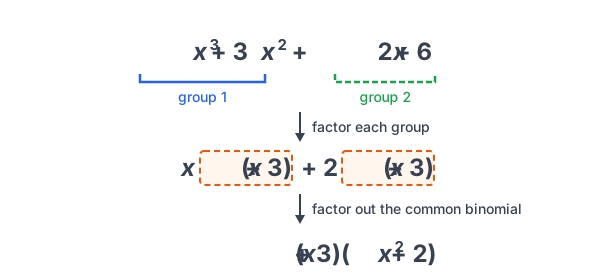
Steps for Factoring by Grouping
- Factor out the GCF of all four terms, if there is one.
- Group the first two terms and the last two terms.
- Factor the GCF out of each group. If the third term is negative, factor out a negative.
- Check that the two binomials match. Then factor out the common binomial.
- If they don’t match, try putting the terms in a different order.
- Check by multiplying.
ax + ay + bx + by = a(x + y) + b(x + y) = (x + y)(a + b)
Worked Examples
Example 1: Four positive terms
Factor x^3 + 3x^2 + 2x + 6.
x^3 + 3x^2 + 2x + 6 = (x^3 + 3x^2) + (2x + 6)
Step 1. Group the first two terms and the last two terms.
Step 2. Factor the GCF out of the first group: x^3 + 3x^2 = x^2(x + 3) (see factoring out the GCF).
= x^2(x + 3) + 2(x + 3)
Step 3. Factor the GCF out of the second group: 2x + 6 = 2(x + 3).
= (x + 3)(x^2 + 2)
Step 4. Both groups now have the same binomial, x + 3. Factor it out.
Answer: (x + 3)(x^2 + 2)
Check: Multiply (see multiplying polynomials): (x + 3)(x^2 + 2) = x^3 + 2x + 3x^2 + 6 = x^3 + 3x^2 + 2x + 6.
Example 2: Coefficients in each group
Factor 2x^3 - 8x^2 + 3x - 12.
2x^3 - 8x^2 + 3x - 12 = (2x^3 - 8x^2) + (3x - 12)
Step 1. Group the first two terms and the last two terms.
2x^3 - 8x^2 = 2x^2(x - 4)
Step 2. Factor the first group. Its GCF is 2x^2.
= 2x^2(x - 4) + 3(x - 4)
Step 3. Factor the second group. Its GCF is 3: 3x - 12 = 3(x - 4).
= (x - 4)(2x^2 + 3)
Step 4. Factor out the shared binomial, x - 4.
Answer: (x - 4)(2x^2 + 3)
Check: (x - 4)(2x^2 + 3) = 2x^3 + 3x - 8x^2 - 12 = 2x^3 - 8x^2 + 3x - 12.
Example 3: A negative third term
Factor x^3 - 2x^2 - 5x + 10.
x^3 - 2x^2 - 5x + 10 = (x^3 - 2x^2) + (-5x + 10)
Step 1. Group the first two terms and the last two terms. Keep the minus sign with the 5x.
x^3 - 2x^2 = x^2(x - 2)
Step 2. Factor the first group.
= x^2(x - 2) - 5(x - 2)
Step 3. The second group starts with a negative, so factor out -5. Divide each term: \frac{-5x}{-5} = x and \frac{10}{-5} = -2 (see multiplying and dividing integers).
= (x - 2)(x^2 - 5)
Step 4. Factor out the shared binomial, x - 2.
Answer: (x - 2)(x^2 - 5). If you factored out +5 instead, you would get 5(-x + 2), which does not match x - 2.
Example 4: Finishing the AC method
Factor 3x^2 + 10x + 8 by grouping.
ac = 3 \cdot 8 = 24
Step 1. Use the AC method (see factoring trinomials when a is not 1) The numbers 6 and 4 multiply to 24 and add to 10.
3x^2 + 10x + 8 = 3x^2 + 6x + 4x + 8
Step 2. Split 10x into 6x + 4x. Now there are four terms.
= (3x^2 + 6x) + (4x + 8)
Step 3. Group the terms in pairs.
= 3x(x + 2) + 4(x + 2)
Step 4. Factor each group: 3x(x + 2) and 4(x + 2).
= (x + 2)(3x + 4)
Step 5. Factor out the shared binomial, x + 2.
Answer: (x + 2)(3x + 4). This matches the box method answer, (3x + 4)(x + 2). Order does not matter when you multiply.
Example 5: Word problem
A rectangle has an area of xy + 2x + 5y + 10 square feet. Find binomials for its length and width. Then find the area when x = 3 and y = 4.
xy + 2x + 5y + 10 = (xy + 2x) + (5y + 10)
Step 1. Group the terms in pairs.
= x(y + 2) + 5(y + 2)
Step 2. Factor each group: xy + 2x = x(y + 2) and 5y + 10 = 5(y + 2).
= (y + 2)(x + 5)
Step 3. Factor out the shared binomial, y + 2.
x + 5 = 3 + 5 = 8
Step 4. The sides are x + 5 and y + 2 feet. Substitute x = 3.
y + 2 = 4 + 2 = 6
Step 5. Substitute y = 4.
8 \cdot 6 = 48
Step 6. Multiply to find the area.
Answer: The sides are x + 5 feet and y + 2 feet. When x = 3 and y = 4, the area is 48 square feet.
Check: Put the values into the area: 3 \cdot 4 + 2 \cdot 3 + 5 \cdot 4 + 10 = 12 + 6 + 20 + 10 = 48.
Common Mistakes
| Mistake | Example of the error | Fix |
|---|---|---|
| Wrong sign in the second group | x^3 - 2x^2 - 5x + 10 = x^2(x - 2) - 5(x + 2) | -5(x + 2) = -5x - 10, not -5x + 10. Use -5(x - 2). |
| Stopping after grouping | x^2(x + 3) + 2(x + 3) | This is still a sum. Factor out (x + 3): (x + 3)(x^2 + 2). |
| Forgetting the 1 | x^3 + 4x^2 + x + 4 = (x + 4)(x^2) | The second group is 1(x + 4). The answer is (x + 4)(x^2 + 1). |
| Giving up when the binomials don’t match | x^2 + 3y + xy + 3x: the first pair has no common factor | Reorder the terms: x^2 + 3x + xy + 3y = x(x + 3) + y(x + 3) = (x + 3)(x + y). |
Grouping Tips
| Situation | What to do |
|---|---|
| All four terms share a factor | Take it out first. 2x^3 + 6x^2 + 4x + 12 = 2(x^3 + 3x^2 + 2x + 6) |
| Third term is negative | Factor a negative out of the second group. |
| Binomials don’t match | Swap the middle two terms and try again. |
| Trinomial with a not 1 | Split the middle term with the AC method, then group. |
Grouping only works when the two binomials match. If no order of the terms gives a match, the polynomial may not factor by grouping. Sometimes a factor like x^2 - 9 can be factored again. You will learn that in the next lesson, Factoring the Difference of Squares.
You can always check your answer by multiplying the factors back together with the distributive property.
Practice Problems
- Factor x^3 + 2x^2 + 4x + 8.
- Factor x^3 - 6x^2 + 2x - 12.
- Factor 3x^3 + 12x^2 + 2x + 8.
- Factor x^3 + 7x^2 - 3x - 21.
- Factor 5x^3 - 15x^2 - x + 3.
- Factor ab + 4a + 2b + 8.
- Factor 10xy - 15x + 4y - 6.
- Factor 2x^2 + 11x + 12 by splitting the middle term and grouping.
- Factor 2x^3 + 6x^2 + 4x + 12 completely.
- A garden has an area of xy + 3x + 4y + 12 square meters. Find binomials for its length and width. Then find the area when x = 2 and y = 5.
Show answers
1.
(x^3 + 2x^2) + (4x + 8)
Group the terms in pairs.
x^2(x + 2) + 4(x + 2)
Factor each group.
(x + 2)(x^2 + 4)
Factor out the shared binomial.
2.
(x^3 - 6x^2) + (2x - 12)
Group the terms in pairs.
x^2(x - 6) + 2(x - 6)
Factor each group.
(x - 6)(x^2 + 2)
Factor out the shared binomial.
3.
(3x^3 + 12x^2) + (2x + 8)
Group the terms in pairs.
3x^2(x + 4) + 2(x + 4)
Factor each group.
(x + 4)(3x^2 + 2)
Factor out the shared binomial.
4.
(x^3 + 7x^2) + (-3x - 21)
Group the terms in pairs.
x^2(x + 7) - 3(x + 7)
Factor each group. Factor -3 out of the second group.
(x + 7)(x^2 - 3)
Factor out the shared binomial.
5.
(5x^3 - 15x^2) + (-x + 3)
Group the terms in pairs.
5x^2(x - 3) - 1(x - 3)
Factor each group. Factor -1 out of the second group.
(x - 3)(5x^2 - 1)
Factor out the shared binomial.
6.
(ab + 4a) + (2b + 8)
Group the terms in pairs.
a(b + 4) + 2(b + 4)
Factor each group.
(b + 4)(a + 2)
Factor out the shared binomial.
7.
(10xy - 15x) + (4y - 6)
Group the terms in pairs.
5x(2y - 3) + 2(2y - 3)
Factor each group.
(2y - 3)(5x + 2)
Factor out the shared binomial.
8.
Find ac and the pair: ac = 24, and 3 and 8 multiply to 24 and add to 11
2x^2 + 3x + 8x + 12
Split the middle term.
(2x^2 + 3x) + (8x + 12)
Group the terms in pairs.
x(2x + 3) + 4(2x + 3)
Factor each group.
(2x + 3)(x + 4)
Factor out the shared binomial.
9.
2x^3 + 6x^2 + 4x + 12 = 2(x^3 + 3x^2 + 2x + 6)
Every term is even. Factor out the GCF, 2.
2[(x^3 + 3x^2) + (2x + 6)]
Group the terms inside.
2[x^2(x + 3) + 2(x + 3)]
Factor each group.
2(x + 3)(x^2 + 2)
Factor out the shared binomial. Keep the 2.
x^2 + 2 can’t be factored, so this is complete.
10.
(xy + 3x) + (4y + 12)
Group the terms in pairs.
x(y + 3) + 4(y + 3)
Factor each group.
(y + 3)(x + 4)
Factor out the shared binomial.
x + 4 = 2 + 4 = 6 \text{ and } y + 3 = 5 + 3 = 8The sides are x + 4 and y + 3 meters. Substitute the values.
6 \cdot 8 = 48
Multiply to find the area.
Check with the area expression: 2 \cdot 5 + 3 \cdot 2 + 4 \cdot 5 + 12 = 10 + 6 + 20 + 12 = 48
The area is 48 square meters.
Want more practice? The Algebra 1 Unit 7 Practice Pack (Part 2) has 38 pages of problems on this and the other lessons in the unit, with step-by-step answers and a cheat sheet.
FAQ
When do you use factoring by grouping?
Use it when a polynomial has four terms, or when you split the middle term of a trinomial like ax^2 + bx + c with the AC method.
What if the two binomials don’t match?
Check the signs first, especially in the second group. If they still don’t match, reorder the terms and try again. Some polynomials can’t be factored by grouping.
When should I factor out a negative?
When the third term is negative, factor a negative out of the second group. That keeps the binomials the same, as in -5(x - 2).
Does factoring by grouping work for trinomials?
Yes, after you split the middle term into two terms. For 3x^2 + 10x + 8, write 3x^2 + 6x + 4x + 8 and then group.
Summary
- Factoring by grouping works on four terms.
- Group the terms in pairs and factor the GCF out of each pair.
- If the binomials match, factor out the common binomial.
- Factor out a negative when the third term is negative, and don’t forget a leftover 1.
- Use grouping to finish the AC method for trinomials. Check by multiplying.
Previous lesson: Factoring Trinomials When a Is Not 1
Next lesson: Factoring the Difference of Squares
Back to the Algebra 1 Index