
Factoring Trinomials When a Is Not 1
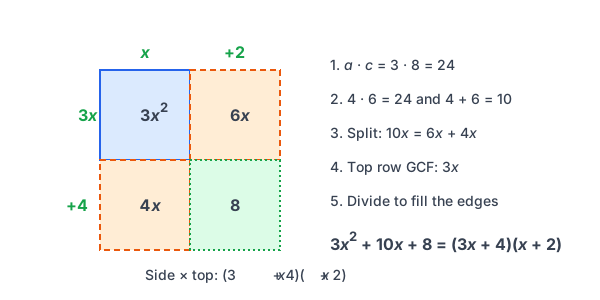
Factoring trinomials when a is not 1 means factoring ax^2 + bx + c when the leading coefficient a is not 1. Use the AC method. Multiply a and c, find two numbers that multiply to ac and add to b, then split the middle term and use a box. For example, 3x^2 + 10x + 8 = (3x + 4)(x + 2).
Before this lesson: You should know factoring trinomials with a = 1, factoring out the GCF, and multiplying binomials.
Extra practice: The Algebra 1 Unit 7 Practice Pack (Part 2) has printable problems, answer keys and a cheat sheet for this unit.
Why a Changes Things
When a = 1, you just need two numbers that multiply to c and add to b. When a is not 1, the first terms of the binomials also change the middle term.
Look at (3x + 4)(x + 2). The outer product is 3x \cdot 2 = 6x and the inner product is 4 \cdot x = 4x. The 3 got mixed into the middle term. That is why the simple method doesn’t work.
The AC method fixes this. The two middle pieces, 6x and 4x, multiply to 24x^2. That is the same as 3x^2 times 8. So you look for numbers that multiply to a \cdot c.
The AC Method for Factoring Trinomials When a Is Not 1
Here a is the leading coefficient, b is the middle coefficient, and c is the last term.
Steps
- Factor out the GCF, if there is one.
- Multiply a and c.
- Find two numbers that multiply to ac and add to b.
- Split the middle term into two terms using those numbers. Put ax^2, the two new terms, and c in a 2-by-2 box.
- Find the GCF of the top row. Divide to fill in the two top edges.
- Divide the bottom-left box by the first top edge to get the last edge.
- Write (left edges)(top edges). Check with FOIL.
The edges work the same way as the box method in multiplying binomials, just backward.
Worked Examples
Example 1: All positive terms
Factor 2x^2 + 7x + 3.
Step 1. This trinomial has a = 2, so the method from factoring trinomials needs one more step. Use the AC method.
2 \cdot 3 = 6
Step 2. Find a times c.
Step 3. Find two numbers that multiply to 6 and add to 7. Try the pairs: 1 and 6 (sum 7), 2 and 3 (sum 5). The pair is 6 and 1.
2x^2 + 7x + 3 = 2x^2 + 6x + x + 3
Step 4. Split the middle term 7x into 6x and x.
Step 5. Put the four terms in a 2 by 2 box. The first term goes top left and the last term goes bottom right.
Step 6. Find the GCF of the top row, 2x^2 and 6x. It is 2x, so write it on the left of the top row. Divide to get the top labels: x and 3.
\frac{x}{x} = 1Step 7. Find the bottom label. Divide the bottom-left box by the top label above it. Here is the finished box.
| x | +3 | |
|---|---|---|
| 2x | 2x^2 | 6x |
| +1 | x | 3 |
2x^2 + 7x + 3 = (2x + 1)(x + 3)
Step 8. The left side and the top are the two factors.
Answer: (2x + 1)(x + 3)
Check: Multiply the factors (see multiplying binomials): (2x + 1)(x + 3) = 2x^2 + 6x + x + 3 = 2x^2 + 7x + 3.
Example 2: A negative middle term
Factor 5x^2 - 13x + 6.
5 \cdot 6 = 30
Step 1. Find a times c.
Step 2. Find two numbers that multiply to 30 and add to -13. The product is positive and the sum is negative, so both numbers are negative (see multiplying and dividing integers). Try the pairs: -1 and -30 (sum -31), -2 and -15 (sum -17), -3 and -10 (sum -13), -5 and -6 (sum -11). The pair is -10 and -3.
5x^2 - 13x + 6 = 5x^2 - 10x - 3x + 6
Step 3. Split the middle term -13x into -10x and -3x.
Step 4. Put the four terms in a 2 by 2 box. The first term goes top left and the last term goes bottom right.
Step 5. Find the GCF of the top row, 5x^2 and -10x. It is 5x, so write it on the left of the top row. Divide to get the top labels: x and -2.
\frac{-3x}{x} = -3Step 6. Find the bottom label. Divide the bottom-left box by the top label above it. Here is the finished box.
| x | -2 | |
|---|---|---|
| 5x | 5x^2 | -10x |
| -3 | -3x | 6 |
5x^2 - 13x + 6 = (5x - 3)(x - 2)
Step 7. The left side and the top are the two factors.
Answer: (5x - 3)(x - 2)
Check: (5x - 3)(x - 2) = 5x^2 - 10x - 3x + 6 = 5x^2 - 13x + 6.
Example 3: A negative last term
Factor 6x^2 + x - 12.
6(-12) = -72
Step 1. Find a times c.
Step 2. Find two numbers that multiply to -72 and add to 1. The product is negative, so the signs are different. The sum is positive, so the larger number is positive. Try the pairs: -1 and 72 (sum 71), -2 and 36 (sum 34), -3 and 24 (sum 21), -4 and 18 (sum 14), -6 and 12 (sum 6), -8 and 9 (sum 1). The pair is 9 and -8.
6x^2 + x - 12 = 6x^2 + 9x - 8x - 12
Step 3. Split the middle term x into 9x and -8x.
Step 4. Put the four terms in a 2 by 2 box. The first term goes top left and the last term goes bottom right.
Step 5. Find the GCF of the top row, 6x^2 and 9x. It is 3x, so write it on the left of the top row. Divide to get the top labels: 2x and 3.
\frac{-8x}{2x} = -4Step 6. Find the bottom label. Divide the bottom-left box by the top label above it. Here is the finished box.
| 2x | +3 | |
|---|---|---|
| 3x | 6x^2 | 9x |
| -4 | -8x | -12 |
6x^2 + x - 12 = (3x - 4)(2x + 3)
Step 7. The left side and the top are the two factors.
Answer: (3x - 4)(2x + 3)
Check: (3x - 4)(2x + 3) = 6x^2 + 9x - 8x - 12 = 6x^2 + x - 12.
Example 4: Take out the GCF first
Factor 8x^2 - 20x - 12.
8x^2 - 20x - 12 = 4(2x^2 - 5x - 3)
Step 1. Every term is divisible by 4. Factor it out first (see factoring out the GCF).
Step 2. Now use the AC method on 2x^2 - 5x - 3.
2(-3) = -6
Step 3. Find a times c.
Step 4. Find two numbers that multiply to -6 and add to -5. The product is negative, so the signs are different. The sum is negative, so the larger number is negative. Try the pairs: 1 and -6 (sum -5), 2 and -3 (sum -1). The pair is -6 and 1.
2x^2 - 5x - 3 = 2x^2 - 6x + x - 3
Step 5. Split the middle term -5x into -6x and x.
Step 6. Put the four terms in a 2 by 2 box. The first term goes top left and the last term goes bottom right.
Step 7. Find the GCF of the top row, 2x^2 and -6x. It is 2x, so write it on the left of the top row. Divide to get the top labels: x and -3.
\frac{x}{x} = 1Step 8. Find the bottom label. Divide the bottom-left box by the top label above it. Here is the finished box.
| x | -3 | |
|---|---|---|
| 2x | 2x^2 | -6x |
| +1 | x | -3 |
8x^2 - 20x - 12 = 4(2x + 1)(x - 3)
Step 9. The left side and the top are the two factors. Keep the 4 in front.
Answer: 4(2x + 1)(x - 3)
Check: 4(2x + 1)(x - 3) = 4(2x^2 - 6x + x - 3) = 4(2x^2 - 5x - 3) = 8x^2 - 20x - 12.
Example 5: Word problem
A rectangular rug has an area of 6x^2 + 17x + 12 square feet. Find binomials for its length and width. Then find its size when x = 2.
6 \cdot 12 = 72
Step 1. Find a times c.
Step 2. Find two numbers that multiply to 72 and add to 17. Try the pairs: 1 and 72 (sum 73), 2 and 36 (sum 38), 3 and 24 (sum 27), 4 and 18 (sum 22), 6 and 12 (sum 18), 8 and 9 (sum 17). The pair is 9 and 8.
6x^2 + 17x + 12 = 6x^2 + 9x + 8x + 12
Step 3. Split the middle term 17x into 9x and 8x.
Step 4. Put the four terms in a 2 by 2 box. The first term goes top left and the last term goes bottom right.
Step 5. Find the GCF of the top row, 6x^2 and 9x. It is 3x, so write it on the left of the top row. Divide to get the top labels: 2x and 3.
\frac{8x}{2x} = 4Step 6. Find the bottom label. Divide the bottom-left box by the top label above it. Here is the finished box.
| 2x | +3 | |
|---|---|---|
| 3x | 6x^2 | 9x |
| +4 | 8x | 12 |
6x^2 + 17x + 12 = (3x + 4)(2x + 3)
Step 7. The left side and the top are the two factors.
3(2) + 4 = 10
Step 8. The sides are 3x + 4 and 2x + 3 feet. Substitute 2 for x in the first side.
2(2) + 3 = 7
Step 9. Substitute 2 for x in the second side.
10 \cdot 7 = 70
Step 10. Multiply to find the area.
Answer: The sides are 3x + 4 feet and 2x + 3 feet. When x = 2, the rug is 10 feet by 7 feet, or 70 square feet.
Check: Put x = 2 into the area: 6(2)^2 + 17(2) + 12 = 6(4) + 17(2) + 12 = 24 + 34 + 12 = 70.
Common Mistakes
| Mistake | Example of the error | Fix |
|---|---|---|
| Looking for a product of c instead of ac | For 2x^2 + 7x + 3: no pair of 3 adds to 7 | Use ac = 6: 1 and 6 work. |
| Dropping a | 2x^2 + 7x + 3 = (x + 1)(x + 6) | That equals x^2 + 7x + 6. The answer is (2x + 1)(x + 3). |
| Mixing up the positions | 2x^2 + 7x + 3 = (2x + 3)(x + 1) | That gives 5x in the middle. FOIL to check: (2x + 1)(x + 3). |
| Sign errors | 5x^2 - 13x + 6 = (5x + 3)(x + 2) | The middle term is negative, so both signs are minus: (5x - 3)(x - 2). |
| Not factoring completely | 4x^2 + 10x + 4 = (4x + 2)(x + 2) | 4x + 2 has a factor of 2: 2(2x + 1)(x + 2). |
Other Methods and Special Cases
Guess and check
You can also test factor pairs of a and c until the middle term works. For 3x^2 + 10x + 8, the first terms must be 3x and x.
| Try | Middle term | Works? |
|---|---|---|
| (3x + 2)(x + 4) | 12x + 2x = 14x | No |
| (3x + 8)(x + 1) | 3x + 8x = 11x | No |
| (3x + 4)(x + 2) | 6x + 4x = 10x | Yes |
Guess and check is fast when a and c have few factors. The AC method always works, so use it when you get stuck.
A negative leading coefficient
Factor out -1 first so that a is positive: -2x^2 + 5x + 3 = -(2x^2 - 5x - 3) = -(2x + 1)(x - 3).
Prime trinomials
If no pair multiplies to ac and adds to b, the trinomial is prime. For 2x^2 + 3x + 4, ac = 8. The pairs 1 and 8 (sum 9) and 2 and 4 (sum 6) don’t add to 3, so it is prime.
In the next lesson, you will see another way to finish step 4: factoring by grouping. It uses the same split.
Practice Problems
- Factor 2x^2 + 5x + 3.
- Factor 3x^2 + 7x + 2.
- Factor 2x^2 - 9x + 10.
- Factor 4x^2 + 4x - 3.
- Factor 6x^2 - 7x - 5.
- Factor 5x^2 + 14x - 3.
- Factor 10x^2 - 11x + 3.
- Factor 6x^2 + 15x + 6.
- Factor -3x^2 + 4x + 4.
- A rectangle has an area of 8x^2 + 10x + 3 square meters. Find binomials for its length and width. Then find its size when x = 1.
Show answers
1.
Find ac: ac = 6. The pair that multiplies to 6 and adds to 5 is 2 and 3
2x^2 + 2x + 3x + 3
Split the middle term.
Box: top row 2x^2 and 2x, bottom row 3x and 3. The top row’s GCF is 2x, so the top labels are x and 1
\frac{3x}{x} = 3Find the bottom label: divide the bottom-left box by the top label.
(2x + 3)(x + 1)
Write the factors.
Check: (2x + 3)(x + 1) = 2x^2 + 2x + 3x + 3 = 2x^2 + 5x + 3
2.
Find ac: ac = 6. The pair that multiplies to 6 and adds to 7 is 6 and 1
3x^2 + 6x + x + 2
Split the middle term.
Box: top row 3x^2 and 6x, bottom row x and 2. The top row’s GCF is 3x, so the top labels are x and 2
\frac{x}{x} = 1Find the bottom label: divide the bottom-left box by the top label.
(3x + 1)(x + 2)
Write the factors.
Check: (3x + 1)(x + 2) = 3x^2 + 6x + x + 2 = 3x^2 + 7x + 2
3.
Find ac: ac = 20. The pair that multiplies to 20 and adds to -9 is -4 and -5
2x^2 - 4x - 5x + 10
Split the middle term.
Box: top row 2x^2 and -4x, bottom row -5x and 10. The top row’s GCF is 2x, so the top labels are x and -2
\frac{-5x}{x} = -5Find the bottom label: divide the bottom-left box by the top label.
(2x - 5)(x - 2)
Write the factors.
Check: (2x - 5)(x - 2) = 2x^2 - 4x - 5x + 10 = 2x^2 - 9x + 10
4.
Find ac: ac = -12. The pair that multiplies to -12 and adds to 4 is -2 and 6
4x^2 - 2x + 6x - 3
Split the middle term.
Box: top row 4x^2 and -2x, bottom row 6x and -3. The top row’s GCF is 2x, so the top labels are 2x and -1
\frac{6x}{2x} = 3Find the bottom label: divide the bottom-left box by the top label.
(2x + 3)(2x - 1)
Write the factors.
Check: (2x + 3)(2x - 1) = 4x^2 - 2x + 6x - 3 = 4x^2 + 4x - 3
5.
Find ac: ac = -30. The pair that multiplies to -30 and adds to -7 is 3 and -10
6x^2 + 3x - 10x - 5
Split the middle term.
Box: top row 6x^2 and 3x, bottom row -10x and -5. The top row’s GCF is 3x, so the top labels are 2x and 1
\frac{-10x}{2x} = -5Find the bottom label: divide the bottom-left box by the top label.
(3x - 5)(2x + 1)
Write the factors.
Check: (3x - 5)(2x + 1) = 6x^2 + 3x - 10x - 5 = 6x^2 - 7x - 5
6.
Find ac: ac = -15. The pair that multiplies to -15 and adds to 14 is 15 and -1
5x^2 + 15x - x - 3
Split the middle term.
Box: top row 5x^2 and 15x, bottom row -x and -3. The top row’s GCF is 5x, so the top labels are x and 3
\frac{-x}{x} = -1Find the bottom label: divide the bottom-left box by the top label.
(5x - 1)(x + 3)
Write the factors.
Check: (5x - 1)(x + 3) = 5x^2 + 15x - x - 3 = 5x^2 + 14x - 3
7.
Find ac: ac = 30. The pair that multiplies to 30 and adds to -11 is -5 and -6
10x^2 - 5x - 6x + 3
Split the middle term.
Box: top row 10x^2 and -5x, bottom row -6x and 3. The top row’s GCF is 5x, so the top labels are 2x and -1
\frac{-6x}{2x} = -3Find the bottom label: divide the bottom-left box by the top label.
(5x - 3)(2x - 1)
Write the factors.
Check: (5x - 3)(2x - 1) = 10x^2 - 5x - 6x + 3 = 10x^2 - 11x + 3
8.
6x^2 + 15x + 6 = 3(2x^2 + 5x + 2)
Factor out the GCF, 3.
Find ac: ac = 4. The pair that multiplies to 4 and adds to 5 is 4 and 1
2x^2 + 4x + x + 2
Split the middle term.
Box: top row 2x^2 and 4x, bottom row x and 2. The top row’s GCF is 2x, so the top labels are x and 2
\frac{x}{x} = 1Find the bottom label: divide the bottom-left box by the top label.
3(2x + 1)(x + 2)
Write the factors.
Check: 3(2x + 1)(x + 2) = 3(2x^2 + 5x + 2) = 6x^2 + 15x + 6
9.
-3x^2 + 4x + 4 = -(3x^2 - 4x - 4)
The leading coefficient is negative, so factor out -1.
Find ac: ac = -12. The pair that multiplies to -12 and adds to -4 is -6 and 2
3x^2 - 6x + 2x - 4
Split the middle term.
Box: top row 3x^2 and -6x, bottom row 2x and -4. The top row’s GCF is 3x, so the top labels are x and -2
\frac{2x}{x} = 2Find the bottom label: divide the bottom-left box by the top label.
-(3x + 2)(x - 2)
Write the factors.
Check: -(3x + 2)(x - 2) = -(3x^2 - 6x + 2x - 4) = -3x^2 + 4x + 4
10.
Find ac: ac = 24. The pair that multiplies to 24 and adds to 10 is 4 and 6
8x^2 + 4x + 6x + 3
Split the middle term.
Box: top row 8x^2 and 4x, bottom row 6x and 3. The top row’s GCF is 4x, so the top labels are 2x and 1
\frac{6x}{2x} = 3Find the bottom label: divide the bottom-left box by the top label.
(4x + 3)(2x + 1)
Write the factors.
4(1) + 3 = 7 \text{ and } 2(1) + 1 = 3Substitute 1 for x in each side.
7 \cdot 3 = 21
Multiply to find the area.
Check with the area expression: 8(1)^2 + 10(1) + 3 = 8 + 10 + 3 = 21
The rectangle is 7 meters by 3 meters, or 21 square meters.
Want more practice? The Algebra 1 Unit 7 Practice Pack (Part 2) has 38 pages of problems on this and the other lessons in the unit, with step-by-step answers and a cheat sheet.
FAQ
How do you factor a trinomial when a is not 1?
Use the AC method. Multiply a and c, find two numbers that multiply to ac and add to b, split the middle term, and use a box or grouping to finish.
What is the AC method?
It is a way to factor ax^2 + bx + c by finding two numbers with product ac and sum b. Those numbers tell you how to split the middle term.
Can I just use guess and check?
Yes. Test factor pairs of the first and last terms until FOIL gives the right middle term. It works well for small numbers.
What if a is negative?
Factor out -1 first. Then factor the trinomial inside, and keep the negative sign in front of your answer.
Summary
- When a is not 1, look for two numbers that multiply to ac and add to b.
- Use those numbers to split the middle term into two terms.
- Put the four terms in a box. The edges of the box are the factors.
- Take out the GCF first, and factor out −1 if the leading coefficient is negative.
- Always check with FOIL. If no pair works, the trinomial is prime.
Previous lesson: Factoring Trinomials
Next lesson: Factoring by Grouping
Back to the Algebra 1 Index