
Factoring Trinomials
Factoring trinomials of the form x^2 + bx + c means writing them as a product of two binomials, (x + p)(x + q). Find two numbers that multiply to c and add to b. For example, x^2 + 7x + 12 = (x + 3)(x + 4), because 3 \cdot 4 = 12 and 3 + 4 = 7. This works when the number in front of x^2 is 1.
Before this lesson: You should know multiplying binomials, factoring out the GCF, and multiplying and dividing integers.
Extra practice: The Algebra 1 Unit 7 Practice Pack (Part 2) has printable problems, answer keys and a cheat sheet for this unit.
FOIL in Reverse
Factoring a trinomial undoes FOIL. Watch what happens when you multiply (x + 3)(x + 4).
(x + 3)(x + 4) = x^2 + 4x + 3x + 12 = x^2 + 7x + 12
The last term, 12, is 3 times 4. The middle term, 7x, comes from 3 plus 4. So to factor, you search for the two numbers that did this.
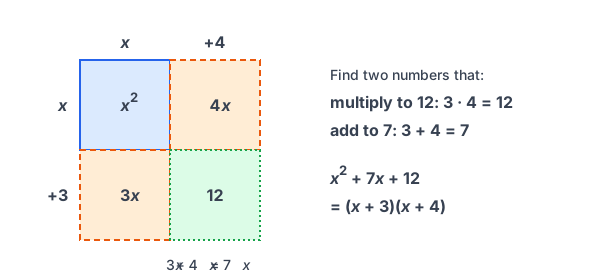
How to Factor Trinomials
A trinomial is a polynomial with three terms. In this lesson, the leading coefficient, the number in front of x^2, is 1.
x^2 + bx + c = (x + p)(x + q) \quad \text{where } p \cdot q = c \text{ and } p + q = bThe signs of b and c tell you the signs of the two numbers.
| Signs in the trinomial | Signs of the two numbers | Example |
|---|---|---|
| c positive, b positive | Both positive | x^2 + 7x + 12 = (x + 3)(x + 4) |
| c positive, b negative | Both negative | x^2 - 9x + 20 = (x - 4)(x - 5) |
| c negative | One positive, one negative. The larger one has the sign of b. | x^2 + 2x - 15 = (x + 5)(x - 3) |
Steps
- Factor out the GCF, if there is one.
- Write the trinomial as x^2 + bx + c. Find b and c.
- List the factor pairs of c. Use the sign table to pick the signs.
- Find the pair that adds to b.
- Write the answer as (x + p)(x + q).
- Check by multiplying with FOIL.
Worked Examples
Example 1: Both numbers positive
Factor x^2 + 8x + 15.
Step 1. Find b and c. Here b = 8 and c = 15. You need two numbers that multiply to 15 and add to 8.
Step 2. Both numbers are positive, because 15 and 8 are both positive. List the positive factor pairs of 15 and add each pair.
| Factor pair of 15 | Sum |
|---|---|
| 1 \cdot 15 | 16 |
| 3 \cdot 5 | 8 \;\checkmark |
x^2 + 8x + 15 = (x + 3)(x + 5)
Step 3. The pair 3 and 5 adds to 8. Use 3 and 5 as the numbers in the two binomials.
Answer: (x + 3)(x + 5)
Check: Multiply the binomials back out (see multiplying binomials): (x + 3)(x + 5) = x^2 + 5x + 3x + 15 = x^2 + 8x + 15.
Example 2: Both numbers negative
Factor x^2 - 10x + 21.
Step 1. Find b and c. Here b = -10 and c = 21. You need two numbers that multiply to 21 and add to -10.
Step 2. The product, 21, is positive, so the two numbers have the same sign. The sum, -10, is negative, so both numbers are negative. (See multiplying and dividing integers.)
Step 3. List the negative factor pairs of 21 and add each pair.
| Factor pair of 21 | Sum |
|---|---|
| (-1)(-21) | -22 |
| (-3)(-7) | -10 \;\checkmark |
x^2 - 10x + 21 = (x - 3)(x - 7)
Step 4. The pair -3 and -7 adds to -10. Write them in the binomials.
Answer: (x - 3)(x - 7)
Check: (x - 3)(x - 7) = x^2 - 7x - 3x + 21 = x^2 - 10x + 21.
Example 3: A negative last term
Factor x^2 + 3x - 28.
Step 1. Find b and c. Here b = 3 and c = -28. You need two numbers that multiply to -28 and add to 3.
Step 2. The product is negative, so one number is positive and one is negative. The sum is positive, so the number farther from 0 is the positive one.
Step 3. List the pairs with the larger number positive, and add each pair.
| Factor pair of −28 | Sum |
|---|---|
| 28 \cdot (-1) | 27 |
| 14 \cdot (-2) | 12 |
| 7 \cdot (-4) | 3 \;\checkmark |
x^2 + 3x - 28 = (x + 7)(x - 4)
Step 4. The pair 7 and -4 adds to 3. Write them in the binomials.
Answer: (x + 7)(x - 4)
Check: (x + 7)(x - 4) = x^2 - 4x + 7x - 28 = x^2 + 3x - 28.
Example 4: Factor out the GCF first
Factor 2x^2 - 2x - 24.
2x^2 - 2x - 24 = 2(x^2 - x - 12)
Step 1. Every term is even, so the greatest common factor is 2. Take it out first (see factoring out the GCF).
Step 2. Factor the trinomial inside. Here b = -1 and c = -12. You need two numbers that multiply to -12 and add to -1.
Step 3. The product is negative, so the signs are different. The sum is negative, so the number farther from 0 is the negative one.
| Factor pair of −12 | Sum |
|---|---|
| 1 \cdot (-12) | -11 |
| 2 \cdot (-6) | -4 |
| 3 \cdot (-4) | -1 \;\checkmark |
2(x^2 - x - 12) = 2(x - 4)(x + 3)
Step 4. The pair 3 and -4 adds to -1. Write the binomials, and keep the 2 in front.
Answer: 2(x - 4)(x + 3). The 2 is one of the factors, so it stays in the answer.
Check: 2(x - 4)(x + 3) = 2(x^2 + 3x - 4x - 12) = 2(x^2 - x - 12) = 2x^2 - 2x - 24.
Example 5: Word problem
A rectangle has an area of x^2 + 11x + 24 square inches. Its length and width are both binomials. Find them. Then find the dimensions when x = 2.
Step 1. You need two numbers that multiply to 24 and add to 11. Both are positive. List the factor pairs of 24.
| Factor pair of 24 | Sum |
|---|---|
| 1 \cdot 24 | 25 |
| 2 \cdot 12 | 14 |
| 3 \cdot 8 | 11 \;\checkmark |
| 4 \cdot 6 | 10 |
x^2 + 11x + 24 = (x + 3)(x + 8)
Step 2. The pair 3 and 8 adds to 11. Write the binomials.
Step 3. The area is width times length, so the width is x + 3 inches and the length is x + 8 inches.
x + 3 = 2 + 3 = 5
Step 4. Substitute x = 2 into the width.
x + 8 = 2 + 8 = 10
Step 5. Substitute x = 2 into the length.
5 \cdot 10 = 50
Step 6. Multiply to find the area.
Answer: The width is x + 3 inches and the length is x + 8 inches. When x = 2, the rectangle is 5 inches by 10 inches.
Check: Put x = 2 into the area: 2^2 + 11(2) + 24 = 4 + 22 + 24 = 50, which matches 5 \cdot 10 = 50.
Common Mistakes
| Mistake | Example of the error | Fix |
|---|---|---|
| The pair multiplies to c but doesn’t add to b | x^2 + 7x + 10 = (x + 1)(x + 10) | Check the sum: 2 and 5 add to 7. So (x + 2)(x + 5). |
| Wrong signs when b is negative | x^2 - 5x + 6 = (x + 2)(x + 3) | The sum must be −5, so both are negative: (x - 2)(x - 3). |
| Giving the larger number the wrong sign | x^2 - 2x - 8 = (x + 4)(x - 2) | That gives +2x. Use (x - 4)(x + 2). |
| Not factoring completely | 3x^2 + 15x + 18 = (3x + 6)(x + 3) | 3x + 6 still has a factor of 3. Take out the GCF first: 3(x + 2)(x + 3). |
| Dropping the GCF | 2x^2 + 10x + 12 = (x + 2)(x + 3) | Keep it: 2(x + 2)(x + 3). |
Special Cases
Trinomials that don’t factor
Some trinomials have no pair that works. Try x^2 + 5x + 9. The pairs of 9 are 1 and 9 (sum 10) and 3 and 3 (sum 6). Neither adds to 5.
A polynomial like this is called prime. It can’t be factored using whole numbers. Writing “prime” is a correct answer.
Two variables
The same method works when the last term has a second variable. For x^2 + 5xy + 6y^2, use 2 and 3 with y attached.
x^2 + 5xy + 6y^2 = (x + 2y)(x + 3y)
When the leading coefficient is not 1
If the trinomial looks like 3x^2 + 10x + 8, and there is no GCF to take out, you need a different method. That is the next lesson, Factoring Trinomials When a Is Not 1.
Some trinomials, like x^2 + 10x + 25 = (x + 5)^2, are the special products you already know. This method still works on them.
Practice Problems
- Factor x^2 + 9x + 20.
- Factor x^2 - 8x + 15.
- Factor x^2 - 11x + 24.
- Factor x^2 + 4x - 21.
- Factor x^2 - 6x - 16.
- Factor y^2 - y - 30.
- Factor 3x^2 + 21x + 30.
- Factor x^2 + 7xy + 10y^2.
- Factor x^2 + 6x + 10, or explain why it can’t be factored.
- A rectangular poster has an area of x^2 + 14x + 45 square inches. Find binomials for its length and width. Then find its dimensions when x = 3.
Show answers
1.
Find the numbers: they multiply to 20 and add to 9. The factor pairs of 20 are 1 and 20 (sum 21), 2 and 10 (sum 12), and 4 and 5 (sum 9)
(x + 4)(x + 5)
Write the binomials.
Check: (x + 4)(x + 5) = x^2 + 5x + 4x + 20 = x^2 + 9x + 20
2.
Find the signs: the product 15 is positive and the sum -8 is negative, so both numbers are negative
Find the numbers: (-1)(-15) has sum -16, and (-3)(-5) has sum -8
(x - 3)(x - 5)
Write the binomials.
Check: (x - 3)(x - 5) = x^2 - 5x - 3x + 15 = x^2 - 8x + 15
3.
Find the signs: the product is positive and the sum is negative, so both numbers are negative
Find the numbers: the pairs of 24 are 1 and 24, 2 and 12, 3 and 8, and 4 and 6. Only -3 and -8 add to -11
(x - 3)(x - 8)
Write the binomials.
Check: (x - 3)(x - 8) = x^2 - 8x - 3x + 24 = x^2 - 11x + 24
4.
Find the signs: the product is negative, so the signs are different. The sum is positive, so the larger number is positive
Find the numbers: 21 \cdot (-1) has sum 20, and 7 \cdot (-3) has sum 4
(x + 7)(x - 3)
Write the binomials.
Check: (x + 7)(x - 3) = x^2 - 3x + 7x - 21 = x^2 + 4x - 21
5.
Find the signs: the product is negative, so the signs are different. The sum is negative, so the larger number is negative
Find the numbers: 1 \cdot (-16) has sum -15, 2 \cdot (-8) has sum -6, and 4 \cdot (-4) has sum 0
(x - 8)(x + 2)
Write the binomials.
Check: (x - 8)(x + 2) = x^2 + 2x - 8x - 16 = x^2 - 6x - 16
6.
Find b and c: the middle term is -y, so b = -1, and c = -30
Find the signs: the product is negative, so the signs are different. The sum is negative, so the larger number is negative
Find the numbers: 5 \cdot (-6) has sum -1
(y - 6)(y + 5)
Write the binomials.
Check: (y - 6)(y + 5) = y^2 + 5y - 6y - 30 = y^2 - y - 30
7.
3x^2 + 21x + 30 = 3(x^2 + 7x + 10)
Factor out the GCF, 3.
Find the numbers inside: 2 and 5 multiply to 10 and add to 7
3(x + 2)(x + 5)
Write the binomials and keep the 3.
Check: 3(x + 2)(x + 5) = 3(x^2 + 7x + 10) = 3x^2 + 21x + 30
8.
Treat y like a number: you need two terms that multiply to 10y^2 and add to 7y
Find the numbers: 2 and 5 multiply to 10 and add to 7, so use 2y and 5y
(x + 2y)(x + 5y)
Write the binomials.
Check: (x + 2y)(x + 5y) = x^2 + 5xy + 2xy + 10y^2 = x^2 + 7xy + 10y^2
9.
List the factor pairs of 10: 1 and 10 (sum 11), and 2 and 5 (sum 7). The negative pairs have negative sums
No pair adds to 6
So x^2 + 6x + 10 is prime. It can’t be factored with integers
10.
Find the numbers: they multiply to 45 and add to 14. The pairs of 45 are 1 and 45 (sum 46), 3 and 15 (sum 18), and 5 and 9 (sum 14)
x^2 + 14x + 45 = (x + 5)(x + 9)
Write the binomials.
3 + 5 = 8
The width is x + 5 inches and the length is x + 9 inches. Substitute x = 3 into the width.
3 + 9 = 12
Substitute into the length.
8 \cdot 12 = 96
Multiply to find the area.
Check with the area expression: 3^2 + 14(3) + 45 = 9 + 42 + 45 = 96
The poster is 8 inches by 12 inches.
Want more practice? The Algebra 1 Unit 7 Practice Pack (Part 2) has 38 pages of problems on this and the other lessons in the unit, with step-by-step answers and a cheat sheet.
FAQ
How do you factor a trinomial when a = 1?
Find two numbers that multiply to the last term and add to the middle coefficient. Put them into (x + p)(x + q) and check with FOIL.
How do you know which signs to use?
If the last term is positive, both numbers have the sign of the middle term. If the last term is negative, one number is positive and one is negative.
What if no pair of numbers works?
Then the trinomial is prime over the integers. It can’t be factored with whole numbers, so you write “prime”.
What should you always do first?
Look for a greatest common factor. Taking it out first gives smaller numbers, like 4x^2 + 4x - 8 = 4(x^2 + x - 2).
Summary
- Factoring x^2 + bx + c undoes FOIL.
- Find two numbers that multiply to c and add to b.
- If c is positive, both numbers share the sign of b. If c is negative, the signs are different.
- Take out the GCF first, and keep it in the answer.
- If no pair works, the trinomial is prime. Always check with FOIL.
Previous lesson: Factoring Out the Greatest Common Factor
Next lesson: Factoring Trinomials When a Is Not 1
Back to the Algebra 1 Index