
Perfect Square Trinomials
A perfect square trinomial is a trinomial that equals a binomial squared. It fits a^2 + 2ab + b^2 = (a + b)^2 or a^2 - 2ab + b^2 = (a - b)^2. The first and last terms are perfect squares, and the middle term is 2 times their roots. For example, x^2 + 10x + 25 = (x + 5)^2.
Before this lesson: You should know special products of binomials, factoring trinomials and factoring the difference of squares.
Extra practice: The Algebra 1 Unit 7 Practice Pack (Part 2) has printable problems, answer keys and a cheat sheet for this unit.
What Is a Perfect Square Trinomial?
A trinomial is a polynomial with three terms. Some trinomials come from squaring a binomial. For example, (x + 5)^2 = x^2 + 10x + 25. Those are perfect square trinomials.
You saw this pattern in Special Products of Binomials. Now you run it backward. Look at the first and last terms, then check the middle term.
Perfect Square Trinomial Formulas
\begin{aligned} a^2 + 2ab + b^2 &= (a + b)^2 \\ a^2 - 2ab + b^2 &= (a - b)^2 \end{aligned}The sign of the middle term tells you the sign in the binomial. The last term is always positive, because it is a square.
Steps for factoring a perfect square trinomial
- Factor out the GCF, if there is one.
- Check that the first and last terms are perfect squares. The last term must be positive.
- Find a and b, the square roots of the first and last terms.
- Check that the middle term is 2ab. Ignore its sign for now.
- Write (a + b)^2 if the middle term is plus. Write (a - b)^2 if it is minus.
- If the middle term doesn’t match, it is not a perfect square. Factor another way.
Worked Examples
Example 1: A plus sign in the middle
Factor x^2 + 10x + 25.
Step 1. Check the first term. x^2 = (x)^2, so a = x.
Step 2. Check the last term. 25 = 5^2, so b = 5 (see square roots).
Step 3. Check the middle term. It should be 2ab: 2 \cdot x \cdot 5 = 10x. It matches, so this is a perfect square trinomial.
x^2 + 10x + 25 = (x + 5)^2
Step 4. The middle sign is plus, so use a^2 + 2ab + b^2 = (a + b)^2 (see special products of binomials).
Answer: (x + 5)^2
Check: (x + 5)^2 = x^2 + 5x + 5x + 25 = x^2 + 10x + 25.
Example 2: A minus sign in the middle
Factor y^2 - 14y + 49.
Step 1. Check the first term: y^2 = (y)^2, so a = y.
Step 2. Check the last term: 49 = 7^2, so b = 7.
Step 3. Check the middle term: 2 \cdot y \cdot 7 = 14y. It matches.
y^2 - 14y + 49 = (y - 7)^2
Step 4. The middle sign is minus, so use a^2 - 2ab + b^2 = (a - b)^2.
Answer: (y - 7)^2
Check: (y - 7)^2 = y^2 - 7y - 7y + 49 = y^2 - 14y + 49.
Example 3: A coefficient on the first term
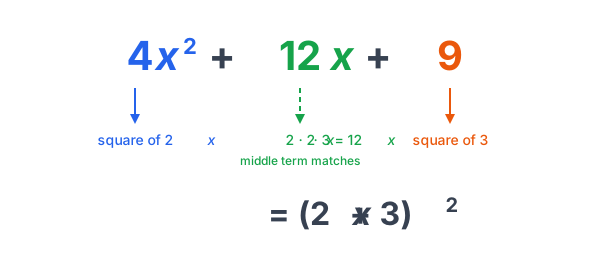
Factor 4x^2 + 12x + 9.
Step 1. Check the first term: 4x^2 = (2x)^2, so a = 2x.
Step 2. Check the last term: 9 = 3^2, so b = 3.
Step 3. Check the middle term: 2 \cdot 2x \cdot 3 = 12x. It matches.
4x^2 + 12x + 9 = (2x + 3)^2
Step 4. The middle sign is plus.
Answer: (2x + 3)^2
Check: (2x + 3)^2 = 4x^2 + 6x + 6x + 9 = 4x^2 + 12x + 9.
Example 4: Factor out the GCF first
Factor 2x^2 - 24x + 72.
2x^2 - 24x + 72 = 2(x^2 - 12x + 36)
Step 1. Every term is even, so take out 2 first (see factoring out the GCF).
Step 2. Check the trinomial inside. x^2 = (x)^2 and 36 = 6^2, so a = x and b = 6.
Step 3. Check the middle term: 2 \cdot x \cdot 6 = 12x. It matches, and the sign is minus.
= 2(x - 6)^2
Step 4. Write the square of the binomial. Keep the 2 in front.
Answer: 2(x - 6)^2
Example 5: Word problem
A square rug has an area of 9x^2 + 12x + 4 square feet. Find the length of one side. Then find the side and the area when x = 2.
Step 1. The area of a square is side squared, so look for a perfect square trinomial. Check the ends: 9x^2 = (3x)^2 and 4 = 2^2.
Step 2. Check the middle term: 2 \cdot 3x \cdot 2 = 12x. It matches.
9x^2 + 12x + 4 = (3x + 2)^2
Step 3. Write the area as a square.
3(2) + 2 = 8
Step 4. So each side is 3x + 2 feet. Substitute 2 for x.
8^2 = 64
Step 5. Square the side to find the area.
Answer: Each side is 3x + 2 feet. When x = 2, a side is 8 feet and the area is 64 square feet.
Check: Put x = 2 into the area: 9(2)^2 + 12(2) + 4 = 9(4) + 12(2) + 4 = 36 + 24 + 4 = 64.
Common Mistakes
| Mistake | Example of the error | Fix |
|---|---|---|
| Using the wrong sign | y^2 - 14y + 49 = (y + 7)^2 | A minus middle term gives a minus: (y - 7)^2. |
| Not checking the middle term | x^2 + 13x + 36 = (x + 6)^2 | 2 \cdot x \cdot 6 = 12x, not 13x. Factor it another way: (x + 4)(x + 9). |
| Missing that the last term is negative | x^2 - 6x - 9 = (x - 3)^2 | (x - 3)^2 = x^2 - 6x + 9. A negative last term is never a perfect square. |
| Not taking the root of the coefficient | 4x^2 + 12x + 9 = (4x + 3)^2 | The root of 4x^2 is 2x. The answer is (2x + 3)^2. |
| Mixing it up with a difference of squares | x^2 + 10x + 25 = (x + 5)(x - 5) | (x + 5)(x - 5) = x^2 - 25. Three terms means (x + 5)^2. |
How to Tell If a Trinomial Is a Perfect Square
| Trinomial | Ends are squares? | Middle is 2ab? | Perfect square? |
|---|---|---|---|
| x^2 + 6x + 9 | Yes: x and 3 | Yes: 6x | Yes, (x + 3)^2 |
| x^2 + 13x + 36 | Yes: x and 6 | No: 12x is needed | No |
| x^2 + 6x - 9 | No: the last term is negative | — | No |
| 9x^2 - 30xy + 25y^2 | Yes: 3x and 5y | Yes: 30xy | Yes, (3x - 5y)^2 |
If a trinomial is not a perfect square, use the methods in Factoring Trinomials or Factoring Trinomials When a Is Not 1.
Finding the missing last term
Sometimes you need to make a perfect square. For x^2 + 8x + c, take half of 8 and square it: 4^2 = 16. So x^2 + 8x + 16 = (x + 4)^2. This idea is the start of completing the square.
Practice Problems
- Factor x^2 + 6x + 9.
- Factor x^2 - 16x + 64.
- Factor m^2 + 2m + 1.
- Factor 25x^2 + 20x + 4.
- Factor 16x^2 - 24x + 9.
- Factor a^2 + 10ab + 25b^2.
- Is x^2 + 10x + 16 a perfect square trinomial? Factor it.
- Factor 3x^2 + 30x + 75 completely.
- Find c so that x^2 - 18x + c is a perfect square trinomial. Then factor it.
- A square photo has an area of 4x^2 + 28x + 49 square inches. Find the length of one side. Then find the side and the area when x = 3.
Show answers
1.
Check the ends: x^2 = (x)^2 and 9 = (3)^2
Check the middle: 2 \cdot x \cdot 3 = 6x
(x + 3)^2
It matches, and the middle sign is plus. Write the square.
2.
Check the ends: x^2 = (x)^2 and 64 = (8)^2
Check the middle: 2 \cdot x \cdot 8 = 16x
(x - 8)^2
It matches, and the middle sign is minus. Write the square.
3.
Check the ends: m^2 = (m)^2 and 1 = (1)^2
Check the middle: 2 \cdot m \cdot 1 = 2m
(m + 1)^2
It matches, and the middle sign is plus. Write the square.
4.
Check the ends: 25x^2 = (5x)^2 and 4 = (2)^2
Check the middle: 2 \cdot 5x \cdot 2 = 20x
(5x + 2)^2
It matches, and the middle sign is plus. Write the square.
5.
Check the ends: 16x^2 = (4x)^2 and 9 = (3)^2
Check the middle: 2 \cdot 4x \cdot 3 = 24x
(4x - 3)^2
It matches, and the middle sign is minus. Write the square.
6.
Check the ends: a^2 = (a)^2 and 25b^2 = (5b)^2
Check the middle: 2 \cdot a \cdot 5b = 10ab
(a + 5b)^2
It matches, and the middle sign is plus. Write the square.
7.
Check the ends: x^2 = (x)^2 and 16 = 4^2
Check the middle: 2 \cdot x \cdot 4 = 8x
The middle term is 10x, not 8x. So it is not a perfect square trinomial
(x + 2)(x + 8)
Factor it another way (see factoring trinomials): 2 and 8 multiply to 16 and add to 10.
No. It factors as (x + 2)(x + 8).
8.
3(x^2 + 10x + 25)
Factor out the GCF, 3.
Check the trinomial: 25 = 5^2 and 2 \cdot x \cdot 5 = 10x
3(x + 5)^2
Write the square. Keep the 3.
9.
\frac{18}{2} = 9The middle term must be 2ab. Here a = x, so 2 \cdot x \cdot b = 18x and b is half of 18.
9^2 = 81
Square b to get c.
x^2 - 18x + 81 = (x - 9)^2
Write the trinomial and factor it.
c = 81
Square b to find c.
10.
Check the ends: 4x^2 = (2x)^2 and 49 = 7^2
Check the middle: 2 \cdot 2x \cdot 7 = 28x
4x^2 + 28x + 49 = (2x + 7)^2
Write the area as a square.
2(3) + 7 = 13
Each side is 2x + 7 inches. Substitute 3 for x.
13^2 = 169
Square the side to find the area.
Check with the area expression: 4(3)^2 + 28(3) + 49 = 36 + 84 + 49 = 169
The side is 13 inches and the area is 169 square inches.
Want more practice? The Algebra 1 Unit 7 Practice Pack (Part 2) has 38 pages of problems on this and the other lessons in the unit, with step-by-step answers and a cheat sheet.
FAQ
How do you know if a trinomial is a perfect square?
The first and last terms must be perfect squares, and the last term must be positive. Then the middle term must equal 2ab, where a and b are the square roots of the ends.
What is the perfect square trinomial formula?
a^2 + 2ab + b^2 = (a + b)^2 and a^2 - 2ab + b^2 = (a - b)^2. The sign in the binomial matches the sign of the middle term.
Is a perfect square trinomial the same as a difference of squares?
No. A perfect square trinomial has three terms and factors into two equal binomials. A difference of squares has two terms and factors into a sum times a difference.
Can a perfect square trinomial have a negative last term?
No. The last term is b^2, and a square is never negative. So a trinomial like x^2 - 4x - 4 is not a perfect square.
Summary
- A perfect square trinomial equals a binomial squared, like x^2 + 10x + 25 = (x + 5)^2.
- Check that the first and last terms are squares and the last term is positive.
- Check that the middle term is 2ab.
- Use the sign of the middle term as the sign in the binomial.
- Take out the GCF first. If the middle term doesn’t match, factor another way.
Previous lesson: Factoring the Difference of Squares
Next lesson: Factoring Completely
Back to the Algebra 1 Index