
Factoring Completely
Factoring completely means writing a polynomial as a product of factors that can’t be factored any more. Take out the GCF first. Then use the number of terms to pick a method, and keep going until every factor is prime. For example, 2x^2 - 18 = 2(x + 3)(x - 3).
Before this lesson: You should know factoring out the GCF, factoring trinomials, factoring by grouping, the difference of squares and perfect square trinomials.
Extra practice: The Algebra 1 Unit 7 Practice Pack (Part 2) has printable problems, answer keys and a cheat sheet for this unit.
What Does It Mean to Factor Completely?
Think about prime factorization. You can write 60 = 2 \cdot 30, but 30 still breaks down. The full answer is 60 = 2 \cdot 2 \cdot 3 \cdot 5.
Polynomials work the same way. 2x^2 - 18 = 2(x^2 - 9) is factored, but not completely. The part x^2 - 9 still factors. The complete answer is 2(x + 3)(x - 3).
A polynomial that can’t be factored with integers is called prime. Examples are x + 3, x^2 + 4 and x^2 + x + 1. You are done when every factor is prime.
The Factoring Strategy
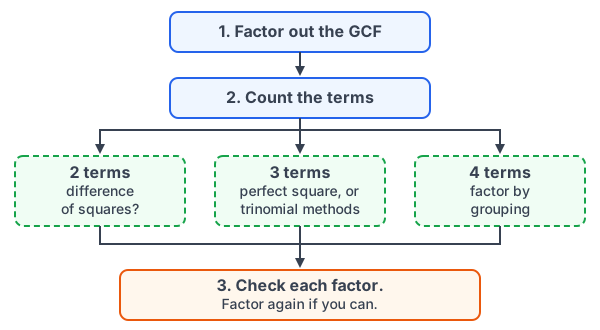
| Number of terms | What to try | Example |
|---|---|---|
| 2 | Difference of squares, a^2 - b^2 | x^2 - 25 = (x + 5)(x - 5) |
| 3 | Perfect square trinomial, or find two numbers (the AC method if a is not 1) | x^2 + 7x + 12 = (x + 3)(x + 4) |
| 4 | Factor by grouping | x^3 + 2x^2 + 3x + 6 = (x + 2)(x^2 + 3) |
Steps for factoring completely
- Factor out the GCF of all the terms. If the first term is negative, you can factor out a negative.
- Count the terms in what is left.
- Use the method that fits: 2 terms, 3 terms or 4 terms.
- Look at each factor. If one can be factored again, factor it.
- Check by multiplying all the factors.
Worked Examples
Example 1: GCF, then a difference of squares
Factor 3x^2 - 12 completely.
3x^2 - 12 = 3(x^2 - 4)
Step 1. Take out the GCF first. Both terms are divisible by 3 (see factoring out the GCF).
= 3[(x)^2 - 2^2]
Step 2. Count the terms left inside: 2. Check for a difference of squares: x^2 - 4 = (x)^2 - 2^2.
= 3(x + 2)(x - 2)
Step 3. Use a^2 - b^2 = (a + b)(a - b) (see factoring the difference of squares).
Step 4. Check each factor. None of 3, x + 2 and x − 2 can be factored again.
Answer: 3(x + 2)(x - 2)
Example 2: GCF, then a perfect square trinomial
Factor 2x^3 + 16x^2 + 32x completely.
2x^3 + 16x^2 + 32x = 2x(x^2 + 8x + 16)
Step 1. Take out the GCF, 2x.
Step 2. Three terms are left. Check for a perfect square: the ends are x^2 and 16 = 4^2, and 2 \cdot x \cdot 4 = 8x matches the middle (see perfect square trinomials).
= 2x(x + 4)^2
Step 3. Write the trinomial as a square.
Step 4. Check each factor. 2x and x + 4 can’t be factored again.
Answer: 2x(x + 4)^2
Example 3: GCF, then a trinomial with a not 1
Factor 4x^3 - 10x^2 - 6x completely.
4x^3 - 10x^2 - 6x = 2x(2x^2 - 5x - 3)
Step 1. Take out the GCF, 2x.
ac = 2(-3) = -6
Step 2. Three terms are left, and a = 2. Use the AC method (see factoring trinomials when a is not 1) The numbers -6 and 1 multiply to -6 and add to -5.
= 2x(2x^2 - 6x + x - 3)
Step 3. Split -5x into -6x + x.
= 2x[(2x^2 - 6x) + (x - 3)]
Step 4. Group the four terms inside.
= 2x[2x(x - 3) + 1(x - 3)]
Step 5. Factor each group.
= 2x(x - 3)(2x + 1)
Step 6. Factor out the shared binomial, x − 3.
Step 7. Check each factor. None can be factored again.
Answer: 2x(2x + 1)(x - 3)
Example 4: Grouping, then a difference of squares
Factor x^3 + 2x^2 - 9x - 18 completely.
x^3 + 2x^2 - 9x - 18 = (x^3 + 2x^2) + (-9x - 18)
Step 1. There is no GCF, and there are 4 terms, so group them (see factoring by grouping).
= x^2(x + 2) - 9(x + 2)
Step 2. Factor each group. Take -9 out of the second group.
= (x + 2)(x^2 - 9)
Step 3. Factor out the shared binomial, x + 2.
= (x + 2)(x + 3)(x - 3)
Step 4. Check each factor. x^2 - 9 = (x)^2 - 3^2 is a difference of squares, so keep going.
Answer: (x + 2)(x + 3)(x - 3)
Example 5: Word problem
A box has a volume of 2x^3 + 10x^2 + 12x cubic inches. Factor completely to find expressions for its three dimensions. Then find them when x = 3.
2x^3 + 10x^2 + 12x = 2x(x^2 + 5x + 6)
Step 1. Take out the GCF, 2x.
= 2x(x + 2)(x + 3)
Step 2. Factor the trinomial (see factoring trinomials). The numbers 2 and 3 multiply to 6 and add to 5.
2(3) = 6, \quad 3 + 2 = 5, \quad 3 + 3 = 6
Step 3. The three factors are the dimensions: 2x, x + 2 and x + 3 inches. Substitute 3 for x in each.
6 \cdot 5 \cdot 6 = 180
Step 4. Multiply to find the volume.
Answer: The dimensions are 2x, x + 2 and x + 3 inches. When x = 3, they are 6, 5 and 6 inches, and the volume is 180 cubic inches.
Check: Put x = 3 into the volume: 2(3)^3 + 10(3)^2 + 12(3) = 2(27) + 10(9) + 12(3) = 54 + 90 + 36 = 180.
Common Mistakes
| Mistake | Example of the error | Fix |
|---|---|---|
| Stopping after the GCF | 3x^2 - 12 = 3(x^2 - 4) | x^2 - 4 still factors: 3(x + 2)(x - 2). |
| Losing the GCF | 3x^2 - 12 = (x + 2)(x - 2) | Keep the 3. (x + 2)(x - 2) = x^2 - 4, not 3x^2 - 12. |
| Skipping the GCF | 2x^2 + 10x + 12 = (2x + 4)(x + 3) | 2x + 4 still has a factor of 2. Take it out first: 2(x + 2)(x + 3). |
| Not factoring a second time | x^4 - 16 = (x^2 + 4)(x^2 - 4) | x^2 - 4 factors again: (x^2 + 4)(x + 2)(x - 2). |
| Factoring a sum of squares | x^2 + 4 = (x + 2)(x - 2) | (x + 2)(x - 2) = x^2 - 4. The sum x^2 + 4 is prime. |
How to Know You Are Done
Before you stop, run through this checklist.
| Question | If yes |
|---|---|
| Do all the terms of any factor share a number or variable? | Factor out that GCF. |
| Is any factor a difference of squares? | Factor it as a sum times a difference. |
| Is any trinomial factor a perfect square or a factorable trinomial? | Factor it. |
| Does any factor have 4 terms? | Try grouping. |
If every answer is no, the polynomial is factored completely. A factor like x^2 + 9 or x^2 + 2x + 5 can stay, because it is prime. Check the final answer by multiplying the factors back together.
Factoring completely is the key step for solving quadratic equations by factoring.
Practice Problems
- Factor 5x^2 - 45 completely.
- Factor 3x^2 + 18x + 27 completely.
- Factor x^3 - 25x completely.
- Factor 2x^2 + 14x + 24 completely.
- Factor 4x^2 - 4x - 24 completely.
- Factor 6x^3 + 3x^2 - 30x completely.
- Factor x^3 + 5x^2 - 4x - 20 completely.
- Factor 2x^4 - 32 completely.
- Factor 3x^2 + 12 completely.
- A box has a volume of 3x^3 + 21x^2 + 30x cubic feet. Factor completely to find its dimensions. Then find the dimensions and the volume when x = 2.
Show answers
1.
5(x^2 - 9)
Take out the GCF, 5.
5(x + 3)(x - 3)
Two terms are left, and x^2 - 9 = (x)^2 - 3^2. Factor the difference of squares.
2.
3(x^2 + 6x + 9)
Take out the GCF, 3.
Check for a perfect square: 9 = 3^2 and 2 \cdot x \cdot 3 = 6x. Write the square: 3(x + 3)^2
3.
x(x^2 - 25)
Take out the GCF, x.
x(x + 5)(x - 5)
Factor the difference of squares.
4.
2(x^2 + 7x + 12)
Take out the GCF, 2.
2(x + 3)(x + 4)
Factor the trinomial: 3 and 4 multiply to 12 and add to 7.
5.
4(x^2 - x - 6)
Take out the GCF, 4.
Factor the trinomial: -3 and 2 multiply to -6 and add to -1: 4(x - 3)(x + 2)
6.
3x(2x^2 + x - 10)
Take out the GCF, 3x.
Use the AC method: ac = -20, and 5 and -4 multiply to -20 and add to 1. Split the middle term: 3x(2x^2 + 5x - 4x - 10)
3x[x(2x + 5) - 2(2x + 5)]
Group and factor each group.
3x(2x + 5)(x - 2)
Factor out the shared binomial.
7.
x^2(x + 5) - 4(x + 5)
No GCF and 4 terms, so group them and factor each group.
(x + 5)(x^2 - 4)
Factor out the shared binomial.
(x + 5)(x + 2)(x - 2)
Factor the difference of squares.
8.
2(x^4 - 16)
Take out the GCF, 2.
2(x^2 + 4)(x^2 - 4)
Factor the difference of squares, since x^4 = (x^2)^2 and 16 = 4^2.
2(x^2 + 4)(x + 2)(x - 2)
Factor x^2 - 4 again.
x^2 + 4 is a sum of squares, so it is prime.
9.
3(x^2 + 4)
Take out the GCF, 3.
Check the factor left: x^2 + 4 is a sum of squares, so it is prime
You are done.
10.
3x(x^2 + 7x + 10)
Take out the GCF, 3x.
3x(x + 2)(x + 5)
Factor the trinomial: 2 and 5 multiply to 10 and add to 7.
3(2) = 6, \quad 2 + 2 = 4, \quad 2 + 5 = 7
Substitute 2 for x in each dimension.
6 \cdot 4 \cdot 7 = 168
Multiply to find the volume.
Check with the volume expression: 3(2)^3 + 21(2)^2 + 30(2) = 24 + 84 + 60 = 168
The box is 6 by 4 by 7 feet, and its volume is 168 cubic feet.
Want more practice? The Algebra 1 Unit 7 Practice Pack (Part 2) has 38 pages of problems on this and the other lessons in the unit, with step-by-step answers and a cheat sheet.
FAQ
What does it mean to factor completely?
It means to keep factoring until no factor can be broken down any more with integers. Every factor in the answer is either a number, a variable or a prime polynomial.
What should you always do first when factoring?
Look for a GCF and take it out. It makes the numbers smaller and often shows a pattern, like a difference of squares, that was hidden.
How do you know when a polynomial is factored completely?
Check each factor. If none has a common factor, none is a difference of squares, and no trinomial or four-term factor can be factored, you are done.
Is (2x + 4)(x + 3) factored completely?
No. The factor 2x + 4 has a GCF of 2. The complete answer is 2(x + 2)(x + 3).
Summary
- Factoring completely means every factor is prime.
- Always take out the GCF first.
- Count the terms: 2 terms, try a difference of squares; 3 terms, try a perfect square or the trinomial methods; 4 terms, try grouping.
- Check each factor and factor again if you can.
- Keep the GCF in the answer, and check by multiplying.
Previous lesson: Perfect Square Trinomials
Next lesson: Simplifying Square Roots
Back to the Algebra 1 Index