
Solving Quadratic Equations by Factoring
Solving quadratic equations by factoring uses the zero product property: if ab = 0, then a = 0 or b = 0. Set the equation equal to 0, factor the quadratic, then set each factor equal to 0 and solve. For example, x^2 + 5x + 6 = 0 becomes (x + 2)(x + 3) = 0, so x = -2 or x = -3.
Before this lesson: You should know factoring trinomials, factoring completely and solving quadratics by graphing.
Extra practice: The Algebra 1 Unit 9 Practice Pack (Part 1) has printable problems, answer keys and a cheat sheet for this unit.
The Zero Product Property
If two numbers multiply to 0, at least one of them must be 0. There is no other way to get a product of 0. This is the zero product property.
\text{If } ab = 0, \text{ then } a = 0 \text{ or } b = 0.So if (x + 2)(x + 3) = 0, then x + 2 = 0 or x + 3 = 0. Each small equation gives one solution.
This only works when one side is 0. A product equal to 6 could come from many pairs, like 2 \cdot 3 or 1 \cdot 6.
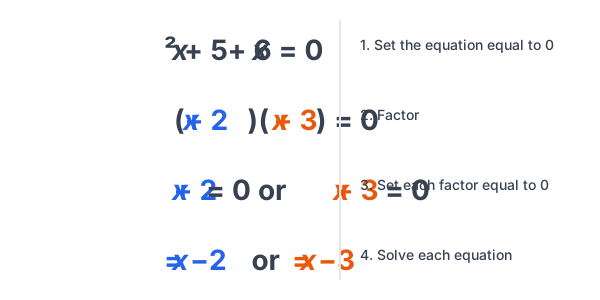
Steps for solving by factoring
- Move all terms to one side so the equation equals 0.
- Factor the quadratic completely.
- Set each factor equal to 0.
- Solve each small equation.
- Check each answer in the original equation.
Worked Examples
Example 1: Already factored
Solve (x - 4)(x + 7) = 0.
x - 4 = 0 \text{ or } x + 7 = 0Step 1. The product is 0, so one of the factors must be 0. Set each factor equal to 0.
x = 4 \text{ or } x = -7Step 2. Solve each equation. Add 4 to the first and subtract 7 from the second (see one-step equations).
Answer: x = 4 or x = -7
Example 2: Factor a trinomial
Solve x^2 + 5x + 6 = 0.
(x + 2)(x + 3) = 0
Step 1. Factor the trinomial (see factoring trinomials). The numbers 2 and 3 multiply to 6 and add to 5.
x + 2 = 0 \text{ or } x + 3 = 0Step 2. Set each factor equal to 0.
x = -2 \text{ or } x = -3Step 3. Subtract to solve each one.
Answer: x = -2 or x = -3
Check: (-2)^2 + 5(-2) + 6 = 4 - 10 + 6 = 0. And (-3)^2 + 5(-3) + 6 = 9 - 15 + 6 = 0.
Example 3: A missing constant
Solve x^2 = 3x.
x^2 - 3x = 0
Step 1. Get 0 on one side. Subtract 3x from both sides.
x(x - 3) = 0
Step 2. Factor out the GCF, x (see factoring out the GCF).
x = 0 \text{ or } x - 3 = 0Step 3. Set each factor equal to 0.
x = 0 \text{ or } x = 3Step 4. Add 3 to solve the second one.
Answer: x = 0 or x = 3. Don’t divide both sides by x. That would lose the solution x = 0.
Example 4: Leading coefficient not 1
Solve 2x^2 - x - 6 = 0.
2x^2 - 4x + 3x - 6 = 0
Step 1. Use the AC method (see factoring trinomials when a is not 1). ac = 2(-6) = -12, and -4 and 3 multiply to -12 and add to -1. Split the middle term.
2x(x - 2) + 3(x - 2) = 0
Step 2. Factor each pair (see factoring by grouping).
(2x + 3)(x - 2) = 0
Step 3. Factor out the common binomial, x - 2.
2x + 3 = 0 \text{ or } x - 2 = 0Step 4. Set each factor equal to 0.
2x = -3 \text{ or } x = 2Step 5. Subtract 3 in the first. Add 2 in the second.
x = -\frac{3}{2} \text{ or } x = 2Step 6. Divide the first by 2.
Answer: x = -\tfrac{3}{2} or x = 2
Example 5: Word problem
A rectangle’s length is 3 feet more than its width. Its area is 40 square feet. Find its length and width.
w(w + 3) = 40
Step 1. Let w be the width. The length is w + 3. Area is width times length.
w^2 + 3w = 40
Step 2. Distribute the w (see distributive property).
w^2 + 3w - 40 = 0
Step 3. Subtract 40 from both sides.
(w + 8)(w - 5) = 0
Step 4. Factor. The numbers 8 and -5 multiply to -40 and add to 3.
w + 8 = 0 \text{ or } w - 5 = 0Step 5. Set each factor equal to 0.
w = -8 \text{ or } w = 5Step 6. Solve each one.
5 + 3 = 8
Step 7. A width can’t be negative, so w = 5. Find the length.
Answer: The width is 5 feet and the length is 8 feet.
Check: 5 \cdot 8 = 40.
Common Mistakes
| Mistake | Example of the error | Fix |
|---|---|---|
| Not setting the equation to 0 | (x - 2)(x + 1) = 4, so x - 2 = 4 or x + 1 = 4 | Expand and subtract 4: x^2 - x - 6 = 0, so (x - 3)(x + 2) = 0 and x = 3 or x = -2. |
| Wrong sign on the solution | x + 7 = 0, so x = 7 | Subtract 7: x = -7. |
| Dividing by x | x^2 = 3x, so x = 3 only | Factor instead: x(x - 3) = 0 gives x = 0 too. |
| Ignoring the coefficient | 2x + 3 = 0, so x = -3 | Divide by 2: x = -\tfrac{3}{2}. |
| Keeping an answer that makes no sense | Width = -8 feet | Lengths can’t be negative. Keep only answers that fit the problem. |
Special Patterns
| Equation | Factor | Solutions |
|---|---|---|
| x^2 - 49 = 0 | (x + 7)(x - 7) = 0 | x = \pm 7 |
| x^2 - 10x + 25 = 0 | (x - 5)^2 = 0 | x = 5 (one solution) |
| 3x^2 - 12 = 0 | 3(x + 2)(x - 2) = 0 | x = \pm 2 |
The symbol \pm means plus or minus. The patterns come from factoring the difference of squares and perfect square trinomials. A number factor like the 3 never equals 0, so it gives no solution.
If a quadratic won’t factor, use square roots, completing the square or the quadratic formula. Those come next in this unit.
Practice Problems
- Solve (x + 5)(x - 1) = 0.
- Solve x^2 - 7x + 12 = 0.
- Solve x^2 + 2x - 15 = 0.
- Solve x^2 - 64 = 0.
- Solve x^2 + 8x = 0.
- Solve x^2 - 12x + 36 = 0.
- Solve 3x^2 + 7x + 2 = 0.
- Solve x^2 = 5x + 14.
- Solve 2x^2 - 18 = 0.
- A ball’s height in feet is h = -16t^2 + 48t. Solve -16t^2 + 48t = 0 to find when it is on the ground.
Show answers
1.
x + 5 = 0 \text{ or } x - 1 = 0Set each factor equal to 0.
x = -5 \text{ or } x = 1Solve each one.
2.
Factor: -3 and -4 multiply to 12 and add to -7: (x - 3)(x - 4) = 0
x - 3 = 0 \text{ or } x - 4 = 0Set each factor equal to 0.
x = 3 \text{ or } x = 4Solve each one.
3.
(x + 5)(x - 3) = 0
Factor: 5 and -3 multiply to -15 and add to 2.
x + 5 = 0 \text{ or } x - 3 = 0Set each factor equal to 0.
x = -5 \text{ or } x = 3Solve each one.
4.
(x + 8)(x - 8) = 0
Factor the difference of squares (see factoring difference of squares)
x + 8 = 0 \text{ or } x - 8 = 0Set each factor equal to 0.
x = -8 \text{ or } x = 8Solve each one.
5.
x(x + 8) = 0
Factor out the GCF, x.
x = 0 \text{ or } x + 8 = 0Set each factor equal to 0.
x = 0 \text{ or } x = -8Solve the second one.
6.
(x - 6)^2 = 0
Factor the perfect square trinomial (see perfect square trinomials)
x - 6 = 0
Both factors are the same, so set it equal to 0 once.
x = 6
Add 6.
7.
AC method: ac = 6, and 6 and 1 multiply to 6 and add to 7. Split the middle term: 3x^2 + 6x + x + 2 = 0
3x(x + 2) + 1(x + 2) = 0
Group and factor each pair.
(3x + 1)(x + 2) = 0
Factor out the common binomial.
3x + 1 = 0 \text{ or } x + 2 = 0Set each factor equal to 0.
x = -\frac{1}{3} \text{ or } x = -2Solve each one.
8.
x^2 - 5x = 14
Subtract 5x from both sides.
x^2 - 5x - 14 = 0
Subtract 14 from both sides.
Factor: -7 and 2 multiply to -14 and add to -5: (x - 7)(x + 2) = 0
x - 7 = 0 \text{ or } x + 2 = 0Set each factor equal to 0.
x = 7 \text{ or } x = -2Solve each one.
9.
2(x^2 - 9) = 0
Factor out the GCF, 2.
2(x + 3)(x - 3) = 0
Factor the difference of squares.
x + 3 = 0 \text{ or } x - 3 = 0The factor 2 is never 0. Set the other factors equal to 0.
x = -3 \text{ or } x = 3Solve each one.
10.
-16t(t - 3) = 0
Factor out the GCF, -16t.
-16t = 0 \text{ or } t - 3 = 0Set each factor equal to 0.
t = 0 \text{ or } t = 3Solve each one.
t = 0 is the launch. It lands after 3 seconds.
Want more practice? The Algebra 1 Unit 9 Practice Pack (Part 1) has 40 pages of problems on this and the other lessons in the unit, with step-by-step answers and a cheat sheet.
FAQ
What is the zero product property?
If a product equals 0, then at least one factor equals 0. That is why you set each factor equal to 0 after factoring.
Why does the equation have to equal 0?
The zero product property only works for 0. If ab = 4, you can’t tell what a or b is.
Can you divide both sides by x?
No. Dividing by x loses the solution x = 0. Factor out x instead.
What if the quadratic doesn’t factor?
Then use another method, like square roots, completing the square or the quadratic formula. They work for every quadratic.
Summary
- Zero product property: if ab = 0, then a = 0 or b = 0.
- Set the equation equal to 0 before you factor.
- Factor completely, then set each variable factor equal to 0.
- Never divide both sides by a variable.
- Check answers, and drop any that don’t fit a word problem.
Previous lesson: Solving Quadratics by Graphing
Next lesson: Solving Quadratics with Square Roots
Back to the Algebra 1 Index