
Solving Quadratics with Square Roots
Solving quadratics with square roots works when the equation has a squared term and no x-term, like x^2 = 25 or (x - 3)^2 = 16. Isolate the squared part, then take the square root of both sides. Use \pm because both a positive and a negative number square to the same value.
Before this lesson: You should know square roots, simplifying square roots and solving quadratic equations by factoring.
Extra practice: The Algebra 1 Unit 9 Practice Pack (Part 1) has printable problems, answer keys and a cheat sheet for this unit.
Why Square Roots Undo Squares
Squaring and taking a square root are inverse operations. Each undoes the other. To solve x^2 = 25, ask which numbers square to 25.
There are two: 5^2 = 25 and (-5)^2 = 25. So x = \pm 5. The symbol \pm means plus or minus. Forgetting the negative answer is the most common mistake.
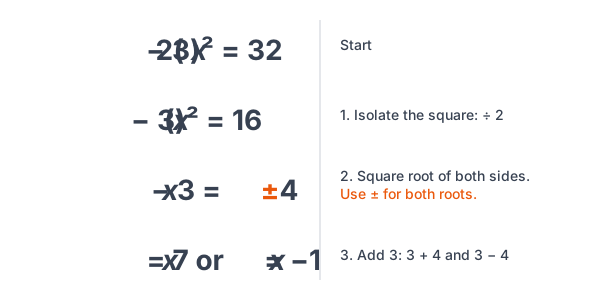
The Square Root Property
\text{If } x^2 = k \text{ and } k \ge 0, \text{ then } x = \pm\sqrt{k}.| Value of k | Solutions |
|---|---|
| k \gt 0 | Two: \sqrt{k} and -\sqrt{k} |
| k = 0 | One: x = 0 |
| k \lt 0 | No real solutions, since no real number squares to a negative |
Steps for solving with square roots
- Isolate the squared part: x^2 or (x - h)^2.
- Take the square root of both sides. Write \pm.
- Simplify the radical.
- If there was a number inside the parentheses, solve the two small equations.
- Check both answers.
Worked Examples
Example 1: A perfect square
Solve x^2 = 49.
x = \pm\sqrt{49}Step 1. Take the square root of both sides. A positive number has two square roots, one positive and one negative, so write \pm.
x = \pm 7
Step 2. 7^2 = 49 and (-7)^2 = 49.
Answer: x = 7 or x = -7
Example 2: Isolate first
Solve 3x^2 - 75 = 0.
3x^2 = 75
Step 1. Get x^2 by itself. Add 75 to both sides (see two-step equations).
x^2 = 25
Step 2. Divide both sides by 3.
x = \pm\sqrt{25}Step 3. Take the square root of both sides.
x = \pm 5
Step 4. Simplify.
Answer: x = 5 or x = -5
Example 3: Simplify the radical
Solve x^2 - 18 = 0.
x^2 = 18
Step 1. Add 18 to both sides.
x = \pm\sqrt{18}Step 2. Take the square root of both sides.
x = \pm\sqrt{9 \cdot 2}Step 3. Simplify the radical (see simplifying square roots). The largest perfect square that divides 18 is 9.
x = \pm 3\sqrt{2}Step 4. Take the square root of 9, which is 3.
3 \cdot 1.414 = 4.242
Step 5. To estimate, use \sqrt{2} \approx 1.414.
Answer: x = \pm 3\sqrt{2}, or about \pm 4.24. Leave the exact answer in simplest radical form.
Example 4: A squared binomial
Solve (x - 4)^2 = 9.
x - 4 = \pm\sqrt{9}Step 1. The square is already alone. Take the square root of both sides.
x - 4 = \pm 3
Step 2. Simplify the root.
x = 4 \pm 3
Step 3. Add 4 to both sides.
x = 4 + 3 \text{ or } x = 4 - 3Step 4. Split into the + and - cases.
x = 7 \text{ or } x = 1Step 5. Add and subtract.
Answer: x = 7 or x = 1. When the number is not a perfect square, keep the radical. For (x + 2)^2 = 5, x + 2 = \pm\sqrt{5}, so x = -2 \pm \sqrt{5}.
Example 5: Word problem
A rock falls from a 144-foot cliff. Its height after t seconds is h = -16t^2 + 144. When does it hit the ground?
0 = -16t^2 + 144
Step 1. It hits the ground when h = 0.
16t^2 = 144
Step 2. Add 16t^2 to both sides.
t^2 = 9
Step 3. Divide both sides by 16.
t = \pm\sqrt{9}Step 4. Take the square root of both sides.
t = \pm 3
Step 5. Simplify.
Step 6. Time can’t be negative, so t = 3.
Answer: The rock hits the ground after 3 seconds.
Check: -16(3)^2 + 144 = -144 + 144 = 0.
Common Mistakes
| Mistake | Example of the error | Fix |
|---|---|---|
| Forgetting the negative root | x^2 = 36, so x = 6 | x = \pm 6. Both 6 and −6 square to 36. |
| Taking the root before isolating | x^2 + 9 = 25, so x + 3 = 5 | Subtract 9 first: x^2 = 16, so x = \pm 4. |
| Not taking the root of the right side | (x - 4)^2 = 9, so x - 4 = \pm 9 | \sqrt{9} = 3, so x - 4 = \pm 3. |
| Square root of a negative | x^2 = -16, so x = \pm 4 | (\pm 4)^2 = 16, not −16. There are no real solutions. |
| Not simplifying | x = \pm\sqrt{18} | Simplify: \pm 3\sqrt{2}. |
When to Use the Square Root Method
| Equation | Best method |
|---|---|
| x^2 = 20 | Square roots: no x-term |
| (2x + 1)^2 = 49 | Square roots: the square is already isolated |
| x^2 + 6x + 8 = 0 | Factoring: it has an x-term |
| x^2 + 6x = 4 | Completing the square (next lesson) or the quadratic formula |
Completing the square turns any quadratic into the form (x - h)^2 = k, so this method works for every quadratic. That is the next lesson.
Practice Problems
- Solve x^2 = 81.
- Solve x^2 - 100 = 0.
- Solve 4x^2 = 36.
- Solve x^2 = 12.
- Solve 5x^2 - 40 = 0.
- Solve (x + 1)^2 = 25.
- Solve (x - 6)^2 = 7.
- Solve x^2 + 10 = 1.
- Solve 2(x - 3)^2 = 50.
- A square garden has an area of 75 square feet. Find the length of a side in simplest radical form.
Show answers
1.
x = \pm\sqrt{81}Take the square root of both sides.
x = \pm 9
Simplify.
2.
x^2 = 100
Add 100 to both sides.
x = \pm 10
Take the square root of both sides.
3.
x^2 = 9
Divide both sides by 4.
x = \pm 3
Take the square root of both sides.
4.
x = \pm\sqrt{12}Take the square root of both sides.
x = \pm\sqrt{4 \cdot 3}The largest perfect square that divides 12 is 4.
x = \pm 2\sqrt{3}Simplify.
5.
5x^2 = 40
Add 40 to both sides.
x^2 = 8
Divide both sides by 5.
x = \pm\sqrt{8}Take the square root of both sides.
Simplify: \sqrt{8} = \sqrt{4 \cdot 2} = 2\sqrt{2}: x = \pm 2\sqrt{2}
6.
x + 1 = \pm 5
Take the square root of both sides.
x = -1 \pm 5
Subtract 1 from both sides.
x = -1 + 5 \text{ or } x = -1 - 5Split into two cases.
x = 4 \text{ or } x = -6Simplify.
7.
x - 6 = \pm\sqrt{7}Take the square root of both sides. 7 is not a perfect square, so keep the radical.
x = 6 \pm \sqrt{7}Add 6 to both sides.
8.
x^2 = -9
Subtract 10 from both sides.
A real number squared is never negative, so nothing works
No real solutions.
9.
(x - 3)^2 = 25
Divide both sides by 2.
x - 3 = \pm 5
Take the square root of both sides.
x = 3 \pm 5
Add 3 to both sides.
x = 3 + 5 \text{ or } x = 3 - 5Split into two cases.
x = 8 \text{ or } x = -2Simplify.
10.
s^2 = 75
The area of a square is side times side, so let s be the side.
s = \pm\sqrt{75}Take the square root of both sides.
s = \pm\sqrt{25 \cdot 3}The largest perfect square that divides 75 is 25.
s = \pm 5\sqrt{3}Simplify.
A length can’t be negative, so use the positive answer
Each side is 5\sqrt{3} feet.
Want more practice? The Algebra 1 Unit 9 Practice Pack (Part 1) has 40 pages of problems on this and the other lessons in the unit, with step-by-step answers and a cheat sheet.
FAQ
Why do you use plus or minus when taking a square root?
Because a positive and a negative number give the same square. Both 7^2 and (-7)^2 equal 49, so x^2 = 49 has two solutions.
When can you solve a quadratic with square roots?
When there is no x-term, like ax^2 + c = 0, or when the square is already isolated, like (x - h)^2 = k.
What if the number under the square root is negative?
Then there are no real solutions. For example, x^2 = -4 has no real answer. In Algebra 2 these lead to complex numbers.
Do I need to simplify the square root?
Yes. Final answers should be in simplest radical form, like \pm 2\sqrt{3} instead of \pm\sqrt{12}.
Summary
- Isolate x^2 or (x - h)^2 first.
- Take the square root of both sides and write \pm.
- Simplify the radical, then solve any small equations.
- If x^2 equals a negative number, there are no real solutions.
- In word problems, drop answers like negative time or length.
Previous lesson: Solving Quadratic Equations by Factoring
Next lesson: Completing the Square
Back to the Algebra 1 Index