
Completing the Square
Completing the square is a way to solve a quadratic by turning one side into a perfect square trinomial. For x^2 + bx, add \left(\frac{b}{2}\right)^2 to both sides. Then x^2 + bx + \left(\frac{b}{2}\right)^2 = \left(x + \frac{b}{2}\right)^2, and you can solve with square roots. It works for every quadratic.
Before this lesson: You should know perfect square trinomials, solving quadratics with square roots and vertex form.
What Does Completing the Square Mean?
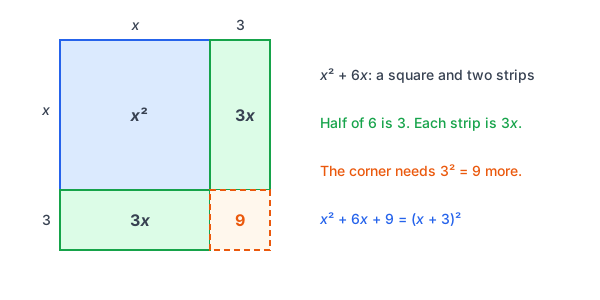
Think of x^2 + 6x as an area. The x^2 is a square. The 6x splits into two strips of 3x, one on each side. Together they almost make a bigger square.
One corner is missing. It is a 3 by 3 square, with area 9. Add 9, and the square is complete: x^2 + 6x + 9 = (x + 3)^2.
The Completing the Square Rule
x^2 + bx + \left(\frac{b}{2}\right)^2 = \left(x + \frac{b}{2}\right)^2Take half of b, the coefficient of x. Square it, and add it. The result always factors as a binomial squared.
Steps for solving by completing the square
- Divide every term by a if a \ne 1.
- Move the constant to the right side: x^2 + bx = k.
- Add \left(\frac{b}{2}\right)^2 to both sides.
- Factor the left side as \left(x + \frac{b}{2}\right)^2.
- Take the square root of both sides with ±, then solve.
Worked Examples
Example 1: Find the missing term
What number completes the square for x^2 + 10x? For x^2 - 8x?
Half of 10 is 5, and 5^2 = 25. So x^2 + 10x + 25 = (x + 5)^2. Half of -8 is -4, and (-4)^2 = 16. So x^2 - 8x + 16 = (x - 4)^2.
Example 2: Solve with whole-number answers
Solve x^2 + 6x - 7 = 0.
\begin{aligned} x^2 + 6x &= 7 \\ x^2 + 6x + 9 &= 7 + 9 \\ (x + 3)^2 &= 16 \\ x + 3 &= \pm 4 \\ x = 1 \quad &\text{or} \quad x = -7 \end{aligned}Example 3: Answers with radicals
Solve x^2 - 4x - 3 = 0.
\begin{aligned} x^2 - 4x &= 3 \\ x^2 - 4x + 4 &= 3 + 4 \\ (x - 2)^2 &= 7 \\ x &= 2 \pm \sqrt{7} \end{aligned}This one doesn’t factor with integers, so completing the square is a good choice.
Example 4: When a is not 1
Solve 2x^2 + 8x - 10 = 0.
Divide every term by 2 first. Then complete the square.
\begin{aligned} x^2 + 4x - 5 &= 0 \\ x^2 + 4x &= 5 \\ x^2 + 4x + 4 &= 9 \\ (x + 2)^2 &= 9 \\ x + 2 &= \pm 3 \\ x = 1 \quad &\text{or} \quad x = -5 \end{aligned}Example 5: Word problem
A rectangle is 4 meters longer than it is wide. Its area is 60 square meters. Find its width and length.
Let w be the width, so w(w + 4) = 60.
\begin{aligned} w^2 + 4w &= 60 \\ w^2 + 4w + 4 &= 64 \\ (w + 2)^2 &= 64 \\ w + 2 &= \pm 8 \\ w = 6 \quad &\text{or} \quad w = -10 \end{aligned}A width can’t be negative, so the rectangle is 6 meters wide and 10 meters long. Check: 6 · 10 = 60.
Common Mistakes
| Mistake | Example of the error | Fix |
|---|---|---|
| Adding to only one side | x^2 + 6x + 9 = 7 | Add 9 to both sides: x^2 + 6x + 9 = 16. |
| Not halving b | For x^2 + 6x, adding 6^2 = 36 | Halve first: (6 \div 2)^2 = 9. |
| Forgetting to divide by a | For 2x^2 + 8x, adding (8/2)^2 = 16 | Divide by 2 first: x^2 + 4x, then add 4. |
| Wrong sign in the binomial | x^2 - 4x + 4 = (x + 2)^2 | Use half of b with its sign: (x - 2)^2. |
| Dropping the ± | (x + 3)^2 = 16, \; x + 3 = 4 | x + 3 = \pm 4, which gives two answers. |
Completing the Square to Find Vertex Form
The same idea rewrites y = ax^2 + bx + c in vertex form. Add and subtract \left(\frac{b}{2}\right)^2 on the same side, so the value doesn’t change.
\begin{aligned} y &= x^2 + 6x + 5 \\ &= (x^2 + 6x + 9) - 9 + 5 \\ &= (x + 3)^2 - 4 \end{aligned}The vertex is (-3, -4). When b is odd, use fractions: x^2 + 3x + \frac{9}{4} = \left(x + \frac{3}{2}\right)^2.
Completing the square on ax^2 + bx + c = 0 in general gives the quadratic formula, the next lesson.
Practice Problems
- What number completes the square for x^2 + 14x?
- What number completes the square for x^2 - 12x?
- Solve x^2 + 8x - 9 = 0 by completing the square.
- Solve x^2 - 2x - 15 = 0 by completing the square.
- Solve x^2 + 4x - 1 = 0 by completing the square.
- Solve x^2 - 10x + 18 = 0 by completing the square.
- Solve 3x^2 - 12x - 15 = 0 by completing the square.
- Solve x^2 + 3x - 4 = 0 by completing the square.
- Write y = x^2 - 8x + 10 in vertex form by completing the square.
- A rectangular patio is 6 feet longer than it is wide, with an area of 112 square feet. Find its dimensions.
Show answers
- (14/2)^2 = 49
- (-12/2)^2 = 36
- x^2 + 8x + 16 = 25, (x + 4)^2 = 25, x + 4 = \pm 5, so x = 1 or x = -9
- x^2 - 2x + 1 = 16, (x - 1)^2 = 16, so x = 5 or x = -3
- x^2 + 4x + 4 = 5, (x + 2)^2 = 5, so x = -2 \pm \sqrt{5}
- x^2 - 10x + 25 = 7, (x - 5)^2 = 7, so x = 5 \pm \sqrt{7}
- Divide by 3: x^2 - 4x = 5, (x - 2)^2 = 9, so x = 5 or x = -1
- x^2 + 3x + \frac{9}{4} = 4 + \frac{9}{4}, \left(x + \frac{3}{2}\right)^2 = \frac{25}{4}, x + \frac{3}{2} = \pm\frac{5}{2}, so x = 1 or x = -4
- (x^2 - 8x + 16) - 16 + 10 = (x - 4)^2 - 6. The vertex is (4, -6).
- w^2 + 6w = 112, (w + 3)^2 = 121, w + 3 = \pm 11, so w = 8. The patio is 8 feet by 14 feet.
FAQ
What does completing the square mean?
It means adding a number to x^2 + bx so it becomes a perfect square trinomial, like (x + 3)^2. The number is \left(\frac{b}{2}\right)^2.
How do you complete the square when a is not 1?
Divide every term by a first, so the x^2 term has a coefficient of 1. Then complete the square as usual.
When should I use completing the square?
Use it when a quadratic doesn’t factor and b is even, or when you need vertex form. The quadratic formula also works on every quadratic.
Why do you add the number to both sides?
An equation stays balanced only if you do the same thing to both sides. Adding to one side would change the solutions.
Summary
- Completing the square turns x^2 + bx into a perfect square by adding \left(\frac{b}{2}\right)^2.
- Divide by a first, and move the constant to the right side.
- Add the same number to both sides, then factor.
- Take square roots with ± and solve.
- The same steps give vertex form.
Previous lesson: Solving Quadratics with Square Roots
Next lesson: Quadratic Formula
Back to the Algebra 1 Index