
Vertex Form
Vertex form of a quadratic function is y = a(x - h)^2 + k, where (h, k) is the vertex. It shows the turning point of the parabola right away. For example, y = 2(x - 3)^2 + 1 has its vertex at (3, 1), opens up because a \gt 0, and has the axis of symmetry x = 3.
Before this lesson: You should know graphing quadratic functions, squaring binomials and function notation.
What Vertex Form Tells You
In graphing quadratic functions, you used x = -\frac{b}{2a} to find the vertex. Vertex form skips that step. The vertex is written into the equation.
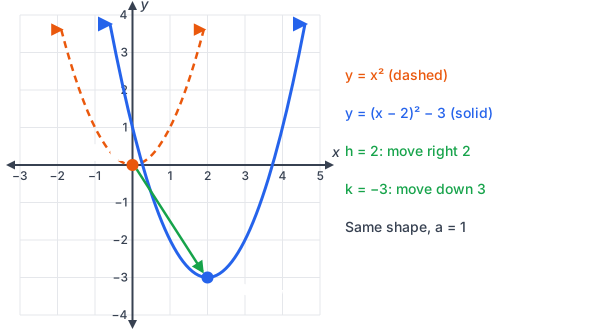
Start with y = x^2. Replacing x with x - h moves the graph h units right. Adding k moves it k units up. So the vertex moves from (0, 0) to (h, k).
The Vertex Form Equation
y = a(x - h)^2 + k
| Part | Meaning |
|---|---|
| (h, k) | The vertex |
| x = h | The axis of symmetry |
| a | Same as in standard form: up if a \gt 0, down if a \lt 0, narrower if |a| \gt 1 |
| k | The minimum value if a \gt 0, or the maximum if a \lt 0 |
Watch the sign of h. The formula has a minus, so (x + 4)^2 means (x - (-4))^2, and h = -4.
Steps for graphing from vertex form
- Read the vertex (h, k). Flip the sign you see inside the parentheses.
- Plot the vertex and draw the axis x = h.
- Use a to see if it opens up or down.
- Plot points 1 unit on each side: they are a units above or below the vertex. Points 2 units away are 4a units away.
- Draw a smooth U through the points.
Worked Examples
Example 1: Read the vertex
Find the vertex of y = (x - 3)^2 + 2 and y = -2(x + 1)^2 - 4.
Step 1. Match y = (x - 3)^2 + 2 to y = a(x - h)^2 + k. Here h = 3 and k = 2, so the vertex is (3, 2).
Step 2. In the second equation, rewrite the plus sign as minus a negative.
x + 1 = x - (-1)
Step 3. So h = -1 and k = -4. The vertex is (-1, -4).
Step 4. Here a = -2 \lt 0, so the parabola opens down and the vertex is a maximum.
Answer: (3, 2) and (-1, -4). The second vertex is a maximum.
Example 2: Graph from vertex form
Graph y = (x - 2)^2 - 3.
Step 1. Read the vertex: h = 2 and k = -3, so the vertex is (2, -3). Plot it. The axis of symmetry is x = 2.
Step 2. Substitute x = 1, one unit left of the vertex.
(1 - 2)^2 - 3 = (-1)^2 - 3 = 1 - 3 = -2
Step 3. Substitute x = 3, one unit right. It gives the same y-value.
(3 - 2)^2 - 3 = 1^2 - 3 = 1 - 3 = -2
Step 4. Substitute x = 0, two units left.
(0 - 2)^2 - 3 = (-2)^2 - 3 = 4 - 3 = 1
Step 5. Substitute x = 4, two units right.
(4 - 2)^2 - 3 = 2^2 - 3 = 4 - 3 = 1
Step 6. Plot (0, 1), (1, -2), (2, -3), (3, -2) and (4, 1), and draw the U-shape. This is the blue graph above.
Answer: A U-shape with vertex (2, -3), through (1, -2), (3, -2), (0, 1) and (4, 1).
Example 3: Vertex form to standard form
Write y = 2(x - 1)^2 + 5 in standard form.
Step 1. Expand the square of a binomial: (x - 1)^2 = x^2 - 2x + 1.
y = 2(x^2 - 2x + 1) + 5
Step 2. Distribute the 2 (see distributive property).
y = 2x^2 - 4x + 2 + 5
Step 3. Combine the constants.
y = 2x^2 - 4x + 7
Answer: y = 2x^2 - 4x + 7
Example 4: Standard form to vertex form
Write y = x^2 + 6x + 4 in vertex form.
Step 1. Find h with the axis formula. Here a = 1 and b = 6.
h = -\frac{6}{2(1)} = -3Step 2. Find k by substituting x = -3 into the equation.
k = (-3)^2 + 6(-3) + 4 = 9 - 18 + 4 = -5
Step 3. Put a = 1, h = -3 and k = -5 into y = a(x - h)^2 + k. Since x - (-3) = x + 3:
y = (x + 3)^2 - 5
Answer: y = (x + 3)^2 - 5
Check: (x + 3)^2 - 5 = x^2 + 6x + 9 - 5 = x^2 + 6x + 4.
Example 5: Word problem
A bridge arch is shaped like a parabola. It is 12 feet high at the center and 8 feet wide at the base. Write an equation for the arch, with the center of the base at the origin.
Step 1. The top of the arch is the vertex, (0, 12). Write vertex form with h = 0 and k = 12.
y = a(x - 0)^2 + 12
Step 2. The base is 8 feet wide, so its ends are 4 feet each way, at (-4, 0) and (4, 0). Substitute the point (4, 0).
0 = a(4 - 0)^2 + 12
Step 3. Square: 4^2 = 16.
0 = 16a + 12
Step 4. Subtract 12 from both sides (see two-step equations).
-12 = 16a
Step 5. Divide both sides by 16 and simplify the fraction.
a = -\frac{12}{16} = -\frac{3}{4}Step 6. Write the equation with a = -\frac{3}{4}.
y = -\frac{3}{4}x^2 + 12Answer: y = -\frac{3}{4}x^2 + 12
Check: The other end: -\frac{3}{4}(-4)^2 + 12 = -\frac{3}{4}(16) + 12 = -12 + 12 = 0.
Common Mistakes
| Mistake | Example of the error | Fix |
|---|---|---|
| Wrong sign for h | Vertex of y = (x + 4)^2 - 1 is (4, -1) | x + 4 = x - (-4), so the vertex is (-4, -1). |
| Flipping the sign of k too | Vertex of y = (x - 2)^2 - 3 is (2, 3) | Only h flips. k = -3, so the vertex is (2, -3). |
| Squaring the binomial wrong | (x - 1)^2 = x^2 + 1 | (x - 1)^2 = x^2 - 2x + 1. |
| Forgetting to multiply by a | 2(x - 1)^2 + 5 = 2x^2 - 2x + 1 + 5 | Multiply every term: 2x^2 - 4x + 2 + 5. |
| Changing a when converting | y = 3x^2 + 6x becomes (x + 1)^2 - 3 | Keep a = 3: y = 3(x + 1)^2 - 3. |
Vertex Form vs. Standard Form
| Form | Equation | Easy to see |
|---|---|---|
| Standard form | y = ax^2 + bx + c | y-intercept (0, c) |
| Vertex form | y = a(x - h)^2 + k | Vertex (h, k) and maximum or minimum |
| Factored form | y = a(x - p)(x - q) | x-intercepts p and q |
Factored form comes from factoring trinomials. Another way to reach vertex form is completing the square.
Practice Problems
- Find the vertex of y = (x - 5)^2 + 1.
- Find the vertex of y = -(x + 2)^2 + 7. Is it a maximum or minimum?
- Find the vertex and axis of symmetry of y = \tfrac{1}{2}(x - 4)^2.
- Write y = (x + 3)^2 - 2 in standard form.
- Write y = -2(x - 1)^2 + 8 in standard form.
- Write y = x^2 - 8x + 10 in vertex form.
- Write y = 2x^2 + 12x + 13 in vertex form.
- Write the equation of a parabola with vertex (1, -4) that passes through (3, 4).
- Describe how y = (x + 1)^2 + 5 is moved from y = x^2.
- A ball’s path has its highest point at (3, 10) and starts at (0, 1), in feet. Write its equation in vertex form.
Show answers
- Match to y = a(x - h)^2 + k: h = 5 and k = 1
The vertex is (5, 1). - Rewrite the plus sign: x + 2 = x - (-2)
So h = -2 and k = 7
a = -1 \lt 0, so it opens down
The vertex is (-2, 7), a maximum. - There is no number added at the end, so k = 0: y = \frac{1}{2}(x - 4)^2 + 0
h = 4. The axis of symmetry is the vertical line through the vertex
Vertex (4, 0), axis x = 4. - Expand the square of the binomial: y = x^2 + 6x + 9 - 2
Combine the constants: y = x^2 + 6x + 7 - Expand the square of the binomial: y = -2(x^2 - 2x + 1) + 8
Distribute -2: y = -2x^2 + 4x - 2 + 8
Combine the constants: y = -2x^2 + 4x + 6 - Find h with a = 1 and b = -8: h = -\frac{-8}{2(1)} = 4
Substitute x = 4 to find k: k = 4^2 - 8(4) + 10 = 16 - 32 + 10 = -6
Write vertex form: y = (x - 4)^2 - 6 - Find h with a = 2 and b = 12: h = -\frac{12}{2(2)} = -\frac{12}{4} = -3
Substitute x = -3 to find k: k = 2(-3)^2 + 12(-3) + 13 = 18 - 36 + 13 = -5
Write vertex form. a stays 2: y = 2(x + 3)^2 - 5 - Start with y = a(x - 1)^2 - 4. Substitute the point (3, 4): 4 = a(3 - 1)^2 - 4
Square: (3 - 1)^2 = 2^2 = 4: 4 = 4a - 4
Add 4 to both sides: 8 = 4a
Divide both sides by 4: a = 2
The equation is y = 2(x - 1)^2 - 4. - x + 1 = x - (-1), so h = -1: the graph moves 1 unit left
k = 5: the graph moves 5 units up
It moves 1 unit left and 5 units up. - Start with y = a(x - 3)^2 + 10. Substitute the point (0, 1): 1 = a(0 - 3)^2 + 10
Square: (0 - 3)^2 = (-3)^2 = 9: 1 = 9a + 10
Subtract 10 from both sides: -9 = 9a
Divide both sides by 9: a = -1
The path is y = -(x - 3)^2 + 10.
FAQ
What is the vertex form of a quadratic?
It is y = a(x - h)^2 + k. The vertex is (h, k), and a tells the direction and width.
How do you find the vertex from vertex form?
Take the number inside the parentheses and flip its sign to get h. Take k as it is. For y = (x + 2)^2 - 6, the vertex is (-2, -6).
How do you convert standard form to vertex form?
Find h = -\frac{b}{2a}, then find k by plugging h into the function. Keep the same a. You can also complete the square.
Why is it called vertex form?
Because the vertex, the turning point of the parabola, can be read right off the equation.
Summary
- Vertex form is y = a(x - h)^2 + k, with vertex (h, k).
- The axis of symmetry is x = h.
- Flip the sign inside the parentheses to get h; keep the sign of k.
- Expand to get standard form. Use the vertex formula to go the other way, keeping the same a.
- Use the vertex and one point to write an equation.
Previous lesson: Graphing Quadratic Functions
Next lesson: Solving Quadratics by Graphing
Back to the Algebra 1 Index