
Graphing Quadratic Functions
Graphing quadratic functions means drawing the U-shaped curve, called a parabola, for y = ax^2 + bx + c. Find the vertex with x = -\frac{b}{2a}, draw the axis of symmetry through it, and plot the y-intercept and its mirror point. If a \gt 0 the parabola opens up; if a \lt 0 it opens down.
Before this lesson: You should know function notation, key features of functions and multiplying binomials.
What Does a Quadratic Function Look Like?
A quadratic function has an x^2 term and no higher power. Its standard form is y = ax^2 + bx + c, where a \ne 0.
Its graph is a parabola, a U shape. Think of the path of a ball tossed in the air, or the curve of a satellite dish.
Every parabola has a turning point called the vertex. A vertical line through the vertex, the axis of symmetry, splits the parabola into two mirror halves.
Key Parts of a Parabola
| Feature | How to find it in y = ax² + bx + c |
|---|---|
| Direction | Opens up if a \gt 0. Opens down if a \lt 0. |
| Axis of symmetry | x = -\frac{b}{2a} |
| Vertex | Use x = -\frac{b}{2a}, then plug that x into the function to get y. |
| y-intercept | (0, c), because y = c when x = 0. |
| Width | If |a| \gt 1, it is narrower than y = x^2. If |a| \lt 1, it is wider. |
Steps for graphing a quadratic function
- Decide if it opens up or down from the sign of a.
- Find the axis of symmetry: x = -\frac{b}{2a}.
- Plug that x-value in to find the vertex.
- Plot the y-intercept (0, c) and its mirror point across the axis.
- Plot one or two more points if needed, then draw a smooth U through them.
Worked Examples
Example 1: The parent function y = x²
Graph y = x^2 with a table of values.
Step 1. Pick x-values on both sides of 0: -2, -1, 0, 1, 2.
Step 2. Square each x-value to get y (see evaluating algebraic expressions). For example, (-2)^2 = 4 and (-1)^2 = 1.
| x | −2 | −1 | 0 | 1 | 2 |
|---|---|---|---|---|---|
| y | 4 | 1 | 0 | 1 | 4 |
Step 3. Plot the five points and join them with a smooth U-shaped curve.
Step 4. The lowest point is (0, 0), so that is the vertex. The y-values match on each side: 1 and 1, 4 and 4. So the axis of symmetry is x = 0, the y-axis.
Answer: The graph is a U-shape with vertex (0, 0) and axis of symmetry x = 0.
Example 2: A parabola that opens down
Describe the graph of y = -2x^2 + 3.
Step 1. Find a, b and c: a = -2, b = 0 and c = 3.
Step 2. a is negative, so the parabola opens down.
Step 3. Find the axis of symmetry with the formula.
x = -\frac{b}{2a} = -\frac{0}{2(-2)} = 0Step 4. Substitute x = 0 to find the y-value of the vertex.
y = -2(0)^2 + 3 = 0 + 3 = 3
Step 5. The vertex is (0, 3). It opens down, so it is a maximum.
Step 6. Compare the width. |-2| = 2, and 2 is greater than 1, so the graph is narrower than y = x^2 (see absolute value).
Answer: It opens down, has a maximum at (0, 3) and axis x = 0, and is narrower than y = x^2.
Example 3: Find the vertex and graph
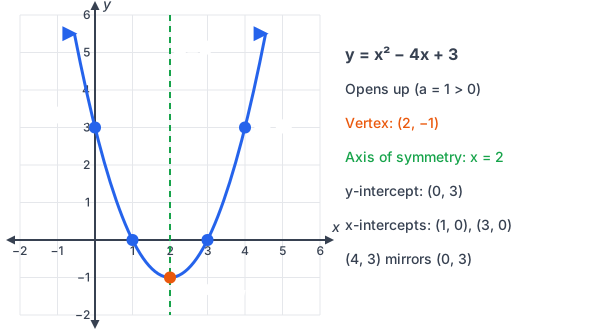
Graph y = x^2 - 4x + 3.
Step 1. Find a and b: a = 1 and b = -4. Use the formula for the axis of symmetry.
x = -\frac{b}{2a} = -\frac{-4}{2(1)} = 2Step 2. Substitute x = 2 to find the y-value of the vertex.
y = 2^2 - 4(2) + 3 = 4 - 8 + 3 = -1
Step 3. The vertex is (2, -1). Since a = 1 is positive, it opens up and the vertex is a minimum.
Step 4. Find the y-intercept by substituting x = 0.
y = 0^2 - 4(0) + 3 = 3
Step 5. The y-intercept (0, 3) is 2 units left of the axis x = 2. Its mirror point is 2 units right, at x = 4.
y = 4^2 - 4(4) + 3 = 16 - 16 + 3 = 3
Step 6. Plot (0, 3), (2, -1) and (4, 3), and draw the U-shape through them. The graph is shown above.
Answer: Vertex (2, -1), axis x = 2, y-intercept (0, 3) and mirror point (4, 3).
Example 4: A negative a with a b-term
Find the vertex, axis and y-intercept of y = -x^2 - 2x + 8.
Step 1. Here a = -1 and b = -2. Find the axis of symmetry.
x = -\frac{-2}{2(-1)} = -\frac{-2}{-2} = -1Step 2. Substitute x = -1. Square first, then multiply, then add (see order of operations).
y = -(-1)^2 - 2(-1) + 8 = -1 + 2 + 8 = 9
Step 3. The vertex is (-1, 9). Since a is negative, it opens down and the vertex is a maximum.
Step 4. Find the y-intercept by substituting x = 0.
y = -0^2 - 2(0) + 8 = 8
Step 5. (0, 8) is 1 unit right of the axis x = -1, so its mirror point is 1 unit left, at x = -2.
y = -(-2)^2 - 2(-2) + 8 = -4 + 4 + 8 = 8
Step 6. The graph crosses the x-axis at x = -4 and x = 2. Check each one: the y-value is 0.
\begin{aligned} -(-4)^2 - 2(-4) + 8 &= -16 + 8 + 8 = 0 \\ -(2)^2 - 2(2) + 8 &= -4 - 4 + 8 = 0 \end{aligned}Answer: Vertex (-1, 9) (a maximum), axis x = -1, y-intercept (0, 8), mirror point (-2, 8), and x-intercepts x = -4 and x = 2.
Example 5: Word problem
Water from a fountain follows the path h = -2x^2 + 8x, where x is the distance from the spout and h is the height, both in feet. How high does the water go? Where does it land?
Step 1. Here a = -2 and b = 8. The highest point is the vertex. Find its x-value.
x = -\frac{8}{2(-2)} = -\frac{8}{-4} = 2Step 2. Substitute x = 2 to find the height.
h = -2(2)^2 + 8(2) = -2(4) + 16 = -8 + 16 = 8
Step 3. The vertex is (2, 8). The water starts at (0, 0), 2 units left of the axis. By symmetry it lands 2 units right of the axis, at x = 4.
Step 4. Check that the height is 0 at x = 4.
-2(4)^2 + 8(4) = -32 + 32 = 0
Answer: The water reaches 8 feet, 2 feet from the spout. It lands 4 feet from the spout.
Common Mistakes
| Mistake | Example of the error | Fix |
|---|---|---|
| Dropping the negative in the formula | For y = x^2 - 4x + 3: x = \frac{-4}{2} = -2 | Use x = -\frac{b}{2a} = -\frac{-4}{2} = 2. |
| Using the x-value as the vertex | Vertex of y = x^2 - 4x + 3 is 2 | The vertex is a point. Plug in to find y: (2, −1). |
| Squaring a negative wrong | -(-1)^2 = 1 | Square first, then apply the minus: -(-1)^2 = -1. |
| Wrong direction | y = -x^2 + 4 opens up | a \lt 0, so it opens down. |
| Connecting points with straight lines | A V shape instead of a U | Draw a smooth curve that is rounded at the vertex. |
How a Changes the Graph
| y = ax^2 | Direction | Shape compared with y = x² |
|---|---|---|
| y = 3x^2 | Up | Narrower |
| y = \tfrac{1}{2}x^2 | Up | Wider |
| y = -x^2 | Down | Same width, flipped |
| y = -4x^2 | Down | Narrower, flipped |
The y-intercept and vertex give you the key features of functions right away: the maximum or minimum, where the graph increases and decreases, and the range. Vertex form, the next lesson, shows the vertex without any formula.
Practice Problems
- Find the vertex and axis of symmetry of y = x^2 + 2x - 3.
- Find the vertex of y = x^2 - 6x + 5. Does it open up or down?
- Find the vertex of y = -x^2 + 4x. Is it a maximum or a minimum?
- Find the vertex of y = 2x^2 - 8x + 1.
- Find the vertex and y-intercept of y = -3x^2 + 6x + 1.
- Describe the graph of y = x^2 - 9: direction, vertex and x-intercepts.
- For y = x^2 + 2x - 3, the y-intercept is (0, -3). Find its mirror point.
- Which is narrower, y = 5x^2 or y = \tfrac{1}{5}x^2?
- A parabola has vertex (3, -2) and passes through (1, 6). Name another point on it.
- A ball’s height is h = -16t^2 + 32t + 4 feet after t seconds. Find its greatest height and when it happens.
Show answers
- Find the axis with a = 1 and b = 2: x = -\frac{2}{2(1)} = -1
Substitute x = -1: y = (-1)^2 + 2(-1) - 3 = 1 - 2 - 3 = -4
Vertex (-1, -4), axis x = -1. - Find the axis with a = 1 and b = -6: x = -\frac{-6}{2(1)} = 3
Substitute x = 3: y = 3^2 - 6(3) + 5 = 9 - 18 + 5 = -4
Vertex (3, -4). It opens up, since a = 1 \gt 0. - Find the axis with a = -1 and b = 4: x = -\frac{4}{2(-1)} = 2
Substitute x = 2: y = -(2)^2 + 4(2) = -4 + 8 = 4
Vertex (2, 4). It is a maximum, since a \lt 0. - Find the axis with a = 2 and b = -8: x = -\frac{-8}{2(2)} = 2
Substitute x = 2: y = 2(2)^2 - 8(2) + 1 = 8 - 16 + 1 = -7
Vertex (2, -7). - Find the axis with a = -3 and b = 6: x = -\frac{6}{2(-3)} = 1
Substitute x = 1: y = -3(1)^2 + 6(1) + 1 = -3 + 6 + 1 = 4
Substitute x = 0 for the y-intercept: y = -3(0)^2 + 6(0) + 1 = 1
Vertex (1, 4), y-intercept (0, 1). - a = 1 \gt 0, so it opens up. With b = 0, the axis is x = 0
Substitute x = 0: y = 0 - 9 = -9. The vertex is (0, -9)
For x-intercepts, set y = 0: x^2 - 9 = 0
Add 9 to both sides: x^2 = 9
Both 3 and -3 square to 9 (see square roots): x = 3 \text{ or } x = -3
Opens up, vertex (0, -9), x-intercepts (-3, 0) and (3, 0). - From problem 1, the axis is x = -1
(0, -3) is 1 unit right of the axis, so the mirror point is 1 unit left, at x = -2
Check it: (-2)^2 + 2(-2) - 3 = 4 - 4 - 3 = -3
The mirror point is (-2, -3). - Compare |a|: |5| = 5 and |\tfrac{1}{5}| = \tfrac{1}{5}
The larger |a| gives the narrower graph
y = 5x^2 is narrower. - The axis goes through the vertex, so it is x = 3
(1, 6) is 3 - 1 = 2 units left of the axis
Its mirror point is 2 units right, at x = 3 + 2 = 5, with the same y-value
(5, 6) is also on the parabola. - The greatest height is at the vertex. Find its t-value with a = -16 and b = 32: t = -\frac{32}{2(-16)} = -\frac{32}{-32} = 1
Substitute t = 1: h = -16(1)^2 + 32(1) + 4 = -16 + 32 + 4 = 20
The greatest height is 20 feet, at 1 second.
FAQ
How do you find the vertex of a quadratic function?
Use x = -\frac{b}{2a} to find the x-coordinate. Then substitute it into the function to find the y-coordinate.
What is the axis of symmetry?
It is the vertical line through the vertex, x = -\frac{b}{2a}. The parabola is a mirror image on each side of it.
How do you know if a parabola opens up or down?
Look at a, the number in front of x^2. If it is positive, the parabola opens up. If it is negative, it opens down.
What is the y-intercept of a quadratic?
It is (0, c), the constant term. For y = x^2 - 4x + 3, the y-intercept is (0, 3).
Summary
- A quadratic y = ax^2 + bx + c graphs as a parabola.
- a \gt 0: opens up, with a minimum. a \lt 0: opens down, with a maximum.
- Axis of symmetry: x = -\frac{b}{2a}. Plug in to get the vertex.
- The y-intercept is (0, c). Reflect it across the axis for a second point.
- Draw a smooth U, not a V.
Previous lesson: Rationalizing the Denominator
Next lesson: Vertex Form
Back to the Algebra 1 Index