
Rationalizing the Denominator
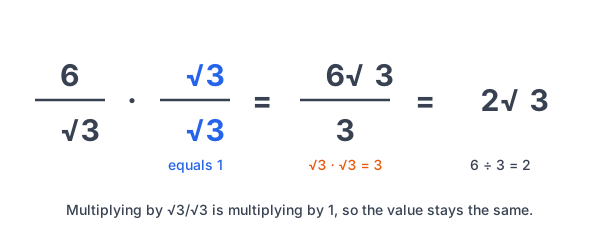
Rationalizing the denominator means rewriting a fraction so there is no radical in the denominator. For one square root, multiply the top and bottom by that root. For a sum like 3 + \sqrt{2}, multiply by its conjugate, 3 - \sqrt{2}. For example, \frac{6}{\sqrt{3}} = \frac{6\sqrt{3}}{3} = 2\sqrt{3}.
Before this lesson: You should know simplifying square roots, multiplying radicals and how to work with fractions.
Why Rationalize the Denominator?
The denominator is the bottom of a fraction. A fraction like \frac{1}{\sqrt{2}} has a radical there. Math teachers and tests expect the answer without it, so \frac{\sqrt{2}}{2} is the simplest form.
The trick is to multiply by a form of 1. Since \frac{\sqrt{3}}{\sqrt{3}} = 1, multiplying by it does not change the value. But it turns \sqrt{3} \cdot \sqrt{3} into 3, a whole number.
Rules for Rationalizing
\begin{aligned} \frac{a}{\sqrt{b}} &= \frac{a}{\sqrt{b}} \cdot \frac{\sqrt{b}}{\sqrt{b}} = \frac{a\sqrt{b}}{b} \\ \frac{c}{a + \sqrt{b}} &= \frac{c}{a + \sqrt{b}} \cdot \frac{a - \sqrt{b}}{a - \sqrt{b}} = \frac{c(a - \sqrt{b})}{a^2 - b} \end{aligned}The conjugate of a + \sqrt{b} is a - \sqrt{b}. It has the same terms with the opposite sign in the middle. Their product, a^2 - b, has no radical.
Steps for rationalizing the denominator
- Simplify any radicals first.
- If the denominator is one square root, multiply the top and bottom by that square root.
- If the denominator is a sum or difference, multiply the top and bottom by its conjugate.
- Multiply out the top and the bottom.
- Simplify. Reduce the fraction if you can.
Worked Examples
Example 1: One square root
Rationalize \frac{5}{\sqrt{2}}.
Step 1. Multiply by \frac{\sqrt{2}}{\sqrt{2}}. It equals 1, so the value doesn’t change.
\frac{5}{\sqrt{2}} \cdot \frac{\sqrt{2}}{\sqrt{2}}Step 2. Multiply the tops and multiply the bottoms (see multiplying and dividing fractions).
\frac{5}{\sqrt{2}} \cdot \frac{\sqrt{2}}{\sqrt{2}} = \frac{5\sqrt{2}}{\sqrt{2} \cdot \sqrt{2}}Step 3. A square root times itself is the number under it: \sqrt{2} \cdot \sqrt{2} = 2.
\frac{5\sqrt{2}}{\sqrt{2} \cdot \sqrt{2}} = \frac{5\sqrt{2}}{2}Answer: \frac{5\sqrt{2}}{2}. The bottom has no radical now.
Example 2: Reduce after rationalizing
Rationalize \frac{6}{\sqrt{3}}.
Step 1. Multiply by \frac{\sqrt{3}}{\sqrt{3}}.
\frac{6}{\sqrt{3}} \cdot \frac{\sqrt{3}}{\sqrt{3}} = \frac{6\sqrt{3}}{3}Step 2. Divide 6 by 3. The \sqrt{3} stays as it is.
\frac{6\sqrt{3}}{3} = 2\sqrt{3}Answer: 2\sqrt{3}
Example 3: Simplify the radical first
Rationalize \frac{3}{\sqrt{12}}.
Step 1. Simplify the bottom first: \sqrt{12} = \sqrt{4 \cdot 3} = 2\sqrt{3}.
\frac{3}{\sqrt{12}} = \frac{3}{2\sqrt{3}}Step 2. Multiply by \frac{\sqrt{3}}{\sqrt{3}}.
\frac{3}{2\sqrt{3}} \cdot \frac{\sqrt{3}}{\sqrt{3}} = \frac{3\sqrt{3}}{2 \cdot 3}Step 3. Multiply the bottom.
\frac{3\sqrt{3}}{2 \cdot 3} = \frac{3\sqrt{3}}{6}Step 4. Divide the top and bottom by 3.
\frac{3\sqrt{3}}{6} = \frac{\sqrt{3}}{2}Answer: \frac{\sqrt{3}}{2}
Example 4: Use the conjugate
Rationalize \frac{4}{3 + \sqrt{5}}.
Step 1. The bottom has two terms. Multiply by its conjugate over itself. The conjugate of 3 + \sqrt{5} is 3 - \sqrt{5}.
\frac{4}{3 + \sqrt{5}} \cdot \frac{3 - \sqrt{5}}{3 - \sqrt{5}} = \frac{4(3 - \sqrt{5})}{(3 + \sqrt{5})(3 - \sqrt{5})}Step 2. Multiply the bottom. A sum times a difference is a difference of squares (see special products of binomials).
(3 + \sqrt{5})(3 - \sqrt{5}) = 3^2 - (\sqrt{5})^2 = 9 - 5 = 4Step 3. Replace the bottom with 4.
\frac{4(3 - \sqrt{5})}{(3 + \sqrt{5})(3 - \sqrt{5})} = \frac{4(3 - \sqrt{5})}{4}Step 4. Divide the top and bottom by 4.
\frac{4(3 - \sqrt{5})}{4} = 3 - \sqrt{5}Answer: 3 - \sqrt{5}
Example 5: Word problem
A rectangle has an area of 12 square feet. Its length is \sqrt{6} feet. Find the exact width. Then estimate it, using \sqrt{6} \approx 2.45.
Step 1. Width is area divided by length.
w = \frac{12}{\sqrt{6}}Step 2. Multiply by \frac{\sqrt{6}}{\sqrt{6}}.
w = \frac{12}{\sqrt{6}} \cdot \frac{\sqrt{6}}{\sqrt{6}} = \frac{12\sqrt{6}}{6}Step 3. Divide 12 by 6.
w = 2\sqrt{6}Step 4. Estimate: replace \sqrt{6} with 2.45 and multiply.
2 \cdot 2.45 = 4.9
Answer: The width is 2\sqrt{6} feet, or about 4.9 feet.
Check: Length times width: \sqrt{6} \cdot 2\sqrt{6} = 2 \cdot 6 = 12.
Common Mistakes
| Mistake | Example of the error | Fix |
|---|---|---|
| Multiplying only the bottom | \frac{5}{\sqrt{2}} = \frac{5}{2} | Multiply the top too: \frac{5\sqrt{2}}{2}. |
| Canceling a number under the radical with one outside | \frac{\sqrt{6}}{3} = \sqrt{2} | You can’t divide inside the radical by 3. \frac{\sqrt{6}}{3} is already simplified. |
| Using the same sign instead of the conjugate | \frac{1}{2 + \sqrt{3}} \cdot \frac{2 + \sqrt{3}}{2 + \sqrt{3}} | The bottom still has a radical. Use 2 - \sqrt{3}: the bottom becomes 4 - 3 = 1. |
| Squaring the conjugate product wrong | (3 + \sqrt{5})(3 - \sqrt{5}) = 9 + 5 | It is a difference of squares: 9 - 5 = 4. |
| Forgetting to reduce | \frac{6\sqrt{3}}{3} | Divide 6 by 3: 2\sqrt{3}. |
Square Roots of Fractions
A square root of a fraction splits into a top root and a bottom root. Then rationalize the bottom.
\sqrt{\frac{2}{3}} = \frac{\sqrt{2}}{\sqrt{3}} \cdot \frac{\sqrt{3}}{\sqrt{3}} = \frac{\sqrt{6}}{3}| Denominator | Multiply top and bottom by | New denominator |
|---|---|---|
| \sqrt{7} | \sqrt{7} | 7 |
| 2\sqrt{5} | \sqrt{5} | 10 |
| 1 + \sqrt{2} | 1 - \sqrt{2} | 1 - 2 = -1 |
| \sqrt{5} - \sqrt{3} | \sqrt{5} + \sqrt{3} | 5 - 3 = 2 |
The conjugate trick is the same difference of squares pattern: (a + b)(a - b) = a^2 - b^2.
Practice Problems
- Rationalize \frac{7}{\sqrt{7}}.
- Rationalize \frac{3}{\sqrt{5}}.
- Rationalize \frac{10}{\sqrt{2}}.
- Simplify \frac{\sqrt{2}}{\sqrt{6}}.
- Rationalize \frac{5}{\sqrt{20}}.
- Simplify \sqrt{\frac{5}{8}}.
- Rationalize \frac{2}{1 + \sqrt{3}}.
- Rationalize \frac{6}{4 - \sqrt{10}}.
- Rationalize \frac{1}{\sqrt{5} - \sqrt{3}}.
- A rectangle has an area of 15 square meters and a length of \sqrt{5} meters. Find the exact width. Then estimate it, using \sqrt{5} \approx 2.24.
Show answers
- Multiply by \frac{\sqrt{7}}{\sqrt{7}}: \frac{7}{\sqrt{7}} \cdot \frac{\sqrt{7}}{\sqrt{7}} = \frac{7\sqrt{7}}{7}
Divide 7 by 7: \frac{7\sqrt{7}}{7} = \sqrt{7} - Multiply by \frac{\sqrt{5}}{\sqrt{5}}: \frac{3}{\sqrt{5}} \cdot \frac{\sqrt{5}}{\sqrt{5}} = \frac{3\sqrt{5}}{5}
3 and 5 have no common factor, so this is the answer - Multiply by \frac{\sqrt{2}}{\sqrt{2}}: \frac{10}{\sqrt{2}} \cdot \frac{\sqrt{2}}{\sqrt{2}} = \frac{10\sqrt{2}}{2}
Divide 10 by 2: \frac{10\sqrt{2}}{2} = 5\sqrt{2} - Multiply by \frac{\sqrt{6}}{\sqrt{6}}: \frac{\sqrt{2}}{\sqrt{6}} \cdot \frac{\sqrt{6}}{\sqrt{6}} = \frac{\sqrt{12}}{6}
Simplify the top: \sqrt{12} = 2\sqrt{3}: \frac{\sqrt{12}}{6} = \frac{2\sqrt{3}}{6}
Divide the top and bottom by 2: \frac{2\sqrt{3}}{6} = \frac{\sqrt{3}}{3} - Simplify the bottom: \sqrt{20} = 2\sqrt{5}: \frac{5}{\sqrt{20}} = \frac{5}{2\sqrt{5}}
Multiply by \frac{\sqrt{5}}{\sqrt{5}}: \frac{5}{2\sqrt{5}} \cdot \frac{\sqrt{5}}{\sqrt{5}} = \frac{5\sqrt{5}}{10}
Divide the top and bottom by 5: \frac{5\sqrt{5}}{10} = \frac{\sqrt{5}}{2} - Take the square root of the top and bottom: \sqrt{\frac{5}{8}} = \frac{\sqrt{5}}{\sqrt{8}}
Simplify the bottom: \sqrt{8} = 2\sqrt{2}: \frac{\sqrt{5}}{\sqrt{8}} = \frac{\sqrt{5}}{2\sqrt{2}}
Multiply by \frac{\sqrt{2}}{\sqrt{2}}: \frac{\sqrt{5}}{2\sqrt{2}} \cdot \frac{\sqrt{2}}{\sqrt{2}} = \frac{\sqrt{10}}{2 \cdot 2}
Multiply the bottom: \frac{\sqrt{10}}{2 \cdot 2} = \frac{\sqrt{10}}{4} - Multiply by the conjugate over itself, \frac{1 - \sqrt{3}}{1 - \sqrt{3}}. The bottom is 1^2 - (\sqrt{3})^2 = 1 - 3: \frac{2}{1 + \sqrt{3}} \cdot \frac{1 - \sqrt{3}}{1 - \sqrt{3}} = \frac{2(1 - \sqrt{3})}{1 - 3}
Subtract on the bottom: \frac{2(1 - \sqrt{3})}{1 - 3} = \frac{2(1 - \sqrt{3})}{-2}
Divide 2 by -2: \frac{2(1 - \sqrt{3})}{-2} = -(1 - \sqrt{3})
Distribute the negative sign: -(1 - \sqrt{3}) = \sqrt{3} - 1 - Multiply by the conjugate over itself, \frac{4 + \sqrt{10}}{4 + \sqrt{10}}. The bottom is 4^2 - (\sqrt{10})^2 = 16 - 10: \frac{6}{4 - \sqrt{10}} \cdot \frac{4 + \sqrt{10}}{4 + \sqrt{10}} = \frac{6(4 + \sqrt{10})}{16 - 10}
Subtract on the bottom: \frac{6(4 + \sqrt{10})}{16 - 10} = \frac{6(4 + \sqrt{10})}{6}
Divide the top and bottom by 6: \frac{6(4 + \sqrt{10})}{6} = 4 + \sqrt{10} - Multiply by the conjugate over itself, \frac{\sqrt{5} + \sqrt{3}}{\sqrt{5} + \sqrt{3}}. The bottom is (\sqrt{5})^2 - (\sqrt{3})^2 = 5 - 3: \frac{1}{\sqrt{5} - \sqrt{3}} \cdot \frac{\sqrt{5} + \sqrt{3}}{\sqrt{5} + \sqrt{3}} = \frac{\sqrt{5} + \sqrt{3}}{5 - 3}
Subtract on the bottom: \frac{\sqrt{5} + \sqrt{3}}{5 - 3} = \frac{\sqrt{5} + \sqrt{3}}{2} - Width is area divided by length: w = \frac{15}{\sqrt{5}}
Multiply by \frac{\sqrt{5}}{\sqrt{5}}: \frac{15}{\sqrt{5}} \cdot \frac{\sqrt{5}}{\sqrt{5}} = \frac{15\sqrt{5}}{5}
Divide 15 by 5: \frac{15\sqrt{5}}{5} = 3\sqrt{5}
Estimate: replace \sqrt{5} with 2.24 and multiply: 3 \cdot 2.24 = 6.72
The width is 3\sqrt{5} meters, or about 6.72 meters.
FAQ
Why do we rationalize the denominator?
It puts answers in one standard form, so they are easy to compare and check. It also makes a value easier to estimate. \frac{\sqrt{2}}{2} is clearly about half of 1.41.
What is a conjugate?
The conjugate of a + \sqrt{b} is a - \sqrt{b}. Multiplying them gives a^2 - b, which has no radical.
Can you leave a radical in the denominator?
The value is the same, but most teachers and tests want it rationalized. Our style is to always rationalize final answers.
How do you rationalize a denominator with two terms?
Multiply the top and bottom by the conjugate of the denominator. For \frac{2}{1 + \sqrt{3}}, multiply by \frac{1 - \sqrt{3}}{1 - \sqrt{3}}.
Summary
- Rationalizing removes radicals from the denominator.
- For one square root, multiply by \frac{\sqrt{b}}{\sqrt{b}}. That is multiplying by 1.
- For a sum or difference, multiply by the conjugate.
- Simplify radicals first, and reduce the fraction at the end.
- Never cancel a number inside a radical with one outside it.
Previous lesson: Multiplying Radicals
Next lesson: Graphing Quadratic Functions
Back to the Algebra 1 Index