
Multiplying Radicals
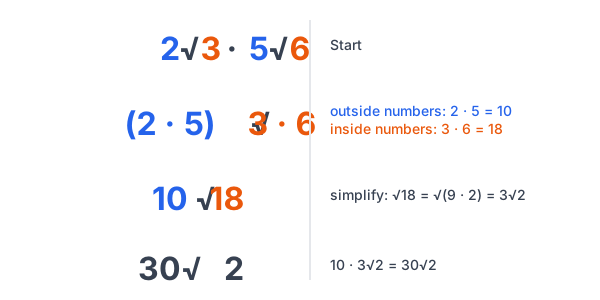
Multiplying radicals uses the product rule, \sqrt{a} \cdot \sqrt{b} = \sqrt{ab}. Multiply the numbers outside the radicals, multiply the numbers inside, and then simplify. For example, 2\sqrt{3} \cdot 5\sqrt{6} = 10\sqrt{18} = 30\sqrt{2}. For sums, use the distributive property or FOIL.
Before this lesson: You should know simplifying square roots, adding and subtracting radicals and multiplying binomials.
How Multiplying Radicals Works
Try it with perfect squares first. \sqrt{4} \cdot \sqrt{9} = 2 \cdot 3 = 6. And \sqrt{4 \cdot 9} = \sqrt{36} = 6. You get the same answer either way.
That is the product rule. Multiply the numbers under the radical signs, and keep one radical. The numbers in front are called coefficients. They multiply with each other.
One case comes up a lot. A square root times itself gives back the number inside: \sqrt{7} \cdot \sqrt{7} = \sqrt{49} = 7.
Rules for Multiplying Radicals
\begin{aligned} \sqrt{a} \cdot \sqrt{b} &= \sqrt{ab} \\ c\sqrt{a} \cdot d\sqrt{b} &= cd\sqrt{ab} \\ \sqrt{a} \cdot \sqrt{a} &= a \end{aligned}These rules work when a and b are not negative.
Steps for multiplying radicals
- Multiply the coefficients (the numbers outside).
- Multiply the radicands (the numbers inside).
- Simplify the new radical.
- For a sum in parentheses, distribute or use FOIL. Then combine like radicals.
Worked Examples
Example 1: Two square roots
Multiply \sqrt{6} \cdot \sqrt{10}.
Step 1. Use the product property: \sqrt{a} \cdot \sqrt{b} = \sqrt{ab}. Put both numbers under one radical.
\sqrt{6} \cdot \sqrt{10} = \sqrt{6 \cdot 10}Step 2. Multiply the numbers under the radical.
\sqrt{6 \cdot 10} = \sqrt{60}Step 3. Find the largest perfect square that divides 60. It is 4.
\sqrt{60} = \sqrt{4 \cdot 15}Step 4. Take the square root of 4, which is 2.
\sqrt{4 \cdot 15} = 2\sqrt{15}Answer: 2\sqrt{15}
Example 2: Coefficients in front
Multiply 2\sqrt{3} \cdot 5\sqrt{6}.
Step 1. Multiply the numbers in front together, and the numbers under the radicals together.
2\sqrt{3} \cdot 5\sqrt{6} = (2 \cdot 5)\sqrt{3 \cdot 6}Step 2. Multiply.
(2 \cdot 5)\sqrt{3 \cdot 6} = 10\sqrt{18}Step 3. The largest perfect square that divides 18 is 9.
10\sqrt{18} = 10\sqrt{9 \cdot 2}Step 4. Take the square root of 9, which is 3.
10\sqrt{9 \cdot 2} = 10 \cdot 3\sqrt{2}Step 5. Multiply the numbers in front.
10 \cdot 3\sqrt{2} = 30\sqrt{2}Answer: 30\sqrt{2}
Example 3: Distributing a radical
Multiply \sqrt{2}(3 + \sqrt{8}).
Step 1. Multiply \sqrt{2} by each term inside the parentheses, as in the distributive property.
\sqrt{2}(3 + \sqrt{8}) = \sqrt{2} \cdot 3 + \sqrt{2} \cdot \sqrt{8}Step 2. Write \sqrt{2} \cdot 3 as 3\sqrt{2}. Multiply the radicals: \sqrt{2} \cdot \sqrt{8} = \sqrt{16}.
\sqrt{2} \cdot 3 + \sqrt{2} \cdot \sqrt{8} = 3\sqrt{2} + \sqrt{16}Step 3. Take the square root of 16, which is 4.
3\sqrt{2} + \sqrt{16} = 3\sqrt{2} + 4Answer: 3\sqrt{2} + 4. The two terms are not like terms, so they don’t combine.
Example 4: FOIL with radicals
Multiply (2 + \sqrt{3})(4 - \sqrt{3}).
Step 1. Use FOIL: first, outer, inner, last. First:
2 \cdot 4 = 8
Step 2. Outer:
2(-\sqrt{3}) = -2\sqrt{3}Step 3. Inner:
\sqrt{3} \cdot 4 = 4\sqrt{3}Step 4. Last. A square root times itself is the number under it, so \sqrt{3} \cdot \sqrt{3} = 3.
\sqrt{3}(-\sqrt{3}) = -3Step 5. Write the four products.
(2 + \sqrt{3})(4 - \sqrt{3}) = 8 - 2\sqrt{3} + 4\sqrt{3} - 3Step 6. Combine the whole numbers, 8 - 3 = 5, and the like radicals, -2\sqrt{3} + 4\sqrt{3} = 2\sqrt{3}.
8 - 2\sqrt{3} + 4\sqrt{3} - 3 = 5 + 2\sqrt{3}Answer: 5 + 2\sqrt{3}
Example 5: Word problem
A rectangle is \sqrt{12} feet long and \sqrt{6} feet wide. Find its exact area. Then estimate it, using \sqrt{2} \approx 1.41.
Step 1. The area of a rectangle is length times width (see area of rectangles). Multiply the radicals.
A = \sqrt{12} \cdot \sqrt{6} = \sqrt{72}Step 2. The largest perfect square that divides 72 is 36.
A = \sqrt{36 \cdot 2}Step 3. Take the square root of 36, which is 6.
A = 6\sqrt{2}Step 4. Estimate: replace \sqrt{2} with 1.41 and multiply.
6 \cdot 1.41 = 8.46
Answer: The area is 6\sqrt{2} square feet, or about 8.46 square feet.
Common Mistakes
| Mistake | Example of the error | Fix |
|---|---|---|
| Multiplying the outside number into the radical | 3\sqrt{2} \cdot 4\sqrt{2} = 12\sqrt{4} | That part is fine, but finish it: 12\sqrt{4} = 12 \cdot 2 = 24. Or use \sqrt{2} \cdot \sqrt{2} = 2. |
| Squaring instead of multiplying | \sqrt{3} \cdot \sqrt{3} = 9 | \sqrt{3} \cdot \sqrt{3} = \sqrt{9} = 3. |
| Squaring a sum term by term | (\sqrt{2} + \sqrt{3})^2 = 2 + 3 | Use FOIL: 2 + 2\sqrt{6} + 3 = 5 + 2\sqrt{6}. |
| Not simplifying the product | \sqrt{6} \cdot \sqrt{3} = \sqrt{18} | 18 has the factor 9. The answer is 3\sqrt{2}. |
| Adding instead of multiplying the radicands | \sqrt{2} \cdot \sqrt{5} = \sqrt{7} | Multiply them: \sqrt{10}. |
Special Products with Radicals
The special products from Special Products of Binomials work with radicals too.
| Pattern | Example | Result |
|---|---|---|
| Square of a sum | (\sqrt{3} + 1)^2 | 3 + 2\sqrt{3} + 1 = 4 + 2\sqrt{3} |
| Sum times difference | (\sqrt{5} + 2)(\sqrt{5} - 2) | 5 - 4 = 1 |
| Sum times difference | (3 + \sqrt{2})(3 - \sqrt{2}) | 9 - 2 = 7 |
Pairs like \sqrt{5} + 2 and \sqrt{5} - 2 are called conjugates. When you multiply them, the radicals go away. You will use this in the next lesson, Rationalizing the Denominator.
Practice Problems
- Multiply \sqrt{3} \cdot \sqrt{12}.
- Multiply \sqrt{5} \cdot \sqrt{15}.
- Multiply 3\sqrt{2} \cdot 4\sqrt{10}.
- Simplify (2\sqrt{6})^2.
- Multiply \sqrt{3}(\sqrt{6} + 2).
- Multiply (3 + \sqrt{5})(1 + \sqrt{5}).
- Multiply (\sqrt{7} + 3)(\sqrt{7} - 3).
- Simplify (\sqrt{2} + 5)^2.
- Multiply \sqrt{2x} \cdot \sqrt{8x}. Assume x \ge 0.
- A right triangle has legs \sqrt{8} and \sqrt{18} centimeters long. Find its area. (Area of a triangle = half of base times height.)
Show answers
- Multiply under one radical: \sqrt{3} \cdot \sqrt{12} = \sqrt{36}
36 is a perfect square: \sqrt{36} = 6 - Multiply under one radical: \sqrt{5} \cdot \sqrt{15} = \sqrt{75}
The largest perfect square that divides 75 is 25: \sqrt{75} = \sqrt{25 \cdot 3}
Take the square root of 25: \sqrt{25 \cdot 3} = 5\sqrt{3} - Multiply the numbers in front and the numbers under the radicals: 3\sqrt{2} \cdot 4\sqrt{10} = (3 \cdot 4)\sqrt{2 \cdot 10}
Multiply: (3 \cdot 4)\sqrt{2 \cdot 10} = 12\sqrt{20}
The largest perfect square that divides 20 is 4: 12\sqrt{20} = 12\sqrt{4 \cdot 5}
Take the square root of 4: 12\sqrt{4 \cdot 5} = 12 \cdot 2\sqrt{5}
Multiply the numbers in front: 12 \cdot 2\sqrt{5} = 24\sqrt{5} - Square each factor (see exponent rules): (2\sqrt{6})^2 = 2^2 \cdot (\sqrt{6})^2
2^2 = 4 and (\sqrt{6})^2 = 6: 2^2 \cdot (\sqrt{6})^2 = 4 \cdot 6
Multiply: 4 \cdot 6 = 24 - Distribute \sqrt{3} to each term: \sqrt{3}(\sqrt{6} + 2) = \sqrt{3} \cdot \sqrt{6} + \sqrt{3} \cdot 2
Multiply each part: \sqrt{3} \cdot \sqrt{6} + \sqrt{3} \cdot 2 = \sqrt{18} + 2\sqrt{3}
Simplify \sqrt{18} = \sqrt{9 \cdot 2} = 3\sqrt{2}. The terms are unlike, so stop: \sqrt{18} + 2\sqrt{3} = 3\sqrt{2} + 2\sqrt{3} - FOIL: first 3 \cdot 1 = 3, outer 3\sqrt{5}, inner \sqrt{5}, last \sqrt{5} \cdot \sqrt{5} = 5: (3 + \sqrt{5})(1 + \sqrt{5}) = 3 + 3\sqrt{5} + \sqrt{5} + 5
Combine the whole numbers, 3 + 5 = 8, and the like radicals, 3\sqrt{5} + \sqrt{5} = 4\sqrt{5}: 3 + 3\sqrt{5} + \sqrt{5} + 5 = 8 + 4\sqrt{5} - FOIL: first \sqrt{7} \cdot \sqrt{7} = 7, outer -3\sqrt{7}, inner 3\sqrt{7}, last 3(-3) = -9: (\sqrt{7} + 3)(\sqrt{7} - 3) = 7 - 3\sqrt{7} + 3\sqrt{7} - 9
The radical terms cancel. This is a sum times a difference (see special products of binomials): 7 - 3\sqrt{7} + 3\sqrt{7} - 9 = 7 - 9
Subtract: 7 - 9 = -2 - Write the square as a product of two binomials: (\sqrt{2} + 5)^2 = (\sqrt{2} + 5)(\sqrt{2} + 5)
FOIL: first \sqrt{2} \cdot \sqrt{2} = 2, outer 5\sqrt{2}, inner 5\sqrt{2}, last 25: 2 + 5\sqrt{2} + 5\sqrt{2} + 25
Combine the whole numbers and the like radicals: 27 + 10\sqrt{2} - Multiply under one radical: \sqrt{2x} \cdot \sqrt{8x} = \sqrt{16x^2}
Both 16 and x^2 are perfect squares: \sqrt{16x^2} = 4x - The legs of a right triangle are its base and height. Multiply half the base by the height: \frac{1}{2}\sqrt{8} \cdot \sqrt{18}
Multiply under one radical: \frac{1}{2}\sqrt{144}
144 is a perfect square: \frac{1}{2} \cdot 12
Multiply: \frac{1}{2} \cdot 12 = 6
The area is 6 square centimeters.
FAQ
How do you multiply radicals with coefficients?
Multiply the outside numbers. Then multiply the inside numbers. Then simplify. For example, 3\sqrt{2} \cdot 4\sqrt{5} = 12\sqrt{10}.
What is a square root times itself?
It is the number under the radical. \sqrt{a} \cdot \sqrt{a} = a when a \ge 0, so \sqrt{11} \cdot \sqrt{11} = 11.
Can you multiply radicals with different radicands?
Yes. You can multiply any two square roots, even when the numbers inside are not the same. \sqrt{2} \cdot \sqrt{3} = \sqrt{6}.
How do you multiply radicals in parentheses?
Use the distributive property for one term times a sum. Use FOIL for two binomials, like (1 + \sqrt{2})(3 + \sqrt{2}). Then simplify and combine like radicals.
Summary
- Use \sqrt{a} \cdot \sqrt{b} = \sqrt{ab} for numbers that are not negative.
- Multiply outside numbers together and inside numbers together.
- A square root times itself is the radicand: \sqrt{a} \cdot \sqrt{a} = a.
- Distribute or use FOIL for sums, then combine like radicals.
- Always simplify your answer.
Previous lesson: Adding and Subtracting Radicals
Next lesson: Rationalizing the Denominator
Back to the Algebra 1 Index