
Adding and Subtracting Radicals
Adding and subtracting radicals works like combining like terms. You can only combine like radicals, which have the same number under the radical sign. Add or subtract the numbers in front, and keep the radical the same. For example, 3\sqrt{5} + 4\sqrt{5} = 7\sqrt{5}.
Before this lesson: You should know simplifying square roots and combining like terms.
Extra practice: The Algebra 1 Unit 8 Practice Pack has printable problems, answer keys and a cheat sheet for this unit.
What Are Like Radicals?
Think of \sqrt{5} as a label, like a variable. You know that 3x + 4x = 7x. In the same way, 3 of something plus 4 of the same thing is 7 of it. So 3\sqrt{5} + 4\sqrt{5} = 7\sqrt{5}.
Like radicals have the same radicand, the number or expression under the radical sign. Only like radicals can be combined. The number in front of a radical is its coefficient.
| Radicals | Like? | Why |
|---|---|---|
| 3\sqrt{2} and 5\sqrt{2} | Yes | Same radicand, 2 |
| 2\sqrt{x} and 7\sqrt{x} | Yes | Same radicand, x |
| \sqrt{2} and \sqrt{3} | No | Different radicands |
| \sqrt{8} and \sqrt{2} | Yes, after simplifying | \sqrt{8} = 2\sqrt{2} |
The Rule for Adding and Subtracting Radicals
\begin{aligned} a\sqrt{c} + b\sqrt{c} &= (a + b)\sqrt{c} \\ a\sqrt{c} - b\sqrt{c} &= (a - b)\sqrt{c} \end{aligned}This is the distributive property in reverse. The radical stays the same. Only the coefficients change.
Steps for adding and subtracting radicals
- Simplify each radical.
- Find the like radicals: the ones with the same radicand.
- Add or subtract their coefficients. Keep the radical the same.
- Leave unlike radicals as separate terms.
Worked Examples
Example 1: Like radicals
Simplify 3\sqrt{5} + 4\sqrt{5} and 9\sqrt{2} - 4\sqrt{2}.
3\sqrt{5} + 4\sqrt{5} = (3 + 4)\sqrt{5}Step 1. Both terms in the first sum have \sqrt{5}, so they are like radicals. Add the numbers in front, just like you combine like terms (see distributive property).
(3 + 4)\sqrt{5} = 7\sqrt{5}Step 2. Add 3 and 4.
9\sqrt{2} - 4\sqrt{2} = (9 - 4)\sqrt{2}Step 3. Both terms in the second problem have \sqrt{2}. Subtract the numbers in front.
(9 - 4)\sqrt{2} = 5\sqrt{2}Step 4. Subtract 4 from 9.
Answer: 7\sqrt{5} and 5\sqrt{2}
Example 2: Some radicals don’t combine
Simplify 6\sqrt{3} + 2\sqrt{7} - 4\sqrt{3}.
6\sqrt{3} + 2\sqrt{7} - 4\sqrt{3} = 6\sqrt{3} - 4\sqrt{3} + 2\sqrt{7}Step 1. Group the like radicals. Only the \sqrt{3} terms are alike.
6\sqrt{3} - 4\sqrt{3} + 2\sqrt{7} = 2\sqrt{3} + 2\sqrt{7}Step 2. Subtract the \sqrt{3} terms: 6 - 4 = 2. The \sqrt{7} term stays as it is.
Answer: 2\sqrt{3} + 2\sqrt{7}
Example 3: Simplify first
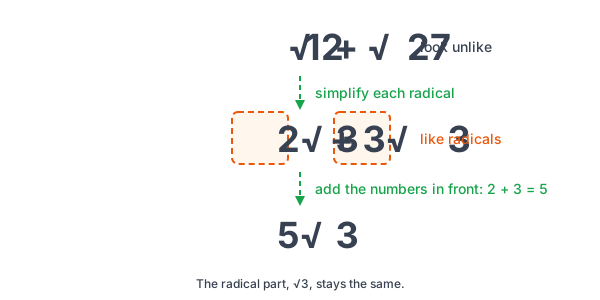
Simplify \sqrt{12} + \sqrt{27}.
\sqrt{12} = \sqrt{4 \cdot 3} = 2\sqrt{3}Step 1. These look unlike. Simplify each radical first. The largest perfect square that divides 12 is 4.
\sqrt{27} = \sqrt{9 \cdot 3} = 3\sqrt{3}Step 2. The largest perfect square that divides 27 is 9.
\sqrt{12} + \sqrt{27} = 2\sqrt{3} + 3\sqrt{3}Step 3. Replace each radical with its simplified form.
2\sqrt{3} + 3\sqrt{3} = 5\sqrt{3}Step 4. Now they are like radicals. Add the numbers in front.
Answer: 5\sqrt{3}
Example 4: Coefficients and subtraction
Simplify 4\sqrt{18} - 2\sqrt{50}.
\sqrt{18} = \sqrt{9 \cdot 2} = 3\sqrt{2}Step 1. Simplify the first radical.
\sqrt{50} = \sqrt{25 \cdot 2} = 5\sqrt{2}Step 2. Simplify the second radical.
4\sqrt{18} - 2\sqrt{50} = 4 \cdot 3\sqrt{2} - 2 \cdot 5\sqrt{2}Step 3. Replace each radical. Keep the numbers in front.
4 \cdot 3\sqrt{2} - 2 \cdot 5\sqrt{2} = 12\sqrt{2} - 10\sqrt{2}Step 4. Multiply the numbers in front.
12\sqrt{2} - 10\sqrt{2} = 2\sqrt{2}Step 5. Subtract the like radicals.
Answer: 2\sqrt{2}
Example 5: Word problem
A rectangle is \sqrt{50} meters long and \sqrt{8} meters wide. Find its exact perimeter. Then estimate it, using \sqrt{2} \approx 1.41.
P = 2\sqrt{50} + 2\sqrt{8}Step 1. The perimeter is 2 lengths plus 2 widths.
\sqrt{50} = \sqrt{25 \cdot 2} = 5\sqrt{2}Step 2. Simplify the length. The largest perfect square that divides 50 is 25.
\sqrt{8} = \sqrt{4 \cdot 2} = 2\sqrt{2}Step 3. Simplify the width. The largest perfect square that divides 8 is 4.
P = 2 \cdot 5\sqrt{2} + 2 \cdot 2\sqrt{2}Step 4. Replace each radical.
P = 10\sqrt{2} + 4\sqrt{2}Step 5. Multiply the numbers in front.
P = 14\sqrt{2}Step 6. Add the like radicals.
14 \cdot 1.41 = 19.74
Step 7. Estimate: replace \sqrt{2} with 1.41 and multiply.
Answer: The perimeter is 14\sqrt{2} meters, or about 19.74 meters.
Common Mistakes
| Mistake | Example of the error | Fix |
|---|---|---|
| Adding the radicands | \sqrt{2} + \sqrt{3} = \sqrt{5} | Unlike radicals don’t combine. \sqrt{2} + \sqrt{3} is already simplified. |
| Changing the radicand | 3\sqrt{2} + 4\sqrt{2} = 7\sqrt{4} | Keep the radical the same: 7\sqrt{2}. |
| Not simplifying first | \sqrt{8} + \sqrt{2} can’t be combined | \sqrt{8} = 2\sqrt{2}, so the sum is 3\sqrt{2}. |
| Combining unlike radicals | 2\sqrt{3} + 3\sqrt{2} = 5\sqrt{5} | The radicands differ, so the answer stays as it is. |
| Forgetting a coefficient of 1 | 5\sqrt{7} - \sqrt{7} = 5 | \sqrt{7} means 1\sqrt{7}. So 5\sqrt{7} - 1\sqrt{7} = 4\sqrt{7}. |
Radicals with Variables and Other Forms
Variables in the radicand
The same rules work with variables. Assume the variables are not negative.
\begin{aligned} 5\sqrt{x} + 2\sqrt{x} &= 7\sqrt{x} \\ \sqrt{9x} + \sqrt{4x} &= 3\sqrt{x} + 2\sqrt{x} = 5\sqrt{x} \end{aligned}Radicals mixed with whole numbers
A whole number and a radical are unlike terms. For example, 4 + 3\sqrt{2} - 1 + \sqrt{2} = 3 + 4\sqrt{2}. Combine the numbers with the numbers and the radicals with the radicals.
| Expression | Combine? | Answer |
|---|---|---|
| 7\sqrt{6} - 2\sqrt{6} | Yes | 5\sqrt{6} |
| \sqrt{5} + \sqrt{20} | Yes, after simplifying | 3\sqrt{5} |
| 2\sqrt{3} + 3\sqrt{5} | No | 2\sqrt{3} + 3\sqrt{5} |
| 6 + 2\sqrt{3} | No | 6 + 2\sqrt{3} |
Multiplying radicals uses a different rule. You will learn it in the next lesson, Multiplying Radicals.
Practice Problems
- Simplify 2\sqrt{7} + 5\sqrt{7}.
- Simplify 10\sqrt{3} - 4\sqrt{3}.
- Simplify \sqrt{6} + 8\sqrt{6} - 3\sqrt{6}.
- Simplify 4\sqrt{5} + 3\sqrt{2} - \sqrt{5}.
- Simplify \sqrt{20} + \sqrt{45}.
- Simplify \sqrt{75} - \sqrt{12}.
- Simplify 3\sqrt{8} + \sqrt{32}.
- Simplify 2\sqrt{27} - 5\sqrt{3} + \sqrt{48}.
- Simplify \sqrt{16x} + 3\sqrt{x}. Assume x \ge 0.
- A triangle has sides \sqrt{18}, \sqrt{32} and \sqrt{50} centimeters long. Find its exact perimeter. Then estimate it, using \sqrt{2} \approx 1.41.
Show answers
1.
2\sqrt{7} + 5\sqrt{7} = (2 + 5)\sqrt{7}Add the numbers in front of the like radicals.
(2 + 5)\sqrt{7} = 7\sqrt{7}Add.
2.
10\sqrt{3} - 4\sqrt{3} = (10 - 4)\sqrt{3}Subtract the numbers in front.
(10 - 4)\sqrt{3} = 6\sqrt{3}Subtract.
3.
The first term has a hidden 1 in front: \sqrt{6} = 1\sqrt{6}. Combine the numbers in front: \sqrt{6} + 8\sqrt{6} - 3\sqrt{6} = (1 + 8 - 3)\sqrt{6}
(1 + 8 - 3)\sqrt{6} = 6\sqrt{6}Add and subtract.
4.
4\sqrt{5} - \sqrt{5} + 3\sqrt{2}Group the like radicals.
Subtract the \sqrt{5} terms: 4 - 1 = 3. The \sqrt{2} term doesn’t combine: 3\sqrt{5} + 3\sqrt{2}
5.
\sqrt{20} = \sqrt{4 \cdot 5} = 2\sqrt{5}Simplify the first radical.
\sqrt{45} = \sqrt{9 \cdot 5} = 3\sqrt{5}Simplify the second radical.
2\sqrt{5} + 3\sqrt{5} = 5\sqrt{5}Add the like radicals.
6.
\sqrt{75} = \sqrt{25 \cdot 3} = 5\sqrt{3}Simplify the first radical.
\sqrt{12} = \sqrt{4 \cdot 3} = 2\sqrt{3}Simplify the second radical.
5\sqrt{3} - 2\sqrt{3} = 3\sqrt{3}Subtract the like radicals.
7.
3\sqrt{8} = 3\sqrt{4 \cdot 2} = 3 \cdot 2\sqrt{2} = 6\sqrt{2}Simplify the first radical and multiply by 3.
\sqrt{32} = \sqrt{16 \cdot 2} = 4\sqrt{2}Simplify the second radical.
6\sqrt{2} + 4\sqrt{2} = 10\sqrt{2}Add the like radicals.
8.
2\sqrt{27} = 2\sqrt{9 \cdot 3} = 2 \cdot 3\sqrt{3} = 6\sqrt{3}Simplify the first radical and multiply by 2.
\sqrt{48} = \sqrt{16 \cdot 3} = 4\sqrt{3}Simplify the last radical.
6\sqrt{3} - 5\sqrt{3} + 4\sqrt{3}Replace both radicals.
(6 - 5 + 4)\sqrt{3} = 5\sqrt{3}Combine the numbers in front.
9.
\sqrt{16x} = \sqrt{16} \cdot \sqrt{x} = 4\sqrt{x}Simplify the first radical. 16 is a perfect square.
4\sqrt{x} + 3\sqrt{x} = 7\sqrt{x}Add the like radicals.
10.
\sqrt{18} = \sqrt{9 \cdot 2} = 3\sqrt{2}The perimeter is the sum of the three sides. Simplify the first side.
\sqrt{32} = \sqrt{16 \cdot 2} = 4\sqrt{2}Simplify the second side.
\sqrt{50} = \sqrt{25 \cdot 2} = 5\sqrt{2}Simplify the third side.
3\sqrt{2} + 4\sqrt{2} + 5\sqrt{2} = 12\sqrt{2}Add the like radicals.
12 \cdot 1.41 = 16.92
Estimate: replace \sqrt{2} with 1.41 and multiply.
The perimeter is 12\sqrt{2} centimeters, or about 16.92 centimeters.
Want more practice? The Algebra 1 Unit 8 Practice Pack has 27 pages of problems on this and the other lessons in the unit, with step-by-step answers and a cheat sheet.
FAQ
Can you add radicals with different radicands?
Not directly. First simplify each radical. If they end up with the same radicand, you can add them. If not, leave the sum as it is, like \sqrt{2} + \sqrt{3}.
What are like radicals?
Like radicals have the same radicand. For example, 4\sqrt{7} and -\sqrt{7} are like radicals, but 4\sqrt{7} and 4\sqrt{5} are not.
Do you add the numbers under the radical sign?
No. Add only the numbers in front. The radicand stays the same, so 2\sqrt{3} + 5\sqrt{3} = 7\sqrt{3}.
Why do you simplify radicals before adding?
Simplifying can show like radicals that were hidden. \sqrt{12} and \sqrt{27} look different, but they are 2\sqrt{3} and 3\sqrt{3}.
Summary
- Like radicals have the same radicand. Only like radicals combine.
- Use a\sqrt{c} + b\sqrt{c} = (a + b)\sqrt{c}. The radical stays the same.
- Simplify every radical first to find hidden like radicals.
- Never add the radicands.
- Leave unlike radicals and whole numbers as separate terms.
Previous lesson: Simplifying Square Roots
Next lesson: Multiplying Radicals
Back to the Algebra 1 Index