
Solving Quadratics by Graphing
Solving quadratics by graphing means finding where the parabola y = ax^2 + bx + c crosses the x-axis. First get the equation in the form ax^2 + bx + c = 0. Then graph the function. Each x-intercept is a solution. A quadratic can have two, one or no real solutions.
Before this lesson: You should know graphing quadratic functions, vertex form and how to find x-intercepts.
Why the x-Intercepts Are the Solutions
A quadratic equation like x^2 - 4 = 0 asks: which x-values make x^2 - 4 equal 0? On the graph of y = x^2 - 4, those are the points where y = 0.
Points where y = 0 sit on the x-axis. So the solutions are the x-intercepts. They are also called the roots or zeros of the function.
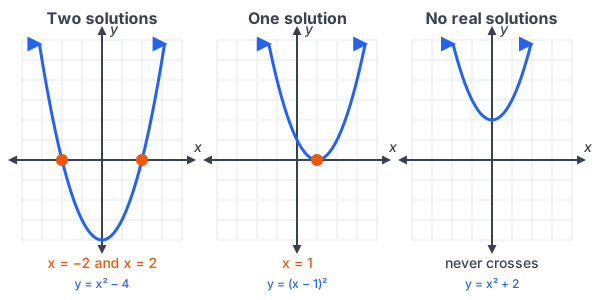
Steps for solving by graphing
- Move every term to one side so the equation reads ax^2 + bx + c = 0.
- Graph y = ax^2 + bx + c. Find the vertex and a few points.
- Find where the graph crosses or touches the x-axis.
- Write each x-intercept as a solution.
- Check each solution in the original equation.
Worked Examples
Example 1: Two solutions
Solve x^2 - 2x - 3 = 0 by graphing.
Step 1. Graph the related function y = x^2 - 2x - 3. Find the axis of the vertex with a = 1 and b = -2.
x = -\frac{-2}{2(1)} = 1Step 2. Substitute x = 1 to find the vertex’s y-value.
y = 1^2 - 2(1) - 3 = 1 - 2 - 3 = -4
Step 3. The vertex is (1, -4). Make a table with x-values on both sides of 1.
| x | −2 | −1 | 0 | 1 | 2 | 3 | 4 |
|---|---|---|---|---|---|---|---|
| y | 5 | 0 | −3 | −4 | −3 | 0 | 5 |
Step 4. Plot the points and draw the parabola. The solutions are its x-intercepts, where y = 0: x = -1 and x = 3.
Step 5. Check x = -1 in the equation.
(-1)^2 - 2(-1) - 3 = 1 + 2 - 3 = 0
Step 6. Check x = 3.
3^2 - 2(3) - 3 = 9 - 6 - 3 = 0
Answer: x = -1 and x = 3
Example 2: One solution
Solve x^2 - 6x + 9 = 0 by graphing.
Step 1. Graph y = x^2 - 6x + 9. Find the axis of the vertex with a = 1 and b = -6.
x = -\frac{-6}{2(1)} = 3Step 2. Substitute x = 3.
y = 3^2 - 6(3) + 9 = 9 - 18 + 9 = 0
Step 3. The vertex (3, 0) sits right on the x-axis, and the parabola opens up. It touches the x-axis only once.
Answer: The only solution is x = 3.
Example 3: No real solutions
Solve x^2 + 2x + 4 = 0 by graphing.
Step 1. Graph y = x^2 + 2x + 4. Find the axis of the vertex with a = 1 and b = 2.
x = -\frac{2}{2(1)} = -1Step 2. Substitute x = -1.
y = (-1)^2 + 2(-1) + 4 = 1 - 2 + 4 = 3
Step 3. The vertex (-1, 3) is above the x-axis, and the parabola opens up because a \gt 0. So the graph never reaches the x-axis.
Answer: There are no real solutions.
Example 4: Rearrange first
Solve x^2 = x + 6 by graphing.
Step 1. Get 0 on one side. Subtract x from both sides (see two-step equations).
x^2 - x = 6
Step 2. Subtract 6 from both sides.
x^2 - x - 6 = 0
Step 3. Graph y = x^2 - x - 6. Its vertex is at x = \frac{1}{2}, so make a table around that value. The graph crosses the x-axis at x = -2 and x = 3.
Step 4. Check x = -2 in the original equation. The left side is (-2)^2 = 4 and the right side is -2 + 6 = 4.
Step 5. Check x = 3. The left side is 3^2 = 9 and the right side is 3 + 6 = 9.
Answer: x = -2 and x = 3
Example 5: Word problem
A model rocket’s height in meters is h = -5t^2 + 20t, where t is time in seconds. When does it land?
Step 1. It lands when h = 0, so solve -5t^2 + 20t = 0. Graph h = -5t^2 + 20t. Find the vertex’s t-value.
t = -\frac{20}{2(-5)} = -\frac{20}{-10} = 2Step 2. Substitute t = 2 to find the highest point.
h = -5(2)^2 + 20(2) = -20 + 40 = 20
Step 3. The vertex is (2, 20). The graph starts at (0, 0), 2 units left of the axis, so it comes back to h = 0 2 units right, at t = 4.
Step 4. Check t = 4.
-5(4)^2 + 20(4) = -80 + 80 = 0
Step 5. The answer t = 0 is the launch, so it does not answer the question.
Answer: The rocket lands after 4 seconds.
Common Mistakes
| Mistake | Example of the error | Fix |
|---|---|---|
| Not setting the equation to 0 | Graphing y = x^2 to solve x^2 = x + 6 | Rewrite as x^2 - x - 6 = 0 first, then graph. |
| Reading the y-intercept as a solution | x^2 - 2x - 3 = 0 has solution -3 | Solutions are where the graph crosses the x-axis, not the y-axis. |
| Writing points instead of x-values | Solution: (3, 0) | The solution is the x-value: x = 3. |
| Saying no solution means 0 | x^2 + 2x + 4 = 0 has solution x = 0 | No x-intercepts means no real solutions. |
| Trusting a rough graph | Reading x^2 = 5 as x = 2 | 2^2 = 4, not 5. Check by substituting. The true answers are about 2.2 and −2.2. |
When the Graph Doesn’t Land on a Grid Line
Some solutions are not whole numbers. For x^2 - 5 = 0, the graph crosses between 2 and 3, and between −3 and −2. A graph only gives an estimate, like x \approx 2.2.
For exact answers, use algebra. The next lessons show factoring, square roots, completing the square and the quadratic formula.
| Graph of y = ax² + bx + c | Number of real solutions |
|---|---|
| Crosses the x-axis twice | 2 |
| Touches the x-axis at the vertex | 1 |
| Never reaches the x-axis | 0 |
Practice Problems
- Solve x^2 - 9 = 0 by graphing.
- Solve x^2 + 4x + 3 = 0 by graphing.
- Solve x^2 - 4x + 4 = 0 by graphing.
- How many real solutions does x^2 + 1 = 0 have?
- Solve -x^2 + 2x + 8 = 0 by graphing.
- Solve x^2 = 2x + 3 by graphing.
- A graph of y = x^2 + x - 2 crosses the x-axis at (-2, 0) and (1, 0). Solve x^2 + x - 2 = 0.
- Between which two whole numbers is the positive solution of x^2 - 7 = 0?
- The vertex of y = -x^2 + 6x - 10 is (3, -1). How many real solutions does -x^2 + 6x - 10 = 0 have?
- A ball’s height in feet is h = -16t^2 + 64t. When does it hit the ground?
Show answers
- Graph y = x^2 - 9. With b = 0, the vertex is at x = 0, and y = 0 - 9 = -9
The graph crosses the x-axis at x = -3 and x = 3. Check x = -3: (-3)^2 - 9 = 9 - 9 = 0
Check x = 3: 3^2 - 9 = 9 - 9 = 0
x = -3 and x = 3 - Find the vertex’s x-value: x = -\frac{4}{2(1)} = -2
Find its y-value: y = (-2)^2 + 4(-2) + 3 = 4 - 8 + 3 = -1
The vertex (-2, -1) is below the axis and the graph opens up. It crosses at x = -3 and x = -1. Check x = -3: (-3)^2 + 4(-3) + 3 = 9 - 12 + 3 = 0
Check x = -1: (-1)^2 + 4(-1) + 3 = 1 - 4 + 3 = 0
x = -3 and x = -1 - Find the vertex’s x-value: x = -\frac{-4}{2(1)} = 2
Find its y-value: y = 2^2 - 4(2) + 4 = 4 - 8 + 4 = 0
The vertex (2, 0) is on the x-axis, so the graph touches it once
One solution: x = 2 - With b = 0, the vertex is at x = 0, and y = 0 + 1 = 1
The vertex (0, 1) is above the x-axis, and the graph opens up, so it never reaches the axis
None. There are no real solutions. - Find the vertex’s x-value: x = -\frac{2}{2(-1)} = 1
Find its y-value: y = -(1)^2 + 2(1) + 8 = -1 + 2 + 8 = 9
The vertex (1, 9) is above the axis and the graph opens down. It crosses at x = -2 and x = 4. Check x = -2: -(-2)^2 + 2(-2) + 8 = -4 - 4 + 8 = 0
Check x = 4: -(4)^2 + 2(4) + 8 = -16 + 8 + 8 = 0
x = -2 and x = 4 - Subtract 2x from both sides: x^2 - 2x = 3
Subtract 3 from both sides: x^2 - 2x - 3 = 0
This is the equation from Example 1. Its graph crosses the x-axis at x = -1 and x = 3
x = -1 and x = 3 - The solutions of x^2 + x - 2 = 0 are the x-values where the graph crosses the x-axis
x = -2 and x = 1 - The graph of y = x^2 - 7 crosses the x-axis where x^2 = 7
Try whole numbers: 2^2 = 4, which is less than 7, and 3^2 = 9, which is more than 7
The positive solution is between 2 and 3. - Check the vertex: -(3)^2 + 6(3) - 10 = -9 + 18 - 10 = -1
The vertex (3, -1) is below the x-axis, and the parabola opens down because a \lt 0. So it never reaches the axis
None. There are no real solutions. - It hits the ground when h = 0. Find the vertex’s t-value: t = -\frac{64}{2(-16)} = 2
Find the highest point: h = -16(2)^2 + 64(2) = -64 + 128 = 64
The graph starts at (0, 0), 2 units left of the axis, so it comes back to 0 at t = 4. Check it: -16(4)^2 + 64(4) = -256 + 256 = 0
t = 0 is the throw, so it hits the ground after 4 seconds.
FAQ
How do you solve a quadratic equation by graphing?
Write it as ax^2 + bx + c = 0, graph y = ax^2 + bx + c, and find the x-intercepts. Each one is a solution.
What are the roots of a quadratic?
The roots are the solutions of the equation. On the graph, they are the x-intercepts, also called the zeros of the function.
Can a quadratic have no solution?
It can have no real solution. That happens when the parabola never touches the x-axis, like y = x^2 + 2.
Is solving by graphing exact?
Only when the graph crosses at clear grid points. Otherwise it gives an estimate. Check answers by substituting them, or use an algebra method.
Summary
- Set the equation equal to 0: ax^2 + bx + c = 0.
- Graph the parabola and read its x-intercepts. Those are the solutions.
- Two crossings, one touch at the vertex, or no crossings: 2, 1 or 0 real solutions.
- Check each solution in the original equation.
- Graphs give estimates when the crossings are between grid lines.
Previous lesson: Vertex Form
Next lesson: Solving Quadratic Equations by Factoring
Back to the Algebra 1 Index