
Quadratic Formula
The quadratic formula solves any quadratic equation ax^2 + bx + c = 0. The solutions are x = \frac{-b \pm \sqrt{b^2 - 4ac}}{2a}. Put the equation in standard form, find a, b and c, and plug them in. It works even when the quadratic won’t factor. The answers are where the graph crosses the x-axis.
Before this lesson: You should know completing the square, solving quadratic equations by factoring and simplifying square roots.
Extra practice: The Algebra 1 Unit 9 Practice Pack (Part 2) has printable problems, answer keys and a cheat sheet for this unit.
What Does the Quadratic Formula Do?
Some quadratics factor nicely. Many don’t. The quadratic formula gives the answers to every quadratic, so you never get stuck.
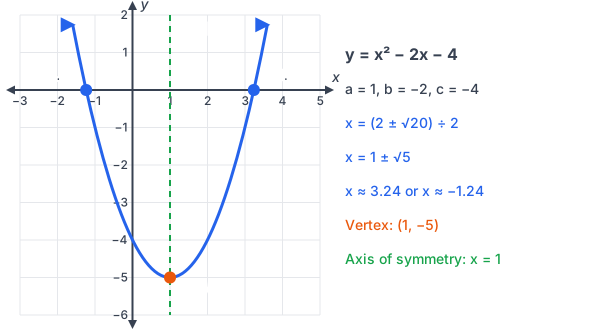
The answers are the x-intercepts of the graph of y = ax^2 + bx + c. The graph below shows y = x^2 - 2x - 4. It crosses the x-axis at x = 1 \pm \sqrt{5}, which don’t come from factoring.
The Quadratic Formula
x = \frac{-b \pm \sqrt{b^2 - 4ac}}{2a}Here a, b and c come from ax^2 + bx + c = 0, and a \ne 0. The \pm sign means you get two answers: one with + and one with −.
The part under the square root, b^2 - 4ac, is called the discriminant. It tells you how many real solutions there are.
Steps for using the quadratic formula
- Write the equation in standard form: ax^2 + bx + c = 0.
- Find a, b and c. Keep their signs.
- Find b^2 - 4ac first.
- Plug everything into the formula.
- Simplify the square root. Then find both answers.
Worked Examples
Example 1: Two whole-number answers
Solve x^2 + 5x + 6 = 0.
Step 1. Find a, b and c: a = 1, b = 5 and c = 6.
5^2 - 4(1)(6) = 25 - 24 = 1
Step 2. Find b^2 - 4ac. Multiply first, then subtract (see order of operations).
x = \frac{-5 \pm \sqrt{1}}{2(1)}Step 3. Put the values into the formula.
x = \frac{-5 \pm 1}{2}Step 4. Simplify. \sqrt{1} = 1 and 2(1) = 2.
x = \frac{-5 + 1}{2} = \frac{-4}{2} = -2Step 5. Use the + sign for one answer.
x = \frac{-5 - 1}{2} = \frac{-6}{2} = -3Step 6. Use the − sign for the other answer.
Answer: x = -2 or x = -3
Check: You could also factor this one (see factoring trinomials): x^2 + 5x + 6 = (x + 2)(x + 3), which gives the same answers.
Example 2: Answers with a square root
Solve x^2 - 2x - 4 = 0.
Step 1. Find a, b and c: a = 1, b = -2 and c = -4.
(-2)^2 - 4(1)(-4) = 4 + 16 = 20
Step 2. Find b^2 - 4ac. A negative times a negative is positive, so -4(1)(-4) = 16 (see multiplying and dividing integers).
x = \frac{2 \pm \sqrt{20}}{2}Step 3. Put the values into the formula. Note that -b = -(-2) = 2.
\sqrt{20} = \sqrt{4 \cdot 5} = 2\sqrt{5}Step 4. Simplify the square root (see simplifying square roots).
x = \frac{2 \pm 2\sqrt{5}}{2}Step 5. Replace the square root.
x = 1 \pm \sqrt{5}Step 6. Divide each term on top by 2.
Answer: x = 1 + \sqrt{5} or x = 1 - \sqrt{5}. Using \sqrt{5} \approx 2.24, the answers are about 1 + 2.24 = 3.24 and 1 - 2.24 = -1.24. They match the graph above.
Example 3: When a is not 1
Solve 2x^2 + 3x - 5 = 0.
Step 1. Find a, b and c: a = 2, b = 3 and c = -5.
3^2 - 4(2)(-5) = 9 + 40 = 49
Step 2. Find b^2 - 4ac.
x = \frac{-3 \pm \sqrt{49}}{2(2)}Step 3. Put the values into the formula. The bottom is 2a = 2(2) = 4.
x = \frac{-3 \pm 7}{4}Step 4. Simplify. \sqrt{49} = 7 (see square roots).
x = \frac{-3 + 7}{4} = \frac{4}{4} = 1Step 5. Use the + sign.
x = \frac{-3 - 7}{4} = \frac{-10}{4} = -\frac{5}{2}Step 6. Use the − sign, and reduce the fraction (see fractions).
Answer: x = 1 or x = -\frac{5}{2}
Example 4: Write it in standard form first
Solve 3x^2 = 4x + 2.
3x^2 - 4x = 2
Step 1. Subtract 4x from both sides.
3x^2 - 4x - 2 = 0
Step 2. Subtract 2 from both sides. Now the equation is in standard form.
Step 3. Find a, b and c: a = 3, b = -4 and c = -2.
(-4)^2 - 4(3)(-2) = 16 + 24 = 40
Step 4. Find b^2 - 4ac.
x = \frac{4 \pm \sqrt{40}}{6}Step 5. Put the values into the formula. -b = 4 and 2a = 6.
\sqrt{40} = \sqrt{4 \cdot 10} = 2\sqrt{10}Step 6. Simplify the square root.
x = \frac{4 \pm 2\sqrt{10}}{6}Step 7. Replace the square root.
x = \frac{2 \pm \sqrt{10}}{3}Step 8. Every term on top and the bottom can be divided by 2. Divide them all by 2.
Answer: x = \frac{2 + \sqrt{10}}{3} or x = \frac{2 - \sqrt{10}}{3}
Example 5: Word problem
A ball is thrown up from 6 feet high. Its height after t seconds is h = -16t^2 + 32t + 6 feet. When does it hit the ground? Use \sqrt{22} \approx 4.69.
-16t^2 + 32t + 6 = 0
Step 1. The ball hits the ground when the height is 0. Set h = 0.
Step 2. Find a, b and c: a = -16, b = 32 and c = 6.
32^2 - 4(-16)(6) = 1024 + 384 = 1408
Step 3. Find b^2 - 4ac.
\sqrt{1408} = \sqrt{64 \cdot 22} = 8\sqrt{22}Step 4. Simplify the square root. 64 is a perfect square factor of 1408.
t = \frac{-32 \pm 8\sqrt{22}}{-32}Step 5. Put the values into the formula. The bottom is 2a = 2(-16) = -32.
t = \frac{-32 + 8\sqrt{22}}{-32} = 1 - \frac{\sqrt{22}}{4}Step 6. Use the + sign. Dividing each term by −32 gives a negative time.
t = \frac{-32 - 8\sqrt{22}}{-32} = 1 + \frac{\sqrt{22}}{4}Step 7. Time can’t be negative, so use the − sign. Divide each term on top by −32.
t \approx 1 + \frac{4.69}{4} = 1 + 1.1725 \approx 2.17Step 8. Estimate with the given value.
Answer: The ball hits the ground after about 2.17 seconds.
Common Mistakes
| Mistake | Example of the error | Fix |
|---|---|---|
| Wrong sign on −b | For b = -2, writing -b = -2 | -b is the opposite of b: -(-2) = 2. |
| Squaring a negative wrong | (-4)^2 = -16 | A negative squared is positive: (-4)^2 = 16. |
| Dividing only part by 2a | -b \pm \frac{\sqrt{b^2 - 4ac}}{2a} | The fraction bar goes under the whole top, -b \pm \sqrt{b^2 - 4ac}. |
| Not in standard form first | For 3x^2 = 4x + 2, using c = 2 | Move every term to one side first: 3x^2 - 4x - 2 = 0, so c = -2. |
| Using 2 instead of 2a | For 2x^2 + 3x - 5 = 0, dividing by 2 | The bottom is 2a = 4. |
Which Method Should I Use?
Every quadratic can be solved with the quadratic formula. But a faster way often works.
| Equation looks like | Best method | Example |
|---|---|---|
| No x term | Square roots | x^2 = 49 |
| Factors easily | Factoring | x^2 + 5x + 6 = 0 |
| a = 1 and b is even | Completing the square | x^2 + 6x - 7 = 0 |
| Anything else | Quadratic formula | 3x^2 - 4x - 2 = 0 |
The formula comes from completing the square on ax^2 + bx + c = 0. It does the same steps once, for every quadratic.
Practice Problems
- Solve x^2 + 7x + 10 = 0.
- Solve x^2 - 3x - 10 = 0.
- Solve 2x^2 - 7x + 3 = 0.
- Solve x^2 + 4x - 1 = 0.
- Solve x^2 - 6x + 4 = 0.
- Solve 2x^2 + 2x - 1 = 0.
- Solve 5x^2 - x = 4.
- Solve 4x^2 = 12x - 9.
- Solve x^2 + 2x + 5 = 0.
- A garden is 2 meters longer than it is wide. Its area is 50 square meters. Find its width to the nearest hundredth. Use \sqrt{51} \approx 7.14.
Show answers
1.
Find the values: a = 1, b = 7, c = 10
7^2 - 4(1)(10) = 49 - 40 = 9
Find b^2 - 4ac.
x = \frac{-7 \pm \sqrt{9}}{2(1)}Put the values into the formula.
x = \frac{-7 \pm 3}{2}Simplify.
x = \frac{-7 + 3}{2} = \frac{-4}{2} = -2Use the + sign.
x = \frac{-7 - 3}{2} = \frac{-10}{2} = -5Use the − sign.
2.
Find the values: a = 1, b = -3, c = -10
(-3)^2 - 4(1)(-10) = 9 + 40 = 49
Find b^2 - 4ac.
x = \frac{3 \pm \sqrt{49}}{2(1)}Put the values into the formula.
x = \frac{3 \pm 7}{2}Simplify.
x = \frac{3 + 7}{2} = \frac{10}{2} = 5Use the + sign.
x = \frac{3 - 7}{2} = \frac{-4}{2} = -2Use the − sign.
3.
Find the values: a = 2, b = -7, c = 3
(-7)^2 - 4(2)(3) = 49 - 24 = 25
Find b^2 - 4ac.
x = \frac{7 \pm \sqrt{25}}{2(2)}Put the values into the formula.
x = \frac{7 \pm 5}{4}Simplify.
x = \frac{7 + 5}{4} = \frac{12}{4} = 3Use the + sign.
x = \frac{7 - 5}{4} = \frac{2}{4} = \frac{1}{2}Use the − sign.
4.
Find the values: a = 1, b = 4, c = -1
4^2 - 4(1)(-1) = 16 + 4 = 20
Find b^2 - 4ac.
x = \frac{-4 \pm \sqrt{20}}{2}Put the values into the formula.
\sqrt{20} = \sqrt{4 \cdot 5} = 2\sqrt{5}Simplify the square root.
x = \frac{-4 \pm 2\sqrt{5}}{2}Replace the square root.
x = -2 \pm \sqrt{5}Divide each term on top by 2.
5.
Find the values: a = 1, b = -6, c = 4
(-6)^2 - 4(1)(4) = 36 - 16 = 20
Find b^2 - 4ac.
x = \frac{6 \pm \sqrt{20}}{2}Put the values into the formula.
\sqrt{20} = \sqrt{4 \cdot 5} = 2\sqrt{5}Simplify the square root.
x = \frac{6 \pm 2\sqrt{5}}{2}Replace the square root.
x = 3 \pm \sqrt{5}Divide each term on top by 2.
6.
Find the values: a = 2, b = 2, c = -1
2^2 - 4(2)(-1) = 4 + 8 = 12
Find b^2 - 4ac.
x = \frac{-2 \pm \sqrt{12}}{4}Put the values into the formula.
\sqrt{12} = \sqrt{4 \cdot 3} = 2\sqrt{3}Simplify the square root.
x = \frac{-2 \pm 2\sqrt{3}}{4}Replace the square root.
x = \frac{-1 \pm \sqrt{3}}{2}Divide every term on top and the bottom by 2.
7.
5x^2 - x - 4 = 0
Subtract 4 from both sides to get standard form.
Find the values: a = 5, b = -1, c = -4
(-1)^2 - 4(5)(-4) = 1 + 80 = 81
Find b^2 - 4ac.
x = \frac{1 \pm \sqrt{81}}{2(5)}Put the values into the formula.
x = \frac{1 \pm 9}{10}Simplify.
x = \frac{1 + 9}{10} = \frac{10}{10} = 1Use the + sign.
x = \frac{1 - 9}{10} = \frac{-8}{10} = -\frac{4}{5}Use the − sign.
8.
4x^2 - 12x = -9
Subtract 12x from both sides.
4x^2 - 12x + 9 = 0
Add 9 to both sides to get standard form.
Find the values: a = 4, b = -12, c = 9
(-12)^2 - 4(4)(9) = 144 - 144 = 0
Find b^2 - 4ac.
x = \frac{12 \pm \sqrt{0}}{8}Put the values into the formula.
x = \frac{12}{8}The square root of 0 is 0, so + and − give the same number.
x = \frac{3}{2}Reduce the fraction.
There is only one answer.
9.
Find the values: a = 1, b = 2, c = 5
2^2 - 4(1)(5) = 4 - 20 = -16
Find b^2 - 4ac.
The number under the square root is negative. No real number squared is negative
So there are no real solutions.
10.
w(w + 2) = 50
Let w be the width, so the length is w + 2. Area is width times length.
w^2 + 2w = 50
Distribute the w.
w^2 + 2w - 50 = 0
Subtract 50 from both sides.
2^2 - 4(1)(-50) = 4 + 200 = 204
Find b^2 - 4ac.
w = \frac{-2 \pm \sqrt{204}}{2}Put the values into the formula.
\sqrt{204} = \sqrt{4 \cdot 51} = 2\sqrt{51}Simplify the square root.
w = \frac{-2 \pm 2\sqrt{51}}{2}Replace the square root.
w = -1 \pm \sqrt{51}Divide each term on top by 2.
w \approx -1 + 7.14 = 6.14
A width must be positive, so use the + sign and the given value.
The width is about 6.14 meters.
Want more practice? The Algebra 1 Unit 9 Practice Pack (Part 2) has 40 pages of problems on this and the other lessons in the unit, with step-by-step answers and a cheat sheet.
FAQ
What is the quadratic formula?
It is x = \frac{-b \pm \sqrt{b^2 - 4ac}}{2a}. It gives the solutions of any quadratic equation ax^2 + bx + c = 0.
When should you use the quadratic formula?
Use it when a quadratic doesn’t factor easily, or when you aren’t sure. It always works.
What if the number under the square root is negative?
Then the equation has no real solutions. The graph never crosses the x-axis.
How do you remember the quadratic formula?
Many students sing it to the tune of “Pop Goes the Weasel.” Writing it out a few times while you practice also helps.
Summary
- The quadratic formula is x = \frac{-b \pm \sqrt{b^2 - 4ac}}{2a}.
- Write the equation in standard form before you find a, b and c.
- Find b^2 - 4ac first, and watch the signs.
- Simplify the square root, then find both answers.
- It works for every quadratic, even ones that don’t factor.
Previous lesson: Completing the Square
Next lesson: The Discriminant
Back to the Algebra 1 Index