
The Discriminant
The discriminant is b^2 - 4ac, the part under the square root in the quadratic formula. It tells you how many real solutions ax^2 + bx + c = 0 has, without solving it. If it is positive, there are two. If it is zero, there is one. If it is negative, there are none.
Before this lesson: You should know the quadratic formula, graphing quadratic functions and solving quadratics by graphing.
Extra practice: The Algebra 1 Unit 9 Practice Pack (Part 2) has printable problems, answer keys and a cheat sheet for this unit.
What Does the Discriminant Tell You?
Look at the quadratic formula: x = \frac{-b \pm \sqrt{b^2 - 4ac}}{2a}. The number under the square root decides what kind of answers you get.
If that number is positive, the ± gives two different answers. If it is 0, adding or subtracting 0 gives the same answer twice. If it is negative, there is no real square root, so there are no real answers.
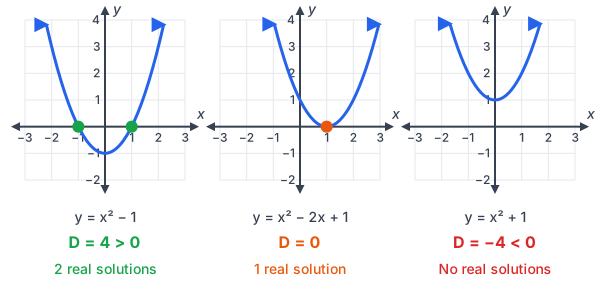
You can see this on a graph. The real solutions are where the parabola meets the x-axis.
The Discriminant Formula
\text{Discriminant} = b^2 - 4ac| Discriminant | Number of real solutions | What the graph does |
|---|---|---|
| b^2 - 4ac \gt 0 | Two | Crosses the x-axis twice |
| b^2 - 4ac = 0 | One | Touches the x-axis once, at the vertex |
| b^2 - 4ac \lt 0 | None | Never meets the x-axis |
One more clue: when a, b and c are integers and the discriminant is a perfect square, like 16 or 49, the solutions are rational. That means the quadratic can be factored.
Steps for using the discriminant
- Write the equation in standard form: ax^2 + bx + c = 0.
- Find a, b and c, with their signs.
- Find b^2 - 4ac.
- Check if it is positive, zero or negative.
Worked Examples
Example 1: A positive discriminant
How many real solutions does x^2 - 6x + 5 = 0 have?
Step 1. Find a, b and c: a = 1, b = -6 and c = 5.
b^2 - 4ac = (-6)^2 - 4(1)(5) = 36 - 20 = 16
Step 2. Put them into b^2 - 4ac. Square first, then multiply, then subtract (see order of operations).
Step 3. Look at the sign. 16 is positive, so there are two real solutions.
Answer: Two real solutions. 16 is also a perfect square, so the quadratic factors (see factoring trinomials): (x - 1)(x - 5) = 0.
Example 2: A discriminant of zero
How many real solutions does x^2 + 4x + 4 = 0 have?
Step 1. Find a, b and c: a = 1, b = 4 and c = 4.
b^2 - 4ac = 4^2 - 4(1)(4) = 16 - 16 = 0
Step 2. Put them into b^2 - 4ac.
Step 3. The discriminant is 0, so there is one real solution.
x^2 + 4x + 4 = (x + 2)^2 = 0
Step 4. To find it, factor the perfect square trinomial (see perfect square trinomials).
x + 2 = 0 \quad \text{so} \quad x = -2Step 5. Set the base equal to 0 and subtract 2 from both sides.
Answer: One real solution, x = -2.
Example 3: A negative discriminant
How many real solutions does 2x^2 + 3x + 4 = 0 have?
Step 1. Find a, b and c: a = 2, b = 3 and c = 4.
b^2 - 4ac = 3^2 - 4(2)(4) = 9 - 32 = -23
Step 2. Put them into b^2 - 4ac.
Step 3. The discriminant is negative. In the quadratic formula, you would need the square root of a negative number, and no real number squared is negative.
Answer: No real solutions. The graph never meets the x-axis (see solving quadratics by graphing).
Example 4: Write it in standard form first
How many real solutions does 3x^2 = 2x + 4 have?
3x^2 - 2x = 4
Step 1. Subtract 2x from both sides.
3x^2 - 2x - 4 = 0
Step 2. Subtract 4 from both sides. Now it is in standard form.
Step 3. Find a, b and c: a = 3, b = -2 and c = -4.
b^2 - 4ac = (-2)^2 - 4(3)(-4) = 4 + 48 = 52
Step 4. Put them into b^2 - 4ac. Since -4(3)(-4) = 48, you add (see multiplying and dividing integers).
Step 5. 52 is positive, so there are two real solutions.
Answer: Two real solutions. 52 is not a perfect square, so the answers have square roots in them (see square roots).
Example 5: Find k
For what values of k does x^2 + kx + 9 = 0 have exactly one solution?
k^2 - 4(1)(9) = 0
Step 1. One solution means the discriminant is 0. Here a = 1, b = k and c = 9.
k^2 - 36 = 0
Step 2. Multiply.
k^2 = 36
Step 3. Add 36 to both sides.
k = \pm 6
Step 4. Take the square root of both sides. Use ± (see solving quadratics with square roots).
Answer: k = 6 or k = -6
Check: x^2 + 6x + 9 = (x + 3)^2 and x^2 - 6x + 9 = (x - 3)^2. Each has one solution.
Example 6: Word problem
A ball is tossed up. Its height after t seconds is h = -16t^2 + 40t + 4 feet. Does it ever reach 30 feet?
-16t^2 + 40t + 4 = 30
Step 1. Set h = 30.
-16t^2 + 40t - 26 = 0
Step 2. Subtract 30 from both sides to get standard form.
Step 3. Find a, b and c: a = -16, b = 40 and c = -26.
b^2 - 4ac = 40^2 - 4(-16)(-26) = 1600 - 1664 = -64
Step 4. Put them into b^2 - 4ac. Since -4(-16)(-26) = -1664, you subtract.
Step 5. The discriminant is negative, so there is no time when the height is 30 feet.
Answer: No. The ball never gets that high.
Check: The highest point is at t = \frac{-40}{2(-16)} = \frac{-40}{-32} = 1.25 seconds, where h = -16(1.25)^2 + 40(1.25) + 4 = -25 + 50 + 4 = 29 feet. That is less than 30.
Common Mistakes
| Mistake | Example of the error | Fix |
|---|---|---|
| Losing the sign of c | For 3x^2 - 2x - 4, writing 4 - 48 | -4(3)(-4) = +48, so it is 4 + 48 = 52. |
| Squaring a negative b wrong | (-6)^2 = -36 | (-6)^2 = 36. The square is never negative. |
| Taking the square root | Discriminant = \sqrt{b^2 - 4ac} | The discriminant is just b^2 - 4ac. No square root. |
| Not in standard form | For 3x^2 = 2x + 4, using b = 2 | Move every term to one side first, so b = -2 and c = -4. |
| Thinking 0 means no solution | b^2 - 4ac = 0, so no answer | Zero means exactly one real solution. Only a negative discriminant means none. |
Practice Problems
- How many real solutions does x^2 + 5x + 6 = 0 have?
- How many real solutions does x^2 - 10x + 25 = 0 have?
- How many real solutions does x^2 + x + 3 = 0 have?
- How many real solutions does 2x^2 - 5x - 1 = 0 have?
- How many real solutions does 4x^2 + 12x + 9 = 0 have?
- How many real solutions does 3x^2 - x + 2 = 0 have?
- Find the discriminant of x^2 - 7x = -10. Can the quadratic be factored?
- Find k so that x^2 - 8x + k = 0 has exactly one solution.
- For what values of k does x^2 + 6x + k = 0 have two real solutions?
- A rock is thrown up. Its height is h = -16t^2 + 48t + 5 feet after t seconds. Does it reach 45 feet?
Show answers
1.
Find the values: a = 1, b = 5, c = 6
5^2 - 4(1)(6) = 25 - 24 = 1
Find b^2 - 4ac.
1 is positive, so there are two real solutions
2.
Find the values: a = 1, b = -10, c = 25
(-10)^2 - 4(1)(25) = 100 - 100 = 0
Find b^2 - 4ac.
The discriminant is 0, so there is one real solution
3.
Find the values: a = 1, b = 1, c = 3
1^2 - 4(1)(3) = 1 - 12 = -11
Find b^2 - 4ac.
−11 is negative, so there are no real solutions
4.
Find the values: a = 2, b = -5, c = -1
(-5)^2 - 4(2)(-1) = 25 + 8 = 33
Find b^2 - 4ac.
33 is positive, so there are two real solutions
5.
Find the values: a = 4, b = 12, c = 9
12^2 - 4(4)(9) = 144 - 144 = 0
Find b^2 - 4ac.
The discriminant is 0, so there is one real solution
6.
Find the values: a = 3, b = -1, c = 2
(-1)^2 - 4(3)(2) = 1 - 24 = -23
Find b^2 - 4ac.
−23 is negative, so there are no real solutions
7.
x^2 - 7x + 10 = 0
Add 10 to both sides to get standard form.
Find the values: a = 1, b = -7, c = 10
(-7)^2 - 4(1)(10) = 49 - 40 = 9
Find b^2 - 4ac.
9 is positive and a perfect square, so there are two real solutions, and the quadratic can be factored
(x - 2)(x - 5) = 0
Factor.
8.
(-8)^2 - 4(1)(k) = 0
One solution means the discriminant is 0.
64 - 4k = 0
Simplify.
-4k = -64
Subtract 64 from both sides.
k = 16
Divide both sides by −4.
Check: x^2 - 8x + 16 = (x - 4)^2.
9.
6^2 - 4(1)(k) \gt 0
Two real solutions means the discriminant is positive.
36 - 4k \gt 0
Simplify.
-4k \gt -36
Subtract 36 from both sides.
k \lt 9
Divide both sides by −4, and flip the sign (see one-step inequalities)
10.
-16t^2 + 48t + 5 = 45
Set h = 45.
-16t^2 + 48t - 40 = 0
Subtract 45 from both sides.
Find the values: a = -16, b = 48, c = -40
48^2 - 4(-16)(-40) = 2304 - 2560 = -256
Find b^2 - 4ac.
The discriminant is negative, so there is no time when the height is 45 feet
No. The rock never reaches 45 feet.
Want more practice? The Algebra 1 Unit 9 Practice Pack (Part 2) has 40 pages of problems on this and the other lessons in the unit, with step-by-step answers and a cheat sheet.
FAQ
What is the discriminant in math?
It is b^2 - 4ac for a quadratic ax^2 + bx + c = 0. It tells you how many real solutions the equation has.
What does a negative discriminant mean?
It means the equation has no real solutions. The parabola never touches the x-axis.
What does it mean when the discriminant is 0?
There is exactly one real solution. The vertex of the parabola sits right on the x-axis.
How does the discriminant tell you if a quadratic can be factored?
If a, b and c are integers and the discriminant is a perfect square, the quadratic factors over the integers. If not, use the quadratic formula.
Summary
- The discriminant is b^2 - 4ac.
- Positive: two real solutions. Zero: one. Negative: none.
- The graph crosses the x-axis twice, touches it once or misses it.
- A perfect-square discriminant means the quadratic can be factored.
- Always write the equation in standard form first.
Previous lesson: Quadratic Formula
Next lesson: Linear-Quadratic Systems
Back to the Algebra 1 Index