
Linear-Quadratic Systems
A linear-quadratic system is a line and a parabola, like y = x^2 - 1 and y = x + 1. Its solutions are the points where the two graphs cross. To solve it, set the two expressions for y equal, solve the quadratic, then find each y. A system can have two, one or no solutions.
Before this lesson: You should know systems of equations, the substitution method and solving quadratic equations by factoring.
Extra practice: The Algebra 1 Unit 9 Practice Pack (Part 2) has printable problems, answer keys and a cheat sheet for this unit.
What Is a Linear-Quadratic System?
A system is two or more equations that share the same variables. In this kind of system, one equation is linear and one is quadratic. The graph of a quadratic function is a parabola, and the linear graph is a line.
A solution is a point that makes both equations true. On the graph, it is a point where the line and the parabola meet.
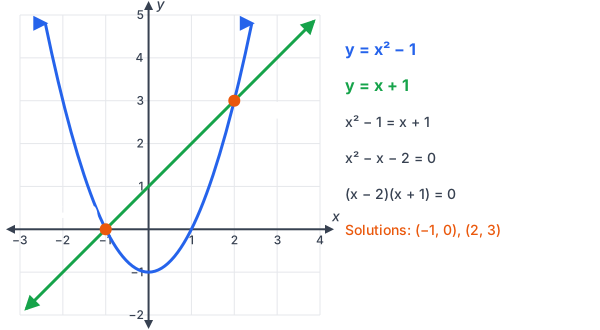
A line can cross a parabola in two places, touch it at one point, or miss it. So the system has two, one or no real solutions.
| Number of solutions | What the graph shows |
|---|---|
| Two | The line crosses the parabola twice |
| One | The line just touches the parabola |
| None | The line misses the parabola |
How to Solve a Linear-Quadratic System
- Solve the linear equation for y, if it isn’t already.
- Set the two expressions for y equal. This is substitution.
- Move every term to one side, so the equation equals 0.
- Solve the quadratic by factoring or the quadratic formula.
- Put each x into the linear equation to find y.
- Write each solution as a point.
Worked Examples
Example 1: Two solutions
Solve the system y = x^2 - 1 and y = x + 1.
x^2 - 1 = x + 1
Step 1. Both equations equal y, so set the right sides equal (see substitution method).
x^2 - x - 2 = 0
Step 2. Subtract x and subtract 1 from both sides, so one side is 0.
(x - 2)(x + 1) = 0
Step 3. Factor the trinomial (see factoring trinomials).
x - 2 = 0 \text{ or } x + 1 = 0Step 4. Set each factor equal to 0 (see solving quadratic equations by factoring).
x = 2 \text{ or } x = -1Step 5. Solve each one.
y = 2 + 1 = 3
Step 6. Find y with the line. Substitute x = 2.
y = -1 + 1 = 0
Step 7. Substitute x = -1 into the line.
Answer: (2, 3) and (-1, 0), the two points on the graph above.
Check: In the parabola, 2^2 - 1 = 3 and (-1)^2 - 1 = 0.
Example 2: The x terms cancel
Solve y = x^2 + 2x - 3 and y = 2x + 1.
x^2 + 2x - 3 = 2x + 1
Step 1. Set the right sides equal.
x^2 - 3 = 1
Step 2. Subtract 2x from both sides. The x terms cancel.
x^2 = 4
Step 3. Add 3 to both sides.
x = \pm 2
Step 4. Take the square root of both sides (see solving quadratics with square roots).
y = 2(2) + 1 = 5
Step 5. Find y with the line. Substitute x = 2.
y = 2(-2) + 1 = -3
Step 6. Substitute x = -2 into the line.
Answer: (2, 5) and (-2, -3)
Example 3: One solution
Solve y = x^2 + 3 and y = 2x + 2.
x^2 + 3 = 2x + 2
Step 1. Set the right sides equal.
x^2 - 2x + 1 = 0
Step 2. Subtract 2x and subtract 2 from both sides.
(x - 1)^2 = 0
Step 3. Factor the perfect square trinomial (see perfect square trinomials).
x - 1 = 0
Step 4. Set the base equal to 0.
x = 1
Step 5. Add 1 to both sides.
y = 2(1) + 2 = 4
Step 6. Find y with the line.
Answer: The only solution is (1, 4). The line just touches the parabola there.
Example 4: No solution
Solve y = x^2 and y = x - 2.
x^2 = x - 2
Step 1. Set the right sides equal.
x^2 - x = -2
Step 2. Subtract x from both sides.
x^2 - x + 2 = 0
Step 3. Add 2 to both sides.
b^2 - 4ac = (-1)^2 - 4(1)(2) = 1 - 8 = -7
Step 4. This doesn’t factor, so find the discriminant with a = 1, b = -1 and c = 2.
Step 5. The discriminant is negative, so the equation has no real solutions.
Answer: There are no real solutions. The line never meets the parabola.
Example 5: Solve the line for y first
Solve y = x^2 - 4x + 5 and x + y = 5.
y = 5 - x
Step 1. Solve the line for y. Subtract x from both sides (see literal equations).
x^2 - 4x + 5 = 5 - x
Step 2. Set the right sides equal.
x^2 - 3x + 5 = 5
Step 3. Add x to both sides.
x^2 - 3x = 0
Step 4. Subtract 5 from both sides.
x(x - 3) = 0
Step 5. Factor out the GCF, x (see factoring out the GCF).
x = 0 \text{ or } x - 3 = 0Step 6. Set each factor equal to 0.
x = 0 \text{ or } x = 3Step 7. Solve.
y = 5 - 0 = 5
Step 8. Find y with y = 5 - x. Substitute x = 0.
y = 5 - 3 = 2
Step 9. Substitute x = 3 into the same equation.
Answer: (0, 5) and (3, 2)
Example 6: Word problem
A ball is kicked up. Its height is h = -5t^2 + 20t meters after t seconds. A drone starts 10 meters up and rises with height h = 5t + 10. When are they at the same height?
-5t^2 + 20t = 5t + 10
Step 1. Set the two heights equal.
-5t^2 + 15t = 10
Step 2. Subtract 5t from both sides.
-5t^2 + 15t - 10 = 0
Step 3. Subtract 10 from both sides.
t^2 - 3t + 2 = 0
Step 4. Divide every term by -5 (see multiplying and dividing integers).
(t - 1)(t - 2) = 0
Step 5. Factor the trinomial.
t = 1 \text{ or } t = 2Step 6. Set each factor equal to 0 and solve.
5(1) + 10 = 15
Step 7. Find the height at 1 second with the drone’s equation.
5(2) + 10 = 20
Step 8. Find the height at 2 seconds.
Answer: They are at the same height at 1 second (15 meters) and at 2 seconds (20 meters).
Check: The ball’s heights match: -5(1)^2 + 20(1) = -5 + 20 = 15 and -5(2)^2 + 20(2) = -20 + 40 = 20.
Common Mistakes
| Mistake | Example of the error | Fix |
|---|---|---|
| Stopping at x | Answer: x = 2 or x = -1 | Find y for each x. Answers are points: (2, 3), (-1, 0). |
| Sign errors when moving terms | x^2 - 1 = x + 1 becomes x^2 + x - 2 = 0 | Subtract x and 1 from both sides: x^2 - x - 2 = 0. |
| Not solving the line for y | Setting x^2 - 4x + 5 equal to x + y | Rewrite x + y = 5 as y = 5 - x first. |
| Expecting two answers every time | Giving up when x^2 - x + 2 = 0 won’t factor | Check the discriminant. The system may have one solution or none. |
| Mixing up the y-values | Pairing x = 2 with the other point’s y | Put each x into the line. Keep each x with its own y. |
Solving by Graphing
You can also graph both equations and read off where they cross. This shows how many solutions there are at a glance. For exact answers, check each point in both equations, or solve with algebra.
If the quadratic part doesn’t factor, use the quadratic formula. Then put each x into the line.
Practice Problems
- Solve y = x^2 and y = 4.
- Solve y = x^2 and y = x + 6.
- Solve y = x^2 - 3x and y = x - 4.
- Solve y = x^2 + 1 and y = -x.
- Solve y = x^2 - 2x - 3 and y = x + 1.
- Solve y = 2x^2 - 5 and y = 3x.
- Solve y = x^2 + 4x and 2x - y = 1.
- How many solutions does the system y = x^2 + 5 and y = 2x + 1 have?
- A company’s revenue is R = -x^2 + 14x and its cost is C = 2x + 20, both in thousands of dollars, where x is hundreds of items sold. Find the break-even points, where R = C.
Show answers
1.
x^2 = 4
Set the right sides equal.
x = \pm 2
Take the square root of both sides.
The line says y = 4 for both
Solutions: (2, 4) and (-2, 4).
2.
x^2 = x + 6
Set the right sides equal.
x^2 - x - 6 = 0
Subtract x and 6 from both sides.
(x - 3)(x + 2) = 0
Factor.
x = 3 \text{ or } x = -2Set each factor equal to 0 and solve.
y = 3 + 6 = 9
Find y with the line when x = 3.
y = -2 + 6 = 4
Find y when x = -2.
Solutions: (3, 9) and (-2, 4).
3.
x^2 - 3x = x - 4
Set the right sides equal.
x^2 - 4x = -4
Subtract x from both sides.
x^2 - 4x + 4 = 0
Add 4 to both sides.
(x - 2)^2 = 0
Factor the perfect square trinomial.
x = 2
Set the base equal to 0 and solve.
y = 2 - 4 = -2
Find y with the line.
(2, -2)
There is one solution. Write it as a point.
4.
x^2 + 1 = -x
Set the right sides equal.
x^2 + x + 1 = 0
Add x to both sides.
1^2 - 4(1)(1) = 1 - 4 = -3
Find the discriminant.
It is negative, so there are no real solutions
5.
x^2 - 2x - 3 = x + 1
Set the right sides equal.
x^2 - 3x - 3 = 1
Subtract x from both sides.
x^2 - 3x - 4 = 0
Subtract 1 from both sides.
(x - 4)(x + 1) = 0
Factor.
x = 4 \text{ or } x = -1Set each factor equal to 0 and solve.
y = 4 + 1 = 5
Find y when x = 4.
y = -1 + 1 = 0
Find y when x = -1.
Solutions: (4, 5) and (-1, 0).
6.
2x^2 - 5 = 3x
Set the right sides equal.
2x^2 - 3x - 5 = 0
Subtract 3x from both sides.
(2x - 5)(x + 1) = 0
Factor with the AC method (see factoring trinomials when a is not 1)
2x - 5 = 0 \text{ or } x + 1 = 0Set each factor equal to 0.
x = \frac{5}{2} \text{ or } x = -1Solve each one.
y = 3 \cdot \frac{5}{2} = \frac{15}{2}Find y with the line when x = \frac{5}{2}.
y = 3(-1) = -3
Find y when x = -1.
Solutions: \left(\frac{5}{2}, \frac{15}{2}\right) and (-1, -3).
7.
-y = 1 - 2x
Solve the line for y. Subtract 2x from both sides.
y = 2x - 1
Multiply both sides by -1.
x^2 + 4x = 2x - 1
Set the right sides equal.
x^2 + 2x = -1
Subtract 2x from both sides.
x^2 + 2x + 1 = 0
Add 1 to both sides.
(x + 1)^2 = 0
Factor.
x = -1
Set the base equal to 0 and solve.
y = 2(-1) - 1 = -3
Find y.
(-1, -3)
There is one solution. Write it as a point.
8.
x^2 + 5 = 2x + 1
Set the right sides equal.
x^2 - 2x + 5 = 1
Subtract 2x from both sides.
x^2 - 2x + 4 = 0
Subtract 1 from both sides.
(-2)^2 - 4(1)(4) = 4 - 16 = -12
Find the discriminant.
It is negative
The system has no solutions.
9.
-x^2 + 14x = 2x + 20
Set revenue equal to cost.
-x^2 + 12x = 20
Subtract 2x from both sides.
-x^2 + 12x - 20 = 0
Subtract 20 from both sides.
x^2 - 12x + 20 = 0
Multiply every term by -1.
(x - 2)(x - 10) = 0
Factor.
x = 2 \text{ or } x = 10Set each factor equal to 0 and solve.
C = 2(2) + 20 = 24
Find the cost when x = 2.
C = 2(10) + 20 = 40
Find the cost when x = 10.
x is in hundreds, so the company breaks even at 200 items (24 thousand dollars) and at 1,000 items (40 thousand dollars).
Want more practice? The Algebra 1 Unit 9 Practice Pack (Part 2) has 40 pages of problems on this and the other lessons in the unit, with step-by-step answers and a cheat sheet.
FAQ
How do you solve a linear-quadratic system?
Set the two expressions for y equal and solve the quadratic. Then put each x into the linear equation to find its y.
How many solutions can a linear-quadratic system have?
It can have two, one or no real solutions. A line can cross a parabola twice, touch it once or miss it.
Can you solve a linear-quadratic system by graphing?
Yes. Graph the line and the parabola, and find where they meet. Check each point in both equations.
Summary
- A linear-quadratic system is a line and a parabola.
- Its solutions are the points where the graphs meet.
- Set the y expressions equal, solve the quadratic, then find each y.
- There can be two, one or no real solutions. The discriminant tells you which.
- Always write each answer as a point.
Previous lesson: The Discriminant
Next lesson: Linear, Quadratic and Exponential Models
Back to the Algebra 1 Index