
Linear, Quadratic and Exponential Models
Linear, quadratic and exponential models are three common ways to describe data. To choose one from a table, look at how y changes as x goes up by the same step. Equal first differences mean linear. Equal second differences mean quadratic. Equal ratios mean exponential. Then write the equation and use it to predict.
Before this lesson: You should know slope-intercept form, graphing quadratic functions, exponential functions and linear vs. exponential functions.
Extra practice: The Algebra 1 Unit 9 Practice Pack (Part 2) has printable problems, answer keys and a cheat sheet for this unit.
How Each Model Changes
Each model has its own pattern. A linear model adds the same amount each step. An exponential model multiplies by the same amount each step.
A quadratic model is in between. The amount it adds changes, but it changes by the same amount each time. The table below shows all three.
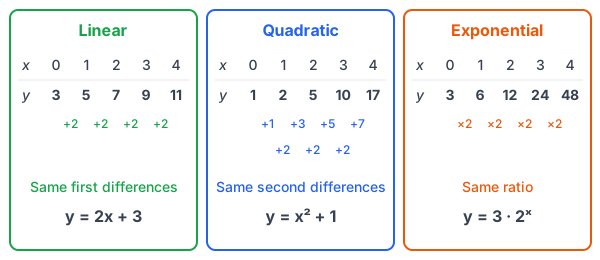
A first difference is the change from one y to the next. A second difference is the change between first differences. A ratio is one y divided by the one before it.
How to Choose a Model From a Table
| Pattern in y | Model | Equation form |
|---|---|---|
| Same first differences | Linear | y = mx + b |
| Same second differences | Quadratic | y = ax^2 + bx + c |
| Same ratio | Exponential | y = a \cdot b^x |
- Check that the x-values go up by the same step.
- Find the first differences. If they are all the same, the model is linear.
- If not, find the second differences. If they are all the same, the model is quadratic.
- If not, divide each y by the one before. If the ratios are all the same, the model is exponential.
- Write the equation, then check it with a point from the table.
Tip: when x goes up by 1, the a in y = ax^2 + bx + c is half the second difference.
Worked Examples
Example 1: A linear table
Which model fits this table? Write its equation.
| x | 0 | 1 | 2 | 3 | 4 |
|---|---|---|---|---|---|
| y | 4 | 7 | 10 | 13 | 16 |
7 - 4 = 3,\; 10 - 7 = 3,\; 13 - 10 = 3,\; 16 - 13 = 3
Step 1. Find the first differences. Subtract each y-value from the next one.
Step 2. The first differences are all 3, so the model is linear. The difference is the slope, m = 3 (see arithmetic sequences).
y = 3x + 4
Step 3. The y-value at x = 0 is the y-intercept, b = 4. Write y = mx + b (see slope-intercept form).
Answer: y = 3x + 4
Check: At x = 4: 3(4) + 4 = 12 + 4 = 16.
Example 2: An exponential table
Which model fits this table? Write its equation.
| x | 0 | 1 | 2 | 3 | 4 |
|---|---|---|---|---|---|
| y | 2 | 6 | 18 | 54 | 162 |
6 - 2 = 4,\; 18 - 6 = 12,\; 54 - 18 = 36,\; 162 - 54 = 108
Step 1. Find the first differences.
\frac{6}{2} = 3,\; \frac{18}{6} = 3,\; \frac{54}{18} = 3,\; \frac{162}{54} = 3Step 2. The differences are not the same, so the model isn’t linear. Divide each y-value by the one before it.
Step 3. Each y-value is 3 times the one before, so the model is exponential with b = 3 (see geometric sequences).
y = 2 \cdot 3^x
Step 4. The y-value at x = 0 is the starting value, a = 2. Write y = a \cdot b^x (see exponential functions).
Answer: y = 2 \cdot 3^x
Check: At x = 4: 2 \cdot 3^4 = 2 \cdot 81 = 162.
Example 3: A quadratic table
Which model fits this table? Write its equation.
| x | 0 | 1 | 2 | 3 | 4 |
|---|---|---|---|---|---|
| y | 0 | 2 | 8 | 18 | 32 |
2 - 0 = 2,\; 8 - 2 = 6,\; 18 - 8 = 10,\; 32 - 18 = 14
Step 1. Find the first differences.
6 - 2 = 4,\; 10 - 6 = 4,\; 14 - 10 = 4
Step 2. The first differences change, so find the second differences. Subtract each first difference from the next one.
Step 3. The second differences are all 4, so the model is quadratic.
a = \frac{4}{2} = 2Step 4. In y = ax^2 + bx + c, the second difference is 2a. Divide it by 2.
y = 2x^2
Step 5. At x = 0, y = 0, so c = 0. Try y = 2x^2 with b = 0.
Answer: y = 2x^2
Check: At x = 3: 2(3)^2 = 2(9) = 18. Every point fits.
Example 4: Find a, b and c
Find a quadratic model for this table.
| x | 0 | 1 | 2 | 3 | 4 |
|---|---|---|---|---|---|
| y | 5 | 8 | 13 | 20 | 29 |
8 - 5 = 3,\; 13 - 8 = 5,\; 20 - 13 = 7,\; 29 - 20 = 9
Step 1. Find the first differences.
5 - 3 = 2,\; 7 - 5 = 2,\; 9 - 7 = 2
Step 2. Find the second differences.
a = \frac{2}{2} = 1Step 3. The second differences are all 2, so it is quadratic. Divide by 2 to find a.
Step 4. At x = 0, y = 5, so c = 5.
1^2 + b(1) + 5 = 8
Step 5. Substitute the point (1, 8) into y = x^2 + bx + 5 (see evaluating algebraic expressions).
1 + b + 5 = 8
Step 6. Simplify the left side.
b + 6 = 8
Step 7. Combine the numbers.
b = 2
Step 8. Subtract 6 from both sides (see one-step equations).
Answer: y = x^2 + 2x + 5
Check: At x = 4: 4^2 + 2(4) + 5 = 16 + 8 + 5 = 29.
Example 5: Choose a model from a situation
Which model fits each situation?
Step 1. A phone plan costs 20 dollars a month plus 5 dollars for each gigabyte. Each gigabyte adds the same 5 dollars, so the cost is linear.
1 + 0.04 = 1.04
Step 2. A town’s population grows by 4% each year. Write 4% as a decimal, 0.04 (see percentages). Each year the population is multiplied by the same number, so it is exponential.
Step 3. The height of a ball thrown in the air rises, then falls. Its graph is a parabola, so it is quadratic.
Answer: Linear, exponential and quadratic.
Example 6: Word problem
A lab counts bacteria every hour. The counts are 50, 100, 200 and 400 for hours 0 to 3. Find a model and predict the count at hour 6.
\frac{100}{50} = 2,\; \frac{200}{100} = 2,\; \frac{400}{200} = 2Step 1. Divide each count by the one before it.
y = 50 \cdot 2^x
Step 2. Each count is 2 times the one before, so the model is exponential. The count at hour 0 is 50.
y = 50 \cdot 2^6 = 50 \cdot 64 = 3{,}200Step 3. Substitute x = 6. Find the power first (see order of operations).
Answer: About 3,200 bacteria at hour 6.
Which Model Grows Fastest?
An increasing exponential model always passes a linear or quadratic model in the long run. Here is y = 10x, y = x^2 and y = 2^x side by side.
| x | 2 | 4 | 6 | 8 | 10 |
|---|---|---|---|---|---|
| 10x | 20 | 40 | 60 | 80 | 100 |
| x^2 | 4 | 16 | 36 | 64 | 100 |
| 2^x | 4 | 16 | 64 | 256 | 1,024 |
At first, 2^x is the smallest. By x = 10, it is more than 10 times bigger than the others. To learn more, see exponential growth and decay.
Common Mistakes
| Mistake | Example of the error | Fix |
|---|---|---|
| Stopping at first differences | Calling 1, 2, 5, 10, 17 “not a pattern” | Find the second differences too. Here they are all 2, so it is quadratic. |
| Uneven x-values | Using differences when x = 0, 1, 3, 4 | Differences only work when x goes up by the same step. |
| Mixing up adding and multiplying | Calling 3, 6, 12, 24 linear because it “goes up by doubling” | Doubling is multiplying by 2. That is exponential, not linear. |
| Using the second difference as a | Second difference 4, so a = 4 | When x steps by 1, a is half the second difference: a = 2. |
| Missing exponential decay | Calling 80, 40, 20, 10 linear because it goes down | The first differences are not equal. Each y is half the one before, so it is exponential. |
Practice Problems
- Which model fits x = 0, 1, 2, 3 and y = 10, 7, 4, 1? Write the equation.
- Which model fits x = 0, 1, 2, 3 and y = 1, 4, 16, 64? Write the equation.
- Which model fits x = 0, 1, 2, 3, 4 and y = 1, 3, 9, 19, 33? Write the equation.
- Which model fits x = 0, 1, 2, 3 and y = 80, 40, 20, 10? Write the equation.
- Which model fits x = 0, 1, 2, 3, 4 and y = 0, −1, 0, 3, 8? Write the equation.
- A car rental costs 30 dollars a day. Which model fits the total cost?
- An investment grows by 5% each year. Which model fits its value?
- Which model fits the area of a circle as its radius grows?
- Which model fits x = 1, 2, 3, 4 and y = 6, 12, 24, 48? Write the equation.
- Which is larger at x = 7: 2^x or x^2?
Show answers
1.
7 - 10 = -3,\; 4 - 7 = -3,\; 1 - 4 = -3
Find the first differences.
y = -3x + 10
They are all -3, so it is linear with m = -3. At x = 0, y = 10, so b = 10.
2.
3,\; 12,\; 48
Find the first differences.
\frac{4}{1} = 4,\; \frac{16}{4} = 4,\; \frac{64}{16} = 4They aren’t equal, so divide each y-value by the one before.
y = 4^x
It is exponential with b = 4. At x = 0, y = 1, so a = 1.
3.
2,\; 6,\; 10,\; 14
Find the first differences.
4,\; 4,\; 4
Find the second differences.
a = \frac{4}{2} = 2They are all 4, so it is quadratic. Divide by 2.
At x = 0, y = 1, so c = 1
2(1)^2 + b(1) + 1 = 3
Substitute (1, 3).
2 + b + 1 = 3
Simplify.
b + 3 = 3
Combine the numbers.
b = 0
Subtract 3 from both sides.
y = 2x^2 + 1
Write the model.
4.
\frac{40}{80} = \frac{1}{2},\; \frac{20}{40} = \frac{1}{2},\; \frac{10}{20} = \frac{1}{2}Divide each y-value by the one before.
y = 80 \cdot \left(\frac{1}{2}\right)^xIt is exponential with b = \frac{1}{2}. At x = 0, y = 80, so a = 80.
5.
-1,\; 1,\; 3,\; 5
Find the first differences.
2,\; 2,\; 2
Find the second differences.
a = \frac{2}{2} = 1They are all 2, so it is quadratic. Divide by 2.
At x = 0, y = 0, so c = 0
1^2 + b(1) + 0 = -1
Substitute (1, -1).
1 + b = -1
Simplify.
b = -2
Subtract 1 from both sides.
y = x^2 - 2x
Write the model.
6.
Each day adds the same 30 dollars
So the model is linear: C = 30d
7.
1 + 0.05 = 1.05
Write 5% as a decimal and add it to 1.
Each year the value is multiplied by 1.05, so the model is exponential
8.
A = \pi r^2
The area of a circle is the radius squared times π.
The variable is squared, so the model is quadratic
9.
\frac{12}{6} = 2,\; \frac{24}{12} = 2,\; \frac{48}{24} = 2Divide each y-value by the one before.
a \cdot 2^1 = 6
It is exponential with b = 2. The table starts at x = 1, so substitute (1, 6).
2a = 6
Simplify.
a = 3
Divide both sides by 2.
y = 3 \cdot 2^x
Write the model.
10.
2^7 = 128
Find the exponential value.
7^2 = 49
Find the quadratic value.
128 \gt 49
Compare: 128 is greater than 49.
So 2^x is larger at x = 7.
Want more practice? The Algebra 1 Unit 9 Practice Pack (Part 2) has 40 pages of problems on this and the other lessons in the unit, with step-by-step answers and a cheat sheet.
FAQ
How do you know if a table is linear, quadratic or exponential?
Check the first differences, then the second differences, then the ratios. Equal first differences mean linear, equal second differences mean quadratic, and equal ratios mean exponential.
What are second differences?
They are the differences between the first differences. Equal second differences tell you the data is quadratic.
Which grows faster, exponential or quadratic?
An increasing exponential function always grows faster in the long run. A quadratic may be bigger at first, but the exponential passes it.
Summary
- Linear models add the same amount each step.
- Quadratic models have equal second differences.
- Exponential models multiply by the same ratio each step.
- The x-values must go up by the same step before you compare.
- Increasing exponential models grow fastest in the long run.
Previous lesson: Linear-Quadratic Systems
Next lesson: Two-Way Tables
Back to the Algebra 1 Index