
Systems of Inequalities
A system of inequalities is two or more inequalities with the same variables. Its solutions are all the points that make every inequality true. To solve it, graph each inequality on the same grid. The solution is the region where the shaded areas overlap.
Before this lesson: You should know how to do graphing linear inequalities, solve systems of equations by graphing, and use slope-intercept form.
Extra practice: The Algebra 1 Unit 5 Practice Pack has printable problems, answer keys and a cheat sheet for this unit.
What Is a System of Inequalities?
Say you want a phone plan that costs under $50 and has at least 10 GB of data. Each rule is an inequality. A plan has to pass both rules to work for you.
A system of inequalities works the same way. One inequality, like y \ge x - 2, has a whole half of the grid as solutions. Add a second inequality, and only the points that pass both tests are left.
On a graph, each inequality shades one side of its line. The solution region is where the two shadings overlap. Every point there is a solution. Points outside it fail at least one inequality.
How to Solve a System of Inequalities
- Solve each inequality for y. If you multiply or divide by a negative, flip the sign.
- Graph each boundary line. Use a solid line for \le or \ge. Use a dashed line for \lt or \gt.
- Shade each inequality. For y \gt or y \ge, shade above the line. For y \lt or y \le, shade below.
- Find the overlap. That region is the solution.
- Check a point from the overlap in every inequality.
Not sure which side to shade? Test a point not on the line, like (0, 0). If it makes the inequality true, shade its side.
Worked Examples
Example 1: Is the Point a Solution?
Decide if each point solves the system y \gt 2x - 1 and y \le -x + 5: (a) (1, 3), (b) (2, 2), (c) (-2, 7).
3 \gt 2(1) - 1
Step 1. (a) Substitute (1, 3) into the first inequality.
3 \le -1 + 5
Step 2. Simplify: 3 \gt 1 is true. Now substitute into the second inequality.
Step 3. Simplify: 3 \le 4 is true. Both are true, so (1, 3) is a solution.
2 \gt 2(2) - 1
Step 4. (b) Substitute (2, 2) into the first inequality.
Step 5. Simplify: 2 \gt 3 is false. One false is enough, so (2, 2) is not a solution.
7 \gt 2(-2) - 1
Step 6. (c) Substitute (-2, 7) into the first inequality.
7 \le -(-2) + 5
Step 7. Simplify: 7 \gt -5 is true. Now substitute into the second inequality.
Step 8. Simplify: 7 \le 7 is true, because \le allows equal. So (-2, 7) is a solution. It sits on the solid line.
Answer: (1, 3) and (-2, 7) are solutions. (2, 2) is not.
Example 2: Graph a System
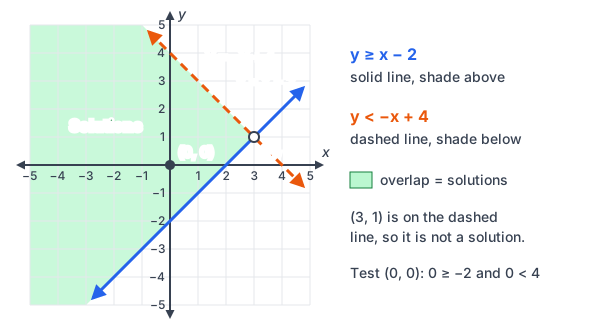
Graph the system y \ge x - 2 and y \lt -x + 4. This is the system in the picture above.
Step 1. Both inequalities are already solved for y, in slope-intercept form.
Step 2. Graph y = x - 2 as a solid line, because the sign is \ge. Its slope is 1 and its y-intercept is −2. (See graphing linear inequalities.)
Step 3. Graph y = -x + 4 as a dashed line, because the sign is \lt. Its slope is −1 and its y-intercept is 4.
Step 4. Shade above the solid line for \ge.
Step 5. Shade below the dashed line for \lt.
0 \ge 0 - 2
Step 6. Check (0, 0) in the first inequality.
0 \lt -0 + 4
Step 7. That gives 0 \ge -2, which is true. Check (0, 0) in the second inequality.
Step 8. That gives 0 \lt 4, which is true. So the overlap is the region with (0, 0), to the left of where the lines cross.
x = 3
Step 9. Find where the lines cross. Set x - 2 = -x + 4 (see substitution method), add x and 2 to both sides to get 2x = 6, and divide by 2.
y = 3 - 2 = 1
Step 10. Substitute x = 3 into y = x - 2.
Answer: The solution is the green region in the graph. The lines cross at (3, 1), but that point is on the dashed line, so it is not a solution.
Example 3: Solve for y First
Graph the system 2x + y \le 6 and x - 2y \lt 4.
y \le -2x + 6
Step 1. Solve the first inequality for y. Subtract 2x from both sides.
-2y \lt -x + 4
Step 2. Solve the second inequality for y. Subtract x from both sides.
y \gt \frac{1}{2}x - 2Step 3. Divide both sides by −2 and flip the sign. (See one-step inequalities.)
Step 4. Graph y = -2x + 6 as a solid line and shade below it.
Step 5. Graph y = \tfrac{1}{2}x - 2 as a dashed line and shade above it.
2(0) + 0 \le 6
Step 6. Check (0, 0) in the first original inequality.
0 - 2(0) \lt 4
Step 7. That gives 0 \le 6, which is true. Check the second.
Step 8. That gives 0 \lt 4, which is true.
Answer: The solution is the overlap: below the solid line and above the dashed line. The point (0, 0) is in it.
Example 4: Three Inequalities
Describe the solution of x \ge 0, y \ge 0 and x + y \le 4. Is (1, 2) a solution? Is (3, 2)?
Step 1. x \ge 0 keeps the y-axis and everything to its right.
Step 2. y \ge 0 keeps the x-axis and everything above it.
y \le -x + 4
Step 3. Solve x + y \le 4 for y. Subtract x from both sides.
Step 4. Draw a solid line and shade below it.
Step 5. All three overlap in a triangle with corners (0, 0), (4, 0) and (0, 4). The edges are included, because all three signs allow equal.
1 + 2 = 3
Step 6. Test (1, 2) in x + y \le 4.
Step 7. 3 \le 4 is true, and both coordinates are positive, so (1, 2) is a solution.
3 + 2 = 5
Step 8. Test (3, 2).
Step 9. 5 \le 4 is false, so (3, 2) is not a solution.
Answer: The solution is the triangle with corners (0, 0), (4, 0) and (0, 4). (1, 2) is a solution. (3, 2) is not.
Example 5: Word Problem
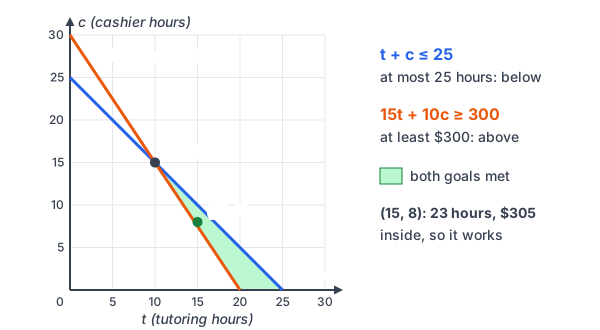
Jada tutors for $15 an hour and works as a cashier for $10 an hour. She can work at most 25 hours a week. She wants to earn at least $300. Write a system. Can she tutor 15 hours and work 8 hours as a cashier?
t + c \le 25
Step 1. Let t = hours tutoring and c = hours as a cashier. “At most 25 hours” gives the first inequality. (See systems of equations word problems.)
15t + 10c \ge 300
Step 2. “At least $300” gives the second inequality.
t \ge 0, \; c \ge 0
Step 3. Hours can’t be negative, so add two more inequalities.
Step 4. Graph all four. The solution region is the green triangle.
15 + 8 = 23
Step 5. Test (15, 8) in the hours inequality.
15(15) + 10(8) = 225 + 80 = 305
Step 6. 23 \le 25 is true. Test the pay inequality.
Step 7. 305 \ge 300 is true.
Answer: Yes. She works 23 hours and earns $305, so both goals are met. On the graph, the point is inside the green region.
Common Mistakes
| Mistake | Example of the error | Fix |
|---|---|---|
| Not flipping the sign when dividing by a negative | -2y \lt -x + 4 becomes y \lt \tfrac{1}{2}x - 2 | Flip it: y \gt \tfrac{1}{2}x - 2 |
| Shading everything that is shaded at all | Using the area shaded by either inequality | Keep only the overlap, where both are shaded |
| Mixing up solid and dashed lines | A solid line for y \lt -x + 4 | Dashed for \lt and \gt; solid for \le and \ge |
| Counting a corner on a dashed line | Calling (3, 1) a solution in Example 2 | A point on a dashed line is not a solution |
| Testing a point in only one inequality | (2, 2) works in y \le -x + 5, so it is a solution | A solution must make every inequality true |
Special Cases
Sometimes the shaded regions never overlap. Then the system has no solution. This can happen when the boundary lines are parallel and each one is shaded away from the other.
| System | What the graph shows | Solutions |
|---|---|---|
| y \gt 2x + 3 and y \lt 2x - 1 | Parallel lines, shaded away from each other | None |
| y \ge 2x - 1 and y \le 2x + 3 | Parallel lines, shaded toward each other | A strip between the lines |
| y \ge x - 2 and y \lt -x + 4 | Lines that cross | A wedge-shaped region |
Systems of inequalities are used to plan with limits on time, money or space, as in Example 5. A system of equations has a point as its answer. A system of inequalities has a whole region.
Practice Problems
- Is (2, 1) a solution of y \lt x + 1 and y \ge -2x + 3?
- Is (0, 4) a solution of y \le 3x + 4 and y \gt x + 4?
- Describe the graph of the system y \gt 1 and x \le 2.
- Which of these points solve y \ge x and y \lt 4: (1, 3), (5, 6), (-2, -3)?
- Solve each inequality for y: 3x + y \le 2 and x - y \gt 3. Is (0, -5) a solution?
- Where do the boundary lines of y \ge 2x - 3 and y \le -x + 6 cross? Is that point a solution?
- Does the system y \gt -x + 2 and y \lt -x - 1 have any solutions?
- Write a system for the region above the dashed line y = x and on or below the solid line y = 5.
- Adult tickets cost $10 and child tickets cost $5. A group can spend at most $60 and needs at least 8 tickets. Write a system. Do 3 adults and 6 children work? Do 4 adults and 5 children?
- Use Jada’s system from Example 5. Can she tutor 18 hours and work 4 hours as a cashier?
Show answers
1.
1 \lt 2 + 1
Substitute (2, 1) into the first inequality.
1 \lt 3
Simplify. This is true.
1 \ge -2(2) + 3
Substitute into the second inequality.
1 \ge -1
Simplify. This is true.
Both are true. Yes, (2, 1) is a solution.
2.
4 \le 3(0) + 4
Substitute (0, 4) into the first inequality.
4 \le 4
Simplify. This is true.
4 \gt 0 + 4
Substitute into the second inequality.
4 \gt 4
Simplify. This is false.
No, (0, 4) is not a solution.
3.
The sign in y > 1 is \gt, so draw a dashed horizontal line at y = 1 and shade above
The sign in x ≤ 2 is \le, so draw a solid vertical line at x = 2 and shade left
The solution is the upper-left region where the shading overlaps.
4.
Test (1, 3): 3 ≥ 1 is true, and 3 < 4 is true
Test (5, 6): 6 ≥ 5 is true, but 6 < 4 is false
Test (−2, −3): −3 ≥ −2 is false
Only (1, 3) is a solution.
5.
y \le -3x + 2
Subtract 3x from both sides of the first inequality.
-y \gt -x + 3
Subtract x from both sides of the second inequality.
y \lt x - 3
Divide both sides by −1 and flip the sign.
-5 \le -3(0) + 2
Test (0, −5) in the first.
-5 \le 2
Simplify. This is true.
-5 \lt 0 - 3
Test (0, −5) in the second.
-5 \lt -3
Simplify. This is true.
Yes, (0, −5) is a solution.
6.
2x - 3 = -x + 6
Set the boundary lines equal.
3x - 3 = 6
Add x to both sides.
3x = 9
Add 3 to both sides.
x = 3
Divide both sides by 3.
y = 2(3) - 3 = 6 - 3 = 3
Substitute into y = 2x − 3.
The lines cross at (3, 3). Both signs allow equal, so both lines are solid and (3, 3) is a solution.
7.
Both boundary lines have slope −1, so they are parallel
The first region is above the line with y-intercept 2
The second region is below the line with y-intercept −1, which is lower
No. The regions never overlap, so the system has no solution.
8.
y \gt x
Above a dashed line means \gt.
y \le 5
On or below a solid line means \le.
The system is y > x and y ≤ 5.
9.
a + c \ge 8
Let a = adult tickets and c = child tickets. At least 8 tickets.
10a + 5c \le 60
At most $60.
3 + 6 = 9
Test 3 adults and 6 children: tickets.
10(3) + 5(6) = 30 + 30 = 60
9 ≥ 8 is true. Cost.
4 + 5 = 9
60 ≤ 60 is true, so 3 and 6 work. Test 4 adults and 5 children: tickets.
10(4) + 5(5) = 40 + 25 = 65
9 ≥ 8 is true. Cost.
65 is more than 60, so 4 and 5 do not work.
10.
18 + 4 = 22
Test the hours.
15(18) + 10(4) = 270 + 40 = 310
22 ≤ 25 is true. Test the pay.
310 ≥ 300 is true. Yes, she can.
Want more practice? The Algebra 1 Unit 5 Practice Pack has 55 pages of problems on this and the other lessons in the unit, with step-by-step answers and a cheat sheet.
FAQ
How do you solve a system of inequalities?
Graph each inequality on the same grid and shade its side. The solution is the region where all the shaded areas overlap.
How do you know which side to shade?
After solving for y, shade above the line for \gt or \ge and below it for \lt or \le. You can also test a point like (0, 0).
Is the point where the lines cross a solution?
Only if both lines are solid. If either line is dashed, the crossing point is not included.
Can a system of inequalities have no solution?
Yes. If the shaded regions never overlap, there is no solution. This happens with parallel lines shaded away from each other.
Summary
- A system of inequalities has two or more inequalities. A solution makes all of them true.
- Graph each inequality: solid line for \le or \ge, dashed for \lt or \gt.
- Shade each one. The solution region is the overlap.
- Points on a dashed boundary are not solutions.
- If the regions never overlap, the system has no solution.
Previous lesson: Graphing Linear Inequalities
Next lesson: Exponent Rules
Back to the Algebra 1 Index