
Systems of Equations Word Problems
Systems of equations word problems describe two unknown amounts with two facts. Name a variable for each unknown and write one equation for each fact. Then solve the system by substitution, elimination or graphing. Last, check that the answer makes sense in the story.
Before this lesson: You should know the substitution method, the elimination method and how to solve systems by graphing.
Extra practice: The Algebra 1 Unit 5 Practice Pack has printable problems, answer keys and a cheat sheet for this unit.
How Word Problems Become Systems
A word problem with two unknowns needs two facts. Each fact becomes one equation. Together, the two equations make a system.
Many problems have a “how many” fact and a “how much” fact. Say a play sold 200 tickets for $1,285. The 200 counts tickets. The $1,285 counts money. Those are two different equations.
| Words in the problem | What to write |
|---|---|
| “a total of 200 tickets” | a + s = 200 |
| “adult tickets cost $8 each” | 8a dollars from adult tickets |
| “5 more than twice the width” | l = 2w + 5 |
| “the same cost” | Set the two costs equal |
| “with the current” / “against the current” | Add the speeds / subtract the speeds |
Steps for Solving Systems Word Problems
- Name the unknowns. Write what each variable stands for, with units. For example, “a = number of adult tickets.”
- Write two equations. Turn each fact into an equation.
- Pick a method. Use substitution if a variable is already alone. Use elimination if both equations look like Ax + By = C.
- Solve for both variables.
- Check and answer. Put the values back into the words, not just the equations. Give units.
Worked Examples
Example 1: Ticket Sales
A school play sold 200 tickets and made $1,285. Adult tickets cost $8 and student tickets cost $5. How many of each were sold?
Step 1. Let a = adult tickets and s = student tickets.
\begin{aligned} a + s &= 200 \\ 8a + 5s &= 1285 \end{aligned}Step 2. Write one equation for tickets and one for money.
s = 200 - a
Step 3. Solve the first equation for s. Subtract a from both sides (see substitution method).
8a + 5(200 - a) = 1285
Step 4. Substitute it into the money equation.
8a + 1000 - 5a = 1285
Step 5. Distribute the 5. (See distributive property.)
3a + 1000 = 1285
Step 6. Combine like terms.
3a = 285
Step 7. Subtract 1000 from both sides.
a = 95
Step 8. Divide both sides by 3.
s = 200 - 95 = 105
Step 9. Back-substitute a = 95 into s = 200 - a.
Answer: 95 adult tickets and 105 student tickets.
Check: 95 + 105 = 200 tickets and 8(95) + 5(105) = 760 + 525 = 1285 dollars.
Example 2: Rectangle Perimeter
A garden is a rectangle with a perimeter of 58 feet. Its length is 5 feet more than twice its width. Find the length and width.
\begin{aligned} l &= 2w + 5 \\ 2l + 2w &= 58 \end{aligned}Step 1. Let l = length and w = width, in feet. Write one equation for the length and one for the perimeter.
2(2w + 5) + 2w = 58
Step 2. l is already alone, so substitute 2w + 5 for l.
4w + 10 + 2w = 58
Step 3. Distribute the 2.
6w + 10 = 58
Step 4. Combine like terms.
6w = 48
Step 5. Subtract 10 from both sides.
w = 8
Step 6. Divide both sides by 6.
l = 2(8) + 5 = 16 + 5 = 21
Step 7. Back-substitute w = 8 into l = 2w + 5.
Answer: The garden is 21 feet long and 8 feet wide.
Check: 2(21) + 2(8) = 42 + 16 = 58.
Example 3: Comparing Two Plans
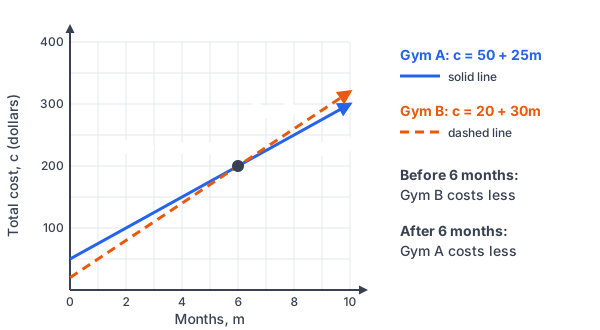
Climbing Gym A charges a $50 joining fee plus $25 a month. Gym B charges a $20 joining fee plus $30 a month. After how many months do they cost the same? Which gym is cheaper for a year?
\begin{aligned} c &= 50 + 25m \\ c &= 20 + 30m \end{aligned}Step 1. Let m = months and c = total cost in dollars. Write an equation for each gym.
50 + 25m = 20 + 30m
Step 2. Both equations equal c, so set them equal.
50 = 20 + 5m
Step 3. Subtract 25m from both sides.
30 = 5m
Step 4. Subtract 20 from both sides.
6 = m
Step 5. Divide both sides by 5.
c = 50 + 25(6) = 50 + 150 = 200
Step 6. Substitute m = 6 into Gym A’s equation to find the cost.
Step 7. The graph shows the same point, (6, 200), where the lines cross.
50 + 25(12) = 50 + 300 = 350
Step 8. Find Gym A’s cost for 12 months.
20 + 30(12) = 20 + 360 = 380
Step 9. Find Gym B’s cost for 12 months.
380 - 350 = 30
Step 10. Subtract to compare.
Answer: They cost the same, $200, at 6 months. For a year, Gym A is cheaper by $30.
Example 4: A Mixture Problem
A cafe mixes coffee that costs $12 per pound with coffee that costs $18 per pound. It wants 30 pounds of a blend worth $14 per pound. How many pounds of each should it use?
Step 1. Let x = pounds of the $12 coffee and y = pounds of the $18 coffee.
14 \cdot 30 = 420
Step 2. Find the value of the whole blend: 30 pounds at $14 per pound.
\begin{aligned} x + y &= 30 \\ 12x + 18y &= 420 \end{aligned}Step 3. Write one equation for pounds and one for value.
y = 30 - x
Step 4. Solve the first equation for y. Subtract x from both sides.
12x + 18(30 - x) = 420
Step 5. Substitute it into the value equation.
12x + 540 - 18x = 420
Step 6. Distribute the 18.
-6x + 540 = 420
Step 7. Combine like terms.
-6x = -120
Step 8. Subtract 540 from both sides.
x = 20
Step 9. Divide both sides by -6.
y = 30 - 20 = 10
Step 10. Back-substitute x = 20 into y = 30 - x.
Answer: Use 20 pounds of the $12 coffee and 10 pounds of the $18 coffee. The answer makes sense: the blend price, $14, is closer to $12, so there is more of the cheaper coffee.
Check: 12(20) + 18(10) = 240 + 180 = 420.
Example 5: Speed with a Current
A kayaker paddles 24 miles down a river in 3 hours. The trip back up the river takes 6 hours. Find the kayaker’s speed in still water and the speed of the current.
Step 1. Let k = kayaker’s speed in still water and c = speed of the current, in miles per hour.
k + c = \frac{24}{3} = 8Step 2. Going down the river, the current helps, so the speed is k + c. Use \text{speed} = \frac{\text{distance}}{\text{time}}.
k - c = \frac{24}{6} = 4Step 3. Going up, the current slows the kayak, so the speed is k - c.
\begin{array}{rrcl}
 & k + c & = & 8 \\
+ & k - c & = & 4 \\
\hline
 & 2k & = & 12
\end{array}
Step 4. Add the equations to eliminate c (see elimination method).
k = 6
Step 5. Divide both sides by 2.
6 + c = 8
Step 6. Substitute k = 6 into k + c = 8.
c = 2
Step 7. Subtract 6 from both sides.
Answer: The kayaker paddles 6 miles per hour in still water. The current is 2 miles per hour.
Check: Upstream: 6 - 2 = 4 miles per hour, and 4 \cdot 6 = 24 miles.
Common Mistakes
| Mistake | Example of the error | Fix |
|---|---|---|
| Mixing a count with money | a + s = 1285 | Count equation: a + s = 200. Money equation: 8a + 5s = 1285 |
| Not saying what each variable means | Finding x = 20 but not knowing which coffee it is | Write “x = pounds of $12 coffee” first |
| Using the blend price as a total | x + y = 14 | The pounds add to 30. Use 14 only in the value: 14 \cdot 30 = 420 |
| Adding the current going upstream | Upstream speed = k + c | Against the current, subtract: k - c |
| Stopping after one variable | “95 adult tickets” and no student count | Find both values and answer every question |
Choosing a Method
| Method | Best when | Example |
|---|---|---|
| Substitution | One variable is alone, like l = 2w + 5 | Examples 1, 2 and 4 |
| Elimination | Both equations are in Ax + By = C form and a variable has matching or opposite coefficients | Example 5 |
| Graphing | You want to see which choice is better before and after a point | Example 3 |
Sometimes the lines never cross. If two plans have the same monthly rate but different fees, their lines are parallel. Then they are never equal, and the system has no solution. See number of solutions for more.
Always ask if the answer fits the story. You can’t sell 95.5 tickets or buy −3 pounds of coffee. An answer like that means a setup or math mistake.
Practice Problems
- Two numbers add to 45. Their difference is 11. Find the numbers.
- A concert sold 150 tickets for $2,200. Floor seats cost $12 and balcony seats cost $20. How many of each were sold?
- A jar has 30 dimes and quarters worth $4.80. How many of each coin are there?
- A rectangle has a perimeter of 70 cm. Its length is 1 cm less than 3 times its width. Find its length and width.
- Plan A costs $40 a month plus $5 per gigabyte. Plan B costs $60 a month plus $1 per gigabyte. For how many gigabytes do they cost the same? What is that cost?
- Peanuts cost $3 per pound and cashews cost $9 per pound. How many pounds of each make 12 pounds of a mix worth $5 per pound?
- A plane flies 1,200 miles with the wind in 3 hours. The return trip against the wind takes 4 hours. Find the plane’s speed in still air and the wind speed.
- The sum of Sam’s and Lea’s ages is 32. Sam is 3 times as old as Lea. How old is each?
- A farm has chickens and cows. There are 40 heads and 110 legs. How many of each animal are there?
- Rental A costs $30 plus $0.20 per mile. Rental B costs $45 plus $0.20 per mile. When do they cost the same?
Show answers
1.
x + y = 45
Let the numbers be x and y. Write the sum.
x - y = 11
Write the difference.
2x = 56
Add the equations. The y-terms cancel.
x = 28
Divide both sides by 2.
28 + y = 45
Substitute into x + y = 45.
y = 17
Subtract 28 from both sides.
Check: 28 − 17 = 11. The numbers are 28 and 17.
2.
f + b = 150
Let f = floor seats and b = balcony seats. Write the ticket equation.
12f + 20b = 2200
Write the money equation.
b = 150 - f
Solve the first equation for b.
12f + 20(150 - f) = 2200
Substitute into the money equation.
12f + 3000 - 20f = 2200
Distribute the 20.
-8f + 3000 = 2200
Combine like terms.
-8f = -800
Subtract 3000 from both sides.
f = 100
Divide both sides by −8.
b = 150 - 100 = 50
Back-substitute.
Check: 12(100) + 20(50) = 1200 + 1000 = 2200. They sold 100 floor seats and 50 balcony seats.
3.
d + q = 30
Let d = dimes and q = quarters. Write the coin equation.
10d + 25q = 480
Write the value equation in cents.
d = 30 - q
Solve the first equation for d.
10(30 - q) + 25q = 480
Substitute into the value equation.
300 - 10q + 25q = 480
Distribute the 10.
300 + 15q = 480
Combine like terms.
15q = 180
Subtract 300 from both sides.
q = 12
Divide both sides by 15.
d = 30 - 12 = 18
Back-substitute.
Check: 10(18) + 25(12) = 180 + 300 = 480 cents. There are 18 dimes and 12 quarters.
4.
l = 3w - 1
Write the length equation.
2l + 2w = 70
Write the perimeter equation.
2(3w - 1) + 2w = 70
Substitute 3w − 1 for l.
6w - 2 + 2w = 70
Distribute the 2.
8w - 2 = 70
Combine like terms.
8w = 72
Add 2 to both sides.
w = 9
Divide both sides by 8.
l = 3(9) - 1 = 27 - 1 = 26
Back-substitute.
Check: 2(26) + 2(9) = 52 + 18 = 70. The rectangle is 26 cm long and 9 cm wide.
5.
40 + 5g = 60 + g
Let g = gigabytes. Set the two costs equal.
40 + 4g = 60
Subtract g from both sides.
4g = 20
Subtract 40 from both sides.
g = 5
Divide both sides by 4.
40 + 5(5) = 40 + 25 = 65
Find the cost with Plan A.
Check with Plan B: 60 + 5 = 65. Both plans cost $65 for 5 gigabytes.
6.
p + c = 12
Let p = pounds of peanuts and c = pounds of cashews. Write the weight equation.
5 \cdot 12 = 60
Find the value of the mix.
3p + 9c = 60
Write the value equation.
c = 12 - p
Solve the first equation for c.
3p + 9(12 - p) = 60
Substitute into the value equation.
3p + 108 - 9p = 60
Distribute the 9.
-6p + 108 = 60
Combine like terms.
-6p = -48
Subtract 108 from both sides.
p = 8
Divide both sides by −6.
c = 12 - 8 = 4
Back-substitute.
Check: 3(8) + 9(4) = 24 + 36 = 60. Use 8 pounds of peanuts and 4 pounds of cashews.
7.
p + w = \frac{1200}{3} = 400Let p = plane speed and w = wind speed. With the wind.
p - w = \frac{1200}{4} = 300Against the wind.
2p = 700
Add the equations. The w-terms cancel.
p = 350
Divide both sides by 2.
350 + w = 400
Substitute into p + w = 400.
w = 50
Subtract 350 from both sides.
Check: 350 − 50 = 300. The plane flies 350 mph in still air, and the wind is 50 mph.
8.
s = 3l
Let s = Sam’s age and l = Lea’s age. Write the age equation.
s + l = 32
Write the sum.
3l + l = 32
Substitute 3l for s.
4l = 32
Combine like terms.
l = 8
Divide both sides by 4.
s = 3(8) = 24
Back-substitute.
Check: 24 + 8 = 32. Lea is 8 and Sam is 24.
9.
c + w = 40
Let c = chickens and w = cows. Write the heads equation.
2c + 4w = 110
Write the legs equation.
w = 40 - c
Solve the first equation for w.
2c + 4(40 - c) = 110
Substitute into the legs equation.
2c + 160 - 4c = 110
Distribute the 4.
-2c + 160 = 110
Combine like terms.
-2c = -50
Subtract 160 from both sides.
c = 25
Divide both sides by −2.
w = 40 - 25 = 15
Back-substitute.
Check: 2(25) + 4(15) = 50 + 60 = 110 legs. There are 25 chickens and 15 cows.
10.
30 + 0.2m = 45 + 0.2m
Let m = miles. Set the costs equal.
30 = 45
Subtract 0.2m from both sides.
30 = 45 is false, so there is no solution. The lines are parallel, and Rental B always costs $15 more.
Want more practice? The Algebra 1 Unit 5 Practice Pack has 55 pages of problems on this and the other lessons in the unit, with step-by-step answers and a cheat sheet.
FAQ
How do you set up a system of equations from a word problem?
Name a variable for each unknown. Then turn each fact into an equation. Most problems give one fact about “how many” and one about “how much.”
Should I use substitution or elimination?
Use substitution when one variable is already alone, like y = 3x. Use elimination when both equations are in Ax + By = C form. Both give the same answer.
How many equations do I need?
You need one equation for each unknown. Two unknowns need two equations that say different things.
What if my answer is a fraction or a negative number?
Check whether that makes sense in the story. A fraction of a ticket or a negative weight means something went wrong. Look again at your equations.
Summary
- Name each unknown with a variable and its units.
- Write one equation for each fact. Keep counts and money in separate equations.
- Solve with substitution, elimination or graphing.
- Check the answer in the words of the problem and give units.
- Parallel lines mean the two amounts are never equal, so there is no solution.
Previous lesson: Number of Solutions
Next lesson: Graphing Linear Inequalities
Back to the Algebra 1 Index