
Linear Congruences
A linear congruence is an equation of the form ax ≡ b (mod n). It has a solution exactly when d = gcd(a, n) divides b, and then it has d solutions mod n. When gcd(a, n) = 1, multiply both sides by the modular inverse of a, found with the extended Euclidean algorithm, to get the single solution x ≡ a⁻¹b (mod n).
Before this lesson: Modular Arithmetic and Euclidean Algorithm
Why you cannot just divide
In ordinary algebra, 7x = 3 gives x = 3/7. Mod n there are no fractions, so “divide by 7” has to mean “multiply by a number that undoes 7.” That number is a modular inverse.
\bar{a} \text{ is an inverse of } a \text{ mod } n \iff a\bar{a} \equiv 1 \pmod{n}For example, 3 is an inverse of 7 mod 10, because 7 · 3 = 21 ≡ 1 (mod 10). Some numbers have no inverse: 2x is always even, so 2x ≡ 1 (mod 10) never holds. The rule is that a has an inverse mod n exactly when gcd(a, n) = 1.
\gcd(a, n) = 1
Assume a and n are relatively prime.
ax + ny = 1
Bézout’s identity gives integers x and y (see extended Euclidean algorithm).
ax - 1 = n(-y)
Subtract 1 and ny from both sides.
ax \equiv 1 \pmod{n}n divides ax − 1, so x is an inverse of a.
Conversely, if ax ≡ 1 (mod n), then ax − 1 = nk, so any common divisor of a and n divides 1. The inverse is unique mod n, and it is written a⁻¹.
How many solutions a linear congruence has
d = \gcd(a, n): \quad ax \equiv b \pmod{n} \text{ has a solution} \iff d \mid b- If d ∤ b, there are no solutions, because ax − b = nk would make d divide b.
- If d = 1, there is exactly one solution mod n: x ≡ a⁻¹b (mod n).
- If d | b, divide a, b and n by d. The reduced congruence (a/d)x ≡ b/d (mod n/d) has one solution x0 mod n/d, and the original has d solutions mod n: x0, x0 + n/d, …, x0 + (d − 1)n/d.
Steps for solving ax ≡ b (mod n)
- Reduce a and b mod n, then find d = gcd(a, n) with the Euclidean algorithm.
- If d does not divide b, stop: there is no solution.
- If d > 1, divide a, b and n by d.
- Find the inverse of the new a with the extended Euclidean algorithm (or by trying small multiples when n is small).
- Multiply both sides by the inverse and reduce.
- If d > 1, list all d solutions mod n by adding multiples of n/d. Check one solution in the original congruence.
Linear congruence examples
Example 1: 7x ≡ 3 (mod 10)
Solve 7x ≡ 3 (mod 10).
\gcd(7, 10) = 1
7 and 10 share no common factor, so there is exactly one solution mod 10.
7 \cdot 3 = 21 \equiv 1 \pmod{10}Try small multiples of 7: 3 is an inverse of 7.
3 \cdot 7x \equiv 3 \cdot 3
Multiply both sides by the inverse.
21x \equiv 9
Multiply.
x \equiv 9 \pmod{10}Reduce 21 ≡ 1.
7 \cdot 9 = 63 \equiv 3
Check: 63 leaves remainder 3 mod 10.
Answer: x ≡ 9 (mod 10), so the solutions are …, −1, 9, 19, 29, ….
Example 2: An inverse from the extended Euclidean algorithm
Solve 17x ≡ 5 (mod 43).
43 = 17 \cdot 2 + 9
Run the Euclidean algorithm on 43 and 17.
17 = 9 \cdot 1 + 8
Divide 17 by 9.
9 = 8 \cdot 1 + 1
Divide 9 by 8. The gcd is 1, so an inverse exists.
1 = 9 - 8
Solve the last division for 1.
1 = 9 - (17 - 9)
Substitute 8 = 17 − 9.
1 = 9 - 17 + 9
Distribute the minus sign.
1 = 2 \cdot 9 - 17
Combine the 9 terms.
1 = 2(43 - 17 \cdot 2) - 17
Substitute 9 = 43 − 17 · 2.
1 = 2 \cdot 43 - 4 \cdot 17 - 17
Distribute the 2.
1 = 2 \cdot 43 - 5 \cdot 17
Combine the 17 terms.
17(-5) \equiv 1 \pmod{43}Reduce mod 43: the 43 term is a multiple of 43.
17^{-1} \equiv -5 \equiv 38Add 43 to get the inverse between 0 and 42.
x \equiv 38 \cdot 5 = 190
Multiply both sides of 17x ≡ 5 by 38.
190 = 43 \cdot 4 + 18
Reduce mod 43.
17 \cdot 18 = 306 = 43 \cdot 7 + 5
Check: 306 leaves remainder 5.
Answer: x ≡ 18 (mod 43).
Example 3: A congruence with no solution
Solve 6x ≡ 4 (mod 9).
\gcd(6, 9) = 3
Find the gcd of a and n.
3 \nmid 4
3 does not divide b = 4.
6x - 4 = 9k
Suppose a solution existed, with k an integer.
6x - 9k = 4
Rearrange: move 9k to the left side and 4 to the right side.
3(2x - 3k) = 4
Factor out 3. The left side is a multiple of 3 but 4 is not.
Answer: there is no solution. As a check, 6x mod 9 only takes the values 0, 6 and 3 as x runs through 0, 1, 2, …, 8.
Example 4: A congruence with several solutions
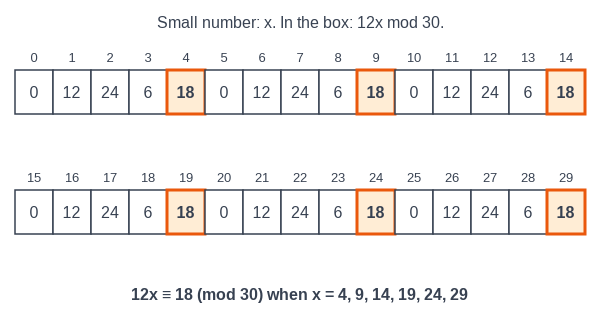
Solve 12x ≡ 18 (mod 30), and list every solution mod 30.
\gcd(12, 30) = 6
Find d.
6 \mid 18
d divides b, so there are exactly 6 solutions mod 30.
2x \equiv 3 \pmod{5}Divide a, b and n by 6.
2 \cdot 3 = 6 \equiv 1 \pmod{5}3 is an inverse of 2 mod 5.
x \equiv 3 \cdot 3 = 9
Multiply both sides by 3.
x \equiv 4 \pmod{5}Reduce mod 5.
x \equiv 4, 9, 14, 19, 24, 29 \pmod{30}Add multiples of n/d = 5 until there are d = 6 values.
12 \cdot 4 = 48 = 30 + 18
Check one solution in the original congruence.
Answer: x ≡ 4, 9, 14, 19, 24 or 29 (mod 30), which is the same as x ≡ 4 (mod 5).
Example 5: Making change (word problem)
Mugs cost $23 each. A café owner paid only with $10 bills and got $4 in change. She bought fewer than 10 mugs. How many did she buy?
23x + 4 \equiv 0 \pmod{10}The amount paid, 23x + 4 dollars, is a multiple of 10.
23x \equiv -4 \pmod{10}Subtract 4 from both sides.
3x \equiv 6 \pmod{10}Reduce: 23 ≡ 3 and −4 ≡ 6.
3 \cdot 7 = 21 \equiv 1 \pmod{10}gcd(3, 10) = 1, and 7 is an inverse of 3.
x \equiv 7 \cdot 6 = 42
Multiply both sides by 7.
x \equiv 2 \pmod{10}Reduce mod 10.
23 \cdot 2 + 4 = 50
Check: 2 mugs cost $46, and $50 in bills leaves $4 change.
Answer: she bought 2 mugs. The other solutions, 12, 22, …, are ruled out because she bought fewer than 10.
Common mistakes
| Mistake | Example of the error | Fix |
|---|---|---|
| Writing a fraction | 7x ≡ 3 (mod 10), so x = 3/7 | Multiply by the inverse: x ≡ 3 · 3 = 9 (mod 10). |
| Dividing a and b but not n | 12x ≡ 18 (mod 30) becomes 2x ≡ 3 (mod 30) | Divide the modulus too: 2x ≡ 3 (mod 5). |
| Giving one solution when there are several | 12x ≡ 18 (mod 30) has only x ≡ 4 | List d = 6 solutions mod 30: 4, 9, 14, 19, 24, 29. |
| Searching for an inverse that does not exist | Trying every multiple of 6 to solve 6x ≡ 4 (mod 9) | Check gcd(a, n) | b first. Here 3 ∤ 4, so stop. |
| Leaving a negative inverse unreduced | 17⁻¹ ≡ −5, then reporting x ≡ −25 | Negative values are correct but reduce them: −5 ≡ 38 and −25 ≡ 18 (mod 43). |
| Forgetting to reduce a first | Solving 23x ≡ 6 (mod 10) by searching up to 23 | Reduce 23 ≡ 3 (mod 10) first. |
Related ideas
A linear congruence ax ≡ b (mod n) is the same problem as the linear Diophantine equation ax + ny = b, whose solvability test, gcd(a, n) | b, comes from Bézout’s identity. Solving several congruences with different moduli at once is the next lesson, Chinese Remainder Theorem, and RSA Encryption builds its private key as a modular inverse.
Practice problems
- Find the inverse of 3 mod 7.
- Find the inverse of 11 mod 26.
- Solve 5x ≡ 4 (mod 9).
- Solve 11x ≡ 7 (mod 26).
- Solve 4x ≡ 6 (mod 10). List all solutions mod 10.
- Solve 8x ≡ 5 (mod 12).
- Solve 9x ≡ 12 (mod 15). List all solutions mod 15.
- Use the inverse from Example 2 to solve 17x ≡ 3 (mod 43).
- Explain why 6 has no inverse mod 9.
- Notebooks cost $9 each. A customer paid only with $20 bills, got $7 in change and bought fewer than 20 notebooks. How many did he buy?
Show answers
1.
3 \cdot 5 = 15
Try multiples of 3 until one is 1 more than a multiple of 7.
15 = 7 \cdot 2 + 1
15 ≡ 1 (mod 7).
Answer: 3⁻¹ ≡ 5 (mod 7)
2.
26 = 11 \cdot 2 + 4
Run the Euclidean algorithm.
11 = 4 \cdot 2 + 3
Divide 11 by 4.
4 = 3 \cdot 1 + 1
Divide 4 by 3. The gcd is 1.
1 = 4 - 3
Solve the last division for 1.
1 = 4 - (11 - 4 \cdot 2)
Substitute 3 = 11 − 4 · 2.
1 = 4 - 11 + 2 \cdot 4
Distribute the minus sign.
1 = 3 \cdot 4 - 11
Combine the 4 terms.
1 = 3(26 - 11 \cdot 2) - 11
Substitute 4 = 26 − 11 · 2.
1 = 3 \cdot 26 - 6 \cdot 11 - 11
Distribute the 3.
1 = 3 \cdot 26 - 7 \cdot 11
Combine the 11 terms.
11(-7) \equiv 1 \pmod{26}Reduce mod 26.
-7 + 26 = 19
Add 26 to get a value from 0 to 25.
11 \cdot 19 = 209 = 26 \cdot 8 + 1
Check.
Answer: 11⁻¹ ≡ 19 (mod 26)
3.
5 \cdot 2 = 10 \equiv 1 \pmod{9}gcd(5, 9) = 1, and 2 is an inverse of 5.
x \equiv 2 \cdot 4 = 8
Multiply both sides by 2.
5 \cdot 8 = 40 = 9 \cdot 4 + 4
Check.
Answer: x ≡ 8 (mod 9)
4.
x \equiv 19 \cdot 7 = 133
Multiply both sides by 11⁻¹ ≡ 19 from problem 2.
133 = 26 \cdot 5 + 3
Reduce mod 26.
11 \cdot 3 = 33 = 26 + 7
Check.
Answer: x ≡ 3 (mod 26)
5.
\gcd(4, 10) = 2
Find d.
2 \mid 6
d divides b, so there are 2 solutions mod 10.
2x \equiv 3 \pmod{5}Divide a, b and n by 2.
x \equiv 3 \cdot 3 = 9
Multiply by 3, the inverse of 2 mod 5.
x \equiv 4 \pmod{5}Reduce mod 5.
x \equiv 4, 9 \pmod{10}Add n/d = 5 once.
4 \cdot 4 = 16 \equiv 6,\ 4 \cdot 9 = 36 \equiv 6
Check both mod 10.
Answer: x ≡ 4 or 9 (mod 10)
6.
\gcd(8, 12) = 4
Find d.
4 \nmid 5
d does not divide b.
Answer: no solution
7.
\gcd(9, 15) = 3
Find d.
3 \mid 12
d divides b, so there are 3 solutions mod 15.
3x \equiv 4 \pmod{5}Divide a, b and n by 3.
3 \cdot 2 = 6 \equiv 1 \pmod{5}2 is an inverse of 3 mod 5.
x \equiv 2 \cdot 4 = 8 \equiv 3 \pmod{5}Multiply by 2, then reduce.
x \equiv 3, 8, 13 \pmod{15}Add multiples of n/d = 5.
9 \cdot 3 = 27 = 15 + 12
Check x = 3.
Answer: x ≡ 3, 8 or 13 (mod 15)
8.
x \equiv 38 \cdot 3 = 114
Multiply both sides by 17⁻¹ ≡ 38.
114 = 43 \cdot 2 + 28
Reduce mod 43.
17 \cdot 28 = 476 = 43 \cdot 11 + 3
Check.
Answer: x ≡ 28 (mod 43)
9.
\gcd(6, 9) = 3
6 and 9 share the factor 3.
6x - 1 = 9k
An inverse would need this for some integers x and k.
3(2x - 3k) = 1
Rearrange and factor. A multiple of 3 cannot equal 1.
Answer: gcd(6, 9) = 3 ≠ 1, so 6 has no inverse mod 9. In fact 6x mod 9 is always 0, 3 or 6
10.
9x + 7 \equiv 0 \pmod{20}The amount paid, 9x + 7 dollars, is a multiple of 20.
9x \equiv -7 \equiv 13 \pmod{20}Subtract 7, then add 20 to reduce.
9 \cdot 9 = 81 \equiv 1 \pmod{20}9 is its own inverse mod 20.
x \equiv 9 \cdot 13 = 117
Multiply both sides by 9.
x \equiv 17 \pmod{20}Reduce: 117 − 100 = 17.
9 \cdot 17 + 7 = 160 = 8 \cdot 20
Check: $153 + $7 = $160 in $20 bills.
Answer: he bought 17 notebooks
Linear congruences FAQ
How do you solve a linear congruence?
Find d = gcd(a, n). If d does not divide b, there is no solution. Otherwise divide a, b and n by d, multiply by the inverse of the new a, and list the d solutions mod n.
How do you find a modular inverse?
Run the extended Euclidean algorithm on a and n to write ax + ny = 1. Then x mod n is the inverse of a. For small n, trying a, 2a, 3a, … until one is 1 more than a multiple of n is quicker.
How many solutions does ax ≡ b (mod n) have?
None if gcd(a, n) does not divide b. Otherwise exactly gcd(a, n) solutions mod n, spaced n/gcd(a, n) apart.
When does a number have an inverse mod n?
Exactly when gcd(a, n) = 1. So mod a prime p, every number from 1 to p − 1 has an inverse.
Summary
- A linear congruence ax ≡ b (mod n) is solvable exactly when d = gcd(a, n) divides b.
- a has an inverse mod n exactly when gcd(a, n) = 1. The extended Euclidean algorithm finds it.
- When d = 1, the unique solution is x ≡ a⁻¹b (mod n).
- When d > 1 and d | b, divide a, b and n by d, solve, then list d solutions spaced n/d apart.
- Always check a solution in the original congruence.
Previous lesson: Modular Arithmetic
Next lesson: Chinese Remainder Theorem
Back to the Discrete Math Index