
RSA Encryption
RSA encryption is a public-key method that hides a message with modular powers. You publish n = pq, the product of two secret primes, and an exponent e. Anyone can encrypt a number m as c ≡ me (mod n), but only you can decrypt with m ≡ cd (mod n), because finding d requires factoring n.
Before this lesson: Fermat’s Little Theorem, Euclidean Algorithm and Chinese Remainder Theorem
The idea of public-key encryption
Picture a mailbox with a slot. Anyone can drop a letter in, but only the owner has the key that opens it. RSA works the same way: the public key (n, e) lets anyone lock a message, and the private key d is the only practical way to unlock it.
The lock is modular exponentiation, which is easy to do. Undoing it without d is believed to be as hard as factoring n, and nobody knows a fast way to factor a product of two primes with hundreds of digits. The method is named for Ron Rivest, Adi Shamir and Leonard Adleman, who published it in 1977.
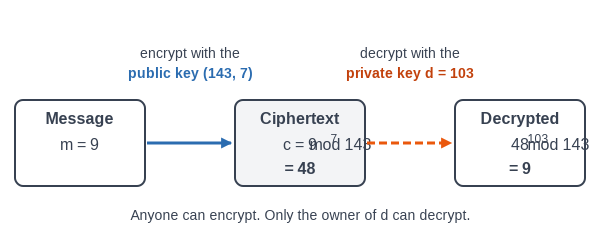
How RSA works
Making the keys takes five steps. Here φ(n) is the number of integers from 1 to n that are relatively prime to n; for n = pq it equals (p − 1)(q − 1).
- Choose two different primes p and q, and keep them secret.
- Compute n = pq. This is public.
- Compute φ(n) = (p − 1)(q − 1). Keep it secret.
- Choose a public exponent e with 1 ≤ e ≤ φ(n) and gcd(e, φ(n)) = 1.
- Find the private exponent d, the inverse of e mod φ(n), with the extended Euclidean algorithm.
A message is first turned into a number m with 0 ≤ m ≤ n − 1. Then:
\text{encrypt: } c \equiv m^{e} \pmod{n} \qquad \text{decrypt: } m \equiv c^{d} \pmod{n}Why decryption works. Since ed ≡ 1 (mod φ(n)), we can write ed = 1 + k(p − 1)(q − 1). If p does not divide m, then Fermat’s little theorem gives mp−1 ≡ 1 (mod p), so med = m · (mp−1)k(q−1) ≡ m (mod p). If p divides m, both sides are 0 mod p. The same holds mod q, so the Chinese remainder theorem gives med ≡ m (mod n).
c^{d} \equiv (m^{e})^{d} = m^{ed} = m^{1 + k\varphi(n)} \equiv m \pmod{n}Real keys use primes with about 300 digits each, so n has about 617 digits (2048 bits), and e is usually 65,537. The examples below use small primes so every step can be done by hand.
RSA encryption examples
Example 1: Making a key pair
Build RSA keys from p = 11 and q = 13 with e = 7.
n = 11 \cdot 13 = 143
Multiply the primes. This is the public modulus.
\varphi(n) = 10 \cdot 12 = 120
Multiply p − 1 and q − 1.
\gcd(7, 120) = 1
7 is prime and does not divide 120, so e = 7 is allowed.
120 = 7 \cdot 17 + 1
Divide 120 by 7 (the first step of the Euclidean algorithm).
1 = 120 - 7 \cdot 17
Solve for the remainder 1.
7 \cdot (-17) \equiv 1 \pmod{120}Reduce mod 120, so −17 is an inverse of 7.
d \equiv -17 + 120 = 103
Add 120 to make d positive.
Answer: public key (n, e) = (143, 7), private key d = 103. Check: 7 · 103 = 721 = 6 · 120 + 1.
Example 2: Encrypting a number
Use the public key (143, 7) to encrypt m = 9. Compute 97 mod 143 by repeated squaring, reducing after every multiplication.
9^2 = 81
Square 9. 81 is less than 143, so no reduction is needed.
9^4 = 81^2 = 6561
Square again.
6561 = 143 \cdot 45 + 126
Reduce mod 143: 94 ≡ 126.
9^7 = 9^4 \cdot 9^2 \cdot 9
Split the exponent: 7 = 4 + 2 + 1.
126 \cdot 81 = 10206 = 143 \cdot 71 + 53
Multiply the first two factors and reduce.
53 \cdot 9 = 477 = 143 \cdot 3 + 48
Multiply by the last factor and reduce.
Answer: c = 48. The ciphertext 48 is what travels over the network.
Example 3: Encrypting a word (word problem)
Maya wants to send the word HI to the owner of the key (143, 7). She codes letters as A = 1, B = 2, …, Z = 26 and encrypts each letter separately. What does she send?
H = 8,\ I = 9
Turn the letters into numbers.
8^2 = 64
Square 8.
8^4 = 64^2 = 4096 = 143 \cdot 28 + 92
Square again and reduce mod 143.
8^7 = 8^4 \cdot 8^2 \cdot 8
Split the exponent: 7 = 4 + 2 + 1.
92 \cdot 64 = 5888 = 143 \cdot 41 + 25
Multiply and reduce.
25 \cdot 8 = 200 = 143 + 57
Multiply by 8 and reduce.
9^7 \equiv 48 \pmod{143}Use the result of Example 2 for I.
Answer: Maya sends 57, 48. Encrypting one letter at a time is only for practice: the same letter always gives the same number, so real systems encrypt larger blocks with random padding.
Example 4: Decrypting with the Chinese remainder theorem
Decrypt c = 48 with the private key d = 103 and n = 143 = 11 · 13. Instead of computing 48103 mod 143 directly, work mod 11 and mod 13.
48 \equiv 4 \pmod{11}Reduce the base: 48 = 44 + 4.
103 = 10 \cdot 10 + 3
By Fermat’s little theorem, reduce the exponent mod 10.
4^3 = 64 \equiv 9 \pmod{11}Compute and reduce: 64 = 55 + 9.
48 \equiv 9 \pmod{13}Reduce the base: 48 = 39 + 9.
103 = 12 \cdot 8 + 7
Reduce the exponent mod 12.
9^3 = 729 = 13 \cdot 56 + 1 \equiv 1 \pmod{13}Find a small power of 9 that is 1 mod 13.
9^7 = (9^3)^2 \cdot 9 \equiv 9 \pmod{13}Split the exponent: 7 = 6 + 1.
m \equiv 9 \ (11),\ m \equiv 9 \ (13)
Combine with the Chinese remainder theorem.
m \equiv 9 \pmod{143}9 satisfies both, and the solution is unique mod 143.
Answer: m = 9, the message from Example 2. Real RSA software uses this shortcut, because two half-size powers are much faster than one full-size power.
Example 5: Breaking a tiny key
Eve intercepts c = 82, sent with the public key (n, e) = (91, 5). Since 91 is small, she can factor it. Find the private key and the message.
91 = 7 \cdot 13
Factor n by trying small primes.
\varphi(91) = 6 \cdot 12 = 72
Compute φ(n) from the factors.
72 = 5 \cdot 14 + 2,\quad 5 = 2 \cdot 2 + 1
Run the Euclidean algorithm on 72 and 5.
1 = 5 - 2 \cdot 2 = 5 - 2(72 - 5 \cdot 14)
Back-substitute the remainder 2.
1 = 5 \cdot 29 - 2 \cdot 72
Collect the multiples of 5 and of 72, so d = 29.
82 \equiv 5 \pmod{7},\ 29 = 6 \cdot 4 + 5Mod 7: reduce the base, and reduce the exponent mod 6.
5^5 = 5^4 \cdot 5 \equiv 2 \cdot 5 = 10 \equiv 3 \pmod{7}52 = 25 ≡ 4, so 54 ≡ 16 ≡ 2.
82 \equiv 4 \pmod{13},\ 29 = 12 \cdot 2 + 5Mod 13: reduce the base, and reduce the exponent mod 12.
4^5 = 4^4 \cdot 4 \equiv 9 \cdot 4 = 36 \equiv 10 \pmod{13}42 = 16 ≡ 3, so 44 ≡ 9.
m \equiv 3 \ (7),\ m \equiv 10 \ (13)
Combine: 10 leaves remainder 3 when divided by 7.
Answer: d = 29 and m = 10. Check: 105 = 100,000 = 91 · 1098 + 82. With a 617-digit n, the first step, factoring, is far beyond any known computer.
Common mistakes
| Mistake | Example of the error | Fix |
|---|---|---|
| Finding d mod n instead of mod φ(n) | Inverting 7 mod 143 | Invert e mod φ(n) = 120, which gives d = 103. |
| Choosing e that shares a factor with φ(n) | e = 5 with φ(n) = 120 | gcd(5, 120) = 5, so 5 has no inverse mod 120. Choose e with gcd(e, φ(n)) = 1. |
| Encrypting a message that is too large | m = 150 with n = 143 decrypts to 7 | Keep 0 ≤ m ≤ n − 1, or split the message into smaller blocks. |
| Computing the whole power before reducing | Writing out 97 = 4,782,969 first | Reduce mod n after every multiplication, as in Example 2. |
| Treating n like a prime | Assuming 2142 ≡ 1 (mod 143), as Fermat’s little theorem would for a prime | 143 = 11 · 13 is not prime, and 2142 ≡ 114 (mod 143). Work mod 11 and mod 13, reducing the exponent mod 10 and mod 12. |
| Making p, q or φ(n) public | Publishing φ(n) = 120 with the key | Anyone who knows φ(n) can compute d. Publish only n and e. |
Related ideas: digital signatures
The keys also work in reverse. To sign a message m, the owner computes s ≡ md (mod n) with the private key. Anyone can check the signature by computing se mod n with the public key and comparing it with m. With the key (143, 7, 103), signing m = 2 gives s ≡ 2103 ≡ 63 (mod 143), and checking gives 637 ≡ 2 (mod 143).
Every step of RSA comes from earlier lessons in this unit: modular arithmetic for the powers, the Euclidean algorithm for d, linear congruences for the inverse, and the Chinese remainder theorem for fast decryption.
Practice problems
- For p = 3 and q = 11, find n and φ(n).
- With φ(n) = 20 and e = 3, find d.
- Encrypt m = 5 with the public key (33, 3).
- Decrypt c = 26 with n = 33 and d = 7.
- Why can’t e = 4 be used when φ(n) = 20?
- For p = 7, q = 17 and e = 5, find n, φ(n) and d.
- Encrypt m = 2 with the public key (119, 5).
- Decrypt c = 32 with n = 119 and d = 77, using the Chinese remainder theorem.
- Break the public key (35, 5): find d, then decrypt c = 33.
- A friend sends you 47 using your public key (143, 7) from Example 1, with letters coded A = 1, …, Z = 26. Use d = 103 to find the letter.
Show answers
1.
n = 3 \cdot 11 = 33
Multiply the primes.
\varphi(n) = 2 \cdot 10 = 20
Multiply p − 1 and q − 1.
Answer: n = 33 and φ(n) = 20
2.
20 = 3 \cdot 6 + 2,\quad 3 = 2 \cdot 1 + 1
Run the Euclidean algorithm.
1 = 3 - 2 = 3 - (20 - 3 \cdot 6)
Back-substitute the remainder 2.
1 = 3 \cdot 7 - 20
Collect the multiples of 3.
Answer: d = 7. Check: 3 · 7 = 21 ≡ 1 (mod 20)
3.
5^3 = 125
Compute the power.
125 = 33 \cdot 3 + 26
Reduce mod 33.
Answer: c = 26
4.
26 \equiv 2 \pmod{3},\ 2^7 \equiv 2 \pmod{3}Mod 3: 2 ≡ −1, and an odd power of −1 is −1 ≡ 2.
26 \equiv 4 \pmod{11}Mod 11: reduce the base. The exponent 7 is already less than 10.
4^2 = 16 \equiv 5,\ 4^4 \equiv 25 \equiv 3 \pmod{11}Square twice, reducing each time.
4^7 = 4^4 \cdot 4^2 \cdot 4 \equiv 3 \cdot 5 \cdot 4 = 60 \equiv 5 \pmod{11}Split the exponent: 7 = 4 + 2 + 1.
m \equiv 2 \ (3),\ m \equiv 5 \ (11)
Combine: 5 leaves remainder 2 when divided by 3.
Answer: m = 5, the message from Problem 3
5.
\gcd(4, 20) = 4
4 divides 20.
Answer: e must be relatively prime to φ(n), or it has no inverse d mod 20
6.
n = 7 \cdot 17 = 119,\ \varphi(n) = 6 \cdot 16 = 96
Multiply the primes, then multiply p − 1 and q − 1.
96 = 5 \cdot 19 + 1
Divide 96 by 5.
5 \cdot (-19) \equiv 1 \pmod{96}Solve for the remainder 1 and reduce.
d \equiv -19 + 96 = 77
Add 96.
Answer: n = 119, φ(n) = 96, d = 77. Check: 5 · 77 = 385 = 4 · 96 + 1
7.
2^5 = 32
32 is less than 119, so no reduction is needed.
Answer: c = 32
8.
32 \equiv 4 \pmod{7},\ 77 = 6 \cdot 12 + 5Mod 7: reduce the base, and reduce the exponent mod 6.
4^5 = 4^3 \cdot 4^2 \equiv 1 \cdot 2 = 2 \pmod{7}43 = 64 ≡ 1 and 42 = 16 ≡ 2.
32 \equiv -2 \pmod{17},\ 77 = 16 \cdot 4 + 13Mod 17: 32 = 34 − 2, and reduce the exponent mod 16.
(-2)^{13} = -2^{13} = -(2^8 \cdot 2^4 \cdot 2)An odd power keeps the minus sign; split 13 = 8 + 4 + 1.
-(1 \cdot (-1) \cdot 2) = 2 \pmod{17}24 = 16 ≡ −1, so 28 ≡ 1.
m \equiv 2 \ (7),\ m \equiv 2 \ (17)
m = 2 satisfies both.
Answer: m = 2, the message from Problem 7
9.
35 = 5 \cdot 7,\ \varphi(35) = 4 \cdot 6 = 24
Factor n and compute φ(n).
5 \cdot 5 = 25 = 24 + 1
Try small inverses: 5 is its own inverse mod 24, so d = 5.
33 \equiv -2 \pmod{35}Rewrite the ciphertext to make the power easy.
(-2)^5 = -32 \equiv 3 \pmod{35}Compute and add 35.
Answer: d = 5 and m = 3
10.
47 \equiv 3 \pmod{11},\ 3^3 = 27 \equiv 5 \pmod{11}Mod 11: 47 = 44 + 3, and 103 ≡ 3 (mod 10).
47 \equiv 8 \pmod{13},\ 8^2 = 64 \equiv -1 \pmod{13}Mod 13: 47 = 39 + 8, and 64 = 65 − 1.
8^7 = (8^2)^3 \cdot 8 \equiv (-1)^3 \cdot 8 = -8 \equiv 5 \pmod{13}103 ≡ 7 (mod 12); split 7 = 6 + 1.
m \equiv 5 \ (11),\ m \equiv 5 \ (13)
m = 5 satisfies both.
Answer: m = 5, which is the letter E
RSA encryption FAQ
What is RSA encryption?
RSA is a public-key method. You publish n = pq and an exponent e, anyone encrypts m as c ≡ me (mod n), and only you can decrypt with m ≡ cd (mod n), where d is the inverse of e mod (p − 1)(q − 1).
Why is RSA secure?
Finding d requires φ(n) = (p − 1)(q − 1), and the only known practical way to get it is to factor n. Multiplying two 300-digit primes is fast, but no known method can factor their 617-digit product in a reasonable time.
How do you find the private key d in RSA?
Run the extended Euclidean algorithm on φ(n) and e to write 1 = ex + φ(n)y. Then d is x reduced mod φ(n). For e = 7 and φ(n) = 120, this gives d = 103.
Why does RSA decryption give back the original message?
Because ed = 1 + kφ(n), Fermat’s little theorem makes med ≡ m mod p and mod q, and the Chinese remainder theorem combines these into med ≡ m (mod n).
Summary
- Keys: choose primes p and q, set n = pq and φ(n) = (p − 1)(q − 1), choose e with gcd(e, φ(n)) = 1, and find d ≡ e−1 (mod φ(n)).
- Publish (n, e); keep p, q, φ(n) and d secret.
- Encrypt with c ≡ me (mod n) and decrypt with m ≡ cd (mod n), reducing after every multiplication.
- Decryption works because ed ≡ 1 (mod φ(n)), by Fermat’s little theorem and the Chinese remainder theorem.
- The security rests on how hard it is to factor n.
Previous lesson: Fermat’s Little Theorem
Next lesson: Sum and Product Rules for Counting
Back to the Discrete Math Index