
Sum and Product Rules for Counting
The sum and product rules for counting are the two basic counting tools. The sum rule says that choosing one option from m ways or n other ways, with no overlap, gives m + n choices. The product rule says that m ways followed by n ways give mn ways.
Before this lesson: Set Operations, Power Sets and Cartesian Products and Permutations and Combinations
When to add and when to multiply
A café offers 4 soups and 3 salads as starters. If you order one starter, you pick a soup or a salad, so you have 4 + 3 = 7 choices. Now suppose a meal is a starter and one of 5 main dishes. Each of the 7 starters pairs with each of the 5 mains, so there are 7 · 5 = 35 meals.
That is the whole idea. “Or” between choices that cannot happen together means add. “And then” between steps that happen one after the other means multiply. Most counting problems are a mix of the two.
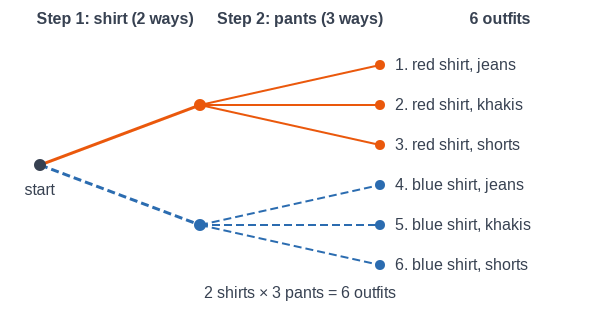
The sum rule and the product rule
Sum rule. If a choice can be made from set A or from set B, and no option is in both (A and B are disjoint), then the number of choices is |A| + |B|. Here |A| means the number of elements of A.
|A \cup B| = |A| + |B| \qquad \text{if } A \cap B = \varnothingProduct rule. If a task is a sequence of k steps, and step i can be done in ni ways no matter how the earlier steps were done, then the task can be done in n1n2⋯nk ways. In set language, this counts the ordered lists in a Cartesian product.
|A_1 \times A_2 \times \cdots \times A_k| = |A_1| \cdot |A_2| \cdots |A_k|
The product rule is also called the multiplication principle or the fundamental counting principle. The key condition is “no matter how the earlier steps were done”: the number of choices at each step must stay the same, even if the choices themselves change.
How to set up a counting problem
- Decide what one outcome looks like, for example a 3-digit number or a meal.
- If outcomes come in separate types that cannot overlap, split into cases and plan to add.
- Within each case, build an outcome step by step and multiply the number of choices at each step.
- Fill the most restricted positions first, such as a first digit that cannot be 0.
- Add the case totals.
Sum and product rule examples
Example 1: The sum rule
A student must take one elective, either one of 5 art courses or one of 4 music courses. No course is in both lists. How many choices does the student have?
|A| = 5,\ |M| = 4
Count each list of options.
A \cap M = \varnothing
No course is in both, so the sum rule applies.
|A \cup M| = 5 + 4 = 9
Add the counts.
Answer: 9 choices.
Example 2: License plates
A license plate has 3 letters followed by 4 digits, and repeats are allowed. How many plates are possible?
26 \cdot 26 \cdot 26 = 17{,}576Each of the 3 letter positions has 26 choices.
10 \cdot 10 \cdot 10 \cdot 10 = 10{,}000Each of the 4 digit positions has 10 choices.
17{,}576 \cdot 10{,}000 = 175{,}760{,}000Multiply the two parts (product rule).
Answer: 175,760,000 plates.
Example 3: Passwords of different lengths
A password has 6, 7 or 8 characters, and each character is an uppercase letter or a digit. How many passwords are possible?
26 + 10 = 36
Each character is a letter or a digit (sum rule).
36^6 = 2{,}176{,}782{,}336Length 6: 6 positions with 36 choices each (product rule).
36^7 = 78{,}364{,}164{,}096Length 7.
36^8 = 2{,}821{,}109{,}907{,}456Length 8.
2{,}176{,}782{,}336 + 78{,}364{,}164{,}096 = 80{,}540{,}946{,}432The lengths are separate cases, so add. Start with the first two.
80{,}540{,}946{,}432 + 2{,}821{,}109{,}907{,}456 = 2{,}901{,}650{,}853{,}888Add the third case.
Answer: 2,901,650,853,888 passwords, about 2.9 trillion. Both rules appear: the sum rule for the 36 symbols and for the three lengths, and the product rule within each length.
Example 4: Numbers with no repeated digit
How many three-digit numbers (100 to 999) have three different digits?
9
The first digit can be 1 to 9, since it cannot be 0.
9
The second digit can be any of the 10 digits except the first one.
8
The third digit can be any digit except the first two.
9 \cdot 9 \cdot 8 = 81 \cdot 8 = 648
Multiply (product rule).
Answer: 648 numbers. The second step always has 9 choices, even though which 9 digits depends on the first digit. That is all the product rule needs.
Example 5: An even locker code (word problem)
A locker code is a three-digit number from 100 to 999 with no repeated digit, and it must be even. How many codes are there?
\text{last digit } 0 \text{ or last digit } 2, 4, 6, 8The last digit controls what the first digit can be, so split into two cases.
1 \cdot 9 \cdot 8 = 72
Case 1: last digit 0. The first digit has 9 choices (1 to 9) and the middle digit has 8.
4
Case 2: choose the last digit from 2, 4, 6, 8.
8
The first digit cannot be 0 or the last digit, so it has 8 choices.
8
The middle digit cannot match the other two, so it has 8 choices.
4 \cdot 8 \cdot 8 = 256
Multiply the case 2 choices.
72 + 256 = 328
The cases do not overlap, so add.
Answer: 328 codes. Filling the first digit first would not work here: whether the last digit can be 0 depends on what came before, so the number of choices would not be constant. Cases fix that.
Common mistakes
| Mistake | Example of the error | Fix |
|---|---|---|
| Adding when the choices happen together | 2 shirts and 3 pants give 2 + 3 = 5 outfits | An outfit is a shirt and pants: 2 · 3 = 6. |
| Multiplying when the choices are alternatives | One elective from 5 art or 4 music courses: 5 · 4 = 20 | One choice from either list: 5 + 4 = 9. |
| Adding overlapping cases | 5 art and 4 music courses, but 1 course is in both lists: 9 choices | Subtract the overlap: 5 + 4 − 1 = 8. |
| Ignoring a restriction | Three-digit numbers with different digits: 10 · 9 · 8 = 720 | The first digit cannot be 0: 9 · 9 · 8 = 648. |
| Using the product rule when the number of choices changes | Even codes: 9 · 8 · 5 = 360 | Split by whether the last digit is 0: 72 + 256 = 328. |
| Leaving out a case | Passwords of 6 to 8 characters: only 368 | Add every length: 366 + 367 + 368. |
Related ideas: counting the complement
Sometimes it is easier to count what you do not want and subtract. How many four-digit PINs (0000 to 9999) have at least one repeated digit?
10^4 = 10{,}000Count all PINs: 4 positions with 10 choices each.
10 \cdot 9 \cdot 8 \cdot 7 = 5040
Count the PINs with no repeated digit.
10{,}000 - 5040 = 4960Subtract to get the PINs with a repeat.
Answer: 4960 PINs. When options overlap, the sum rule becomes |A ∪ B| = |A| + |B| − |A ∩ B|, which is the start of the Inclusion-Exclusion Principle. Ordered choices without repeats are permutations, and the product rule also shows that a set with n elements has 2n subsets.
Practice problems
- A café has 6 hot drinks and 4 cold drinks. How many ways can you choose one drink?
- How many ways can you choose one hot drink from Problem 1 and one of 5 pastries?
- How many bit strings of length 10 are there?
- How many functions are there from a set with 3 elements to a set with 4 elements?
- Use the product rule to count the subsets of a set with 7 elements.
- How many four-digit PINs (0000 to 9999) have no repeated digit?
- A variable name is a single letter, or a letter followed by one digit. How many names are possible?
- How many three-digit numbers (100 to 999) are odd and have three different digits?
- How many passwords of length 3 or 4 can be made from the 26 lowercase letters, with repeats allowed?
- A meal is a starter (one of 4 soups or one of 3 salads), one of 6 mains, and either one of 5 desserts or no dessert. How many meals are possible?
Show answers
1.
6 + 4 = 10
Hot or cold, with no overlap (sum rule).
Answer: 10
2.
6 \cdot 5 = 30
A hot drink and then a pastry (product rule).
Answer: 30
3.
2^{10} = 1024Each of the 10 positions is 0 or 1.
Answer: 1024
4.
4 \cdot 4 \cdot 4 = 4^3
Each of the 3 inputs can go to any of the 4 outputs.
4^3 = 64
Multiply.
Answer: 64
5.
2 \cdot 2 \cdots 2 = 2^7
For each of the 7 elements, decide in or out.
2^7 = 128
Multiply.
Answer: 128
6.
10 \cdot 9 \cdot 8 \cdot 7
Each new position cannot repeat an earlier digit.
90 \cdot 56 = 5040
Multiply in pairs: 10 · 9 = 90 and 8 · 7 = 56.
Answer: 5040
7.
26
Names with one character: a letter.
26 \cdot 10 = 260
Names with two characters: a letter and then a digit.
26 + 260 = 286
The two lengths are separate cases, so add.
Answer: 286
8.
5
Choose the last digit first: 1, 3, 5, 7 or 9.
8
The first digit cannot be 0 or the last digit.
8
The middle digit cannot match the other two.
5 \cdot 8 \cdot 8 = 320
Multiply. No cases are needed, since 0 is never the last digit.
Answer: 320
9.
26^3 = 17{,}576Length 3.
26^4 = 456{,}976Length 4.
17{,}576 + 456{,}976 = 474{,}552Add the two lengths.
Answer: 474,552
10.
4 + 3 = 7
Starters: a soup or a salad.
5 + 1 = 6
Dessert options: one of 5 desserts, or none.
7 \cdot 6 \cdot 6 = 252
Starter, main and dessert option (product rule).
Answer: 252 meals
Sum and product rules FAQ
What is the difference between the sum rule and the product rule?
The sum rule counts one choice made from separate groups, so you add. The product rule counts a sequence of choices made one after another, so you multiply.
When do you add and when do you multiply in counting?
Add when the word is “or” and the cases cannot happen together. Multiply when the word is “and” or “then” and each step has a fixed number of choices.
Is the product rule the same as the fundamental counting principle?
Yes. The product rule, the multiplication principle and the fundamental counting principle are three names for the same idea: m ways followed by n ways gives mn ways.
What if the cases in the sum rule overlap?
Then adding counts the shared options twice. Subtract the overlap: |A ∪ B| = |A| + |B| − |A ∩ B|. This is the two-set case of inclusion-exclusion.
Summary
- Sum rule: one choice from disjoint groups of sizes m and n can be made in m + n ways.
- Product rule: a task of steps with n1, n2, …, nk choices can be done in n1n2⋯nk ways, as long as each count stays the same whatever came before.
- Fill the most restricted positions first, and split into cases when the number of choices would change.
- Counting the complement and subtracting is often faster.
- If cases overlap, subtract the overlap instead of simply adding.
Previous lesson: RSA Encryption
Next lesson: Pigeonhole Principle
Back to the Discrete Math Index