
Regular Markov Chains
A regular Markov chain is a Markov chain whose transition matrix P has some power with all positive entries. In a regular Markov chain, the state vector settles to one steady-state vector S, whatever the starting state. You find S by solving SP = S with entries that add to 1.
Before this lesson: Markov Chains, Substitution Method for Systems of Equations and Systems of Equations in Three Variables
The idea
In the coffee-shop chain from Markov chains, 80% of Brew customers return each week and 30% of Daily customers switch to Brew. Start with everyone at Brew, or everyone at Daily, and multiply by P again and again. Both runs drift toward 60% Brew and 40% Daily.
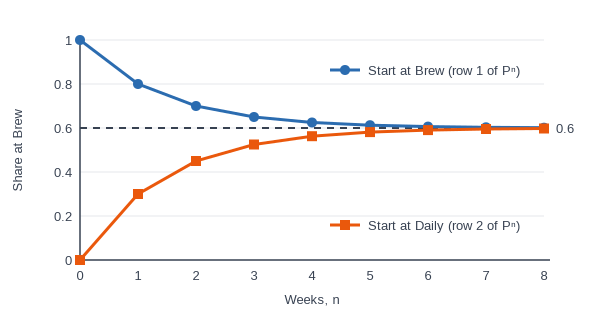
At 60% and 40%, one more step changes nothing: the customers who leave Brew are balanced by the ones who arrive. That balance point is the steady state. A regular chain always reaches it in the long run.
Steady-state vector of a regular Markov chain
A transition matrix P is regular if some power P^k has only positive entries (no zeros). Then:
- There is exactly one steady-state vector S (also called the stationary distribution): a row vector with nonnegative entries that add to 1 and SP = S.
- For any starting vector X_0, the vectors X_0 P^n approach S as n grows.
- Every row of P^n approaches S.
SP = S \qquad s_1 + s_2 + \cdots + s_n = 1
- Write S with unknown entries, such as S = \begin{bmatrix} x & y \end{bmatrix}.
- Multiply S by each column of P and set the result equal to the matching entry of S.
- Replace one of these equations with x + y + ⋯ = 1 (one column equation is always redundant).
- Solve the system and check that the entries are nonnegative and add to 1.
Regular Markov chain examples
Example 1: Testing whether a chain is regular
Decide whether each matrix is regular: (a) P = \begin{bmatrix} 0 & 1 \\ 0.4 & 0.6 \end{bmatrix} and (b) Q = \begin{bmatrix} 1 & 0 \\ 0.3 & 0.7 \end{bmatrix}.
(a)
p^{(2)}_{11} = 0(0) + 1(0.4) = 0.4Row 1 of P times column 1 (see matrix multiplication).
p^{(2)}_{12} = 0(1) + 1(0.6) = 0.6Row 1 times column 2.
p^{(2)}_{21} = 0.4(0) + 0.6(0.4) = 0.24Row 2 times column 1.
p^{(2)}_{22} = 0.4(1) + 0.6(0.6) = 0.76Row 2 times column 2.
P^2 = \begin{bmatrix} 0.4 & 0.6 \\ 0.24 & 0.76 \end{bmatrix}Every entry is positive, so P is regular.
(b)
q^{(2)}_{11} = 1(1) + 0(0.3) = 1,\ q^{(2)}_{12} = 1(0) + 0(0.7) = 0Row 1 of Q^2 is still (1, 0).
\text{row 1 of } Q^k = \begin{bmatrix} 1 & 0 \end{bmatrix} \text{ for every } kState 1 always returns to state 1, so the 0 never fills in.
Answer: (a) P is regular, even though P itself has a zero. (b) Q is not regular. Its state 1 is absorbing: once the chain enters it, it never leaves.
Example 2: Steady state of a two-state chain
Find the steady-state vector for the coffee-shop chain P = \begin{bmatrix} 0.8 & 0.2 \\ 0.3 & 0.7 \end{bmatrix}.
S = \begin{bmatrix} x & y \end{bmatrix}Name the unknown shares of Brew and Daily.
0.8x + 0.3y = x
S times column 1 must equal x.
0.3y = 0.2x
Subtract 0.8x from both sides.
x = 1.5y
Divide both sides by 0.2.
x + y = 1
The entries of S add to 1.
1.5y + y = 1
Substitute x = 1.5y (see substitution method).
2.5y = 1
Combine like terms.
y = 0.4
Divide both sides by 2.5.
x = 1.5(0.4) = 0.6
Substitute back into x = 1.5y.
0.2(0.6) + 0.7(0.4) = 0.12 + 0.28 = 0.4
Check with column 2: the result equals y.
Answer: S = \begin{bmatrix} 0.6 & 0.4 \end{bmatrix}. In the long run, 60% of customers buy at Brew and 40% at Daily.
Example 3: Steady state of a three-state chain
A shared bike is returned each day to station A, B or C. Find the long-run share of days the bike spends at each station.
P = \begin{bmatrix} 0.5 & 0.5 & 0 \\ 0.25 & 0.5 & 0.25 \\ 0 & 0.5 & 0.5 \end{bmatrix} \quad \text{(order A, B, C)}P has zeros, but every entry of P^2 is positive (for example, A reaches C in two steps through B), so the chain is regular.
S = \begin{bmatrix} x & y & z \end{bmatrix}Name the unknown shares.
0.5x + 0.25y + 0z = x
S times column A must equal x.
0.25y = 0.5x
Subtract 0.5x from both sides.
y = 2x
Divide both sides by 0.25.
0x + 0.25y + 0.5z = z
S times column C must equal z.
0.25y = 0.5z
Subtract 0.5z from both sides.
y = 2z
Divide both sides by 0.25.
z = x
Both 2x and 2z equal y, so divide 2z = 2x by 2.
x + 2x + x = 1
Substitute into x + y + z = 1 (see systems of equations in three variables).
4x = 1
Combine like terms.
x = 0.25
Divide both sides by 4.
y = 2(0.25) = 0.5,\ z = 0.25
Substitute back.
0.5(0.25) + 0.5(0.5) + 0.5(0.25) = 0.5
Check with column B: the result equals y.
Answer: S = \begin{bmatrix} 0.25 & 0.5 & 0.25 \end{bmatrix}. The bike spends about half its days at station B and a quarter at each of A and C.
Example 4: Powers of P approach the steady state
Use P^2 = \begin{bmatrix} 0.70 & 0.30 \\ 0.45 & 0.55 \end{bmatrix} for the coffee-shop chain (from Markov Chains, Example 3) to find P^4. Compare its rows with S.
P^4 = P^2 \cdot P^2
Four steps are two steps done twice.
0.7(0.7) + 0.3(0.45) = 0.49 + 0.135 = 0.625
Row 1 times column 1.
0.7(0.3) + 0.3(0.55) = 0.21 + 0.165 = 0.375
Row 1 times column 2.
0.45(0.7) + 0.55(0.45) = 0.315 + 0.2475 = 0.5625
Row 2 times column 1.
0.45(0.3) + 0.55(0.55) = 0.135 + 0.3025 = 0.4375
Row 2 times column 2.
P^4 = \begin{bmatrix} 0.625 & 0.375 \\ 0.5625 & 0.4375 \end{bmatrix}Write the four-step matrix.
Answer: both rows of P^4 are already close to (0.6, 0.4), and they get closer with each higher power. These are the points at n = 2 and n = 4 on the graph above.
Example 5: Long-run apartment occupancy (word problem)
An apartment complex has 200 units. Each month, 5% of occupied units become vacant, and 60% of vacant units are rented. In the long run, about how many units are occupied?
P = \begin{bmatrix} 0.95 & 0.05 \\ 0.6 & 0.4 \end{bmatrix}States in the order Occupied, Vacant; each row adds to 1.
0.95x + 0.6y = x
S times column 1 must equal x.
0.6y = 0.05x
Subtract 0.95x from both sides.
x = 12y
Divide both sides by 0.05.
12y + y = 1
Substitute into x + y = 1.
13y = 1
Combine like terms.
y = 1/13 \approx 0.077
Divide both sides by 13.
x = 12/13 \approx 0.923
Substitute back into x = 12y.
200(12/13) \approx 184.6
Multiply the long-run share by the number of units.
Answer: about 92.3% of units, or about 185 of the 200, are occupied in the long run.
Common mistakes
| Mistake | Example of the error | Fix |
|---|---|---|
| Forgetting the equation x + y = 1 | Stopping at x = 1.5y in Example 2 | SP = S alone has infinitely many solutions. Add the condition that the entries add to 1. |
| Solving PS = S with a column vector | Multiplying P by rows of S in the wrong order | With row vectors, solve SP = S: multiply S by the columns of P. |
| Deciding a matrix is not regular because P has a zero | Rejecting P in Example 1(a) | Check powers of P. If any power has all positive entries, the chain is regular. |
| Thinking every chain settles to one steady state | Expecting \begin{bmatrix} 0 & 1 \\ 1 & 0 \end{bmatrix} to settle | That chain flips back and forth forever. Only regular chains are sure to converge to one S from every start. |
| Rounding P^n entries and calling it S | Reporting (0.625, 0.375) as the steady state | Powers only approach S. Solve SP = S for the exact answer. |
| Using a column sum instead of a row sum | Checking that column 1 of P adds to 1 | Rows of P add to 1. The steady-state vector S must also add to 1. |
Related ideas
A shortcut for two states
If P = \begin{bmatrix} 1 - a & a \\ b & 1 - b \end{bmatrix} with a and b positive (and not both 1), the steady state is S = \begin{bmatrix} \frac{b}{a + b} & \frac{a}{a + b} \end{bmatrix}. For the coffee shops, a = 0.2 and b = 0.3, so S = (0.3/0.5, 0.2/0.5) = (0.6, 0.4).
Eigenvector view
The equation SP = S says that S is a left eigenvector of P for the eigenvalue 1. Equivalently, the transpose of S is an eigenvector of the transpose of P. See eigenvalues and eigenvectors and transpose of a matrix.
Chains that are not regular
A chain with an absorbing state, like Q in Example 1, is not regular. Its long-run behavior is the topic of the next lesson, Absorbing Markov Chains.
Practice problems
- Is \begin{bmatrix} 0.3 & 0.7 \\ 1 & 0 \end{bmatrix} regular?
- Is \begin{bmatrix} 1 & 0 \\ 0.5 & 0.5 \end{bmatrix} regular?
- Is \begin{bmatrix} 0 & 1 \\ 1 & 0 \end{bmatrix} regular?
- Find the steady-state vector of \begin{bmatrix} 0.9 & 0.1 \\ 0.4 & 0.6 \end{bmatrix}.
- Find the steady-state vector of \begin{bmatrix} 0.5 & 0.5 \\ 0.25 & 0.75 \end{bmatrix}.
- In a gym, P = \begin{bmatrix} 0.7 & 0.3 \\ 0.4 & 0.6 \end{bmatrix} with states Workout, Skip. What share of members work out in the long run?
- Show that \begin{bmatrix} 0.25 & 0.75 \end{bmatrix} is the steady-state vector of \begin{bmatrix} 0.4 & 0.6 \\ 0.2 & 0.8 \end{bmatrix}.
- Find the steady-state vector of \begin{bmatrix} 0.5 & 0.5 & 0 \\ 0.5 & 0 & 0.5 \\ 0 & 0.5 & 0.5 \end{bmatrix}.
- In a town of 5,000 voters, 85% of party A voters stay with A each election and 15% switch to B; 10% of B voters switch to A. How many vote A in the long run?
- Each year, 20% of phone carrier X’s customers switch to carrier Y, and 10% of Y’s customers switch to X. What long-run share of customers does X have?
Show answers
1.
p^{(2)}_{11} = 0.3(0.3) + 0.7(1) = 0.09 + 0.7 = 0.79Row 1 times column 1.
p^{(2)}_{12} = 0.3(0.7) + 0.7(0) = 0.21Row 1 times column 2.
p^{(2)}_{21} = 1(0.3) + 0(1) = 0.3,\ p^{(2)}_{22} = 1(0.7) + 0(0) = 0.7Row 2 of P^2 is row 1 of P.
Answer: Yes. Every entry of P^2 is positive.
2.
\text{row 1 of every power} = \begin{bmatrix} 1 & 0 \end{bmatrix}State 1 is absorbing, so its row never changes.
Answer: No. Every power has a 0 in row 1.
3.
P^2 = \begin{bmatrix} 1 & 0 \\ 0 & 1 \end{bmatrix}Two flips return each state to itself.
P^3 = P,\ P^4 = P^2
The powers repeat, so they always contain zeros.
Answer: No. The chain alternates between the two states forever.
4.
0.9x + 0.4y = x
S times column 1 equals x.
0.4y = 0.1x
Subtract 0.9x from both sides.
x = 4y
Divide both sides by 0.1.
4y + y = 1
Substitute into x + y = 1.
y = 0.2,\ x = 0.8
Divide by 5, then x = 4(0.2).
Answer: S = \begin{bmatrix} 0.8 & 0.2 \end{bmatrix}
5.
0.5x + 0.25y = x
S times column 1 equals x.
0.25y = 0.5x
Subtract 0.5x from both sides.
y = 2x
Divide both sides by 0.25.
x + 2x = 1
Substitute into x + y = 1.
x = 1/3,\ y = 2/3
Divide by 3, then y = 2x.
Answer: S = \begin{bmatrix} \frac{1}{3} & \frac{2}{3} \end{bmatrix}
6.
0.7x + 0.4y = x
S times column 1 equals x.
0.4y = 0.3x
Subtract 0.7x from both sides.
x = \frac{4}{3}yDivide both sides by 0.3.
\frac{4}{3}y + y = 1Substitute into x + y = 1.
\frac{7}{3}y = 1Combine like terms.
y = 3/7,\ x = 4/7 \approx 0.571
Multiply by 3/7, then x = 1 − y.
Answer: about 57.1% (exactly 4/7)
7.
0.25(0.4) + 0.75(0.2) = 0.1 + 0.15 = 0.25
S times column 1 gives the first entry back.
0.25(0.6) + 0.75(0.8) = 0.15 + 0.6 = 0.75
S times column 2 gives the second entry back.
0.25 + 0.75 = 1
The entries add to 1.
Answer: SP = S and the entries add to 1, so S is the steady state (the chain is regular since P has no zeros).
8.
0.5x + 0.5y = x
S times column 1 equals x.
y = x
Subtract 0.5x, then divide by 0.5.
0.5y + 0.5z = z
S times column 3 equals z.
z = y
Subtract 0.5z, then divide by 0.5.
3x = 1
Substitute into x + y + z = 1.
Answer: S = \begin{bmatrix} \frac{1}{3} & \frac{1}{3} & \frac{1}{3} \end{bmatrix} (the chain is regular: P^2 has no zeros)
9.
0.85x + 0.1y = x
S times column A equals x.
0.1y = 0.15x
Subtract 0.85x from both sides.
y = 1.5x
Divide both sides by 0.1.
2.5x = 1
Substitute into x + y = 1 and combine.
x = 0.4
Divide both sides by 2.5.
5000(0.4) = 2000
Multiply by the number of voters.
Answer: about 2,000 vote A in the long run.
10.
P = \begin{bmatrix} 0.8 & 0.2 \\ 0.1 & 0.9 \end{bmatrix}States in the order X, Y.
0.8x + 0.1y = x
S times column X equals x.
0.1y = 0.2x
Subtract 0.8x from both sides.
y = 2x
Divide both sides by 0.1.
3x = 1
Substitute into x + y = 1 and combine.
Answer: X has 1/3 of the customers in the long run (about 33.3%).
Regular Markov chains FAQ
What makes a Markov chain regular?
Its transition matrix has some power with every entry positive. That means every state can reach every state in the same number of steps.
What is a steady-state vector?
It is a probability row vector S with SP = S. If the chain is in distribution S, it stays in S at every later step.
How do you find the steady state of a Markov chain?
Write S with unknowns, set SP = S, replace one equation with the condition that the entries add to 1, and solve the system.
Does every Markov chain have a steady state?
Every chain with finitely many states has at least one vector with SP = S, but the chain may not settle there. A regular chain has exactly one, and it reaches it from every start.
Summary
- A chain is regular if some power of P has all positive entries.
- A regular chain has one steady-state vector S with SP = S and entries that add to 1.
- From any start, X_0 P^n approaches S, and every row of P^n approaches S.
- To find S, use the column equations of SP = S together with the sum-to-1 equation.
- For two states, S = (b/(a + b), a/(a + b)), where a and b are the switching probabilities.
Previous lesson: Markov Chains
Next lesson: Absorbing Markov Chains
Back to the Finite Math and Business Calculus Index