
Eigenvalues and Eigenvectors
An eigenvector of a square matrix A is a nonzero vector v that A only stretches, shrinks or flips: Av = λv. The number λ is the matching eigenvalue. To check an eigenvector, compute Av and compare it with v. To find the eigenspace for λ, solve (A − λI)x = 0.
Before this lesson: Matrix Equation Ax = b, Null Space and Column Space and Invertible Matrix Theorem
What eigenvalues and eigenvectors mean
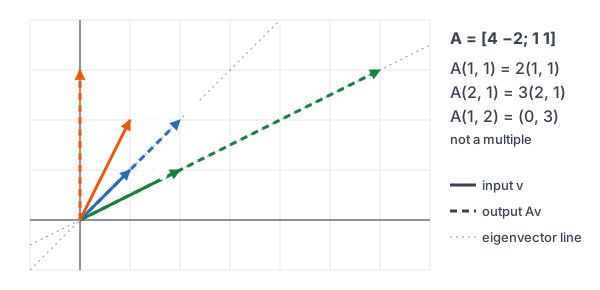
Most vectors change direction when you multiply them by a matrix. A few special vectors keep their direction. The matrix only scales them, so the output lies on the same line through the origin as the input.
Those special vectors are the eigenvectors, and the scale factors are the eigenvalues. An eigenvalue of 3 triples the vector, ½ halves it, −1 flips it and 0 sends it to the zero vector.
Definitions
Let A be an n × n matrix.
- A nonzero vector v is an eigenvector of A if Av = \lambda v for some scalar λ. The zero vector is never an eigenvector.
- The scalar λ is an eigenvalue of A if Av = \lambda v has a nonzero solution v. An eigenvalue can be 0.
- The eigenspace of λ is the set of all solutions of Av = \lambda v: every eigenvector for λ plus the zero vector.
Move λv to the left side to get a homogeneous system:
Av = \lambda v \quad \Longleftrightarrow \quad (A - \lambda I)v = 0
So the eigenspace of λ is the null space of A − λI, which makes it a subspace of ℝⁿ. The number λ is an eigenvalue exactly when A − λI has a nontrivial null space, which means A − λI is not invertible.
Two useful facts:
- The eigenvalues of a triangular matrix are the entries on its main diagonal.
- 0 is an eigenvalue of A exactly when A is not invertible, because then Ax = 0 has a nonzero solution.
How to check and find eigenvectors
- To check whether v is an eigenvector: compute Av. If Av is a scalar multiple λv of v (and v ≠ 0), then v is an eigenvector with eigenvalue λ.
- To check whether λ is an eigenvalue: form A − λI by subtracting λ from each diagonal entry, then row reduce. A free variable means λ is an eigenvalue.
- To find the eigenspace of λ: solve (A − λI)x = 0 and write the solution in parametric vector form. The vectors in that form are a basis for the eigenspace.
This lesson starts with a known λ. Finding every eigenvalue of a matrix from scratch is the job of the next lesson, Characteristic Polynomial.
Eigenvalues and eigenvectors examples
Example 1: Checking eigenvectors
Let A = \begin{bmatrix} 4 & -2 \\ 1 & 1 \end{bmatrix}. Is v = (2, 1) an eigenvector of A? Is w = (1, 2)?
Av = \begin{bmatrix} 4 & -2 \\ 1 & 1 \end{bmatrix}\begin{bmatrix} 2 \\ 1 \end{bmatrix} = \begin{bmatrix} 8 - 2 \\ 2 + 1 \end{bmatrix}Multiply row by column (see matrix multiplication).
= \begin{bmatrix} 6 \\ 3 \end{bmatrix}Simplify each entry.
= 3\begin{bmatrix} 2 \\ 1 \end{bmatrix}Factor out 3. Av is a multiple of v.
Aw = \begin{bmatrix} 4 & -2 \\ 1 & 1 \end{bmatrix}\begin{bmatrix} 1 \\ 2 \end{bmatrix} = \begin{bmatrix} 4 - 4 \\ 1 + 2 \end{bmatrix}Multiply A by w.
= \begin{bmatrix} 0 \\ 3 \end{bmatrix}Simplify each entry.
\begin{bmatrix} 0 \\ 3 \end{bmatrix} \ne c\begin{bmatrix} 1 \\ 2 \end{bmatrix}A multiple of w with first entry 0 would need c = 0, but then the second entry would be 0, not 3.
Answer: v = (2, 1) is an eigenvector with eigenvalue 3. w = (1, 2) is not an eigenvector.
Example 2: Checking an eigenvalue and finding its eigenspace
For the same A, show that λ = 2 is an eigenvalue and find a basis for its eigenspace.
A - 2I = \begin{bmatrix} 4 - 2 & -2 \\ 1 & 1 - 2 \end{bmatrix} = \begin{bmatrix} 2 & -2 \\ 1 & -1 \end{bmatrix}Subtract 2 from each diagonal entry.
\begin{bmatrix} 2 & -2 \\ 1 & -1 \end{bmatrix} \sim \begin{bmatrix} 2 & -2 \\ 0 & 0 \end{bmatrix}R₂ − ½R₁ → R₂ (see Gaussian elimination).
\sim \begin{bmatrix} 1 & -1 \\ 0 & 0 \end{bmatrix}½R₁ → R₁. Column 2 has no pivot, so x₂ is free and λ = 2 is an eigenvalue.
x_1 = x_2
Row 1 says x₁ − x₂ = 0.
x = x_2\begin{bmatrix} 1 \\ 1 \end{bmatrix}Write the solution in parametric vector form.
A\begin{bmatrix} 1 \\ 1 \end{bmatrix} = \begin{bmatrix} 4 - 2 \\ 1 + 1 \end{bmatrix} = \begin{bmatrix} 2 \\ 2 \end{bmatrix}Check: A(1, 1) = 2(1, 1).
Answer: λ = 2 is an eigenvalue, and its eigenspace is the line spanned by (1, 1), with basis {(1, 1)}.
Example 3: A two-dimensional eigenspace
Let A = \begin{bmatrix} 4 & -1 & 2 \\ 2 & 1 & 4 \\ 1 & -1 & 5 \end{bmatrix}. Find a basis for the eigenspace of λ = 3.
A - 3I = \begin{bmatrix} 1 & -1 & 2 \\ 2 & -2 & 4 \\ 1 & -1 & 2 \end{bmatrix}Subtract 3 from each diagonal entry.
\sim \begin{bmatrix} 1 & -1 & 2 \\ 0 & 0 & 0 \\ 1 & -1 & 2 \end{bmatrix}R₂ − 2R₁ → R₂.
\sim \begin{bmatrix} 1 & -1 & 2 \\ 0 & 0 & 0 \\ 0 & 0 & 0 \end{bmatrix}R₃ − R₁ → R₃. Two free variables, x₂ and x₃.
x_1 = x_2 - 2x_3
Solve row 1 for x₁.
x = x_2\begin{bmatrix} 1 \\ 1 \\ 0 \end{bmatrix} + x_3\begin{bmatrix} -2 \\ 0 \\ 1 \end{bmatrix}Split the solution by free variable.
A\begin{bmatrix} 1 \\ 1 \\ 0 \end{bmatrix} = \begin{bmatrix} 4 - 1 + 0 \\ 2 + 1 + 0 \\ 1 - 1 + 0 \end{bmatrix} = \begin{bmatrix} 3 \\ 3 \\ 0 \end{bmatrix}Check the first basis vector.
A\begin{bmatrix} -2 \\ 0 \\ 1 \end{bmatrix} = \begin{bmatrix} -8 + 0 + 2 \\ -4 + 0 + 4 \\ -2 + 0 + 5 \end{bmatrix} = \begin{bmatrix} -6 \\ 0 \\ 3 \end{bmatrix}Check the second basis vector.
Answer: the eigenspace of λ = 3 is a plane in ℝ³ with basis {(1, 1, 0), (−2, 0, 1)}. Its dimension is 2, the nullity of A − 3I (see basis and dimension).
Example 4: A triangular matrix
Find the eigenvalues of A = \begin{bmatrix} 2 & 5 & -1 \\ 0 & -3 & 4 \\ 0 & 0 & 7 \end{bmatrix} and a basis for the eigenspace of λ = −3.
\lambda = 2,\ -3,\ 7
A is upper triangular, so its eigenvalues are the diagonal entries.
A + 3I = \begin{bmatrix} 5 & 5 & -1 \\ 0 & 0 & 4 \\ 0 & 0 & 10 \end{bmatrix}A − (−3)I adds 3 to each diagonal entry.
\sim \begin{bmatrix} 5 & 5 & -1 \\ 0 & 0 & 4 \\ 0 & 0 & 0 \end{bmatrix}R₃ − (5/2)R₂ → R₃.
\sim \begin{bmatrix} 5 & 5 & -1 \\ 0 & 0 & 1 \\ 0 & 0 & 0 \end{bmatrix}¼R₂ → R₂.
\sim \begin{bmatrix} 5 & 5 & 0 \\ 0 & 0 & 1 \\ 0 & 0 & 0 \end{bmatrix}R₁ + R₂ → R₁.
\sim \begin{bmatrix} 1 & 1 & 0 \\ 0 & 0 & 1 \\ 0 & 0 & 0 \end{bmatrix}⅕R₁ → R₁.
x_1 = -x_2,\quad x_3 = 0
Read rows 1 and 2; x₂ is free.
x = x_2\begin{bmatrix} -1 \\ 1 \\ 0 \end{bmatrix}Parametric vector form.
A\begin{bmatrix} -1 \\ 1 \\ 0 \end{bmatrix} = \begin{bmatrix} -2 + 5 \\ -3 \\ 0 \end{bmatrix} = \begin{bmatrix} 3 \\ -3 \\ 0 \end{bmatrix}Check: this is −3 times (−1, 1, 0).
Answer: the eigenvalues are 2, −3 and 7. The eigenspace of −3 has basis {(−1, 1, 0)}.
Example 5: Two cities that trade residents
Each year, 10% of the people in city P move to city Q, and 20% of the people in Q move to P. Everyone else stays. If p and q are the populations this year, next year’s are given by M\begin{bmatrix} p \\ q \end{bmatrix} with M = \begin{bmatrix} 0.9 & 0.2 \\ 0.1 & 0.8 \end{bmatrix}. Show that (2, 1) and (1, −1) are eigenvectors of M and explain what they mean for a total population of 300,000.
M\begin{bmatrix} 2 \\ 1 \end{bmatrix} = \begin{bmatrix} 1.8 + 0.2 \\ 0.2 + 0.8 \end{bmatrix}Multiply M by (2, 1).
= \begin{bmatrix} 2 \\ 1 \end{bmatrix}Simplify. The eigenvalue is 1.
M\begin{bmatrix} 1 \\ -1 \end{bmatrix} = \begin{bmatrix} 0.9 - 0.2 \\ 0.1 - 0.8 \end{bmatrix}Multiply M by (1, −1).
= \begin{bmatrix} 0.7 \\ -0.7 \end{bmatrix} = 0.7\begin{bmatrix} 1 \\ -1 \end{bmatrix}Simplify and factor out 0.7. The eigenvalue is 0.7.
\begin{bmatrix} 200{,}000 \\ 100{,}000 \end{bmatrix} = 100{,}000\begin{bmatrix} 2 \\ 1 \end{bmatrix}Split 300,000 in the ratio 2 : 1.
Answer: (2, 1) has eigenvalue 1, so 200,000 people in P and 100,000 in Q stay that way every year: 20,000 move each way. (1, −1) has eigenvalue 0.7, so any gap from that split shrinks by 30% each year, and the populations settle toward 200,000 and 100,000.
Common mistakes
| Mistake | Example of the error | Fix |
|---|---|---|
| Calling the zero vector an eigenvector | “v = 0 works because A0 = λ0“ | Eigenvectors must be nonzero. The zero vector is in every eigenspace but is not an eigenvector. |
| Thinking 0 cannot be an eigenvalue | Rejecting λ = 0 for \begin{bmatrix} 2 & 4 \\ 1 & 2 \end{bmatrix} | λ = 0 is allowed. It happens exactly when A is not invertible. |
| Subtracting λ from every entry | Writing A − 2I for \begin{bmatrix} 4 & -2 \\ 1 & 1 \end{bmatrix} as \begin{bmatrix} 2 & -4 \\ -1 & -1 \end{bmatrix} | λI only has λ on the diagonal: A − 2I = \begin{bmatrix} 2 & -2 \\ 1 & -1 \end{bmatrix}. |
| Row reducing A instead of A − λI | Finding the null space of A to get the eigenspace of λ = 3 | The null space of A is the eigenspace of λ = 0 only. For λ = 3, row reduce A − 3I. |
| Reading eigenvalues off any diagonal | Saying \begin{bmatrix} 4 & -2 \\ 1 & 1 \end{bmatrix} has eigenvalues 4 and 1 | The diagonal shortcut only works for triangular matrices. This A has eigenvalues 2 and 3. |
Related ideas
Transformations. For the linear transformation T(x) = Ax, an eigenvector spans a line that T maps onto itself. A reflection across a line has eigenvalue 1 along the line and −1 perpendicular to it, as in Practice 10.
Eigenvector bases. If the eigenvectors of A form a basis, then A acts like a diagonal matrix in that basis (see change of basis). Diagonalization builds on this. Systems of differential equations and Markov chains use the same idea, as in Example 5.
Practice problems
- Let A = \begin{bmatrix} 1 & 2 \\ 3 & 2 \end{bmatrix}. Is v = (2, 3) an eigenvector? If so, give its eigenvalue.
- For the same A, is w = (1, 1) an eigenvector?
- For the same A, show that λ = −1 is an eigenvalue and find a basis for its eigenspace.
- Is λ = 2 an eigenvalue of \begin{bmatrix} 2 & 1 \\ 1 & 2 \end{bmatrix}?
- Find the eigenvalues of \begin{bmatrix} 6 & 0 & 0 \\ 2 & -1 & 0 \\ 5 & 4 & 3 \end{bmatrix}.
- Find a basis for the eigenspace of λ = 3 for \begin{bmatrix} 3 & 1 \\ 0 & 3 \end{bmatrix}.
- Find a basis for the eigenspace of λ = 2 for \begin{bmatrix} 2 & 0 & 0 \\ 0 & 2 & 0 \\ 1 & -1 & 3 \end{bmatrix}.
- Show that 0 is an eigenvalue of \begin{bmatrix} 2 & 4 \\ 1 & 2 \end{bmatrix} and find an eigenvector for it.
- v is an eigenvector of A with eigenvalue 5. Write A³v in terms of v.
- The matrix R = \begin{bmatrix} 0 & 1 \\ 1 & 0 \end{bmatrix} reflects the plane across the line y = x. Show that (1, 1) and (1, −1) are eigenvectors and find their eigenvalues.
Show answers
1.
Av = \begin{bmatrix} 1 & 2 \\ 3 & 2 \end{bmatrix}\begin{bmatrix} 2 \\ 3 \end{bmatrix} = \begin{bmatrix} 2 + 6 \\ 6 + 6 \end{bmatrix}Multiply A by v.
= \begin{bmatrix} 8 \\ 12 \end{bmatrix} = 4\begin{bmatrix} 2 \\ 3 \end{bmatrix}Simplify and factor out 4.
Answer: yes, v is an eigenvector with eigenvalue 4.
2.
Aw = \begin{bmatrix} 1 + 2 \\ 3 + 2 \end{bmatrix} = \begin{bmatrix} 3 \\ 5 \end{bmatrix}Multiply A by w.
Answer: no. A multiple of (1, 1) has equal entries, but 3 ≠ 5.
3.
A + I = \begin{bmatrix} 2 & 2 \\ 3 & 3 \end{bmatrix}A − (−1)I adds 1 to each diagonal entry.
\sim \begin{bmatrix} 2 & 2 \\ 0 & 0 \end{bmatrix}R₂ − (3/2)R₁ → R₂. x₂ is free, so −1 is an eigenvalue.
x_1 = -x_2
Row 1 says 2x₁ + 2x₂ = 0.
x = x_2\begin{bmatrix} -1 \\ 1 \end{bmatrix}Parametric vector form.
A\begin{bmatrix} -1 \\ 1 \end{bmatrix} = \begin{bmatrix} -1 + 2 \\ -3 + 2 \end{bmatrix} = \begin{bmatrix} 1 \\ -1 \end{bmatrix}Check: this is −1 times (−1, 1).
Answer: the eigenspace of −1 has basis {(−1, 1)}.
4.
A - 2I = \begin{bmatrix} 0 & 1 \\ 1 & 0 \end{bmatrix}Subtract 2 from each diagonal entry.
\sim \begin{bmatrix} 1 & 0 \\ 0 & 1 \end{bmatrix}Swap R₁ and R₂. Both columns have pivots.
Answer: no. (A − 2I)x = 0 has only the trivial solution, so 2 is not an eigenvalue.
5.
\lambda = 6,\ -1,\ 3
The matrix is lower triangular, so read the diagonal.
Answer: 6, −1 and 3.
6.
A - 3I = \begin{bmatrix} 0 & 1 \\ 0 & 0 \end{bmatrix}Subtract 3 from each diagonal entry. This is already in reduced form.
x_2 = 0
Row 1 says x₂ = 0; x₁ is free.
x = x_1\begin{bmatrix} 1 \\ 0 \end{bmatrix}Parametric vector form.
Answer: basis {(1, 0)}. Even though 3 appears twice on the diagonal, its eigenspace is only one-dimensional.
7.
A - 2I = \begin{bmatrix} 0 & 0 & 0 \\ 0 & 0 & 0 \\ 1 & -1 & 1 \end{bmatrix}Subtract 2 from each diagonal entry.
\sim \begin{bmatrix} 1 & -1 & 1 \\ 0 & 0 & 0 \\ 0 & 0 & 0 \end{bmatrix}Swap R₁ and R₃.
x_1 = x_2 - x_3
Solve row 1 for x₁; x₂ and x₃ are free.
x = x_2\begin{bmatrix} 1 \\ 1 \\ 0 \end{bmatrix} + x_3\begin{bmatrix} -1 \\ 0 \\ 1 \end{bmatrix}Parametric vector form.
Answer: basis {(1, 1, 0), (−1, 0, 1)}. Check: A(1, 1, 0) = (2, 2, 0) and A(−1, 0, 1) = (−2, 0, 2).
8.
\begin{bmatrix} 2 & 4 \\ 1 & 2 \end{bmatrix} \sim \begin{bmatrix} 2 & 4 \\ 0 & 0 \end{bmatrix}R₂ − ½R₁ → R₂ (here A − 0I = A). x₂ is free, so 0 is an eigenvalue.
x_1 = -2x_2
Row 1 says 2x₁ + 4x₂ = 0.
A\begin{bmatrix} -2 \\ 1 \end{bmatrix} = \begin{bmatrix} -4 + 4 \\ -2 + 2 \end{bmatrix} = \begin{bmatrix} 0 \\ 0 \end{bmatrix}Check with x₂ = 1.
Answer: (−2, 1) is an eigenvector for λ = 0 (any nonzero multiple works).
9.
A^2v = A(Av) = A(5v)
Use Av = 5v.
= 5Av = 25v
Pull out the scalar, then use Av = 5v again.
A^3v = A(25v) = 25Av = 125v
Repeat once more.
Answer: A³v = 125v. In general, Aᵏv = 5ᵏv.
10.
R\begin{bmatrix} 1 \\ 1 \end{bmatrix} = \begin{bmatrix} 0 + 1 \\ 1 + 0 \end{bmatrix} = \begin{bmatrix} 1 \\ 1 \end{bmatrix}Multiply R by (1, 1).
R\begin{bmatrix} 1 \\ -1 \end{bmatrix} = \begin{bmatrix} 0 - 1 \\ 1 + 0 \end{bmatrix} = \begin{bmatrix} -1 \\ 1 \end{bmatrix} = -1\begin{bmatrix} 1 \\ -1 \end{bmatrix}Multiply R by (1, −1) and factor out −1.
Answer: (1, 1) has eigenvalue 1 (points on the mirror line stay put), and (1, −1) has eigenvalue −1 (perpendicular vectors flip).
Eigenvalues and eigenvectors FAQ
What is an eigenvalue and an eigenvector?
An eigenvector of A is a nonzero vector v with Av = λv, so A only scales it. The scale factor λ is the eigenvalue.
Can an eigenvalue be zero?
Yes. λ = 0 is an eigenvalue exactly when Ax = 0 has a nonzero solution, which means A is not invertible. Only the eigenvector itself must be nonzero.
What is an eigenspace?
The eigenspace of λ is the null space of A − λI: all eigenvectors for λ together with the zero vector. It is a subspace, so it can be a line, a plane or larger.
How do you find the eigenvalues of a matrix?
For a triangular matrix, read the diagonal. In general, solve det(A − λI) = 0, the characteristic equation, which the next lesson covers.
Summary
- Av = λv with v ≠ 0: v is an eigenvector and λ is its eigenvalue.
- To check v, compute Av and see whether it is a multiple of v.
- The eigenspace of λ is Nul(A − λI); find it by row reducing A − λI.
- λ is an eigenvalue exactly when A − λI is not invertible; 0 is an eigenvalue exactly when A is not invertible.
- A triangular matrix has its eigenvalues on the diagonal.
Previous lesson: Change of Basis
Next lesson: Characteristic Polynomial
Back to the Linear Algebra Index