
Invertible Matrix Theorem
The invertible matrix theorem says that for a square n × n matrix A, many statements are all true or all false together: A is invertible, A has n pivots, Ax = 0 has only the trivial solution, the columns of A are independent and span ℝⁿ, and det A ≠ 0. One check settles them all.
Before this lesson: Elementary Matrices, Linear Independence, One-to-One and Onto Transformations and Determinant of a Matrix
Why so many tests agree
For a general m × n matrix, the questions “does Ax = b always have a solution?” and “is the solution unique?” are separate. The first needs a pivot in every row; the second needs a pivot in every column. A matrix can pass one test and fail the other.
A square matrix is different. It has as many rows as columns, so n pivots means a pivot in every row and every column at once, and fewer than n pivots means both tests fail. That single count, the number of pivot positions, is what ties every statement in the theorem together.
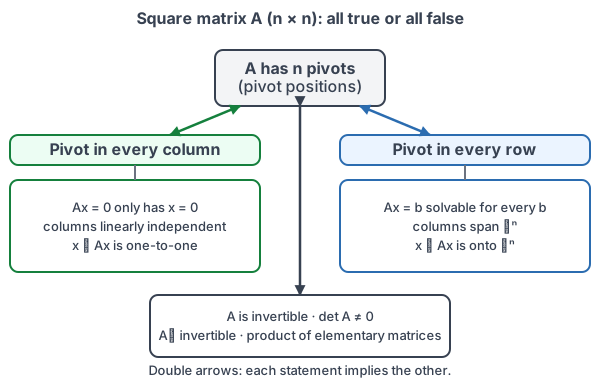
The invertible matrix theorem
Let A be an n × n matrix. The following statements are equivalent: for a given A, they are either all true or all false.
- (a) A is invertible.
- (b) A is row equivalent to the identity matrix Iₙ (its reduced row echelon form is Iₙ).
- (c) A has n pivot positions.
- (d) The equation Ax = 0 has only the trivial solution x = 0.
- (e) The columns of A are linearly independent.
- (f) The linear transformation x ↦ Ax is one-to-one.
- (g) The equation Ax = b has at least one solution for every b in ℝⁿ.
- (h) The columns of A span ℝⁿ.
- (i) The linear transformation x ↦ Ax maps ℝⁿ onto ℝⁿ.
- (j) There is an n × n matrix C with CA = I.
- (k) There is an n × n matrix D with AD = I.
- (l) Aᵀ is invertible.
- (m) det A ≠ 0.
- (n) A is a product of elementary matrices.
When A is invertible, the solution of Ax = b is also unique: it is x = A⁻¹b. Later lessons add more statements to the list, such as “0 is not an eigenvalue of A” and “the rank of A is n.”
A square matrix that is not invertible is called singular. For a singular matrix, every statement on the list is false: it has fewer than n pivots, Ax = 0 has nontrivial solutions, its columns are dependent and do not span ℝⁿ, and det A = 0.
How to use the invertible matrix theorem
- Make sure A is square. The theorem says nothing about m × n matrices with m ≠ n.
- Check the statement that is easiest for this matrix: a determinant for a 2 × 2 or 3 × 3 matrix, a pivot count after row reduction, or an obvious relation between the columns.
- If that statement is true, every statement is true. If it is false, every statement is false.
- Answer the question asked by reading off the matching statement from the list.
Invertible matrix theorem examples
Example 1: Count pivots, then read off the rest
Let A = [1 2 −1; 2 5 0; −1 −1 4] (rows separated by semicolons). Use row reduction to decide whether A is invertible. Then say what this means for Ax = 0, for the columns of A and for Ax = b.
\begin{bmatrix} 1 & 2 & -1 \\ 2 & 5 & 0 \\ -1 & -1 & 4 \end{bmatrix} \to \begin{bmatrix} 1 & 2 & -1 \\ 0 & 1 & 2 \\ -1 & -1 & 4 \end{bmatrix}R₂ − 2R₁ → R₂. Row 2: (2 − 2, 5 − 4, 0 + 2) = (0, 1, 2) (see Gaussian elimination).
\to \begin{bmatrix} 1 & 2 & -1 \\ 0 & 1 & 2 \\ 0 & 1 & 3 \end{bmatrix}R₃ + R₁ → R₃. Row 3: (−1 + 1, −1 + 2, 4 − 1) = (0, 1, 3).
\to \begin{bmatrix} 1 & 2 & -1 \\ 0 & 1 & 2 \\ 0 & 0 & 1 \end{bmatrix}R₃ − R₂ → R₃. Row 3: (0, 1 − 1, 3 − 2) = (0, 0, 1).
\text{pivots in columns } 1, 2, 3The echelon form has 3 pivots, and A is 3 × 3.
Answer: A has n = 3 pivots, so A is invertible. By the theorem, Ax = 0 has only the trivial solution, the columns of A are linearly independent and span ℝ³, and Ax = b has exactly one solution for every b in ℝ³.
Example 2: Spot a column relation
Let A = [1 2 3; 0 1 1; 2 −1 1]. Notice that column 3 equals column 1 plus column 2. What does the theorem say about A? Find a nontrivial solution of Ax = 0.
\mathbf{a}_1 + \mathbf{a}_2 = (1 + 2,\ 0 + 1,\ 2 - 1) = (3, 1, 1) = \mathbf{a}_3Add columns 1 and 2: the sum is column 3.
\mathbf{a}_1 + \mathbf{a}_2 - \mathbf{a}_3 = \mathbf{0}Subtract a₃ from both sides.
\mathbf{x} = (1, 1, -1)The weights 1, 1, −1 give a solution of Ax = 0.
A\mathbf{x} = \begin{bmatrix} 1(1) + 2(1) + 3(-1) \\ 0(1) + 1(1) + 1(-1) \\ 2(1) + (-1)(1) + 1(-1) \end{bmatrix} = \begin{bmatrix} 0 \\ 0 \\ 0 \end{bmatrix}Check by multiplying.
Answer: the columns are linearly dependent, so A is singular. By the theorem, A has fewer than 3 pivots, det A = 0, the columns do not span ℝ³, and some equations Ax = b have no solution. One nontrivial solution of Ax = 0 is x = (1, 1, −1).
Example 3: When is a 2 × 2 matrix invertible?
For which values of k is A = [k 4; 3 k + 1] invertible?
\det A = k(k + 1) - 4(3)
For a 2 × 2 matrix, det A = ad − bc.
= k^2 + k - 12
Distribute and multiply.
= (k + 4)(k - 3)
Factor the trinomial (see factoring trinomials).
(k + 4)(k - 3) = 0 \Rightarrow k = -4 \text{ or } k = 3Set each factor equal to 0.
Answer: A is invertible for every k except k = −4 and k = 3. Check k = 3: A = [3 4; 3 4] has two equal rows, so it is clearly singular.
Example 4: Reason from one fact
A is a 4 × 4 matrix, and the equation Ax = b has a solution for every b in ℝ⁴. Is the solution always unique? Can the columns of A be linearly dependent?
\text{(g) is true}“Ax = b has a solution for every b” is statement (g) of the list.
\text{(a) is true: } A^{-1} \text{ exists}A is square, so the theorem makes every statement true.
\mathbf{x} = A^{-1}\mathbf{b}Multiply both sides of Ax = b on the left by A⁻¹.
\text{(e) is true}Statement (e) says the columns are linearly independent.
Answer: yes, each solution is unique, namely x = A⁻¹b, and no, the columns cannot be dependent. The argument needs A to be square: a 4 × 5 matrix could have solutions for every b that are not unique.
Example 5: Can every grain order be filled?
A mill sells three blends of flour. One bag of blend 1 holds 2 kg wheat, 1 kg rye and 1 kg oats; blend 2 holds 1, 2 and 1 kg; blend 3 holds 1, 1 and 2 kg. A baker wants exact amounts of wheat, rye and oats. Can every order be filled by exactly one mix of bag counts? Then find the mix for 9 kg wheat, 8 kg rye and 7 kg oats.
A = \begin{bmatrix} 2 & 1 & 1 \\ 1 & 2 & 1 \\ 1 & 1 & 2 \end{bmatrix}Each column is one blend; each row is one grain.
\det A = 2(2 \cdot 2 - 1 \cdot 1) - 1(1 \cdot 2 - 1 \cdot 1) + 1(1 \cdot 1 - 2 \cdot 1)
Expand along row 1.
= 2(3) - 1(1) + 1(-1)
Work out each 2 × 2 determinant.
= 4
Multiply and add. Since 4 ≠ 0, A is invertible.
2x_1 + x_2 + x_3 = 9,\ \ x_1 + 2x_2 + x_3 = 8,\ \ x_1 + x_2 + 2x_3 = 7
Write Ax = b for b = (9, 8, 7).
4(x_1 + x_2 + x_3) = 24
Add the three equations.
x_1 + x_2 + x_3 = 6
Divide both sides by 4.
x_1 = 9 - 6 = 3,\ \ x_2 = 8 - 6 = 2,\ \ x_3 = 7 - 6 = 1
Each equation is (sum) + one variable, so subtract 6 from each right side.
Answer: det A = 4 ≠ 0, so every order (any b in ℝ³) has exactly one solution. For 9, 8 and 7 kg the mix is 3 bags of blend 1, 2 of blend 2 and 1 of blend 3. Check: 2(3) + 2 + 1 = 9, 3 + 2(2) + 1 = 8, 3 + 2 + 2(1) = 7. A real order also needs whole, nonnegative bag counts, which the theorem does not promise.
Common mistakes
| Mistake | Example of the error | Fix |
|---|---|---|
| Using the theorem on a non-square matrix | Saying a 3 × 4 matrix with independent rows is invertible | Only square matrices can be invertible; check the size first. |
| Mixing up “every row” and “every column” | Thinking a 3 × 3 matrix can have a pivot in every row but not in every column | For a square matrix, a pivot in every row means n pivots, which is a pivot in every column too. |
| Concluding from a nonzero entry | Saying A is invertible because no entry is 0 | A = [1 2; 2 4] has no zero entries, but det A = 0. |
| Forgetting that Ax = 0 always has x = 0 | Calling A singular because Ax = 0 has a solution | Every matrix has the trivial solution. A is singular when there is a nontrivial one. |
| Reading “invertible” as “every solution is nice” | Expecting whole-number bag counts in Example 5 for every order | The theorem gives exactly one real solution; whole numbers are a separate question. |
Related ideas
Inverse from one side. Statements (j) and (k) mean that for square matrices a one-sided inverse is automatically two-sided: if AD = I, then D = A⁻¹ and DA = I as well. This fails for non-square matrices. The inverse itself is found with the [A | I] method from the inverse matrices lesson.
What comes next. LU Decomposition factors A without finding A⁻¹. The determinant test (m) is developed in Properties of Determinants, and Cramer’s rule gives a formula for each entry of x = A⁻¹b when det A ≠ 0.
Practice problems
- Is A = [3 6; 1 2] invertible? Explain with the theorem.
- Is A = [1 2 0; 0 1 4; 0 0 5] invertible?
- A is 3 × 3 and its columns are linearly dependent. Does Ax = b have a solution for every b in ℝ³?
- A is 5 × 5 and x ↦ Ax is one-to-one. Is it onto ℝ⁵?
- Find every value of h that makes A = [1 h; 2 6] singular.
- Row reduce A = [1 −1 2; 2 1 1; 3 0 3]. Is A invertible? If not, find a nontrivial solution of Ax = 0.
- A and D are n × n and AD = I. Explain why DA = I too.
- A is 4 × 4 with det A = −2. Is Aᵀ invertible? Does Ax = 0 have a nontrivial solution?
- Is T(x₁, x₂) = (x₁ + 3x₂, 2x₁ + 6x₂) one-to-one? If not, find a nonzero x with T(x) = 0.
- Use a determinant to decide whether A = [2 1 0; 1 2 1; 0 1 2] is invertible.
Show answers
1.
\det A = 3(2) - 6(1)
Use det A = ad − bc.
= 0
Multiply and subtract.
Answer: no. det A = 0, so A is singular. Column 2 is 2 times column 1, so the columns are also dependent.
2.
\text{pivots: } 1, 1, 5 \text{ on the diagonal}A is already upper triangular with nonzero diagonal entries.
\det A = 1(1)(5) = 5
A triangular determinant is the product of the diagonal.
Answer: yes. A has 3 pivots and det A = 5 ≠ 0.
3.
\text{(e) is false}Dependent columns means statement (e) fails.
\text{(g) is false}A is square, so every statement fails.
Answer: no. Some b in ℝ³ give an equation Ax = b with no solution.
4.
\text{(f) is true}One-to-one is statement (f), and A is square.
\text{(i) is true}Every statement is then true, including onto.
Answer: yes, x ↦ Ax maps ℝ⁵ onto ℝ⁵ (and A is invertible).
5.
\det A = 1(6) - h(2) = 6 - 2h
Use det A = ad − bc.
6 - 2h = 0
A is singular exactly when det A = 0.
-2h = -6
Subtract 6 from both sides.
h = 3
Divide both sides by −2.
Answer: h = 3, which makes A = [1 3; 2 6] with column 2 = 3 × column 1.
6.
\begin{bmatrix} 1 & -1 & 2 \\ 2 & 1 & 1 \\ 3 & 0 & 3 \end{bmatrix} \to \begin{bmatrix} 1 & -1 & 2 \\ 0 & 3 & -3 \\ 3 & 0 & 3 \end{bmatrix}R₂ − 2R₁ → R₂. Row 2: (2 − 2, 1 + 2, 1 − 4) = (0, 3, −3).
\to \begin{bmatrix} 1 & -1 & 2 \\ 0 & 3 & -3 \\ 0 & 3 & -3 \end{bmatrix}R₃ − 3R₁ → R₃. Row 3: (3 − 3, 0 + 3, 3 − 6) = (0, 3, −3).
\to \begin{bmatrix} 1 & -1 & 2 \\ 0 & 3 & -3 \\ 0 & 0 & 0 \end{bmatrix}R₃ − R₂ → R₃. Only 2 pivots, so A is singular.
x_3 = t
x₃ is a free variable.
3x_2 - 3t = 0 \Rightarrow x_2 = t
Row 2: add 3t to both sides, then divide by 3.
x_1 - t + 2t = 0 \Rightarrow x_1 = -t
Row 1: substitute x₂ = t, combine like terms and subtract t.
\mathbf{x} = t(-1, 1, 1)Write the solution in parametric vector form.
Answer: not invertible. With t = 1, x = (−1, 1, 1): A x = (−1 − 1 + 2, −2 + 1 + 1, −3 + 0 + 3) = (0, 0, 0).
7.
\text{(k) is true}AD = I is statement (k).
A^{-1} \text{ exists}So statement (a) is true.
D = A^{-1}AD = A^{-1}I = A^{-1}Multiply AD = I on the left by A⁻¹.
DA = A^{-1}A = ISubstitute D = A⁻¹.
Answer: D must be A⁻¹, so DA = I.
8.
\det A = -2 \ne 0
Statement (m) is true.
Answer: Aᵀ is invertible (statement l), and Ax = 0 has only the trivial solution (statement d).
9.
A = \begin{bmatrix} 1 & 3 \\ 2 & 6 \end{bmatrix}Read the standard matrix from the coefficients.
\det A = 1(6) - 3(2) = 0
Use det A = ad − bc.
T(3, -1) = (3 - 3,\ 6 - 6) = (0, 0)
Column 2 is 3 times column 1, so try x = (3, −1).
Answer: T is not one-to-one; T(3, −1) = (0, 0) = T(0, 0).
10.
\det A = 2(2 \cdot 2 - 1 \cdot 1) - 1(1 \cdot 2 - 1 \cdot 0) + 0
Expand along row 1.
= 2(3) - 1(2)
Work out each 2 × 2 determinant.
= 4
Multiply and subtract.
Answer: yes, det A = 4 ≠ 0, so A is invertible.
Invertible matrix theorem FAQ
What is the invertible matrix theorem?
It is a list of statements about a square matrix A, such as “A is invertible,” “det A ≠ 0” and “the columns of A are linearly independent,” that are either all true or all false for each A.
Does the invertible matrix theorem apply to non-square matrices?
No. It is only for n × n matrices. A non-square matrix is never invertible, and for it “solutions always exist” and “solutions are unique” are separate questions.
What does it mean if the determinant of a matrix is 0?
The matrix is singular: it has no inverse, its columns are linearly dependent, and Ax = 0 has nontrivial solutions.
What is the fastest way to tell if a matrix is invertible?
For a 2 × 2 or 3 × 3 matrix, compute the determinant. For larger matrices, row reduce to echelon form and count the pivots; n pivots means invertible.
Summary
- The theorem applies only to square n × n matrices.
- All its statements are equivalent: invertible, n pivots, Ax = 0 has only x = 0, independent columns, columns span ℝⁿ, one-to-one, onto, det A ≠ 0, Aᵀ invertible, a product of elementary matrices.
- The key is the pivot count: for a square matrix, a pivot in every row is the same as a pivot in every column.
- If A is invertible, Ax = b has exactly one solution, x = A⁻¹b.
- A singular matrix fails every statement on the list.
Previous lesson: Elementary Matrices
Next lesson: LU Decomposition
Back to the Linear Algebra Index