
Properties of Determinants
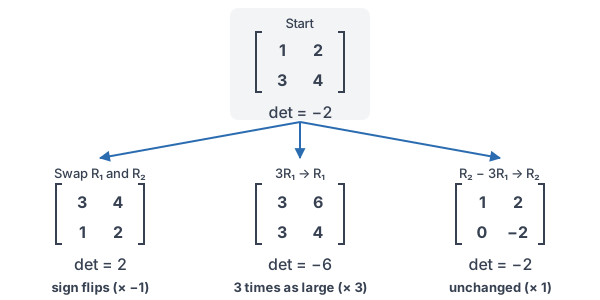
The properties of determinants tell you how a determinant changes when you change the matrix. Swapping two rows flips the sign, multiplying a row by k multiplies the determinant by k, and adding a multiple of one row to another changes nothing. Also, det(AB) = det A · det B and det(Aᵀ) = det A.
Before this lesson: Cofactor Expansion, Elementary Matrices and Transpose of a Matrix
Why these properties matter
Cofactor expansion works for any square matrix, but it gets slow fast: a 6 × 6 matrix with no zeros needs 720 products. Row reduction is much faster. These properties let you row-reduce a matrix to triangular form and keep track of how each step changed the determinant.
They also answer questions without any arithmetic. If you know det A, you can find det(3A), det(A⁻¹) or det(A⁵) right away, and you can spot a determinant of 0 just by seeing that one row is a combination of others.
Properties of determinants
Let A be an n × n matrix. The first three rules describe the three row operations:
| Row operation | Effect on the determinant | Elementary matrix E |
|---|---|---|
| Swap two rows (Rᵢ ↔ Rⱼ) | Multiplies det by −1 | det E = −1 |
| Multiply a row by k (kRᵢ → Rᵢ) | Multiplies det by k | det E = k |
| Add a multiple of one row to another (Rᵢ + cRⱼ → Rᵢ) | No change | det E = 1 |
The rest follow from these:
- Transpose: det(Aᵀ) = det A. So every rule above also works for columns.
- Products: det(AB) = det A · det B.
- Scalar multiples: det(kA) = kⁿ det A, because kA multiplies all n rows by k.
- Inverses: if A is invertible, det(A⁻¹) = 1/det A.
- Powers: det(Aᵐ) = (det A)ᵐ.
- Zero determinant: if A has a row of zeros, two equal rows, or one row that is a combination of other rows, then det A = 0.
- Triangular matrices: det A is the product of the diagonal entries.
- Invertibility: A is invertible if and only if det A ≠ 0.
Why they hold. Each row operation is multiplication by an elementary matrix E, and you can check det E directly for each type. The key fact is det(EA) = det E · det A. Row-reduce A to an echelon form U: if A is invertible, A is a product of elementary matrices and det(AB) = det A · det B follows; if not, U has a zero row and both sides of det(AB) = det A · det B are 0. The inverse rule comes from det A · det(A⁻¹) = det(AA⁻¹) = det I = 1.
How to find a determinant by row reduction
- Row-reduce A toward a triangular matrix, as in Gaussian elimination.
- Each time you swap two rows, multiply the running factor by −1.
- Each time you factor a number k out of a row, multiply the running factor by k.
- Row replacements (Rᵢ + cRⱼ → Rᵢ) need no change.
- Once the matrix is triangular, det A = (running factor) × (product of the diagonal).
Watch the direction of scaling. Writing det A = k · det B after you factor k out of a row of A is safe. If you instead multiply a row of A by k to get B, then det B = k · det A, so det A = det B ÷ k.
Properties of determinants examples
Example 1: Use det A to find other determinants
A is a 3 × 3 matrix with det A = 5. Find the determinant of each matrix.
\det B = -\det A = -5
(a) B is A with rows 1 and 2 swapped. A swap changes the sign.
\det C = 3\det A = 3(5) = 15
(b) C is A with row 3 multiplied by 3. Scaling one row by 3 scales det by 3.
\det D = \det A = 5
(c) D comes from A by R₂ + 4R₁ → R₂. A row replacement changes nothing.
\det(2A) = 2^{3}\det A = 8(5) = 40(d) 2A scales all 3 rows by 2, so use kⁿ with n = 3.
\det(A^{T}) = \det A = 5(e) The transpose has the same determinant.
\det(A^{-1}) = \dfrac{1}{\det A} = \dfrac{1}{5}(f) Use the inverse rule.
\det(A^{3}) = (\det A)^{3} = 5^{3} = 125(g) Use the product rule three times.
Answer: (a) −5, (b) 15, (c) 5, (d) 40, (e) 5, (f) 1/5, (g) 125.
Example 2: A 4 × 4 determinant by row reduction
Find det A for A = [0 1 2 −1; 2 4 −2 6; 1 3 0 2; −1 −1 4 1] (rows separated by semicolons).
\det A = \begin{vmatrix} 0 & 1 & 2 & -1 \\ 2 & 4 & -2 & 6 \\ 1 & 3 & 0 & 2 \\ -1 & -1 & 4 & 1 \end{vmatrix}Start with A. The top-left entry is 0, so a swap comes first.
= -\begin{vmatrix} 1 & 3 & 0 & 2 \\ 2 & 4 & -2 & 6 \\ 0 & 1 & 2 & -1 \\ -1 & -1 & 4 & 1 \end{vmatrix}R₁ ↔ R₃. A swap changes the sign.
= -2\begin{vmatrix} 1 & 3 & 0 & 2 \\ 1 & 2 & -1 & 3 \\ 0 & 1 & 2 & -1 \\ -1 & -1 & 4 & 1 \end{vmatrix}Factor 2 out of row 2.
= -2\begin{vmatrix} 1 & 3 & 0 & 2 \\ 0 & -1 & -1 & 1 \\ 0 & 1 & 2 & -1 \\ -1 & -1 & 4 & 1 \end{vmatrix}R₂ − R₁ → R₂ (no change). Row 2: (1 − 1, 2 − 3, −1 − 0, 3 − 2) = (0, −1, −1, 1).
= -2\begin{vmatrix} 1 & 3 & 0 & 2 \\ 0 & -1 & -1 & 1 \\ 0 & 1 & 2 & -1 \\ 0 & 2 & 4 & 3 \end{vmatrix}R₄ + R₁ → R₄ (no change). Row 4: (−1 + 1, −1 + 3, 4 + 0, 1 + 2) = (0, 2, 4, 3).
= -2\begin{vmatrix} 1 & 3 & 0 & 2 \\ 0 & -1 & -1 & 1 \\ 0 & 0 & 1 & 0 \\ 0 & 2 & 4 & 3 \end{vmatrix}R₃ + R₂ → R₃ (no change). Row 3: (0, 1 − 1, 2 − 1, −1 + 1) = (0, 0, 1, 0).
= -2\begin{vmatrix} 1 & 3 & 0 & 2 \\ 0 & -1 & -1 & 1 \\ 0 & 0 & 1 & 0 \\ 0 & 0 & 2 & 5 \end{vmatrix}R₄ + 2R₂ → R₄ (no change). Row 4: (0, 2 − 2, 4 − 2, 3 + 2) = (0, 0, 2, 5).
= -2\begin{vmatrix} 1 & 3 & 0 & 2 \\ 0 & -1 & -1 & 1 \\ 0 & 0 & 1 & 0 \\ 0 & 0 & 0 & 5 \end{vmatrix}R₄ − 2R₃ → R₄ (no change). Row 4: (0, 0, 2 − 2, 5 − 0) = (0, 0, 0, 5).
= -2(1)(-1)(1)(5)
The matrix is triangular: multiply the diagonal.
= 10
Multiply.
Answer: det A = 10. One swap and one factor of 2 were all there was to track.
Example 3: Check the product rule
Let A = [3 1; 4 2] and B = [1 −1; 2 5]. Find det A, det B and det(AB), and check that det(AB) = det A · det B.
\det A = 3(2) - 1(4) = 2
Use ad − bc.
\det B = 1(5) - (-1)(2) = 7
Use ad − bc.
AB = \begin{bmatrix} 3(1) + 1(2) & 3(-1) + 1(5) \\ 4(1) + 2(2) & 4(-1) + 2(5) \end{bmatrix} = \begin{bmatrix} 5 & 2 \\ 8 & 6 \end{bmatrix}Multiply rows of A by columns of B (see matrix multiplication).
\det(AB) = 5(6) - 2(8) = 14
Use ad − bc.
2 \cdot 7 = 14
Multiply det A by det B.
Answer: det A = 2, det B = 7 and det(AB) = 14 = 2 · 7. Note that det(A + B) is not det A + det B in general: A + B = [4 0; 6 7] has determinant 28, not 9.
Example 4: Spot a zero determinant
Find det A for A = [1 2 −1 3; 2 0 1 1; 3 2 0 4; 5 −1 2 6].
\text{row } 1 + \text{row } 2 = (1 + 2, 2 + 0, -1 + 1, 3 + 1) = (3, 2, 0, 4)Notice that row 3 looks like the sum of rows 1 and 2. Add them to check.
\det A = \begin{vmatrix} 1 & 2 & -1 & 3 \\ 2 & 0 & 1 & 1 \\ 2 & 0 & 1 & 1 \\ 5 & -1 & 2 & 6 \end{vmatrix}R₃ − R₁ → R₃ (no change). Row 3: (3 − 1, 2 − 2, 0 + 1, 4 − 3) = (2, 0, 1, 1).
= \begin{vmatrix} 1 & 2 & -1 & 3 \\ 2 & 0 & 1 & 1 \\ 0 & 0 & 0 & 0 \\ 5 & -1 & 2 & 6 \end{vmatrix}R₃ − R₂ → R₃ (no change). Row 3: (2 − 2, 0 − 0, 1 − 1, 1 − 1) = (0, 0, 0, 0).
= 0
A matrix with a row of zeros has determinant 0.
Answer: det A = 0, so A is not invertible. No cofactors were needed.
Example 5: Area after two transformations
A design app applies the transformation with matrix A = [2 1; 1 3] to a logo, and then the transformation with matrix B = [1 2; 0 −1]. The logo has an area of 12 cm². Find det(BA), the area of the final image, and whether the image is flipped.
\det A = 2(3) - 1(1) = 5
Use ad − bc.
\det B = 1(-1) - 2(0) = -1
Use ad − bc.
\det(BA) = \det B \cdot \det A = (-1)(5) = -5
Apply A first, then B, so the combined matrix is BA. Use the product rule.
|\det(BA)| \cdot 12 = 5 \cdot 12 = 60
A 2 × 2 matrix scales every area by |det| (see matrix transformations).
Answer: det(BA) = −5, so the final image has area 60 cm². The negative sign means the image is flipped (its orientation is reversed). Check: BA = [4 7; −1 −3], and 4(−3) − 7(−1) = −12 + 7 = −5.
Common mistakes
| Mistake | Example of the error | Fix |
|---|---|---|
| Writing det(kA) = k det A | Saying det(2A) = 10 when A is 3 × 3 and det A = 5 | Every row is scaled, so det(kA) = kⁿ det A = 8 · 5 = 40. |
| Forgetting the sign after a swap | Swapping rows and keeping the same determinant | Each swap multiplies the determinant by −1. |
| Scaling in the wrong direction | Multiplying row 1 of A by 3 and still writing det A = 3 det B | If B has row 1 multiplied by 3, then det B = 3 det A, so det A = det B ÷ 3. |
| Assuming det(A + B) = det A + det B | In Example 3, guessing det(A + B) = 2 + 7 = 9 | There is no sum rule; A + B = [4 0; 6 7] has determinant 28. |
| Changing the determinant for a row replacement | Multiplying by c after Rᵢ + cRⱼ → Rᵢ | Row replacements never change the determinant. |
Related ideas
Determinants of elementary matrices. The table’s last column explains every rule: det(EA) = det E · det A, and det E is −1, k or 1. This also proves that det A ≠ 0 exactly when A is invertible, which is statement (m) of the invertible matrix theorem.
Determinants from LU. If A = LU, the product rule gives det A = det L · det U = det U, the product of U’s pivots (see LU decomposition). Next, the cofactors from Cofactor Expansion build a formula for A⁻¹ in Adjugate Matrix.
Practice problems
In Problems 1–5, A is a 3 × 3 matrix with det A = −4.
- Find the determinant after swapping rows 1 and 3 of A.
- Find the determinant after multiplying row 2 of A by 5.
- Find the determinant after the row operation R₃ + 2R₁ → R₃.
- Find det(3A).
- Find det(A⁻¹), det(Aᵀ) and det(A²).
- Find det A by row reduction for A = [2 4 −2; 1 3 1; 3 5 0].
- Find det A by row reduction for A = [0 2 1 1; 1 1 0 2; 2 2 1 3; 1 3 2 4].
- A and B are 4 × 4 matrices with det A = 2 and det B = −3. Find det(AB) and det(2AB⁻¹).
- Without expanding, find det A for A = [1 0 2 1; 3 1 −1 2; 0 4 1 5; 4 1 1 3].
- A map app applies a transformation with determinant 3 twice to a park region of area 4 km², then a reflection with determinant −1. Find the determinant of the combined transformation and the area of the final region.
Show answers
1.
\det = -(-4) = 4
A swap changes the sign.
Answer: 4.
2.
\det = 5(-4) = -20
Scaling one row by 5 multiplies det by 5.
Answer: −20.
3.
\det = -4
A row replacement does not change the determinant.
Answer: −4.
4.
\det(3A) = 3^{3}(-4)All 3 rows are scaled by 3.
= 27(-4) = -108
Multiply.
Answer: −108.
5.
\det(A^{-1}) = \dfrac{1}{-4} = -\dfrac{1}{4}Use the inverse rule.
\det(A^{T}) = -4The transpose has the same determinant.
\det(A^{2}) = (-4)^{2} = 16Use the product rule: det A · det A.
Answer: −1/4, −4 and 16.
6.
\begin{vmatrix} 2 & 4 & -2 \\ 1 & 3 & 1 \\ 3 & 5 & 0 \end{vmatrix} = 2\begin{vmatrix} 1 & 2 & -1 \\ 1 & 3 & 1 \\ 3 & 5 & 0 \end{vmatrix}Factor 2 out of row 1.
= 2\begin{vmatrix} 1 & 2 & -1 \\ 0 & 1 & 2 \\ 3 & 5 & 0 \end{vmatrix}R₂ − R₁ → R₂. Row 2: (1 − 1, 3 − 2, 1 + 1) = (0, 1, 2).
= 2\begin{vmatrix} 1 & 2 & -1 \\ 0 & 1 & 2 \\ 0 & -1 & 3 \end{vmatrix}R₃ − 3R₁ → R₃. Row 3: (3 − 3, 5 − 6, 0 + 3) = (0, −1, 3).
= 2\begin{vmatrix} 1 & 2 & -1 \\ 0 & 1 & 2 \\ 0 & 0 & 5 \end{vmatrix}R₃ + R₂ → R₃. Row 3: (0, −1 + 1, 3 + 2) = (0, 0, 5).
= 2(1)(1)(5) = 10
Multiply the diagonal, then multiply by the factor 2.
Answer: det A = 10.
7.
\begin{vmatrix} 0 & 2 & 1 & 1 \\ 1 & 1 & 0 & 2 \\ 2 & 2 & 1 & 3 \\ 1 & 3 & 2 & 4 \end{vmatrix} = -\begin{vmatrix} 1 & 1 & 0 & 2 \\ 0 & 2 & 1 & 1 \\ 2 & 2 & 1 & 3 \\ 1 & 3 & 2 & 4 \end{vmatrix}R₁ ↔ R₂. A swap changes the sign.
= -\begin{vmatrix} 1 & 1 & 0 & 2 \\ 0 & 2 & 1 & 1 \\ 0 & 0 & 1 & -1 \\ 1 & 3 & 2 & 4 \end{vmatrix}R₃ − 2R₁ → R₃. Row 3: (2 − 2, 2 − 2, 1 − 0, 3 − 4) = (0, 0, 1, −1).
= -\begin{vmatrix} 1 & 1 & 0 & 2 \\ 0 & 2 & 1 & 1 \\ 0 & 0 & 1 & -1 \\ 0 & 2 & 2 & 2 \end{vmatrix}R₄ − R₁ → R₄. Row 4: (1 − 1, 3 − 1, 2 − 0, 4 − 2) = (0, 2, 2, 2).
= -\begin{vmatrix} 1 & 1 & 0 & 2 \\ 0 & 2 & 1 & 1 \\ 0 & 0 & 1 & -1 \\ 0 & 0 & 1 & 1 \end{vmatrix}R₄ − R₂ → R₄. Row 4: (0, 2 − 2, 2 − 1, 2 − 1) = (0, 0, 1, 1).
= -\begin{vmatrix} 1 & 1 & 0 & 2 \\ 0 & 2 & 1 & 1 \\ 0 & 0 & 1 & -1 \\ 0 & 0 & 0 & 2 \end{vmatrix}R₄ − R₃ → R₄. Row 4: (0, 0, 1 − 1, 1 + 1) = (0, 0, 0, 2).
= -(1)(2)(1)(2) = -4
Multiply the diagonal and keep the minus sign.
Answer: det A = −4.
8.
\det(AB) = 2(-3) = -6
Use the product rule.
\det(2AB^{-1}) = 2^{4} \cdot 2 \cdot \dfrac{1}{-3}Use kⁿ with n = 4, the product rule and the inverse rule.
= -\dfrac{32}{3}Multiply: 16 · 2 = 32.
Answer: det(AB) = −6 and det(2AB⁻¹) = −32/3.
9.
(1 + 3, 0 + 1, 2 - 1, 1 + 2) = (4, 1, 1, 3)
Row 1 + row 2 equals row 4.
\det A = 0
R₄ − R₁ → R₄ and then R₄ − R₂ → R₄ give a row of zeros, and neither step changes det A.
Answer: det A = 0.
10.
3 \cdot 3 \cdot (-1) = -9
The combined matrix is a product, so multiply the determinants.
|-9| \cdot 4 = 36
Area scales by |det|.
Answer: the combined determinant is −9, so the final region has area 36 km² and is flipped.
Properties of determinants FAQ
How do row operations affect the determinant?
Swapping two rows multiplies the determinant by −1. Multiplying a row by k multiplies it by k. Adding a multiple of one row to another leaves it unchanged.
Is det(AB) equal to det(A)det(B)?
Yes, for any two square matrices of the same size. It follows that det(AB) = det(BA), even when AB ≠ BA.
What is det(kA) for an n × n matrix?
det(kA) = kⁿ det A, because multiplying A by k multiplies each of its n rows by k. For a 3 × 3 matrix, det(2A) = 8 det A.
Is det(A + B) = det A + det B?
No. There is no simple rule for the determinant of a sum. For example, det I + det I = 2 for the 2 × 2 identity, but det(2I) = 4.
Summary
- A row swap multiplies det by −1, scaling a row by k multiplies det by k, and a row replacement changes nothing.
- det(Aᵀ) = det A, so the same rules hold for columns.
- det(AB) = det A · det B, det(A⁻¹) = 1/det A and det(kA) = kⁿ det A.
- A row of zeros, two equal rows, or a row that is a combination of others gives det A = 0.
- To find a large determinant, row-reduce to triangular form, track swaps and factors, and multiply the diagonal.
Previous lesson: Cofactor Expansion
Next lesson: Adjugate Matrix
Back to the Linear Algebra Index