
Adjugate Matrix
The adjugate matrix of a square matrix A, written adj A, is the transpose of the matrix of cofactors of A. It gives a formula for the inverse: if det A ≠ 0, then A⁻¹ = (1/det A) adj A. For a 2 × 2 matrix [a b; c d], adj A = [d −b; −c a].
Before this lesson: Cofactor Expansion, Properties of Determinants and Inverse Matrices
What the adjugate matrix is
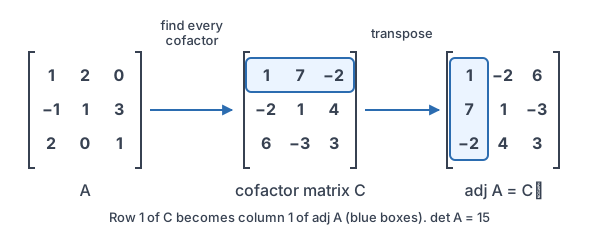
In cofactor expansion, each entry aᵢⱼ of A has a cofactor Cᵢⱼ = (−1)ⁱ⁺ʲMᵢⱼ. Put all n² cofactors in a grid, in the same positions as the entries, and you get the cofactor matrix C. Flip C over its main diagonal (take its transpose) and you get the adjugate.
The adjugate is also called the classical adjoint. Its big use is a formula for A⁻¹ built entirely from determinants. That formula is slow for large matrices, but it explains why A⁻¹ exists exactly when det A ≠ 0, and it is the fastest way to get one entry of A⁻¹.
The adjugate formula for the inverse
For an n × n matrix A with cofactors Cᵢⱼ, the adjugate is the transpose of the cofactor matrix, so the entry in row i, column j of adj A is Cⱼᵢ:
\operatorname{adj} A = \begin{bmatrix} C_{11} & C_{21} & \cdots & C_{n1} \\ C_{12} & C_{22} & \cdots & C_{n2} \\ \vdots & \vdots & & \vdots \\ C_{1n} & C_{2n} & \cdots & C_{nn} \end{bmatrix}The key fact is that A times its adjugate is a multiple of the identity:
A\,(\operatorname{adj} A) = (\det A)\,I \qquad\text{so, if } \det A \ne 0,\qquad A^{-1} = \frac{1}{\det A}\operatorname{adj} AWhy it works. Entry (i, i) of A(adj A) is aᵢ₁Cᵢ₁ + ⋯ + aᵢₙCᵢₙ, the cofactor expansion of det A along row i. Entry (i, k) with i ≠ k is aᵢ₁Cₖ₁ + ⋯ + aᵢₙCₖₙ, the expansion of a matrix whose row k has been replaced by row i. That matrix has two equal rows, so by the properties of determinants it equals 0.
For a 2 × 2 matrix the cofactors are single entries, which gives the familiar shortcut: swap a and d, and change the signs of b and c.
How to find the inverse with the adjugate
- Find det A. If det A = 0, stop: A has no inverse.
- Find all n² cofactors Cᵢⱼ = (−1)ⁱ⁺ʲMᵢⱼ and arrange them as the cofactor matrix C.
- Transpose C to get adj A.
- Multiply adj A by 1/det A.
- Check one or two entries of A·A⁻¹ against the identity.
Tip: once you have the cofactors of row 1, det A = a₁₁C₁₁ + a₁₂C₁₂ + ⋯ + a₁ₙC₁ₙ comes with little extra work.
Adjugate matrix examples
Example 1: The adjugate and inverse of a 2 × 2 matrix
Find adj A and A⁻¹ for A = [5 3; 4 2] (rows separated by semicolons).
\det A = 5(2) - 3(4) = -2
Use ad − bc.
\operatorname{adj} A = \begin{bmatrix} 2 & -3 \\ -4 & 5 \end{bmatrix}Swap 5 and 2, and change the signs of 3 and 4.
A^{-1} = -\dfrac{1}{2}\begin{bmatrix} 2 & -3 \\ -4 & 5 \end{bmatrix}Multiply adj A by 1/det A = −1/2.
= \begin{bmatrix} -1 & \frac{3}{2} \\ 2 & -\frac{5}{2} \end{bmatrix}Multiply each entry by −1/2 (see multiplying fractions).
\begin{bmatrix} 5 & 3 \\ 4 & 2 \end{bmatrix}\begin{bmatrix} -1 & \frac{3}{2} \\ 2 & -\frac{5}{2} \end{bmatrix} = \begin{bmatrix} 1 & 0 \\ 0 & 1 \end{bmatrix}Check: row 1 times column 1 is −5 + 6 = 1, and row 1 times column 2 is 15/2 − 15/2 = 0.
Answer: adj A = [2 −3; −4 5] and A⁻¹ = [−1 3/2; 2 −5/2].
Example 2: The adjugate of a 3 × 3 matrix
Find the cofactor matrix and the adjugate of A = [1 2 0; −1 1 3; 2 0 1].
C_{11} = \begin{vmatrix} 1 & 3 \\ 0 & 1 \end{vmatrix} = 1 - 0 = 1Delete row 1 and column 1. The sign at (1, 1) is +.
C_{12} = -\begin{vmatrix} -1 & 3 \\ 2 & 1 \end{vmatrix} = -(-1 - 6) = 7Delete row 1 and column 2. The sign is −.
C_{13} = \begin{vmatrix} -1 & 1 \\ 2 & 0 \end{vmatrix} = 0 - 2 = -2Delete row 1 and column 3. The sign is +.
C_{21} = -\begin{vmatrix} 2 & 0 \\ 0 & 1 \end{vmatrix} = -(2 - 0) = -2Delete row 2 and column 1. The sign is −.
C_{22} = \begin{vmatrix} 1 & 0 \\ 2 & 1 \end{vmatrix} = 1 - 0 = 1Delete row 2 and column 2. The sign is +.
C_{23} = -\begin{vmatrix} 1 & 2 \\ 2 & 0 \end{vmatrix} = -(0 - 4) = 4Delete row 2 and column 3. The sign is −.
C_{31} = \begin{vmatrix} 2 & 0 \\ 1 & 3 \end{vmatrix} = 6 - 0 = 6Delete row 3 and column 1. The sign is +.
C_{32} = -\begin{vmatrix} 1 & 0 \\ -1 & 3 \end{vmatrix} = -(3 - 0) = -3Delete row 3 and column 2. The sign is −.
C_{33} = \begin{vmatrix} 1 & 2 \\ -1 & 1 \end{vmatrix} = 1 + 2 = 3Delete row 3 and column 3. The sign is +.
C = \begin{bmatrix} 1 & 7 & -2 \\ -2 & 1 & 4 \\ 6 & -3 & 3 \end{bmatrix}Put each cofactor in its entry’s position.
\operatorname{adj} A = C^{T} = \begin{bmatrix} 1 & -2 & 6 \\ 7 & 1 & -3 \\ -2 & 4 & 3 \end{bmatrix}Transpose: row 1 of C becomes column 1 of adj A, and so on.
Answer: adj A = [1 −2 6; 7 1 −3; −2 4 3].
Example 3: The inverse from the adjugate
Use Example 2 to find A⁻¹ for A = [1 2 0; −1 1 3; 2 0 1].
\det A = 1(1) + 2(7) + 0(-2)
Expand along row 1 with the cofactors C₁₁ = 1, C₁₂ = 7 and C₁₃ = −2.
= 15
Multiply, then add.
A^{-1} = \dfrac{1}{15}\begin{bmatrix} 1 & -2 & 6 \\ 7 & 1 & -3 \\ -2 & 4 & 3 \end{bmatrix}Multiply adj A by 1/det A.
1(1) + 2(7) + 0(-2) = 15
Check entry (1, 1) of A(adj A): row 1 of A times column 1 of adj A gives det A.
1(-2) + 2(1) + 0(4) = 0
Check entry (1, 2): row 1 of A times column 2 of adj A gives 0.
Answer: A⁻¹ = (1/15)[1 −2 6; 7 1 −3; −2 4 3]. In entries: row 1 is (1/15, −2/15, 2/5), row 2 is (7/15, 1/15, −1/5) and row 3 is (−2/15, 4/15, 1/5).
Example 4: One entry of the inverse
For A = [2 1 3; 0 −1 2; 1 4 1], find the entry in row 2, column 3 of A⁻¹ without finding the whole inverse.
(A^{-1})_{23} = \dfrac{C_{32}}{\det A}Entry (i, j) of adj A is Cⱼᵢ, so entry (2, 3) of A⁻¹ uses C₃₂. Note the swapped indices.
C_{32} = -\begin{vmatrix} 2 & 3 \\ 0 & 2 \end{vmatrix} = -(4 - 0) = -4Delete row 3 and column 2. The sign at (3, 2) is −.
C_{11} = \begin{vmatrix} -1 & 2 \\ 4 & 1 \end{vmatrix} = -1 - 8 = -9For det A, expand down column 1, which has a 0. First find C₁₁.
C_{31} = \begin{vmatrix} 1 & 3 \\ -1 & 2 \end{vmatrix} = 2 + 3 = 5Delete row 3 and column 1. The sign is +.
\det A = 2(-9) + 0 + 1(5) = -13
Column 1 is (2, 0, 1): multiply each entry by its cofactor and add.
(A^{-1})_{23} = \dfrac{-4}{-13} = \dfrac{4}{13}Divide.
Answer: the entry in row 2, column 3 of A⁻¹ is 4/13.
Example 5: Decode a message
A puzzle club encodes three-letter words. Each letter becomes its place in the alphabet (A = 1, …, Z = 26), the word becomes a vector x, and the club sends y = Ax, where A = [1 2 1; 0 1 1; 1 1 1]. You receive y = (46, 29, 37). What is the word?
\det A = 1(1 - 1) - 2(0 - 1) + 1(0 - 1) = 0 + 2 - 1 = 1
Expand along row 1 and find each 2 × 2 determinant.
C_{11} = 1 - 1 = 0,\; C_{12} = -(0 - 1) = 1,\; C_{13} = 0 - 1 = -1Cofactors from row 1: delete row 1 and each column in turn.
C_{21} = -(2 - 1) = -1,\; C_{22} = 1 - 1 = 0,\; C_{23} = -(1 - 2) = 1Cofactors from row 2. Its signs are − + −.
C_{31} = 2 - 1 = 1,\; C_{32} = -(1 - 0) = -1,\; C_{33} = 1 - 0 = 1Cofactors from row 3. Its signs are + − +.
A^{-1} = \operatorname{adj} A = \begin{bmatrix} 0 & -1 & 1 \\ 1 & 0 & -1 \\ -1 & 1 & 1 \end{bmatrix}Transpose the cofactor matrix. Since det A = 1, A⁻¹ = adj A.
x_1 = 0(46) - 1(29) + 1(37) = 8
Row 1 of A⁻¹ times y.
x_2 = 1(46) + 0(29) - 1(37) = 9
Row 2 of A⁻¹ times y.
x_3 = -1(46) + 1(29) + 1(37) = 20
Row 3 of A⁻¹ times y.
Answer: x = (8, 9, 20), which spells HIT. Because det A = 1, the adjugate formula shows A⁻¹ has whole-number entries, so decoding never needs fractions.
Common mistakes
| Mistake | Example of the error | Fix |
|---|---|---|
| Forgetting to transpose | Using the cofactor matrix C as adj A | adj A = Cᵀ: entry (i, j) of adj A is Cⱼᵢ. |
| Dropping the cofactor signs | Using the minors Mᵢⱼ in place of Cᵢⱼ | Attach (−1)ⁱ⁺ʲ to every minor before you build C. |
| Using the wrong 2 × 2 pattern | Writing adj [5 3; 4 2] = [2 3; 4 5] | Swap a and d, and negate b and c: [2 −3; −4 5]. |
| Forgetting to divide by det A | Writing A⁻¹ = adj A when det A = 15 | A⁻¹ = (1/det A) adj A; adj A alone is the inverse only when det A = 1. |
| Using the formula when det A = 0 | Dividing by 0 for A = [1 2; 2 4] | If det A = 0, A has no inverse, even though adj A still exists. |
Related ideas
Cramer’s rule. Multiplying b by A⁻¹ = (1/det A) adj A and grouping the terms gives each xᵢ as a ratio of two determinants. That is Cramer’s rule, so the adjugate formula is the reason Cramer’s rule works.
Speed. For a 3 × 3 matrix the adjugate needs nine 2 × 2 determinants. For larger matrices, row-reducing [A | I] as in inverse matrices is much faster. Two more facts: A(adj A) = (det A)I gives det(adj A) = (det A)ⁿ⁻¹, and the next lesson, Determinants as Area and Volume (coming soon), shows what the size of det A means geometrically.
Practice problems
- Find adj A and A⁻¹ for A = [7 2; 3 1].
- Find A⁻¹ for A = [4 −2; 3 1] using the adjugate.
- Find the cofactor matrix of A = [2 0 1; 1 3 0; 0 1 4].
- Use Problem 3 to find det A, adj A and A⁻¹.
- For A = [3 1 0; 2 −1 4; 1 0 2], find the entry in row 1, column 3 of A⁻¹ without finding the whole inverse.
- Find adj A and A(adj A) for A = [1 2; 2 4]. Does A have an inverse?
- A is a 3 × 3 matrix with det A = 4. Find det(adj A).
- Find adj A and A⁻¹ for the upper triangular matrix A = [1 2 3; 0 1 4; 0 0 1].
- Solve Ax = b for A = [2 1; 5 3] and b = (4, 11) using A⁻¹ = (1/det A) adj A.
- The puzzle club in Example 5 sends y = (35, 21, 34). What is the word?
Show answers
1.
\det A = 7(1) - 2(3) = 1
Use ad − bc.
\operatorname{adj} A = \begin{bmatrix} 1 & -2 \\ -3 & 7 \end{bmatrix}Swap 7 and 1, and change the signs of 2 and 3.
A^{-1} = \dfrac{1}{1}\operatorname{adj} A = \begin{bmatrix} 1 & -2 \\ -3 & 7 \end{bmatrix}Divide by det A = 1.
Answer: adj A = A⁻¹ = [1 −2; −3 7].
2.
\det A = 4(1) - (-2)(3) = 10
Use ad − bc.
\operatorname{adj} A = \begin{bmatrix} 1 & 2 \\ -3 & 4 \end{bmatrix}Swap 4 and 1, and change the signs of −2 and 3.
A^{-1} = \dfrac{1}{10}\begin{bmatrix} 1 & 2 \\ -3 & 4 \end{bmatrix}Multiply by 1/det A.
Answer: A⁻¹ = (1/10)[1 2; −3 4] = [1/10 1/5; −3/10 2/5].
3.
C_{11} = 12 - 0 = 12,\; C_{12} = -(4 - 0) = -4,\; C_{13} = 1 - 0 = 1Row 1: delete row 1 and each column; signs + − +.
C_{21} = -(0 - 1) = 1,\; C_{22} = 8 - 0 = 8,\; C_{23} = -(2 - 0) = -2Row 2: signs − + −.
C_{31} = 0 - 3 = -3,\; C_{32} = -(0 - 1) = 1,\; C_{33} = 6 - 0 = 6Row 3: signs + − +.
Answer: C = [12 −4 1; 1 8 −2; −3 1 6].
4.
\det A = 2(12) + 0(-4) + 1(1) = 25
Expand along row 1 with the row 1 cofactors.
\operatorname{adj} A = C^{T} = \begin{bmatrix} 12 & 1 & -3 \\ -4 & 8 & 1 \\ 1 & -2 & 6 \end{bmatrix}Transpose C.
A^{-1} = \dfrac{1}{25}\begin{bmatrix} 12 & 1 & -3 \\ -4 & 8 & 1 \\ 1 & -2 & 6 \end{bmatrix}Multiply by 1/det A.
2(1) + 0(8) + 1(-2) = 0
Check: row 1 of A times column 2 of adj A is 0.
Answer: det A = 25, adj A = [12 1 −3; −4 8 1; 1 −2 6] and A⁻¹ = (1/25) adj A.
5.
(A^{-1})_{13} = \dfrac{C_{31}}{\det A}Entry (1, 3) of A⁻¹ uses C₃₁.
C_{31} = \begin{vmatrix} 1 & 0 \\ -1 & 4 \end{vmatrix} = 4 - 0 = 4Delete row 3 and column 1. The sign is +.
C_{11} = \begin{vmatrix} -1 & 4 \\ 0 & 2 \end{vmatrix} = -2 - 0 = -2For det A, expand along row 1, which has a 0. First find C₁₁.
C_{12} = -\begin{vmatrix} 2 & 4 \\ 1 & 2 \end{vmatrix} = -(4 - 4) = 0Delete row 1 and column 2. The sign is −.
\det A = 3(-2) + 1(0) + 0 = -6
Multiply each entry of row 1 by its cofactor and add.
(A^{-1})_{13} = \dfrac{4}{-6} = -\dfrac{2}{3}Divide and simplify.
Answer: −2/3.
6.
\operatorname{adj} A = \begin{bmatrix} 4 & -2 \\ -2 & 1 \end{bmatrix}Swap 1 and 4, and change the signs of both 2s.
A(\operatorname{adj} A) = \begin{bmatrix} 1(4) + 2(-2) & 1(-2) + 2(1) \\ 2(4) + 4(-2) & 2(-2) + 4(1) \end{bmatrix} = \begin{bmatrix} 0 & 0 \\ 0 & 0 \end{bmatrix}Multiply rows of A by columns of adj A.
Answer: A(adj A) is the zero matrix, which is (det A)I with det A = 0. A has no inverse.
7.
\det(\operatorname{adj} A) = (\det A)^{3-1}Use det(adj A) = (det A)ⁿ⁻¹ with n = 3.
= 4^{2} = 16Square 4.
Answer: 16.
8.
C_{11} = 1,\; C_{12} = 0,\; C_{13} = 0Row 1 cofactors: 1(1) − 4(0) = 1, −(0 − 0) = 0 and 0 − 0 = 0.
C_{21} = -(2 - 0) = -2,\; C_{22} = 1 - 0 = 1,\; C_{23} = -(0 - 0) = 0Row 2 cofactors, signs − + −.
C_{31} = 8 - 3 = 5,\; C_{32} = -(4 - 0) = -4,\; C_{33} = 1 - 0 = 1Row 3 cofactors, signs + − +.
\operatorname{adj} A = \begin{bmatrix} 1 & -2 & 5 \\ 0 & 1 & -4 \\ 0 & 0 & 1 \end{bmatrix}Transpose the cofactor matrix.
\det A = 1 \cdot 1 \cdot 1 = 1
A is triangular, so multiply the diagonal.
Answer: adj A = A⁻¹ = [1 −2 5; 0 1 −4; 0 0 1], because det A = 1.
9.
\det A = 2(3) - 1(5) = 1
Use ad − bc.
A^{-1} = \begin{bmatrix} 3 & -1 \\ -5 & 2 \end{bmatrix}adj A divided by 1.
x_1 = 3(4) - 1(11) = 1
Row 1 of A⁻¹ times b.
x_2 = -5(4) + 2(11) = 2
Row 2 of A⁻¹ times b.
Answer: x = (1, 2). Check: 2(1) + 2 = 4 and 5(1) + 3(2) = 11.
10.
x_1 = 0(35) - 1(21) + 1(34) = 13
Use A⁻¹ = adj A from Example 5. Row 1 times y.
x_2 = 1(35) + 0(21) - 1(34) = 1
Row 2 times y.
x_3 = -1(35) + 1(21) + 1(34) = 20
Row 3 times y.
Answer: x = (13, 1, 20), which spells MAT.
Adjugate matrix FAQ
What is the difference between the adjugate and the adjoint?
Older books call adj A the “adjoint” or “classical adjoint.” Today “adjoint” usually means the conjugate transpose, a different matrix, so “adjugate” avoids the mix-up.
How do you find the adjugate of a 2 × 2 matrix?
For A = [a b; c d], adj A = [d −b; −c a]: swap the diagonal entries and change the signs of the other two.
Does every square matrix have an adjugate?
Yes. Every square matrix has cofactors, so adj A always exists. It gives an inverse only when det A ≠ 0.
Is the adjugate method a good way to invert large matrices?
No. An n × n adjugate needs n² determinants of size n − 1, so it grows very fast. Use row reduction on [A | I] for anything larger than 3 × 3.
Summary
- The cofactor matrix C holds every cofactor Cᵢⱼ = (−1)ⁱ⁺ʲMᵢⱼ; the adjugate is adj A = Cᵀ.
- A(adj A) = (det A)I, so A⁻¹ = (1/det A) adj A whenever det A ≠ 0.
- For a 2 × 2 matrix, adj [a b; c d] = [d −b; −c a].
- One entry of A⁻¹: (A⁻¹)ᵢⱼ = Cⱼᵢ / det A, with the indices swapped.
- If det A = 1 and A has whole-number entries, so does A⁻¹.
Previous lesson: Properties of Determinants
Next lesson: Determinants as Area and Volume (coming soon)
Back to the Linear Algebra Index