
Determinants as Area and Volume
Determinants as area and volume: for vectors u and v in ℝ², the parallelogram they span has area |det[u v]|, and for vectors u, v and w in ℝ³, the parallelepiped they span has volume |det[u v w]|. So a linear transformation T(x) = Ax multiplies every area or volume by |det A|.
Before this lesson: Properties of Determinants, Linear Transformations and Matrix Transformations
What the determinant measures
Put two vectors u = (a, b) and v = (c, d) in the columns of a 2 × 2 matrix. The parallelogram with sides u and v, starting at the origin, has area |ad − bc|, which is exactly |det[u v]|. The absolute value is needed because a determinant can be negative, but an area cannot.
Here is a quick check when all four numbers are positive and v lies above u. Draw the rectangle that encloses the parallelogram: it is (a + c) by (b + d). Cutting off two triangles of area ab/2, two of area cd/2 and two rectangles of area bc leaves (a + c)(b + d) − ab − cd − 2bc = ad − bc.
The deeper reason comes from the properties of determinants. Scaling one column by k scales the area by |k|. Adding a multiple of one column to another is a shear, which slides one side of the parallelogram without changing its base or height. And det I = 1 matches the unit square. Area obeys the same three rules, so the two must agree.
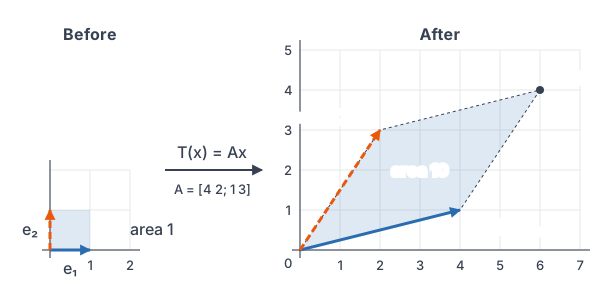
The area and volume formulas
Area in ℝ². The parallelogram with sides u = (u₁, u₂) and v = (v₁, v₂) has
\text{Area} = \left|\det\begin{bmatrix} u_1 & v_1 \\ u_2 & v_2 \end{bmatrix}\right| = |u_1 v_2 - v_1 u_2|Volume in ℝ³. The parallelepiped (a slanted box whose six faces are parallelograms) with edges u, v and w has
\text{Volume} = \left|\det\begin{bmatrix} u_1 & v_1 & w_1 \\ u_2 & v_2 & w_2 \\ u_3 & v_3 & w_3 \end{bmatrix}\right|Scaling by a linear transformation. If T(x) = Ax and S is any region with an area (in ℝ²) or a volume (in ℝ³), then
\text{Area of } T(S) = |\det A| \cdot \text{Area of } S \qquad \text{Volume of } T(S) = |\det A| \cdot \text{Volume of } SThis works for any region, not only parallelograms: fill S with tiny squares (or cubes), and each one becomes a tiny parallelogram (or parallelepiped) whose size is multiplied by |det A|.
How to find an area or volume with a determinant
- Find the edge vectors. If the shape does not start at the origin, subtract a shared corner from its two (or three) neighboring corners.
- Put the edge vectors in the columns of a matrix. (Rows work too, since det Aᵀ = det A.)
- Find the determinant.
- Take the absolute value. For a triangle, also take half.
- For a transformed region, multiply the original area or volume by |det A|. The sign of det A tells you whether the picture was flipped.
Determinants as area and volume examples
Example 1: The area of a parallelogram
Find the area of the parallelogram with sides u = (4, 1) and v = (2, 3).
\det\begin{bmatrix} 4 & 2 \\ 1 & 3 \end{bmatrix} = 4(3) - 2(1)Put u and v in the columns and use ad − bc (see determinant of a matrix).
= 12 - 2 = 10
Multiply, then subtract.
\text{Area} = |10| = 10Take the absolute value.
Answer: the area is 10 square units. This is the parallelogram in the figure above.
Example 2: A parallelogram that is not at the origin
A parallelogram has vertices P(1, 2), Q(6, 4), R(3, 7) and S(8, 9), where Q and R are the two vertices next to P. Find its area.
u = Q - P = (6 - 1,\ 4 - 2) = (5, 2)
Subtract the shared corner P from its neighbor Q.
v = R - P = (3 - 1,\ 7 - 2) = (2, 5)
Subtract P from its other neighbor R.
P + u + v = (1 + 5 + 2,\ 2 + 2 + 5) = (8, 9) = S
Check that the fourth corner is S, so u and v really are the sides.
\det\begin{bmatrix} 5 & 2 \\ 2 & 5 \end{bmatrix} = 5(5) - 2(2) = 21Put u and v in the columns and find the determinant.
\text{Area} = |21| = 21Take the absolute value.
Answer: the area is 21 square units.
Example 3: The volume of a parallelepiped
Find the volume of the parallelepiped with edges u = (2, 0, 1), v = (1, 3, 0) and w = (0, 1, 4).
A = \begin{bmatrix} 2 & 1 & 0 \\ 0 & 3 & 1 \\ 1 & 0 & 4 \end{bmatrix}Put u, v and w in the columns.
\det A = 2\begin{vmatrix} 3 & 1 \\ 0 & 4 \end{vmatrix} - 1\begin{vmatrix} 0 & 1 \\ 1 & 4 \end{vmatrix} + 0\begin{vmatrix} 0 & 3 \\ 1 & 0 \end{vmatrix}Expand along row 1 with the signs + − + (see cofactor expansion).
= 2(12 - 0) - 1(0 - 1) + 0
Find each 2 × 2 determinant.
= 24 + 1 = 25
Multiply, then add.
\text{Volume} = |25| = 25Take the absolute value.
Answer: the volume is 25 cubic units.
Example 4: How a transformation changes area
Let T(x) = Ax with A = [1 3; 2 1]. Find the area of the image of the triangle with vertices (0, 0), (2, 0) and (0, 3), and say whether T flips orientation.
\text{Area of triangle} = \tfrac{1}{2}(2)(3) = 3The triangle is a right triangle with legs 2 and 3 (see area of triangles).
\det A = 1(1) - 3(2) = -5
Use ad − bc.
\text{Area of image} = |-5| \cdot 3 = 15Multiply the area by |det A|.
T(2, 0) = (1(2) + 3(0),\ 2(2) + 1(0)) = (2, 4)
Check: find the image of the corner (2, 0).
T(0, 3) = (1(0) + 3(3),\ 2(0) + 1(3)) = (9, 3)
Find the image of the corner (0, 3). The corner (0, 0) stays at (0, 0).
\tfrac{1}{2}\left|\det\begin{bmatrix} 2 & 9 \\ 4 & 3 \end{bmatrix}\right| = \tfrac{1}{2}|6 - 36| = 15The image is a triangle with edge vectors (2, 4) and (9, 3); half the parallelogram area matches.
Answer: the image has area 15 square units. Since det A = −5 is negative, T flips orientation, like a mirror image.
Example 5: Volume of a crystal cell
The atoms in a crystal repeat in a slanted box called a unit cell. One unit cell has edge vectors a = (4, 0, 0), b = (1, 4, 0) and c = (1, 1, 5), in ångströms (Å). Find its volume. The crystal is then squeezed so that every point (x, y, z) moves to (x, y, 0.95z). Find the new volume.
M = \begin{bmatrix} 4 & 1 & 1 \\ 0 & 4 & 1 \\ 0 & 0 & 5 \end{bmatrix}Put a, b and c in the columns.
\det M = 4 \cdot 4 \cdot 5 = 80
M is upper triangular, so multiply the diagonal entries.
\text{Volume} = |80| = 80Take the absolute value. The units are cubic ångströms.
B = \begin{bmatrix} 1 & 0 & 0 \\ 0 & 1 & 0 \\ 0 & 0 & 0.95 \end{bmatrix}Write the squeeze as a matrix: it keeps x and y and multiplies z by 0.95.
\det B = 1 \cdot 1 \cdot 0.95 = 0.95
B is diagonal, so multiply the diagonal entries.
\text{New volume} = 0.95 \cdot 80 = 76Multiply the volume by |det B|. This equals |det(BM)| = |det B||det M|.
Answer: the unit cell has volume 80 ų before the squeeze and 76 ų after it.
Common mistakes
| Mistake | Example of the error | Fix |
|---|---|---|
| Leaving the sign on | Calling the area −22 when det[u v] = −22 | Area and volume are |det|, so the area is 22. The sign only tells orientation. |
| Using corners instead of edge vectors | Using (6, 4) and (3, 7) as the sides of the parallelogram in Example 2 | Subtract the shared corner first: u = (5, 2) and v = (2, 5). |
| Using a diagonal as a side | Using S − P = (7, 7) as an edge in Example 2 | Use the two corners next to the shared corner, not the opposite one. |
| Forgetting the 1/2 for a triangle | Saying the triangle with edge vectors (4, 1) and (1, 5) has area 19 | A triangle is half the parallelogram: 19/2 = 9.5. |
| Adding scale factors for a composition | Saying B after A scales area by 2 + 1 = 3 when det A = 2 and det B = −1 | Multiply: det(BA) = det B · det A = −2, so areas double and the picture is flipped. |
Related ideas
Orientation. If det A is positive, T keeps the order of the sides (counterclockwise stays counterclockwise in ℝ²). If det A is negative, T reverses it, as a reflection does. If det A = 0, T squashes the plane onto a line or a point (or space onto a plane or less), so every image has area or volume 0. This is the geometric side of the invertible matrix theorem: A is invertible exactly when it does not flatten space.
Compositions. Since det(BA) = det B · det A, doing T and then another transformation multiplies the scale factors, which fits composition of linear transformations.
The triple product and Jacobians. The scalar triple product w · (u × v) in the cross product lesson equals det[u v w], so it gives the same volume. In calculus, a nonlinear change of variables stretches each tiny piece of a region by the absolute value of a determinant, the Jacobian; see change of variables with the Jacobian.
Practice problems
- Find the area of the parallelogram with sides u = (3, 1) and v = (1, 4).
- Find the area of the parallelogram with sides u = (−2, 5) and v = (4, 1).
- A parallelogram has vertices (0, 1), (4, 2), (1, 5) and (5, 6), where (4, 2) and (1, 5) are next to (0, 1). Find its area.
- Find the area of the triangle with vertices (1, 1), (5, 2) and (2, 6).
- Find the volume of the parallelepiped with edges u = (1, 2, 0), v = (0, 1, 3) and w = (2, 0, 1).
- Do the vectors (1, 2, 3), (4, 5, 6) and (7, 8, 9) lie in one plane? Use a determinant.
- T(x) = Ax with A = [2 5; 1 4]. Find the area of the image of a disk of radius 3.
- T(x) = Ax with A = [0 2; 3 1]. A square has area 4. Find the area of its image, and say whether T flips orientation.
- T(x) = Ax with A = [2 0 0; 1 3 0; 4 1 1]. Find the volume of the image of the unit ball (radius 1).
- A logo has area 12 cm². An app applies A = [2 1; 0 1] and then the reflection B = [1 0; 0 −1]. Find the area of the final logo and say whether it is mirrored.
Show answers
1.
\det\begin{bmatrix} 3 & 1 \\ 1 & 4 \end{bmatrix} = 3(4) - 1(1) = 11Put u and v in the columns and use ad − bc.
\text{Area} = |11| = 11Take the absolute value.
Answer: 11 square units.
2.
\det\begin{bmatrix} -2 & 4 \\ 5 & 1 \end{bmatrix} = -2(1) - 4(5)Put u and v in the columns and use ad − bc.
= -2 - 20 = -22
Multiply, then subtract.
\text{Area} = |-22| = 22Take the absolute value.
Answer: 22 square units.
3.
u = (4 - 0,\ 2 - 1) = (4, 1)
Subtract the shared corner (0, 1) from (4, 2).
v = (1 - 0,\ 5 - 1) = (1, 4)
Subtract (0, 1) from (1, 5).
\det\begin{bmatrix} 4 & 1 \\ 1 & 4 \end{bmatrix} = 16 - 1 = 15Find the determinant.
Answer: 15 square units. Check: (0, 1) + u + v = (5, 6), the fourth corner.
4.
u = (5 - 1,\ 2 - 1) = (4, 1)
Subtract the corner (1, 1) from (5, 2).
v = (2 - 1,\ 6 - 1) = (1, 5)
Subtract (1, 1) from (2, 6).
\det\begin{bmatrix} 4 & 1 \\ 1 & 5 \end{bmatrix} = 20 - 1 = 19Find the determinant. This is the parallelogram’s area.
\text{Area} = \tfrac{1}{2}|19| = 9.5A triangle is half the parallelogram.
Answer: 9.5 square units.
5.
A = \begin{bmatrix} 1 & 0 & 2 \\ 2 & 1 & 0 \\ 0 & 3 & 1 \end{bmatrix}Put u, v and w in the columns.
\det A = 1\begin{vmatrix} 1 & 0 \\ 3 & 1 \end{vmatrix} - 0\begin{vmatrix} 2 & 0 \\ 0 & 1 \end{vmatrix} + 2\begin{vmatrix} 2 & 1 \\ 0 & 3 \end{vmatrix}Expand along row 1 with the signs + − +.
= 1(1 - 0) - 0 + 2(6 - 0)
Find each 2 × 2 determinant.
= 1 + 12 = 13
Multiply, then add.
Answer: 13 cubic units.
6.
\det\begin{bmatrix} 1 & 4 & 7 \\ 2 & 5 & 8 \\ 3 & 6 & 9 \end{bmatrix} = 1(45 - 48) - 4(18 - 24) + 7(12 - 15)Expand along row 1.
= -3 + 24 - 21 = 0
Multiply, then add.
Answer: yes. The determinant is 0, so the parallelepiped is flat (volume 0), and the three vectors lie in one plane through the origin.
7.
\det A = 2(4) - 5(1) = 3
Use ad − bc.
\text{Area of disk} = \pi(3)^2 = 9\piUse A = πr² (see area of a circle).
\text{Area of image} = 3 \cdot 9\pi = 27\piMultiply by |det A|.
Answer: 27π ≈ 84.8 square units. The image is an ellipse.
8.
\det A = 0(1) - 2(3) = -6
Use ad − bc.
\text{Area of image} = |-6| \cdot 4 = 24Multiply the area by |det A|.
Answer: 24 square units. The determinant is negative, so T flips orientation.
9.
\det A = 2 \cdot 3 \cdot 1 = 6
A is lower triangular, so multiply the diagonal entries.
\text{Volume of ball} = \tfrac{4}{3}\pi(1)^3 = \tfrac{4}{3}\piUse V = (4/3)πr³ (see volume of a sphere).
\text{Volume of image} = 6 \cdot \tfrac{4}{3}\pi = 8\piMultiply by |det A|.
Answer: 8π ≈ 25.1 cubic units.
10.
\det A = 2(1) - 1(0) = 2
Use ad − bc.
\det B = 1(-1) - 0(0) = -1
Use ad − bc.
\det(BA) = (-1)(2) = -2
The final matrix is BA, and det(BA) = det B · det A.
\text{Final area} = |-2| \cdot 12 = 24Multiply the area by |det(BA)|.
Answer: 24 cm². The determinant is negative, so the final logo is mirrored.
Determinants as area and volume FAQ
Why is the determinant the area of a parallelogram?
Both obey the same rules: scaling one side by k scales each by |k|, a shear changes neither, and the unit square gives 1. Those rules pin down a single value, so |det[u v]| must equal the area.
What does a negative determinant mean geometrically?
It means the transformation reverses orientation, like a mirror. The size of the change is still |det A|; the sign only records the flip.
How do you find the volume of a parallelepiped with a determinant?
Put its three edge vectors in the columns of a 3 × 3 matrix, find the determinant and take the absolute value. If the shape does not start at the origin, subtract a shared corner first.
What does a determinant of zero mean geometrically?
The columns lie on a line (in ℝ²) or in a plane (in ℝ³), so the parallelogram or box is flat and has no area or volume. The transformation squashes space and cannot be undone.
Summary
- The parallelogram with sides u and v has area |det[u v]|; the parallelepiped with edges u, v and w has volume |det[u v w]|.
- If a shape does not start at the origin, subtract a shared corner to get edge vectors. A triangle is half a parallelogram.
- A linear transformation T(x) = Ax multiplies every area or volume by |det A|.
- The sign of det A gives orientation: positive keeps it, negative flips it, and 0 flattens space.
- For a composition, det(BA) = det B · det A, so the scale factors multiply.
Previous lesson: Adjugate Matrix
Next lesson: Vector Spaces
Back to the Linear Algebra Index