
Jacobians and Change of Variables
A change of variables rewrites a multiple integral in new variables u and v to make the region or the integrand simpler. The Jacobian is the determinant that tells how much the substitution stretches area. You replace dA with |∂(x, y)/∂(u, v)| du dv and integrate over the new region.
Before this lesson: Double Integrals over General Regions, Double Integrals in Polar Coordinates, Partial Derivatives and Determinant of a Matrix
Why integrals need a stretch factor
In single-variable u-substitution, dx = g′(u) du. The factor g′(u) says how much a small piece of the u-axis is stretched when it is mapped to the x-axis. In two variables, a transformation x = x(u, v), y = y(u, v) maps a small rectangle in the uv-plane to a small, almost parallelogram-shaped patch in the xy-plane.
The area of that patch is the area of the rectangle, du dv, times a stretch factor. That factor is the absolute value of the Jacobian. You already met two Jacobians: r in polar and cylindrical coordinates, and ρ² sin φ in spherical coordinates.
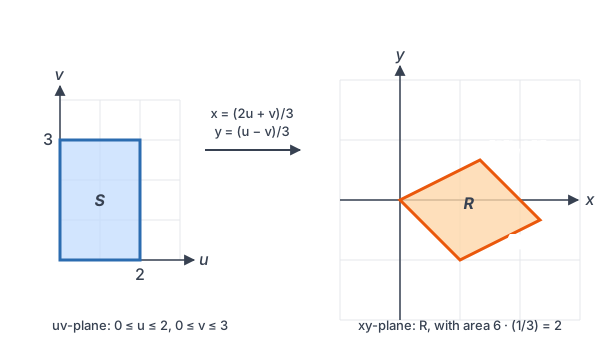
Jacobian and change of variables formula
\dfrac{\partial(x, y)}{\partial(u, v)} = \begin{vmatrix} \dfrac{\partial x}{\partial u} & \dfrac{\partial x}{\partial v} \\[2mm] \dfrac{\partial y}{\partial u} & \dfrac{\partial y}{\partial v} \end{vmatrix} = \dfrac{\partial x}{\partial u}\dfrac{\partial y}{\partial v} - \dfrac{\partial x}{\partial v}\dfrac{\partial y}{\partial u}\iint_R f(x, y)\,dA = \iint_S f\big(x(u, v), y(u, v)\big)\left|\dfrac{\partial(x, y)}{\partial(u, v)}\right|du\,dvHere S is the region in the uv-plane that the transformation maps onto R. Use the absolute value: the Jacobian can be negative, but area cannot.
- Choose u and v from the boundary curves or the integrand. Lines such as x + y = c suggest u = x + y.
- Solve for x and y in terms of u and v (or use the shortcut in Related methods).
- Compute the Jacobian ∂(x, y)/∂(u, v) and take its absolute value.
- Find the new region S by rewriting each boundary of R in u and v.
- Rewrite the integrand, multiply by |J| and integrate over S.
Jacobian change of variables examples
Example 1: The Jacobian of polar coordinates
Find the Jacobian of x = r cos θ, y = r sin θ.
\dfrac{\partial x}{\partial r} = \cos\theta, \quad \dfrac{\partial x}{\partial \theta} = -r\sin\thetaTake the partial derivatives of x.
\dfrac{\partial y}{\partial r} = \sin\theta, \quad \dfrac{\partial y}{\partial \theta} = r\cos\thetaTake the partial derivatives of y.
\dfrac{\partial(x, y)}{\partial(r, \theta)} = \cos\theta \cdot r\cos\theta - (-r\sin\theta)\sin\thetaApply the determinant formula.
= r\cos^2\theta + r\sin^2\theta
Multiply.
= r
Factor out r and use cos² θ + sin² θ = 1 (see fundamental trig identities).
Answer: the Jacobian is r. That is why dA = r dr dθ in double integrals in polar coordinates.
Example 2: A parallelogram region
Evaluate \iint_R (x + y)^2\,dA, where R is the parallelogram bounded by x + y = 0, x + y = 2, x − 2y = 0 and x − 2y = 3.
u = x + y, \quad v = x - 2y
The boundaries suggest these new variables.
0 \le u \le 2, \quad 0 \le v \le 3
The four boundary lines become the sides of a rectangle S.
u - v = 3y
Subtract the two equations: (x + y) − (x − 2y).
y = \dfrac{u - v}{3}Divide both sides by 3.
x = u - y = \dfrac{2u + v}{3}Solve u = x + y for x and substitute.
\dfrac{\partial(x, y)}{\partial(u, v)} = \dfrac{2}{3}\cdot\Big(-\dfrac{1}{3}\Big) - \dfrac{1}{3}\cdot\dfrac{1}{3}Apply the determinant formula: x_u = 2/3, x_v = 1/3, y_u = 1/3, y_v = −1/3.
= -\dfrac{3}{9} = -\dfrac{1}{3}Combine the fractions.
|J| = \dfrac{1}{3}Take the absolute value.
\iint_R (x + y)^2\,dA = \int_0^3 \int_0^2 u^2 \cdot \dfrac{1}{3}\,du\,dvRewrite the integral: (x + y)² = u².
\int_0^2 \dfrac{u^2}{3}\,du = \Big[\dfrac{u^3}{9}\Big]_0^2 = \dfrac{8}{9}Integrate in u.
\int_0^3 \dfrac{8}{9}\,dv = \dfrac{8}{3}Integrate in v: multiply by 3.
Answer: 8/3. In x and y, this region would need three separate integrals.
Example 3: Area of an ellipse
Find the area of the ellipse x²/9 + y²/4 ≤ 1.
x = 3u, \quad y = 2v
Stretch the unit circle: these make x²/9 + y²/4 = u² + v².
u^2 + v^2 \le 1
So S is the unit disk.
\dfrac{\partial(x, y)}{\partial(u, v)} = 3 \cdot 2 - 0 \cdot 0 = 6Apply the determinant formula: x_u = 3, x_v = 0, y_u = 0, y_v = 2.
\text{Area} = \iint_S 6\,du\,dvIntegrate 1 times |J|.
= 6 \cdot \pi(1)^2
The area of the unit disk is π.
= 6\pi
Multiply.
Answer: 6π ≈ 18.85. In general, an ellipse with semi-axes a and b has area πab.
Example 4: A region between hyperbolas
Evaluate \iint_R xy\,dA, where R is the region in the first quadrant between the hyperbolas xy = 1 and xy = 4 and the lines y = x and y = 4x.
u = xy, \quad v = \dfrac{y}{x}The boundaries are u = 1, u = 4, v = 1 and v = 4.
\dfrac{\partial(u, v)}{\partial(x, y)} = y \cdot \dfrac{1}{x} - x \cdot \Big(-\dfrac{y}{x^2}\Big)It is easier to find the Jacobian of u and v first: u_x = y, u_y = x, v_x = −y/x², v_y = 1/x.
= \dfrac{2y}{x} = 2vCombine like terms and use v = y/x.
\dfrac{\partial(x, y)}{\partial(u, v)} = \dfrac{1}{2v}Take the reciprocal. It is positive, since v ≥ 1.
\iint_R xy\,dA = \int_1^4 \int_1^4 u \cdot \dfrac{1}{2v}\,du\,dvRewrite: xy = u.
\int_1^4 u\,du = \dfrac{16 - 1}{2} = \dfrac{15}{2}Integrate in u.
\int_1^4 \dfrac{1}{2v}\,dv = \dfrac{1}{2}\ln 4 = \ln 2Integrate in v (see integrals that give natural logarithms) and use (1/2) ln 4 = ln 2.
\dfrac{15}{2}\ln 2 \approx 5.199The limits are constants, so multiply the two results.
Answer: (15/2) ln 2 ≈ 5.20.
Example 5: Water in an oval pond
An oval pond is 30 m long and 20 m wide, so its edge is the ellipse x²/225 + y²/100 = 1. Its depth in meters is d = 2(1 − x²/225 − y²/100), so it is 2 m deep in the middle. How much water does it hold?
V = \iint_R 2\Big(1 - \dfrac{x^2}{225} - \dfrac{y^2}{100}\Big)\,dAVolume = depth integrated over the surface of the pond.
x = 15u, \quad y = 10v
Change variables to turn the ellipse into the unit disk.
\dfrac{\partial(x, y)}{\partial(u, v)} = 15 \cdot 10 = 150Apply the determinant formula. The off-diagonal entries are 0.
V = \iint_{u^2 + v^2 \le 1} 2(1 - u^2 - v^2) \cdot 150\,du\,dvSubstitute: x²/225 = u² and y²/100 = v².
= 300\int_0^{2\pi} \int_0^1 (1 - r^2)\,r\,dr\,d\thetaSwitch the unit disk to polar coordinates.
\int_0^1 (r - r^3)\,dr = \dfrac{1}{2} - \dfrac{1}{4} = \dfrac{1}{4}Distribute the r and integrate in r.
V = 300 \cdot 2\pi \cdot \dfrac{1}{4}Integrate in θ: multiply by 2π.
= 150\pi \approx 471.2
Simplify and evaluate.
Answer: about 471 m³ of water. As a check, the surface area is π(15)(10) = 150π m², so the average depth is 1 m, half of the 2 m center depth.
Common mistakes
| Mistake | Example of the error | Fix |
|---|---|---|
| Forgetting the Jacobian | Writing ∫∫ u² du dv in Example 2 and getting 8 | Always multiply by |∂(x, y)/∂(u, v)|. |
| Using ∂(u, v)/∂(x, y) as the factor | Multiplying by 3 instead of 1/3 in Example 2 | The factor is ∂(x, y)/∂(u, v), the reciprocal of ∂(u, v)/∂(x, y). |
| Using a negative Jacobian | Multiplying by −1/3 and getting −8/3 | Take the absolute value of the Jacobian. |
| Keeping the old limits | Integrating over x and y limits after switching to u and v | Rewrite every boundary of R in u and v to find S. |
| Mixing up the determinant entries | Computing x_u y_u − x_v y_v | The determinant is x_u y_v − x_v y_u. |
Related methods
The Jacobian of the inverse transformation
If it is hard to solve for x and y, find u and v as functions of x and y and use ∂(x, y)/∂(u, v) = 1 ÷ ∂(u, v)/∂(x, y). Example 4 used this shortcut. In Example 2, ∂(u, v)/∂(x, y) = (1)(−2) − (1)(1) = −3, and its reciprocal is −1/3, as found above.
Jacobians for triple integrals
For x = x(u, v, w), y = y(u, v, w), z = z(u, v, w), the Jacobian is the 3 × 3 determinant of all nine partial derivatives, and dV = |∂(x, y, z)/∂(u, v, w)| du dv dw. For spherical coordinates this determinant is ρ² sin φ.
Practice problems
- Find the Jacobian of x = 3u − v, y = u + 2v.
- Find the Jacobian of x = uv, y = u.
- Use x = 5u, y = 4v to find the area of the ellipse x²/25 + y²/16 ≤ 1.
- Evaluate \iint_R (x - y)(x + y)\,dA, where R is the square bounded by x − y = 0, x − y = 2, x + y = 1 and x + y = 3.
- Find the area of the region R in Problem 4 with a change of variables.
- For u = x + y and v = x − 3y, find ∂(x, y)/∂(u, v) without solving for x and y.
- Evaluate \iint_R x^2\,dA, where R is the ellipse x²/4 + y² ≤ 1.
- Find the area of the region in the first quadrant between xy = 1 and xy = 3 and between the lines y = x and y = ex.
- Use x = 2u, y = 3v, z = 4w to find the volume of the ellipsoid x²/4 + y²/9 + z²/16 ≤ 1.
- An oval lawn has semi-axes 40 m and 25 m. One bag of fertilizer covers 400 m². Find the area of the lawn and the number of bags needed.
Show answers
1.
\dfrac{\partial(x, y)}{\partial(u, v)} = 3 \cdot 2 - (-1)(1)Apply the determinant formula: x_u = 3, x_v = −1, y_u = 1, y_v = 2.
= 7
Simplify: 6 + 1.
Answer: 7
2.
\dfrac{\partial(x, y)}{\partial(u, v)} = v \cdot 0 - u \cdot 1Apply the determinant formula: x_u = v, x_v = u, y_u = 1, y_v = 0.
= -u
Simplify.
Answer: −u, so the area factor is |u|.
3.
\dfrac{\partial(x, y)}{\partial(u, v)} = 5 \cdot 4 = 20Apply the determinant formula.
\text{Area} = 20 \cdot \pi = 20\piS is the unit disk, with area π.
Answer: 20π ≈ 62.83
4.
u = x - y, \quad v = x + y
Choose new variables: 0 ≤ u ≤ 2 and 1 ≤ v ≤ 3.
x = \dfrac{u + v}{2}, \quad y = \dfrac{v - u}{2}Add and subtract the two equations, then divide by 2.
\dfrac{\partial(x, y)}{\partial(u, v)} = \dfrac{1}{2} \cdot \dfrac{1}{2} - \dfrac{1}{2} \cdot \Big(-\dfrac{1}{2}\Big) = \dfrac{1}{2}Apply the determinant formula.
\int_1^3 \int_0^2 uv \cdot \dfrac{1}{2}\,du\,dvRewrite: (x − y)(x + y) = uv.
\dfrac{1}{2} \cdot 2 \cdot 4 = 4Split: the u integral is 2 and the v integral is (9 − 1)/2 = 4.
Answer: 4
5.
\text{Area} = \int_1^3 \int_0^2 \dfrac{1}{2}\,du\,dvIntegrate 1 times |J| over S.
= \dfrac{1}{2} \cdot 2 \cdot 2 = 2S is a 2-by-2 square.
Answer: 2
6.
\dfrac{\partial(u, v)}{\partial(x, y)} = 1 \cdot (-3) - 1 \cdot 1 = -4Apply the determinant formula to u and v.
\dfrac{\partial(x, y)}{\partial(u, v)} = -\dfrac{1}{4}Take the reciprocal.
Answer: −1/4 (area factor 1/4)
7.
x = 2u, \quad y = v, \quad |J| = 2
Turn the ellipse into the unit disk.
\iint_R x^2\,dA = \iint_S 4u^2 \cdot 2\,du\,dv = 8\iint_S u^2\,du\,dv
Substitute x² = 4u².
\iint_S u^2\,du\,dv = \int_0^{2\pi} \cos^2\theta\,d\theta \int_0^1 r^3\,drUse polar coordinates: u = r cos θ, with the extra r.
= \pi \cdot \dfrac{1}{4}Integrate each factor.
8 \cdot \dfrac{\pi}{4} = 2\piMultiply.
Answer: 2π ≈ 6.28
8.
u = xy, \quad v = \dfrac{y}{x}, \quad |J| = \dfrac{1}{2v}Use the result of Example 4: 1 ≤ u ≤ 3 and 1 ≤ v ≤ e.
\text{Area} = \int_1^e \int_1^3 \dfrac{1}{2v}\,du\,dvIntegrate 1 times |J|.
= 2 \cdot \dfrac{1}{2}(\ln e - \ln 1) = 1The u integral is 2 and the v integral is (1/2) ln v from 1 to e.
Answer: 1
9.
\dfrac{\partial(x, y, z)}{\partial(u, v, w)} = 2 \cdot 3 \cdot 4 = 24The determinant of a diagonal matrix is the product of its diagonal.
V = 24 \cdot \dfrac{4\pi}{3} = 32\piS is the unit ball, with volume 4π/3.
Answer: 32π ≈ 100.53
10.
\text{Area} = \pi(40)(25) = 1000\pi \approx 3141.6Use x = 40u, y = 25v: |J| = 1000 and the unit disk has area π.
\dfrac{3141.6}{400} \approx 7.85Divide by the area one bag covers.
Answer: about 3142 m²; 8 bags (7 bags would cover only 2800 m²)
Jacobian and change of variables FAQ
What is a Jacobian in calculus?
It is the determinant of the partial derivatives of a transformation. Its absolute value is the factor by which the transformation stretches small areas (or volumes in 3D).
Why do you take the absolute value of the Jacobian?
A negative Jacobian only means the transformation flips orientation, like a mirror. Area is always positive, so the integral uses |J|.
How do you choose u and v?
Look at the boundary curves. If R is bounded by x + y = 0 and x + y = 2, then u = x + y turns those into u = 0 and u = 2. Sometimes the integrand suggests u and v instead.
What is the Jacobian for polar coordinates?
It is r, so dA = r dr dθ. For cylindrical coordinates it is also r, and for spherical coordinates it is ρ² sin φ.
Summary
- The Jacobian is ∂(x, y)/∂(u, v) = x_u y_v − x_v y_u.
- Change of variables: dA = |∂(x, y)/∂(u, v)| du dv, over the new region S.
- Pick u and v that turn the boundaries of R into constants.
- If u and v are given in terms of x and y, use the reciprocal of ∂(u, v)/∂(x, y).
- Polar: J = r. Spherical: J = ρ² sin φ.
Previous lesson: Triple Integrals in Spherical Coordinates
Next lesson: Vector Fields
Back to the Calculus 3 Index