
U-Substitution
U-substitution is a way to find integrals by changing the variable. Let u be an inside function g(x) whose derivative also appears in the integral. Replace g′(x) dx with du, integrate in terms of u, then put g(x) back in for u. It undoes the chain rule: \int f\big(g(x)\big)\,g'(x)\,dx = \int f(u)\,du.
Before this lesson: Antiderivatives and Indefinite Integrals, Chain Rule and Differentials
Why u-substitution works
Start with a derivative you know. By the chain rule, the derivative of sin(x²) is cos(x²) · 2x. Read that backward: the integral of cos(x²) · 2x is sin(x²) + C.
The integrand has two parts: a function of an inside piece, cos(x²), and the derivative of that inside piece, 2x. When you see that pattern, call the inside piece u. The 2x dx becomes du, and the messy integral turns into a basic one.
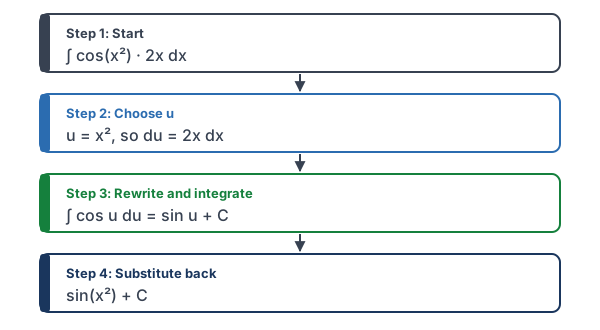
U-substitution formula and steps
If u = g(x), then du = g′(x) dx, and:
\int f\big(g(x)\big)\,g'(x)\,dx = \int f(u)\,du
How to do u-substitution:
- Choose u. Good choices are the inside of a power, a root, a trig function or an exponent, especially when its derivative appears elsewhere.
- Find du = u′ dx (see differentials).
- Rewrite the whole integral in terms of u. If a constant is off, divide it out. No x may be left.
- Integrate with respect to u.
- Substitute g(x) back in for u and add + C.
- Check: the derivative of your answer should be the original integrand.
U-substitution examples
Example 1: A power of an inside function
Find \int 2x(x^2 + 5)^4\,dx.
u = x^2 + 5
Let u be the inside of the power.
du = 2x\,dx
Differentiate u. The 2x dx is already in the integral.
\int 2x(x^2 + 5)^4\,dx = \int u^4\,du
Replace x² + 5 with u and 2x dx with du.
= \dfrac{u^5}{5} + CIntegrate with the power rule (see antiderivatives).
= \dfrac{(x^2 + 5)^5}{5} + CSubstitute x² + 5 back in for u.
Answer: \dfrac{(x^2 + 5)^5}{5} + C. Check: by the chain rule, the derivative is (x² + 5)⁴ · 2x.
Example 2: Fixing a constant
Find \int x^2\sqrt{x^3 + 1}\,dx.
u = x^3 + 1
Let u be the inside of the root.
du = 3x^2\,dx
Differentiate u.
x^2\,dx = \dfrac{1}{3}\,duThe integral has x² dx, not 3x² dx, so divide both sides by 3.
\int x^2\sqrt{x^3 + 1}\,dx = \int \dfrac{1}{3}u^{1/2}\,duReplace x³ + 1 with u, write the root as a power (see rational exponents), and replace x² dx.
= \dfrac{1}{3}\cdot\dfrac{2}{3}u^{3/2} + CPower rule: add 1 to get 3/2, then divide by 3/2.
= \dfrac{2}{9}(x^3 + 1)^{3/2} + CMultiply the fractions and substitute back.
Answer: \dfrac{2}{9}(x^3 + 1)^{3/2} + C
Example 3: A linear inside function
Find \int \sin(5x)\,dx.
u = 5x
Let u be the inside of the sine.
du = 5\,dx
Differentiate u, so dx = du/5.
\int \sin(5x)\,dx = \int \dfrac{1}{5}\sin u\,duReplace 5x with u and dx with du/5.
= -\dfrac{1}{5}\cos u + CAn antiderivative of sin u is −cos u.
= -\dfrac{1}{5}\cos(5x) + CSubstitute back.
Answer: -\dfrac{1}{5}\cos(5x) + C. Shortcut: when the inside is ax + b, integrate as usual and divide by a.
Example 4: An exponential
Find \int x e^{-x^2}\,dx.
u = -x^2
Let u be the exponent.
du = -2x\,dx
Differentiate u.
x\,dx = -\dfrac{1}{2}\,duDivide both sides by −2.
\int x e^{-x^2}\,dx = \int -\dfrac{1}{2}e^u\,duReplace −x² with u and x dx with −du/2.
= -\dfrac{1}{2}e^u + Ce^u is its own antiderivative.
= -\dfrac{1}{2}e^{-x^2} + CSubstitute back.
Answer: -\dfrac{1}{2}e^{-x^2} + C. Notice that the x outside the exponent is what makes this work. Without it, \int e^{-x^2}\,dx has no basic antiderivative.
Example 5: A growing population
A town’s population grows at a rate of P'(t) = \dfrac{40t}{\sqrt{t^2 + 9}} people per year, t years from now. Today the population is 500. Find P(t) and the population 4 years from now.
u = t^2 + 9
Let u be the inside of the root.
du = 2t\,dt
Differentiate u, so 40t dt = 20 du.
\int \dfrac{40t}{\sqrt{t^2 + 9}}\,dt = \int 20u^{-1/2}\,duReplace t² + 9 with u and 40t dt with 20 du.
= 40u^{1/2} + CPower rule: 20 divided by 1/2 is 40.
= 40\sqrt{t^2 + 9} + CSubstitute back.
40\sqrt{0 + 9} + C = 500Use P(0) = 500.
120 + C = 500
√9 = 3, and 40 · 3 = 120.
C = 380
Subtract 120 from both sides.
40\sqrt{16 + 9} + 380 = 40(5) + 380 = 580Find P(4).
Answer: P(t) = 40\sqrt{t^2 + 9} + 380, and the population in 4 years is 580.
Common mistakes
| Mistake | Example of the error | Fix |
|---|---|---|
| Not replacing dx | \int \sin(5x)\,dx = -\cos(5x) + C | du = 5 dx, so dx = du/5: the answer is -\dfrac{1}{5}\cos(5x) + C. |
| Leaving an x in the u-integral | \int 2x(x^2 + 5)^4\,dx = \int 2x\,u^4\,du | The 2x dx becomes du. Every x must turn into u. |
| Forgetting to substitute back | Final answer \dfrac{u^5}{5} + C | The question is in x, so the answer must be too. |
| Dropping the constant factor | \int x^2\sqrt{x^3 + 1}\,dx = \dfrac{2}{3}(x^3 + 1)^{3/2} + C | x² dx = du/3, so multiply by 1/3: \dfrac{2}{9}(x^3 + 1)^{3/2} + C. |
| Picking a u whose derivative is missing | \int e^{x^2}\,dx with u = x² | du = 2x dx, but there is no x. U-substitution does not work here. |
Related methods
When an x is left over
Sometimes an extra x remains after you replace du. Solve the u equation for x and substitute that too. For \int x\sqrt{x + 1}\,dx, let u = x + 1. Then x = u − 1, and the integral becomes \int (u - 1)u^{1/2}\,du. Practice problem 9 works this out.
Definite integrals
With limits, you can change the limits to u-values and skip substituting back. That is the next lesson, U-Substitution with Definite Integrals.
Integrals that give logarithms
When u ends up in a denominator by itself, as in \int \dfrac{2x}{x^2 + 1}\,dx, the answer uses ln |u|. These come later in this unit, in Integrals That Give Natural Logarithms.
Practice problems
- Find \int 3x^2(x^3 - 2)^5\,dx.
- Find \int (4x + 1)^3\,dx.
- Find \int x\sqrt{x^2 + 4}\,dx.
- Find \int \cos(3x)\,dx.
- Find \int e^{7x}\,dx.
- Find \int \sin x\cos^4 x\,dx.
- Find \int \dfrac{x}{(x^2 + 1)^3}\,dx.
- Find \int \sec^2(2x)\,dx.
- Find \int x\sqrt{x + 1}\,dx.
- A young tree is 2 feet tall. It grows at a rate of h'(t) = \dfrac{3t}{\sqrt{t^2 + 16}} feet per year, t years after planting. Find h(t) and the tree’s height after 3 years.
Show answers
1.
u = x^3 - 2
Let u be the inside of the power.
du = 3x^2\,dx
Differentiate u.
\int 3x^2(x^3 - 2)^5\,dx = \int u^5\,du = \dfrac{u^6}{6} + CSubstitute and integrate.
= \dfrac{(x^3 - 2)^6}{6} + CSubstitute back.
Answer: \dfrac{(x^3 - 2)^6}{6} + C
2.
u = 4x + 1
Let u be the inside.
du = 4\,dx
Differentiate u, so dx = du/4.
\int (4x + 1)^3\,dx = \int \dfrac{1}{4}u^3\,du = \dfrac{u^4}{16} + CSubstitute and integrate.
= \dfrac{(4x + 1)^4}{16} + CSubstitute back.
Answer: \dfrac{(4x + 1)^4}{16} + C
3.
u = x^2 + 4
Let u be the inside of the root.
du = 2x\,dx
Differentiate u, so x dx = du/2.
\int x\sqrt{x^2 + 4}\,dx = \int \dfrac{1}{2}u^{1/2}\,duSubstitute.
= \dfrac{1}{2}\cdot\dfrac{2}{3}u^{3/2} + C = \dfrac{1}{3}u^{3/2} + CIntegrate and multiply.
= \dfrac{1}{3}(x^2 + 4)^{3/2} + CSubstitute back.
Answer: \dfrac{1}{3}(x^2 + 4)^{3/2} + C
4.
u = 3x
Let u be the inside.
du = 3\,dx
Differentiate u, so dx = du/3.
\int \cos(3x)\,dx = \int \dfrac{1}{3}\cos u\,du = \dfrac{1}{3}\sin u + CSubstitute and integrate.
= \dfrac{1}{3}\sin(3x) + CSubstitute back.
Answer: \dfrac{1}{3}\sin(3x) + C
5.
u = 7x
Let u be the exponent.
du = 7\,dx
Differentiate u, so dx = du/7.
\int e^{7x}\,dx = \int \dfrac{1}{7}e^u\,du = \dfrac{1}{7}e^u + CSubstitute and integrate.
= \dfrac{1}{7}e^{7x} + CSubstitute back.
Answer: \dfrac{1}{7}e^{7x} + C
6.
u = \cos x
Let u be the base of the power.
du = -\sin x\,dx
Differentiate u, so sin x dx = −du.
\int \sin x\cos^4 x\,dx = \int -u^4\,du = -\dfrac{u^5}{5} + CSubstitute and integrate.
= -\dfrac{\cos^5 x}{5} + CSubstitute back.
Answer: -\dfrac{\cos^5 x}{5} + C
7.
u = x^2 + 1
Let u be the inside of the power.
du = 2x\,dx
Differentiate u, so x dx = du/2.
\int \dfrac{x}{(x^2 + 1)^3}\,dx = \int \dfrac{1}{2}u^{-3}\,duSubstitute; 1/u³ is u⁻³.
= \dfrac{1}{2}\cdot\dfrac{u^{-2}}{-2} + C = -\dfrac{1}{4u^2} + CPower rule, then simplify.
= -\dfrac{1}{4(x^2 + 1)^2} + CSubstitute back.
Answer: -\dfrac{1}{4(x^2 + 1)^2} + C
8.
u = 2x
Let u be the inside.
du = 2\,dx
Differentiate u, so dx = du/2.
\int \sec^2(2x)\,dx = \int \dfrac{1}{2}\sec^2 u\,du = \dfrac{1}{2}\tan u + CThe derivative of tan u is sec² u.
= \dfrac{1}{2}\tan(2x) + CSubstitute back.
Answer: \dfrac{1}{2}\tan(2x) + C
9.
u = x + 1
Let u be the inside of the root.
du = 1\,dx
Differentiate u; also x = u − 1.
\int x\sqrt{x + 1}\,dx = \int (u - 1)u^{1/2}\,duReplace x with u − 1 and the root with u^(1/2).
= \int (u^{3/2} - u^{1/2})\,duDistribute (see distributive property).
= \dfrac{2}{5}u^{5/2} - \dfrac{2}{3}u^{3/2} + CPower rule on each term.
= \dfrac{2}{5}(x + 1)^{5/2} - \dfrac{2}{3}(x + 1)^{3/2} + CSubstitute back.
Answer: \dfrac{2}{5}(x + 1)^{5/2} - \dfrac{2}{3}(x + 1)^{3/2} + C
10.
u = t^2 + 16
Let u be the inside of the root.
du = 2t\,dt
Differentiate u, so 3t dt = (3/2) du.
\int \dfrac{3t}{\sqrt{t^2 + 16}}\,dt = \int \dfrac{3}{2}u^{-1/2}\,du = 3u^{1/2} + CSubstitute and integrate.
= 3\sqrt{t^2 + 16} + CSubstitute back.
3\sqrt{0 + 16} + C = 2Use h(0) = 2.
12 + C = 2
√16 = 4, and 3 · 4 = 12.
C = -10
Subtract 12 from both sides.
3\sqrt{9 + 16} - 10 = 3(5) - 10 = 5Find h(3).
Answer: h(t) = 3\sqrt{t^2 + 16} - 10; the tree is 5 feet tall after 3 years.
U-substitution FAQ
How do you know what to pick for u?
Look for an inside function whose derivative also appears, up to a constant. The inside of a power, a root, an exponent or a trig function is usually a good choice.
What does du mean in u-substitution?
du is the differential of u: du = u′(x) dx. It tells you how to trade the x-pieces of the integral for u-pieces.
Why do you substitute back at the end?
The question asks for a function of x. The u was only a helper, so you replace it with g(x) before you finish.
How do you check a u-substitution answer?
Differentiate it with the chain rule. If you get the original integrand, the answer is right.
Summary
- U-substitution reverses the chain rule: \int f\big(g(x)\big)\,g'(x)\,dx = \int f(u)\,du.
- Choose u as an inside function whose derivative is in the integral.
- Find du, then rewrite everything in u; divide out any missing constant.
- Integrate, substitute back and add + C.
- If an x is left over, solve the u equation for x.
- Check your answer by differentiating.
Previous lesson: Displacement and Total Distance
Next lesson: U-Substitution with Definite Integrals
Back to the Calculus 1 Index