
Integrals That Give Natural Logarithms
Integrals that give natural logarithms have a numerator that is the derivative of the denominator: \int \dfrac{g'(x)}{g(x)}\,dx = \ln|g(x)| + C. The simplest case is \int \dfrac{1}{x}\,dx = \ln|x| + C. The same rule gives the integrals of tan x, cot x, sec x and csc x.
Before this lesson: U-Substitution, Derivatives of Logarithmic Functions and Properties of Logarithms
Why the answer is a logarithm
The power rule \int x^n\,dx = \dfrac{x^{n+1}}{n + 1} + C fails when n = −1, because you would divide by 0. Yet 1/x clearly has an antiderivative. You already know a function whose derivative is 1/x: the natural log, since (ln x)′ = 1/x.
The absolute value lets the rule work for negative x too. For x less than 0, the chain rule gives (ln(−x))′ = (−1)/(−x) = 1/x. So ln|x| is an antiderivative of 1/x on both sides of 0.
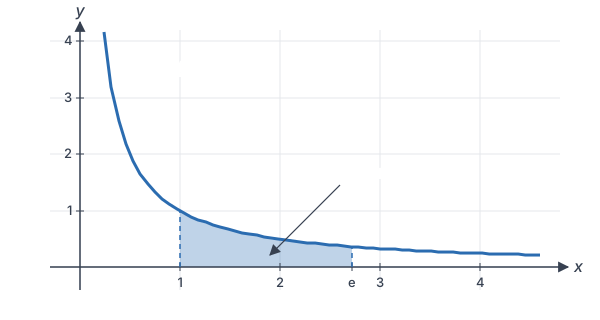
Natural log integral formulas
\int \dfrac{1}{x}\,dx = \ln|x| + C\int \dfrac{g'(x)}{g(x)}\,dx = \ln|g(x)| + CThe second rule is u-substitution with u = g(x): the integral becomes \int \dfrac{1}{u}\,du. Four trig integrals follow from it:
| Integral | Result | How to get it |
|---|---|---|
| \int \tan x\,dx | -\ln|\cos x| + C = \ln|\sec x| + C | tan x = sin x / cos x; let u = cos x |
| \int \cot x\,dx | \ln|\sin x| + C | cot x = cos x / sin x; let u = sin x |
| \int \sec x\,dx | \ln|\sec x + \tan x| + C | Multiply by (sec x + tan x)/(sec x + tan x); let u = sec x + tan x |
| \int \csc x\,dx | -\ln|\csc x + \cot x| + C | Multiply by (csc x + cot x)/(csc x + cot x); let u = csc x + cot x |
How to spot a log integral:
- Look at the denominator. Find its derivative.
- If the numerator is that derivative, or a constant times it, let u be the denominator.
- Rewrite as a constant times \int \dfrac{1}{u}\,du.
- Integrate to ln|u|, substitute back and add + C. Drop the absolute value only if the inside is always positive.
Natural log integral examples
Example 1: The numerator is the derivative
Find \int \dfrac{2x}{x^2 + 1}\,dx.
u = x^2 + 1
Let u be the denominator.
du = 2x\,dx
The numerator 2x dx is exactly du.
\int \dfrac{2x}{x^2 + 1}\,dx = \int \dfrac{1}{u}\,duRewrite in u (see u-substitution).
= \ln|u| + C
Integrate 1/u.
= \ln(x^2 + 1) + C
Substitute back. x² + 1 is always positive, so no absolute value is needed.
Answer: \ln(x^2 + 1) + C
Example 2: A linear denominator
Find \int \dfrac{1}{4x + 3}\,dx.
u = 4x + 3
Let u be the denominator.
du = 4\,dx
Differentiate u, so dx = du/4.
\int \dfrac{1}{4x + 3}\,dx = \int \dfrac{1}{4}\cdot\dfrac{1}{u}\,duRewrite in u.
= \dfrac{1}{4}\ln|u| + CIntegrate 1/u.
= \dfrac{1}{4}\ln|4x + 3| + CSubstitute back.
Answer: \dfrac{1}{4}\ln|4x + 3| + C. Keep the absolute value, because 4x + 3 is negative when x is less than −3/4.
Example 3: The integral of tan x
Find \int \tan x\,dx.
\int \tan x\,dx = \int \dfrac{\sin x}{\cos x}\,dxWrite tan x as sin x over cos x (see fundamental trig identities).
u = \cos x
Let u be the denominator.
du = -\sin x\,dx
Differentiate u, so sin x dx = −du.
\int \dfrac{\sin x}{\cos x}\,dx = \int -\dfrac{1}{u}\,duRewrite in u.
= -\ln|u| + C
Integrate 1/u.
= -\ln|\cos x| + C
Substitute back.
= \ln|\sec x| + C
−ln a = ln(1/a), and 1/cos x = sec x.
Answer: -\ln|\cos x| + C, which is the same as \ln|\sec x| + C.
Example 4: A definite log integral
Evaluate \int_0^2 \dfrac{x^2}{x^3 + 1}\,dx.
u = x^3 + 1
Let u be the denominator.
du = 3x^2\,dx
Differentiate u, so x² dx = du/3.
x = 0 \to u = 1, \quad x = 2 \to u = 9
Change the limits (see u-substitution with definite integrals).
\int_0^2 \dfrac{x^2}{x^3 + 1}\,dx = \int_1^9 \dfrac{1}{3u}\,duRewrite in u.
= \Big[\dfrac{1}{3}\ln u\Big]_1^9Integrate. u is positive from 1 to 9.
= \dfrac{1}{3}\ln 9 - \dfrac{1}{3}\ln 1 = \dfrac{1}{3}\ln 9Plug in the limits; ln 1 = 0.
= \dfrac{2}{3}\ln 3ln 9 = ln 3² = 2 ln 3.
\approx 0.732
Use ln 3 ≈ 1.0986.
Answer: \dfrac{2}{3}\ln 3 \approx 0.732
Example 5: New users of an app
A new app gains users at a rate of r(t) = \dfrac{600}{t + 2} users per day, t days after launch. How many users does it gain in the first 10 days?
\int_0^{10} \dfrac{600}{t + 2}\,dt = \Big[600\ln(t + 2)\Big]_0^{10}Let u = t + 2, so du = dt; t + 2 is positive here.
= 600\ln 12 - 600\ln 2
Plug in the limits and subtract.
= 600\ln 6
ln 12 − ln 2 = ln(12/2) by the quotient rule for logs.
\approx 1075
Use ln 6 ≈ 1.7918.
Answer: about 1,075 new users in the first 10 days.
Common mistakes
| Mistake | Example of the error | Fix |
|---|---|---|
| Dropping the absolute value | \int \dfrac{1}{x}\,dx = \ln x + C for all x | Use \ln|x| + C. Drop the bars only when the inside is always positive. |
| Using ln for other powers | \int \dfrac{1}{x^2}\,dx = \ln(x^2) + C | Only the power −1 gives a log. Here use the power rule: -\dfrac{1}{x} + C. |
| Using ln when the top is not the derivative | \int \dfrac{1}{x^2 + 1}\,dx = \ln(x^2 + 1) + C | The derivative of x² + 1 is 2x, not 1. This integral is arctan x + C (next lesson). |
| Forgetting the constant factor | \int \dfrac{1}{4x + 3}\,dx = \ln|4x + 3| + C | du = 4 dx, so multiply by 1/4. |
| Integrating across 0 | \int_{-1}^{1} \dfrac{1}{x}\,dx = \ln 1 - \ln 1 = 0 | 1/x is not continuous at 0, so the rule doesn’t apply. This is an improper integral (Calculus 2). |
Related methods
Divide first when the top is too big
If the degree of the numerator is at least the degree of the denominator, divide first (see polynomial long division). For example, \dfrac{x}{x + 1} = 1 - \dfrac{1}{x + 1}, so \int \dfrac{x}{x + 1}\,dx = x - \ln|x + 1| + C.
Logs of other bases
Because \dfrac{d}{dx}a^x = a^x\ln a, you get \int a^x\,dx = \dfrac{a^x}{\ln a} + C. This is the exponential version of the same idea (see derivatives of exponential functions).
Arctangent instead of ln
A denominator like x² + 1 with a constant numerator gives an inverse trig function, not a log. That is the next lesson, Integrals That Give Inverse Trig Functions.
Practice problems
- Find \int \dfrac{5}{x}\,dx.
- Find \int \dfrac{1}{2x + 7}\,dx.
- Find \int \dfrac{6x^2}{x^3 - 4}\,dx.
- Find \int \dfrac{\cos x}{\sin x + 3}\,dx.
- Find \int \cot x\,dx.
- Find \int \dfrac{e^x}{e^x + 1}\,dx.
- Evaluate \int_1^e \dfrac{3}{x}\,dx.
- Evaluate \int_0^1 \dfrac{2x + 1}{x^2 + x + 1}\,dx.
- Find \int \dfrac{x^2 + 3x + 1}{x}\,dx.
- A tank drains at a rate of r(t) = \dfrac{40}{t + 4} liters per minute. How much water drains out from t = 0 to t = 8 minutes?
Show answers
1.
\int \dfrac{5}{x}\,dx = 5\int \dfrac{1}{x}\,dx = 5\ln|x| + CFactor out 5, then integrate 1/x.
Answer: 5\ln|x| + C
2.
u = 2x + 7
Let u be the denominator.
du = 2\,dx
Differentiate u, so dx = du/2.
\int \dfrac{1}{2x + 7}\,dx = \int \dfrac{1}{2u}\,du = \dfrac{1}{2}\ln|u| + CRewrite and integrate.
= \dfrac{1}{2}\ln|2x + 7| + CSubstitute back.
Answer: \dfrac{1}{2}\ln|2x + 7| + C
3.
u = x^3 - 4
Let u be the denominator.
du = 3x^2\,dx
Differentiate u, so 6x² dx = 2 du.
\int \dfrac{6x^2}{x^3 - 4}\,dx = \int \dfrac{2}{u}\,du = 2\ln|u| + CRewrite and integrate.
= 2\ln|x^3 - 4| + C
Substitute back.
Answer: 2\ln|x^3 - 4| + C
4.
u = \sin x + 3
Let u be the denominator.
du = \cos x\,dx
The numerator is du.
\int \dfrac{\cos x}{\sin x + 3}\,dx = \int \dfrac{1}{u}\,du = \ln|u| + CRewrite and integrate.
= \ln(\sin x + 3) + C
Substitute back; sin x + 3 is at least 2, so it is always positive.
Answer: \ln(\sin x + 3) + C
5.
\int \cot x\,dx = \int \dfrac{\cos x}{\sin x}\,dxWrite cot x as cos x over sin x.
u = \sin x
Let u be the denominator.
du = \cos x\,dx
The numerator is du.
\int \dfrac{\cos x}{\sin x}\,dx = \int \dfrac{1}{u}\,du = \ln|u| + C = \ln|\sin x| + CIntegrate and substitute back.
Answer: \ln|\sin x| + C
6.
u = e^x + 1
Let u be the denominator.
du = e^x\,dx
The numerator is du.
\int \dfrac{e^x}{e^x + 1}\,dx = \int \dfrac{1}{u}\,du = \ln(e^x + 1) + CIntegrate and substitute back; eˣ + 1 is positive.
Answer: \ln(e^x + 1) + C
7.
\int_1^e \dfrac{3}{x}\,dx = \Big[3\ln x\Big]_1^eIntegrate; x is positive on [1, e].
= 3\ln e - 3\ln 1 = 3(1) - 0 = 3
ln e = 1 and ln 1 = 0.
Answer: 3
8.
u = x^2 + x + 1
Let u be the denominator.
du = (2x + 1)\,dx
The numerator is du.
x = 0 \to u = 1, \quad x = 1 \to u = 3
Change the limits.
\int_1^3 \dfrac{1}{u}\,du = \Big[\ln u\Big]_1^3 = \ln 3 - \ln 1 = \ln 3Integrate and evaluate.
Answer: \ln 3 \approx 1.099
9.
\dfrac{x^2 + 3x + 1}{x} = x + 3 + \dfrac{1}{x}Divide each term by x.
\int \left(x + 3 + \dfrac{1}{x}\right)dx = \dfrac{x^2}{2} + 3x + \ln|x| + CIntegrate each term.
Answer: \dfrac{x^2}{2} + 3x + \ln|x| + C
10.
\int_0^8 \dfrac{40}{t + 4}\,dt = \Big[40\ln(t + 4)\Big]_0^8Let u = t + 4, so du = dt; t + 4 is positive here.
= 40\ln 12 - 40\ln 4 = 40\ln 3
ln 12 − ln 4 = ln 3.
\approx 43.9
Use ln 3 ≈ 1.0986.
Answer: about 43.9 liters
Natural log integrals FAQ
What is the integral of 1/x?
The integral of 1/x is ln|x| + C. The absolute value makes the answer work for negative x as well as positive x.
What is the integral of tan x?
The integral of tan x is −ln|cos x| + C, which can also be written ln|sec x| + C.
When do you use ln in integration?
Use ln when the integrand is a fraction whose numerator is the derivative of its denominator, up to a constant. Then the integral is that constant times ln|denominator| + C.
Why is there an absolute value in ln|x|?
ln x is only defined for positive x, but 1/x is also defined for negative x. ln|x| has derivative 1/x on both sides of 0.
Summary
- \int \dfrac{1}{x}\,dx = \ln|x| + C, the case the power rule misses.
- \int \dfrac{g'(x)}{g(x)}\,dx = \ln|g(x)| + C: let u be the denominator.
- tan x, cot x, sec x and csc x all integrate to logs.
- Keep the absolute value unless the inside is always positive.
- If the top’s degree is too big, divide first.
Previous lesson: U-Substitution with Definite Integrals
Next lesson: Integrals That Give Inverse Trig Functions
Back to the Calculus 1 Index