
Derivatives of Exponential Functions
The derivative of an exponential function depends on its base. The derivative of e^x is e^x itself. For any other base a \gt 0, the derivative of a^x is a^x \ln a. With an inside function u, use the chain rule: \frac{d}{dx}e^u = e^u \cdot u' and \frac{d}{dx}a^u = a^u \ln a \cdot u'.
Before this lesson: Chain Rule, The Number e and Logarithms
Why e^x is its own derivative
Every exponential curve y = a^x has a slope that is proportional to its height: the higher the curve, the steeper it is. For y = 2^x, the slope is about 0.69 times the height. For y = 3^x, it is about 1.10 times the height.
The number e \approx 2.718 is the base where that factor is exactly 1. So at every point on y = e^x, the slope equals the height. At (0, 1) the slope is 1, and at (1, e) the slope is e.
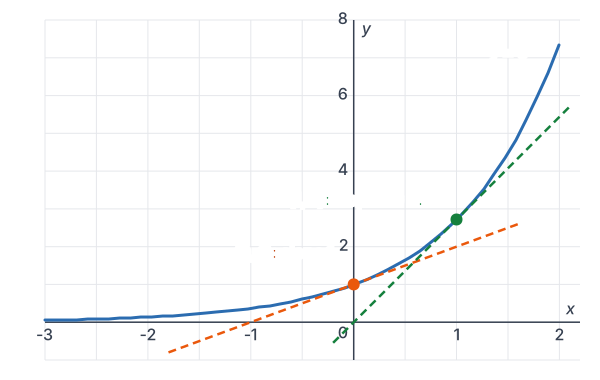
The factor for base a is the natural log, ln a. That is where the formula a^x \ln a comes from, and since \ln e = 1, it agrees with the rule for e^x.
Exponential derivative rules
| Function | Derivative | With an inside function u |
|---|---|---|
| e^x | e^x | e^u \cdot u' |
| a^x | a^x \ln a | a^u \ln a \cdot u' |
| k e^x (k a constant) | k e^x | k e^u \cdot u' |
Do not use the power rule here. The power rule is for x^n, where the variable is in the base. In e^x and a^x, the variable is in the exponent.
Derivatives of exponential functions examples
Example 1: A sum with e^x
Differentiate y = 4e^x - x^2.
y' = 4e^x - 2x
The derivative of eˣ is eˣ, so 4eˣ stays 4eˣ. Power rule on x².
Answer: y' = 4e^x - 2x.
Example 2: Chain rule with e
Differentiate y = e^{3x^2}.
u = 3x^2, \; u' = 6x
The inside function is the exponent, 3x².
y' = e^{3x^2} \cdot 6xThe derivative of eᵘ is eᵘ · u′ (see chain rule). Keep the exponent the same.
y' = 6x\,e^{3x^2}Write the factor in front.
Answer: y' = 6x\,e^{3x^2}.
Example 3: Product rule with e^x
Differentiate y = x^2 e^x and factor the answer.
y' = (2x)(e^x) + (x^2)(e^x)
Product rule: the derivative of x² is 2x and of eˣ is eˣ (see product rule).
y' = e^x(x^2 + 2x)
Factor out eˣ.
y' = x e^x(x + 2)
Factor out x (see factoring out the GCF).
Answer: y' = xe^x(x + 2). Since e^x is never 0, the factored form shows that y′ = 0 only at x = 0 and x = −2.
Example 4: A base other than e
Differentiate y = 5^x and find the slope at x = 2.
y' = 5^x \ln 5
Use the rule for aˣ with a = 5.
y'(2) = 5^2 \ln 5 = 25\ln 5
Substitute x = 2.
25\ln 5 \approx 25(1.6094) \approx 40.24
Use ln 5 ≈ 1.6094.
Answer: y' = 5^x \ln 5, and the slope at x = 2 is 25\ln 5 \approx 40.24.
Example 5: Word problem with bacteria
A bacteria colony has P(t) = 500e^{0.4t} cells after t hours. How fast is it growing at t = 5 hours?
P'(t) = 500e^{0.4t} \cdot 0.4Chain rule: the exponent 0.4t has derivative 0.4.
P'(t) = 200e^{0.4t}Multiply 500 · 0.4.
P'(5) = 200e^{2}Substitute t = 5: 0.4 · 5 = 2.
200e^2 \approx 200(7.389) \approx 1478
Use e² ≈ 7.389.
Answer: at 5 hours, the colony grows by about 1,478 cells per hour. Notice that P'(t) = 0.4P(t): the growth rate is always 40% of the current size per hour, which is what exponential growth means (see exponential growth and decay).
Common mistakes
| Mistake | Example of the error | Fix |
|---|---|---|
| Using the power rule on e^x | \frac{d}{dx}e^x = xe^{x-1} | The variable is in the exponent: \frac{d}{dx}e^x = e^x. |
| Forgetting the chain rule | \frac{d}{dx}e^{3x^2} = e^{3x^2} | Multiply by the exponent’s derivative, 6x. |
| Changing the exponent | \frac{d}{dx}e^{3x^2} = e^{6x} | Keep the exponent the same: 6x\,e^{3x^2}. |
| Forgetting ln a for other bases | \frac{d}{dx}5^x = 5^x | Only base e works that way: 5^x \ln 5. |
| Treating e as a variable | \frac{d}{dx}e^2 = 2e | e^2 is a constant, so its derivative is 0. |
Related methods
Rewriting a^x with base e
Any exponential can be written with base e: a^x = e^{x\ln a}. Then the chain rule gives e^{x\ln a} \cdot \ln a = a^x \ln a, which is the rule above.
Logarithmic derivatives
The derivative of \ln x is the next lesson, Derivatives of Logarithmic Functions. It comes from this one: since \ln x is the inverse of e^x, the rule for derivatives of inverse functions gives \frac{1}{x}.
Practice problems
- Differentiate y = 7e^x.
- Differentiate y = e^{5x}.
- Differentiate y = e^{-x^2}.
- Differentiate y = 2^x.
- Differentiate y = xe^{2x} and factor the answer.
- Differentiate y = \frac{e^x}{x}.
- Find the tangent line to y = e^x at x = 0.
- Differentiate y = 3^{x^2}.
- Find where y = xe^{-x} has a horizontal tangent line.
- A car worth $24,000 loses value so that it is worth V(t) = 24000(0.85)^t dollars after t years. How fast is its value changing at t = 2?
Show answers
1.
y' = 7e^x
A constant times eˣ keeps the constant.
Answer: y' = 7e^x
2.
y' = e^{5x} \cdot 5Chain rule: the exponent has derivative 5.
Answer: y' = 5e^{5x}
3.
y' = e^{-x^2} \cdot (-2x)Chain rule: the exponent −x² has derivative −2x.
Answer: y' = -2x\,e^{-x^2}
4.
y' = 2^x \ln 2
Rule for aˣ with a = 2.
Answer: y' = 2^x \ln 2
5.
y' = 1 \cdot e^{2x} + x \cdot 2e^{2x}Product rule, with the chain rule on e²ˣ.
y' = e^{2x}(1 + 2x)Factor out e²ˣ.
Answer: y' = e^{2x}(1 + 2x)
6.
y' = \frac{e^x \cdot x - e^x \cdot 1}{x^2}Quotient rule (see quotient rule).
y' = \frac{e^x(x - 1)}{x^2}Factor out eˣ in the numerator.
Answer: y' = \frac{e^x(x - 1)}{x^2}
7.
y(0) = e^0 = 1
Find the point (0, 1).
y'(0) = e^0 = 1
The slope is also e⁰ = 1.
y - 1 = 1(x - 0)
Point-slope form (see point-slope form).
y = x + 1
Add 1 to both sides.
Answer: y = x + 1
8.
y' = 3^{x^2} \ln 3 \cdot 2xRule for aᵘ with u = x² and u′ = 2x.
Answer: y' = 2x \cdot 3^{x^2}\ln 3
9.
y' = 1 \cdot e^{-x} + x \cdot (-e^{-x})Product rule; the derivative of e⁻ˣ is −e⁻ˣ.
y' = e^{-x}(1 - x)Factor out e⁻ˣ.
1 - x = 0 \Rightarrow x = 1
e⁻ˣ is never 0, so set the other factor equal to 0.
Answer: x = 1, at the point (1, 1/e)
10.
V'(t) = 24000(0.85)^t \ln 0.85
Rule for aˣ with a = 0.85.
V'(2) = 24000(0.7225)\ln 0.85
Substitute t = 2: 0.85² = 0.7225.
V'(2) = 17340 \ln 0.85 \approx 17340(-0.16252)
Multiply, and use ln 0.85 ≈ −0.16252.
V'(2) \approx -2818
Multiply.
Answer: after 2 years, the car is losing value at about $2,818 per year.
Derivatives of exponential functions FAQ
What is the derivative of e^x?
The derivative of e^x is e^x. It is the only basic function (apart from constant multiples of it) that is its own derivative.
What is the derivative of a^x?
\frac{d}{dx}a^x = a^x \ln a. For example, \frac{d}{dx}2^x = 2^x \ln 2 \approx 0.693 \cdot 2^x.
What is the derivative of e^(2x)?
By the chain rule, \frac{d}{dx}e^{2x} = 2e^{2x}. Multiply by the derivative of the exponent.
Why can’t you use the power rule on e^x?
The power rule is for a variable base raised to a constant power, like x^3. In e^x, the base is a constant and the variable is in the exponent, so a different rule applies.
Summary
- \frac{d}{dx}e^x = e^x and \frac{d}{dx}a^x = a^x \ln a.
- With an inside function: \frac{d}{dx}e^u = e^u u'.
- Keep the exponent the same, then multiply by its derivative.
- Never use the power rule when the variable is in the exponent.
- For growth models, P' = kP: the rate is proportional to the amount.
Previous lesson: Derivatives of Trig Functions
Next lesson: Derivatives of Logarithmic Functions
Back to the Calculus 1 Index