
Derivatives of Trig Functions
The derivatives of trig functions are: the derivative of sin x is cos x, of cos x is −sin x, and of tan x is sec²x. The other three are \frac{d}{dx}\sec x = \sec x\tan x, \frac{d}{dx}\csc x = -\csc x\cot x and \frac{d}{dx}\cot x = -\csc^2 x. These formulas work only when x is in radians.
Before this lesson: Chain Rule, Quotient Rule, Unit Circle and Squeeze Theorem
Why the derivative of sine is cosine
Look at the graph of y = sin x. At x = 0 it climbs with slope 1. At x = \frac{\pi}{2} it is at its peak, so its slope is 0. At x = π it falls with slope −1. Those slopes, 1, 0 and −1, are exactly the values of cos x at the same points.
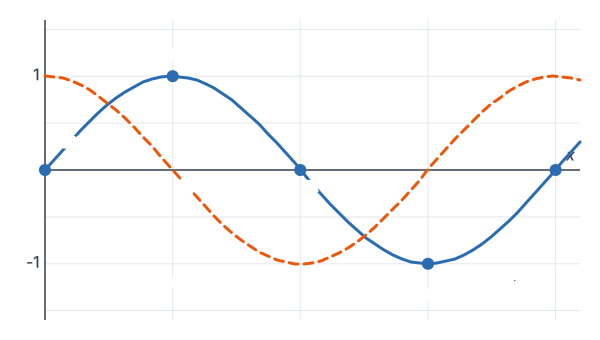
The proof uses the limit \lim_{h \to 0} \frac{\sin h}{h} = 1, which comes from the squeeze theorem. That limit is true only when angles are measured in radians, so calculus with trig functions always uses radians.
Trig derivative formulas
| Function | Derivative | Function | Derivative |
|---|---|---|---|
| \sin x | \cos x | \csc x | -\csc x \cot x |
| \cos x | -\sin x | \sec x | \sec x \tan x |
| \tan x | \sec^2 x | \cot x | -\csc^2 x |
A memory trick: the three “co” functions (cosine, cosecant, cotangent) have derivatives with a minus sign. Each one is the matching formula with every function swapped for its co-function and a minus sign added.
With the chain rule, an inside function u adds a factor of u′:
\frac{d}{dx}\left[\sin u\right] = \cos u \cdot u', \qquad \frac{d}{dx}\left[\cos u\right] = -\sin u \cdot u', \qquad \frac{d}{dx}\left[\tan u\right] = \sec^2 u \cdot u'Derivatives of trig functions examples
Example 1: A sum of trig functions
Differentiate y = 3\sin x - 2\cos x.
y' = 3\cos x - 2(-\sin x)
Differentiate each term: sin x gives cos x and cos x gives −sin x.
y' = 3\cos x + 2\sin x
Simplify the signs.
Answer: y' = 3\cos x + 2\sin x.
Example 2: Product rule with sine
Differentiate y = x^2\sin x.
y' = (2x)(\sin x) + (x^2)(\cos x)
Product rule: the derivative of x² is 2x and of sin x is cos x (see product rule).
y' = 2x\sin x + x^2\cos x
Remove the parentheses.
Answer: y' = 2x\sin x + x^2\cos x.
Example 3: Chain rule with sine
Differentiate y = \sin(3x^2).
u = 3x^2, \; u' = 6x
The inside function is 3x².
y' = \cos(3x^2) \cdot 6x
The derivative of sin u is cos u · u′. Keep the inside the same.
y' = 6x\cos(3x^2)
Write the factor in front.
Answer: y' = 6x\cos(3x^2). A common slip is writing \cos(6x). The inside stays 3x².
Example 4: Tangent line to y = tan x
Find the tangent line to y = \tan x at x = \frac{\pi}{4}.
y = \tan\frac{\pi}{4} = 1Find the point (see trig values of special angles).
y' = \sec^2 x
Differentiate tan x.
\sec\frac{\pi}{4} = \frac{1}{\cos\frac{\pi}{4}} = \sqrt{2}Secant is 1 over cosine, and \cos\frac{\pi}{4} = \frac{\sqrt{2}}{2}.
y'\left(\frac{\pi}{4}\right) = (\sqrt{2})^2 = 2Square it. The slope is 2.
y - 1 = 2\left(x - \frac{\pi}{4}\right)Use point-slope form (see point-slope form).
y = 2x - \frac{\pi}{2} + 1Distribute and add 1 to both sides.
Answer: y = 2x - \frac{\pi}{2} + 1, or about y = 2x − 0.571.
Example 5: Word problem with a spring
A weight on a spring moves up and down. Its position is s(t) = 4\sin(2t) cm after t seconds. Find its velocity and acceleration at t = \frac{\pi}{6}.
v(t) = 4\cos(2t) \cdot 2 = 8\cos(2t)
Velocity is s′(t). Chain rule: the inside 2t has derivative 2.
a(t) = 8(-\sin(2t)) \cdot 2 = -16\sin(2t)
Acceleration is v′(t). Chain rule again.
v\left(\frac{\pi}{6}\right) = 8\cos\frac{\pi}{3} = 8 \cdot \frac{1}{2} = 4Substitute t = π/6, so 2t = π/3.
a\left(\frac{\pi}{6}\right) = -16\sin\frac{\pi}{3} = -16 \cdot \frac{\sqrt{3}}{2}Substitute t = π/6.
a\left(\frac{\pi}{6}\right) = -8\sqrt{3} \approx -13.86Multiply, then estimate with √3 ≈ 1.732.
Answer: at t = \frac{\pi}{6} s, the weight moves up at 4 cm/s, and its acceleration is about −13.86 cm/s². See position, velocity and acceleration for what these signs mean.
Common mistakes
| Mistake | Example of the error | Fix |
|---|---|---|
| Wrong sign on the derivative of cosine | \frac{d}{dx}\cos x = \sin x | It is -\sin x. Cosine starts by falling. |
| Forgetting the inside derivative | \frac{d}{dx}\sin(3x^2) = \cos(3x^2) | Multiply by u′ = 6x. |
| Changing the inside | \frac{d}{dx}\sin(3x^2) = \cos(6x) | Keep the inside: 6x\cos(3x^2). |
| Using degrees | Slope of sin x at 90 as cos 90° = 0 | Use radians. The formulas are false in degrees. |
| Confusing sec²x and sec(x²) | Writing \sec(x^2) for the derivative of tan x | \sec^2 x means (\sec x)^2. |
Related methods
Getting the other four from sine and cosine
Once you know the derivatives of sin x and cos x, the quotient rule gives the rest. For tan x:
\frac{d}{dx}\left[\frac{\sin x}{\cos x}\right] = \frac{\cos x \cdot \cos x - \sin x \cdot (-\sin x)}{\cos^2 x} = \frac{\cos^2 x + \sin^2 x}{\cos^2 x} = \frac{1}{\cos^2 x} = \sec^2 xThe step \cos^2 x + \sin^2 x = 1 is the Pythagorean identity (see fundamental trig identities). The same method works for sec x, csc x and cot x.
The cycle of derivatives
Differentiating sin x over and over gives a cycle of four: sin x, cos x, −sin x, −cos x, then back to sin x. So the 4th derivative of sin x is sin x, and the 10th derivative is the same as the 2nd, −sin x (see higher-order derivatives).
Practice problems
- Differentiate y = 5\cos x + x^3.
- Differentiate y = \sin x\cos x.
- Differentiate y = x\tan x.
- Differentiate y = \sin(4x).
- Differentiate y = \cos(x^2 + 1).
- Differentiate y = \sin^2 x.
- Differentiate y = \sec(3x).
- Differentiate y = \frac{\sin x}{x}.
- Find every x in [0, 2\pi] where f(x) = 2\sin x + x has a horizontal tangent.
- Find the tangent line to y = \cos x at x = \frac{\pi}{3}.
Show answers
1.
y' = -5\sin x + 3x^2
The derivative of cos x is −sin x; power rule on x³.
Answer: y' = -5\sin x + 3x^2
2.
y' = \cos x \cdot \cos x + \sin x \cdot (-\sin x)
Product rule.
y' = \cos^2 x - \sin^2 x
Simplify. This also equals cos 2x (see double-angle formulas).
Answer: y' = \cos^2 x - \sin^2 x
3.
y' = 1 \cdot \tan x + x\sec^2 x
Product rule: the derivative of tan x is sec²x.
Answer: y' = \tan x + x\sec^2 x
4.
y' = \cos(4x) \cdot 4
Chain rule: the inside 4x has derivative 4.
Answer: y' = 4\cos(4x)
5.
y' = -\sin(x^2 + 1) \cdot 2x
Chain rule: the inside has derivative 2x.
Answer: y' = -2x\sin(x^2 + 1)
6.
y = (\sin x)^2
Read sin²x as (sin x)².
y' = 2\sin x \cdot \cos x
General power rule: the inside sin x has derivative cos x.
Answer: y' = 2\sin x\cos x, which also equals sin 2x
7.
y' = \sec(3x)\tan(3x) \cdot 3
The derivative of sec u is sec u tan u · u′, with u′ = 3.
Answer: y' = 3\sec(3x)\tan(3x)
8.
y' = \frac{\cos x \cdot x - \sin x \cdot 1}{x^2}Quotient rule.
Answer: y' = \frac{x\cos x - \sin x}{x^2}
9.
f'(x) = 2\cos x + 1
Differentiate.
2\cos x + 1 = 0
A horizontal tangent needs f′(x) = 0.
\cos x = -\frac{1}{2}Subtract 1, then divide by 2.
x = \frac{2\pi}{3} \text{ or } x = \frac{4\pi}{3}Use the unit circle: cosine is −½ in Quadrants II and III (see solving trig equations).
Answer: x = \frac{2\pi}{3} and x = \frac{4\pi}{3}
10.
y = \cos\frac{\pi}{3} = \frac{1}{2}Find the point.
y' = -\sin x
Differentiate cos x.
y'\left(\frac{\pi}{3}\right) = -\frac{\sqrt{3}}{2}Substitute: \sin\frac{\pi}{3} = \frac{\sqrt{3}}{2}.
y - \frac{1}{2} = -\frac{\sqrt{3}}{2}\left(x - \frac{\pi}{3}\right)Point-slope form.
Answer: y = -\frac{\sqrt{3}}{2}\left(x - \frac{\pi}{3}\right) + \frac{1}{2}, or about y = −0.866x + 1.407
Derivatives of trig functions FAQ
What is the derivative of sin x?
The derivative of sin x is cos x, when x is in radians. With an inside function, \frac{d}{dx}\sin u = \cos u \cdot u'.
Why is the derivative of cos x negative?
Right after x = 0, the cosine graph falls from its peak of 1, so its slope is negative. The formula -\sin x matches: it is negative for x between 0 and π.
Why do trig derivatives need radians?
The key limit \frac{\sin h}{h} \to 1 is true only in radians. In degrees the derivative of sin x would be \frac{\pi}{180}\cos x, which is messy.
How do you remember the six trig derivatives?
Learn sin → cos, tan → sec² and sec → sec tan. For the co-functions, swap each function for its co-function and add a minus sign.
Summary
- (\sin x)' = \cos x and (\cos x)' = -\sin x.
- (\tan x)' = \sec^2 x, (\sec x)' = \sec x\tan x, (\csc x)' = -\csc x\cot x, (\cot x)' = -\csc^2 x.
- The co-functions have derivatives with a minus sign.
- Use the chain rule for inside functions: (\sin u)' = \cos u \cdot u'.
- Always work in radians.
Previous lesson: Derivatives of Inverse Functions
Next lesson: Derivatives of Exponential Functions
Back to the Calculus 1 Index