
Higher-Order Derivatives
Higher-order derivatives are derivatives of derivatives. The second derivative, f''(x), is the derivative of f'(x). It tells you how fast the slope is changing. The third derivative is the derivative of f''(x), and so on. To find them, differentiate again, one step at a time.
Before this lesson: Power Rule, Sketching the Graph of a Derivative and Rational Exponents
What a second derivative means
The first derivative f'(x) is a new function. It gives the slope of f at each x. Since f'(x) is a function too, you can take its derivative.
That derivative is the second derivative, f''(x). It measures how fast the slope of f is changing. If f''(x) \gt 0, the slope is increasing. If f''(x) \lt 0, the slope is decreasing.
Here is a picture of it. For f(x) = x^3 - 3x, the slope f'(x) = 3x^2 - 3 falls until x = 0 and then rises. The second derivative, f''(x) = 6x, is negative before 0 and positive after 0. That matches what the slope does.
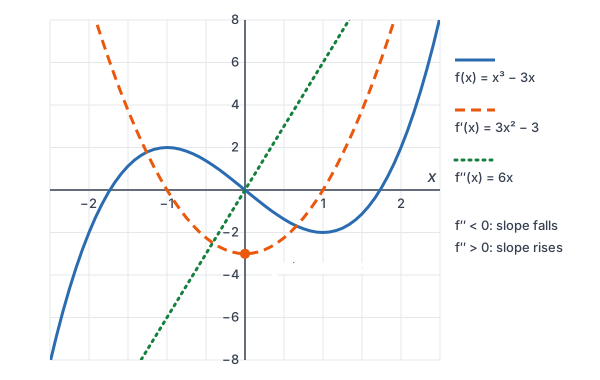
Each new derivative is called a higher order. The third derivative is the derivative of the second, the fourth is the derivative of the third, and so on. Together these are the higher-order derivatives.
Higher-order derivative notation
| Derivative | Prime notation | Leibniz notation | Read as |
|---|---|---|---|
| First | f'(x) | \frac{dy}{dx} | “f prime of x” |
| Second | f''(x) | \frac{d^2y}{dx^2} | “f double prime of x” |
| Third | f'''(x) | \frac{d^3y}{dx^3} | “f triple prime of x” |
| Fourth | f^{(4)}(x) | \frac{d^4y}{dx^4} | “the fourth derivative of f” |
| nth | f^{(n)}(x) | \frac{d^ny}{dx^n} | “the nth derivative of f” |
After three primes, the count goes in parentheses. The parentheses matter: f^{(4)}(x) is the fourth derivative, but f^4(x) means [f(x)]^4. In Leibniz notation, the 2 in \frac{d^2y}{dx^2} is not an exponent on y. It says “take d/dx twice.”
How to find higher-order derivatives
To get the next derivative, differentiate the one you just found:
f''(x) = \frac{d}{dx}\left[f'(x)\right], \quad f'''(x) = \frac{d}{dx}\left[f''(x)\right]- Rewrite roots and fractions as powers of x, such as \sqrt{x} = x^{1/2} and \frac{1}{x^2} = x^{-2}.
- Find f'(x) with the power rule. Simplify it.
- Differentiate f'(x) to get f''(x). Simplify again.
- Repeat until you reach the derivative you need.
- If you need a value, such as f''(2), substitute the number last.
Substitute last. If you plug a number into f'(x) first, you get a constant, and the derivative of a constant is 0. That gives a wrong answer.
Higher-order derivative examples
Example 1: Every derivative of a polynomial
Find all derivatives of f(x) = 2x^4 - 5x^3 + x - 7 until you reach 0.
f'(x) = 8x^3 - 15x^2 + 1
Differentiate each term with the power rule. The constant −7 becomes 0.
f''(x) = 24x^2 - 30x
Differentiate f’. The constant 1 becomes 0.
f'''(x) = 48x - 30
Differentiate f”.
f^{(4)}(x) = 48Differentiate f”’. The derivative of 48x is 48.
f^{(5)}(x) = 0The derivative of a constant is 0.
Answer: f^{(4)}(x) = 48, and every derivative from the fifth on is 0. Each derivative lowers the degree by 1, so a degree-4 polynomial reaches a constant after 4 steps.
Example 2: A negative exponent
Find \frac{d^2y}{dx^2} for y = \frac{6}{x^2}. Then evaluate it at x = 2.
y = 6x^{-2}Rewrite as a power of x (see negative exponents).
\frac{dy}{dx} = 6(-2)x^{-3}Power rule: bring down −2 and subtract 1 from the exponent.
\frac{dy}{dx} = -12x^{-3}Multiply 6(−2).
\frac{d^2y}{dx^2} = -12(-3)x^{-4}Power rule again: bring down −3 and subtract 1.
\frac{d^2y}{dx^2} = 36x^{-4}Multiply (−12)(−3). Two negatives make a positive.
\frac{d^2y}{dx^2} = \frac{36}{x^4}Rewrite with a positive exponent.
\frac{36}{2^4} = \frac{36}{16}Substitute x = 2.
\frac{36}{16} = \frac{9}{4}Simplify the fraction by 4.
Answer: \frac{d^2y}{dx^2} = \frac{36}{x^4}, and its value at x = 2 is \frac{9}{4}.
Example 3: A square root
For f(x) = 8\sqrt{x}, find f''(x), f'''(x) and f''(4).
f(x) = 8x^{1/2}Rewrite the root as a power.
f'(x) = 8 \cdot \frac{1}{2}x^{-1/2}Power rule: \frac{1}{2} - 1 = -\frac{1}{2}.
f'(x) = 4x^{-1/2}Multiply 8 \cdot \frac{1}{2}.
f''(x) = 4 \cdot \left(-\frac{1}{2}\right)x^{-3/2}Power rule: -\frac{1}{2} - 1 = -\frac{3}{2}.
f''(x) = -2x^{-3/2}Multiply.
f'''(x) = -2 \cdot \left(-\frac{3}{2}\right)x^{-5/2}Power rule: -\frac{3}{2} - 1 = -\frac{5}{2}.
f'''(x) = 3x^{-5/2}Multiply. Two negatives make a positive.
f''(4) = -2 \cdot 4^{-3/2}Substitute x = 4 into f”.
4^{-3/2} = \frac{1}{(\sqrt{4})^3} = \frac{1}{8}Take the square root, cube it, then flip it.
f''(4) = -2 \cdot \frac{1}{8} = -\frac{1}{4}Multiply.
Answer: f''(x) = -2x^{-3/2}, f'''(x) = 3x^{-5/2} and f''(4) = -\frac{1}{4}. The negative value means the slope of 8\sqrt{x} is getting smaller at x = 4. The curve keeps rising, but it flattens out.
Example 4: Finding the nth derivative
Find a formula for the nth derivative of f(x) = \frac{1}{x}.
f(x) = x^{-1}Rewrite as a power.
f'(x) = -x^{-2}Power rule: bring down −1 and subtract 1.
f''(x) = (-1)(-2)x^{-3} = 2x^{-3}Power rule. Keep the product of the numbers you bring down.
f'''(x) = 2(-3)x^{-4} = -6x^{-4}Power rule.
f^{(4)}(x) = -6(-4)x^{-5} = 24x^{-5}Power rule.
1, 2, 6, 24 \;\to\; 1!, 2!, 3!, 4!
Ignore the signs and look at the numbers: they are factorials (see factorials).
f^{(n)}(x) = (-1)^n \, n! \, x^{-(n+1)}The signs alternate, starting with − for n = 1, and the exponent is always −(n + 1).
Answer: f^{(n)}(x) = \frac{(-1)^n \, n!}{x^{n+1}}. Check with n = 3: \frac{(-1)^3 \cdot 6}{x^4} = -\frac{6}{x^4}, which matches f'''(x). Unlike a polynomial, \frac{1}{x} never runs out of derivatives.
Example 5: Word problem with a growing town
The population of a town t years after 2020 is P(t) = 40{,}000 + 600t + 30t^2 - t^3 people. Find P'(5) and P''(5), and say what each means. Then find when the growth rate stops speeding up.
P'(t) = 600 + 60t - 3t^2
Differentiate with the power rule.
P'(5) = 600 + 60(5) - 3(5)^2
Substitute t = 5.
P'(5) = 600 + 300 - 75 = 825
Simplify. The town is growing by about 825 people per year.
P''(t) = 60 - 6t
Differentiate P’.
P''(5) = 60 - 6(5) = 30
Substitute t = 5.
60 - 6t = 0
The growth rate stops speeding up when P” changes from positive to negative, so set P”(t) = 0.
-6t = -60
Subtract 60 from both sides.
t = 10
Divide both sides by −6.
Answer: in 2025, the town grows by about 825 people per year, and that growth rate is rising by about 30 people per year, each year. The second derivative is the rate of change of the growth rate. After t = 10 (the year 2030), P''(t) \lt 0, so the town keeps growing for a while but more slowly each year.
Common mistakes
| Mistake | Example of the error | Fix |
|---|---|---|
| Writing f^4(x) for the fourth derivative | “f^4(x) = 48” for Example 1 | Use parentheses: f^{(4)}(x) = 48. Without them, it means [f(x)]^4. |
| Substituting the number too early | For f(x) = x^3: f'(2) = 12, so “f''(2) = 0“ | Differentiate first: f''(x) = 6x, so f''(2) = 12. |
| Squaring the first derivative | For f(x) = x^3: “f''(x) = (3x^2)^2 = 9x^4“ | f'' is the derivative of f': f''(x) = 6x. |
| Losing a negative sign | For f'(x) = -2x^{-3}: “f''(x) = -6x^{-4}“ | (-2)(-3) = 6, so f''(x) = 6x^{-4}. |
| Subtracting 1 the wrong way from a negative exponent | -\frac{1}{2} - 1 = \frac{1}{2} | Move left on the number line: -\frac{1}{2} - 1 = -\frac{3}{2}. |
| Reading \frac{d^2y}{dx^2} as \left(\frac{dy}{dx}\right)^2 | For y = x^3: “\frac{d^2y}{dx^2} = 9x^4“ | It means differentiate twice: \frac{d^2y}{dx^2} = 6x. |
Related methods
Reading the second derivative from a graph
You can see the sign of f'' without a formula. Where the graph of f bends upward like a cup, its slope is increasing, so f''(x) \gt 0. Where it bends downward like a cap, f''(x) \lt 0. This bending is called concavity, and the Calculus 1 lesson on concavity and inflection points covers it in full. To sketch f' and f'' from a graph, use the same method as sketching the graph of a derivative, applied twice.
Position, velocity and acceleration
If s(t) is position, then s'(t) is velocity and s''(t) is acceleration. The next lesson, Position, Velocity and Acceleration, uses higher-order derivatives to describe motion along a line.
The last nonzero derivative of a polynomial
A polynomial of degree n has f^{(n)}(x) = n! \cdot a, where a is the leading coefficient. Every derivative after that is 0. In Example 1, the degree is 4 and a = 2, so f^{(4)}(x) = 4! \cdot 2 = 48.
Practice problems
- Find f''(x) for f(x) = x^5 - 3x^2.
- Find f'''(x) for f(x) = 4x^3 + 2x^2 - 9x + 1.
- Find \frac{d^2y}{dx^2} for y = 7x^2 - 3x + 8.
- Find f^{(4)}(x) for f(x) = x^6.
- Find f''(x) and f''(-1) for f(x) = \frac{3}{x}.
- Find f''(9) for f(x) = 4x^{3/2}.
- Find f''(1) and f'''(1) for f(x) = 2x^4 - x^3.
- Find the tenth derivative of f(x) = x^9 + 5x^4.
- Find every x where f''(x) = 0 for f(x) = x^4 - 6x^2 + 3x.
- A new website’s total number of visitors t days after launch is V(t) = 200t^2 - 10t^3, for 0 \le t \le 12. Find V'(4) and V''(4), and say what each means.
Show answers
1.
f'(x) = 5x^4 - 6x
Differentiate each term.
f''(x) = 20x^3 - 6
Differentiate again.
Answer: f''(x) = 20x^3 - 6
2.
f'(x) = 12x^2 + 4x - 9
Differentiate each term.
f''(x) = 24x + 4
Differentiate again.
f'''(x) = 24
Differentiate a third time.
Answer: f'''(x) = 24
3.
\frac{dy}{dx} = 14x - 3Differentiate each term.
\frac{d^2y}{dx^2} = 14Differentiate again.
Answer: \frac{d^2y}{dx^2} = 14
4.
f'(x) = 6x^5
Power rule.
f''(x) = 30x^4
Multiply 6 · 5.
f'''(x) = 120x^3
Multiply 30 · 4.
f^{(4)}(x) = 360x^2Multiply 120 · 3.
Answer: f^{(4)}(x) = 360x^2
5.
f(x) = 3x^{-1}Rewrite as a power.
f'(x) = -3x^{-2}Power rule: 3(−1) = −3.
f''(x) = 6x^{-3}Power rule: (−3)(−2) = 6.
f''(x) = \frac{6}{x^3}Rewrite with a positive exponent.
f''(-1) = \frac{6}{(-1)^3} = \frac{6}{-1}Substitute x = −1.
f''(-1) = -6
Divide.
Answer: f''(x) = \frac{6}{x^3} and f''(-1) = -6
6.
f'(x) = 4 \cdot \frac{3}{2}x^{1/2}Power rule: \frac{3}{2} - 1 = \frac{1}{2}.
f'(x) = 6x^{1/2}Multiply.
f''(x) = 6 \cdot \frac{1}{2}x^{-1/2}Power rule: \frac{1}{2} - 1 = -\frac{1}{2}.
f''(x) = \frac{3}{\sqrt{x}}Multiply, then rewrite with a root.
f''(9) = \frac{3}{\sqrt{9}} = \frac{3}{3}Substitute x = 9.
f''(9) = 1
Divide.
Answer: f''(9) = 1
7.
f'(x) = 8x^3 - 3x^2
Differentiate each term.
f''(x) = 24x^2 - 6x
Differentiate again.
f''(1) = 24 - 6 = 18
Substitute x = 1.
f'''(x) = 48x - 6
Differentiate f”.
f'''(1) = 48 - 6 = 42
Substitute x = 1.
Answer: f''(1) = 18 and f'''(1) = 42
8.
\frac{d^{5}}{dx^{5}}\left(5x^4\right) = 0The fourth derivative of 5x^4 is the constant 5 \cdot 4! = 120, so its fifth and later derivatives are 0.
\frac{d^{9}}{dx^{9}}\left(x^9\right) = 9! = 362{,}880The ninth derivative of x^9 is the constant 9!.
\frac{d^{10}}{dx^{10}}\left(x^9\right) = 0The derivative of a constant is 0.
f^{(10)}(x) = 0 + 0 = 0Add the two terms.
Answer: f^{(10)}(x) = 0
9.
f'(x) = 4x^3 - 12x + 3
Differentiate each term.
f''(x) = 12x^2 - 12
Differentiate again.
12x^2 - 12 = 0
Set f” equal to 0.
12x^2 = 12
Add 12 to both sides.
x^2 = 1
Divide both sides by 12.
x = \pm 1
Take the square root of both sides (see solving quadratics with square roots).
Answer: x = −1 and x = 1
10.
V'(t) = 400t - 30t^2
Differentiate each term.
V'(4) = 400(4) - 30(4)^2
Substitute t = 4.
V'(4) = 1600 - 480 = 1120
Simplify.
V''(t) = 400 - 60t
Differentiate V’.
V''(4) = 400 - 240 = 160
Substitute t = 4.
Answer: on day 4, the site gains about 1,120 visitors per day, and that daily rate is rising by about 160 visitors per day, each day.
Higher-order derivatives FAQ
What does the second derivative tell you?
It tells how fast the first derivative is changing. If f''(x) \gt 0, the slope is increasing and the graph bends upward. If f''(x) \lt 0, the slope is decreasing and the graph bends downward. For position, the second derivative is acceleration.
How do you write the fourth derivative?
Write f^{(4)}(x) or \frac{d^4y}{dx^4}. Use parentheses around the 4, because f^4(x) means f(x) raised to the fourth power.
Is the second derivative the same as the first derivative squared?
No. The second derivative is the derivative of f'(x). For f(x) = x^3, f''(x) = 6x, but [f'(x)]^2 = 9x^4.
Do higher-order derivatives ever end?
For a polynomial, yes. A polynomial of degree n has a constant nth derivative, and every derivative after that is 0. Functions like \frac{1}{x} and \sqrt{x} never reach 0.
Summary
- The second derivative f''(x) is the derivative of f'(x). It tells how fast the slope is changing.
- Find higher-order derivatives one at a time. Rewrite roots and fractions as powers first.
- Notation: f', f'', f''', then f^{(4)}, f^{(5)} with parentheses; or \frac{d^ny}{dx^n}.
- Substitute a number only after you finish differentiating.
- Each derivative lowers a polynomial’s degree by 1, so it eventually reaches 0.
Previous lesson: Equation of a Tangent Line
Next lesson: Position, Velocity and Acceleration
Back to the Calculus 1 Index