
Power Rule
The power rule says the derivative of x^n is nx^{n-1}: bring the exponent down in front, then subtract 1 from it. So the derivative of x^5 is 5x^4. It works for any real exponent n. Together with the constant, constant multiple and sum rules, it differentiates any polynomial in one step.
Before this lesson: Definition of the Derivative, Exponent Rules, Zero and Negative Exponents and Rational Exponents
Why the power rule works
With the limit definition you found that x^2 has derivative 2x and x^3 has derivative 3x^2. The pattern continues: x^4 has derivative 4x^3, and in general the exponent comes down in front and drops by one.
The reason is the binomial expansion. In (x + h)^n = x^n + nx^{n-1}h + (\text{terms with } h^2 \text{ or higher}), subtracting x^n and dividing by h leaves nx^{n-1} plus terms that still contain h. Those vanish as h approaches 0.
Three companion rules make the power rule useful: the derivative of a constant is 0, a constant multiplier stays in front, and you can differentiate a sum one term at a time.
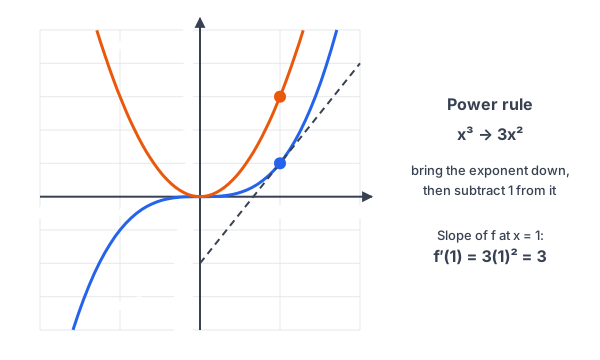
The power rule and basic derivative rules
| Rule | Formula | Example |
|---|---|---|
| Power rule | \frac{d}{dx}[x^n] = nx^{n-1} | \frac{d}{dx}[x^7] = 7x^6 |
| Constant rule | \frac{d}{dx}[c] = 0 | \frac{d}{dx}[9] = 0 |
| Constant multiple rule | \frac{d}{dx}[c\,f(x)] = c\,f'(x) | \frac{d}{dx}[4x^3] = 12x^2 |
| Sum and difference rule | \frac{d}{dx}[f \pm g] = f' \pm g' | \frac{d}{dx}[x^2 + x] = 2x + 1 |
Special cases: the derivative of x is 1 (since x = x^1), and the derivative of any constant is 0.
Before using the power rule, rewrite roots and fractions as powers of x: \sqrt{x} = x^{1/2} and \frac{1}{x^n} = x^{-n}.
Power rule examples
Example 1: Single powers
Find the derivatives of f(x) = x^5 and g(x) = x^{-3}.
f'(x) = 5x^{5 - 1}Power rule with n = 5: bring 5 down, subtract 1 from the exponent.
f'(x) = 5x^4
Simplify the exponent.
g'(x) = -3x^{-3 - 1}Power rule with n = −3.
g'(x) = -3x^{-4}Simplify: −3 − 1 = −4 (see subtracting integers).
Answer: f'(x) = 5x^4 and g'(x) = -3x^{-4} = -\frac{3}{x^4}.
Example 2: A polynomial
Differentiate f(x) = 4x^3 - 7x^2 + 2x - 9.
f'(x) = 4(3x^2) - 7(2x) + 2(1) - 0
Use the sum rule term by term, keep each constant multiplier, apply the power rule, and use the constant rule for −9.
f'(x) = 12x^2 - 14x + 2
Multiply.
Answer: f'(x) = 12x^2 - 14x + 2.
Example 3: Roots and fractions
Differentiate f(x) = 6\sqrt{x} - \frac{3}{x^2}.
f(x) = 6x^{1/2} - 3x^{-2}Rewrite as powers of x (see rational exponents).
f'(x) = 6\left(\frac{1}{2}x^{-1/2}\right) - 3(-2x^{-3})Apply the power rule to each term.
f'(x) = 3x^{-1/2} + 6x^{-3}Multiply the coefficients.
f'(x) = \frac{3}{\sqrt{x}} + \frac{6}{x^3}Rewrite with positive exponents.
Answer: f'(x) = \frac{3}{\sqrt{x}} + \frac{6}{x^3}.
Example 4: Expand first
Differentiate f(x) = (x^2 + 1)(x - 3).
f(x) = x^3 - 3x^2 + x - 3
Multiply out the product first (see multiplying polynomials). The power rule works on sums, not products.
f'(x) = 3x^2 - 6x + 1
Apply the power rule to each term. The constant −3 has derivative 0.
Answer: f'(x) = 3x^2 - 6x + 1. (The product rule, coming in Unit 3, handles products without expanding.)
Example 5: Word problem with a thrown ball
A ball’s height after t seconds is h(t) = -16t^2 + 64t + 5 feet. Find its velocity function, its velocity at t = 1, and the time it reaches the top.
h'(t) = -16(2t) + 64(1) + 0
Velocity is the derivative of height. Apply the power rule to each term.
h'(t) = -32t + 64
Multiply.
h'(1) = -32(1) + 64 = 32
Substitute t = 1.
-32t + 64 = 0
At the top, the ball stops rising, so the velocity is 0.
t = 2
Subtract 64 and divide by −32 (see two-step equations).
Answer: the velocity is h'(t) = −32t + 64 ft/s. At t = 1 the ball rises at 32 ft/s, and it reaches the top at t = 2 seconds, where h(2) = 69 feet.
Common mistakes
| Mistake | Example of the error | Fix |
|---|---|---|
| Forgetting to lower the exponent | \frac{d}{dx}[x^5] = 5x^5 | Bring the 5 down and subtract 1: 5x^4. |
| Subtracting 1 the wrong way with a negative exponent | \frac{d}{dx}[x^{-3}] = -3x^{-2} | −3 − 1 = −4, so -3x^{-4}. |
| Using the power rule on a fraction directly | \frac{d}{dx}\left[\frac{3}{x^2}\right] = \frac{0}{2x} | Rewrite as 3x^{-2} first, then differentiate: -6x^{-3}. |
| Differentiating a product factor by factor | \frac{d}{dx}[(x^2 + 1)(x - 3)] = (2x)(1) | Expand first (or use the product rule). |
| Giving a constant a nonzero derivative | \frac{d}{dx}[9] = 1 | Constants never change, so their derivative is 0. |
| Using the power rule on an exponential | \frac{d}{dx}[2^x] = x \cdot 2^{x-1} | The power rule needs a variable base and a constant exponent. Exponentials have their own rule in Unit 4. |
Related methods
Leibniz notation
If y = x^n, then \frac{dy}{dx} = nx^{n-1}. For example, if y = 8x^{3/2}, then \frac{dy}{dx} = 8 \cdot \frac{3}{2}x^{1/2} = 12\sqrt{x}.
Tangent lines
The power rule makes slopes quick to find, which is the first step in writing the equation of a tangent line. For f(x) = x^3, the slope at x = 1 is f'(1) = 3, as the graph above shows.
Practice problems
- Find \frac{d}{dx}[x^8].
- Find \frac{d}{dx}[7].
- Find \frac{d}{dx}[-5x^4].
- Differentiate f(x) = 3x^2 - 8x + 1.
- Differentiate f(x) = x^{-2}.
- Differentiate f(x) = \sqrt[3]{x}.
- Differentiate f(x) = \frac{2}{x^3} + 4\sqrt{x}.
- Differentiate f(x) = (2x - 1)^2 by expanding first.
- Differentiate f(x) = \frac{x^4 - 3x^2}{x}, then find f'(2).
- A company’s cost to make x bikes is C(x) = 0.002x^3 - 0.5x^2 + 60x + 800 dollars. Find C'(100) and explain what it means.
Show answers
1.
f'(x) = 8x^7
Power rule with n = 8.
Answer: 8x^7
2.
f'(x) = 0
The derivative of a constant is 0.
Answer: 0
3.
f'(x) = -5(4x^3)
Keep the constant multiplier; power rule on x^4.
f'(x) = -20x^3
Multiply.
Answer: -20x^3
4.
f'(x) = 3(2x) - 8(1) + 0
Differentiate term by term.
f'(x) = 6x - 8
Multiply.
Answer: 6x − 8
5.
f'(x) = -2x^{-3}Power rule: −2 − 1 = −3.
Answer: -2x^{-3} = -\frac{2}{x^3}
6.
f(x) = x^{1/3}Rewrite the cube root as a power.
f'(x) = \frac{1}{3}x^{-2/3}Power rule: \frac{1}{3} - 1 = -\frac{2}{3}.
Answer: \frac{1}{3}x^{-2/3} = \frac{1}{3\sqrt[3]{x^2}}
7.
f(x) = 2x^{-3} + 4x^{1/2}Rewrite as powers of x.
f'(x) = -6x^{-4} + 2x^{-1/2}Power rule on each term: 2(−3) = −6 and 4 \cdot \frac{1}{2} = 2.
Answer: -\frac{6}{x^4} + \frac{2}{\sqrt{x}}
8.
f(x) = 4x^2 - 4x + 1
Expand (2x - 1)^2 (see special products of binomials).
f'(x) = 8x - 4
Differentiate term by term.
Answer: 8x − 4
9.
f(x) = x^3 - 3x
Divide each term by x first.
f'(x) = 3x^2 - 3
Power rule.
f'(2) = 3(4) - 3 = 9
Substitute x = 2.
Answer: f'(x) = 3x^2 - 3 and f'(2) = 9
10.
C'(x) = 0.006x^2 - x + 60
Differentiate term by term: 0.002(3) = 0.006 and −0.5(2) = −1.
C'(100) = 0.006(10000) - 100 + 60
Substitute x = 100.
C'(100) = 60 - 100 + 60 = 20
Simplify.
Answer: $20 per bike. When the company is making 100 bikes, one more bike adds about $20 to the cost.
Power rule FAQ
What is the power rule in calculus?
It is the rule \frac{d}{dx}[x^n] = nx^{n-1}: multiply by the exponent, then lower the exponent by 1.
Does the power rule work for negative and fractional exponents?
Yes. It works for any real number n. Rewrite roots and fractions as powers of x first, such as \frac{1}{x^2} = x^{-2}.
What is the derivative of a constant?
Zero. A constant function is a horizontal line, and its slope is 0 everywhere.
Can you use the power rule on a product or quotient?
Only after rewriting it as a sum of powers, by expanding or dividing. Otherwise use the product or quotient rule from Unit 3.
Summary
- Power rule: \frac{d}{dx}[x^n] = nx^{n-1} for any real n.
- The derivative of a constant is 0, and the derivative of x is 1.
- Constant multipliers stay in front, and sums are differentiated term by term.
- Rewrite roots and fractions as powers of x before differentiating.
- Expand products and divide quotients first when that turns them into sums of powers.
Previous lesson: Differentiability
Next lesson: Equation of a Tangent Line
Back to the Calculus 1 Index