
Quotient Rule
The quotient rule finds the derivative of one function divided by another. For \frac{f(x)}{g(x)}, the derivative is \frac{f'g - fg'}{g^2}: the bottom times the derivative of the top, minus the top times the derivative of the bottom, all over the bottom squared. The order in the numerator matters.
Before this lesson: Product Rule, Power Rule and Zero and Negative Exponents
The idea behind the quotient rule
A fraction changes when its top changes and when its bottom changes. If the top grows, the fraction grows. If the bottom grows, the fraction shrinks. That is why the numerator of the rule has a minus sign: the change in the bottom works against the change in the top.
Dividing by the bottom squared scales the result. A change in a small denominator has a big effect, and a change in a large denominator has a small effect.
The quotient rule formula
\frac{d}{dx}\left[\frac{f(x)}{g(x)}\right] = \frac{f'(x)\,g(x) - f(x)\,g'(x)}{\left[g(x)\right]^2}, \qquad g(x) \ne 0A memory trick: “low d-high minus high d-low, over the square of what’s below.” Here “high” is the numerator f, “low” is the denominator g, and “d” means “the derivative of.” Unlike the product rule, you can’t swap the two terms, because subtraction is not commutative.
- Name the top f(x) and the bottom g(x).
- Find f′(x) and g′(x).
- Substitute into \frac{f'g - fg'}{g^2}.
- Simplify the numerator. Usually leave the denominator squared, not expanded.
Quotient rule examples
Example 1: Two linear functions
Differentiate y = \frac{3x + 2}{x - 1}.
f(x) = 3x + 2, \; g(x) = x - 1
Name the top and the bottom.
f'(x) = 3, \; g'(x) = 1
Differentiate each one.
y' = \frac{3(x - 1) - (3x + 2)(1)}{(x - 1)^2}Substitute into (f′g − fg′)/g².
y' = \frac{3x - 3 - 3x - 2}{(x - 1)^2}Distribute. The minus sign applies to every term of (3x + 2) (see distributive property).
y' = \frac{-5}{(x - 1)^2}Combine like terms in the numerator.
Answer: y' = -\frac{5}{(x - 1)^2}. The derivative is negative for every x ≠ 1, so the graph falls on both sides of its vertical asymptote.
Example 2: Quadratics on top and bottom
Differentiate y = \frac{x^2}{x^2 + 4}.
f(x) = x^2, \; g(x) = x^2 + 4
Name the top and the bottom.
f'(x) = 2x, \; g'(x) = 2x
Differentiate each one.
y' = \frac{2x(x^2 + 4) - x^2(2x)}{(x^2 + 4)^2}Substitute into the quotient rule.
y' = \frac{2x^3 + 8x - 2x^3}{(x^2 + 4)^2}Distribute in the numerator.
y' = \frac{8x}{(x^2 + 4)^2}Combine like terms. The cubes cancel.
Answer: y' = \frac{8x}{(x^2 + 4)^2}.
Example 3: Tangent line to a quotient
Find the tangent line to f(x) = \frac{x^2 + 1}{x + 2} at x = 0.
f(0) = \frac{0 + 1}{0 + 2} = \frac{1}{2}Find the point. The line passes through (0, ½).
f'(x) = \frac{2x(x + 2) - (x^2 + 1)(1)}{(x + 2)^2}Quotient rule: f′ = 2x on top and g′ = 1 on the bottom.
f'(x) = \frac{2x^2 + 4x - x^2 - 1}{(x + 2)^2}Distribute.
f'(x) = \frac{x^2 + 4x - 1}{(x + 2)^2}Combine like terms.
f'(0) = \frac{-1}{4}Substitute x = 0. The slope is −¼.
y - \frac{1}{2} = -\frac{1}{4}(x - 0)Use point-slope form (see point-slope form).
y = -\frac{1}{4}x + \frac{1}{2}Add ½ to both sides.
Answer: the tangent line is y = -\frac{1}{4}x + \frac{1}{2}.
Example 4: Using a table of values
Suppose f(3) = 4, f′(3) = 2, g(3) = −2 and g′(3) = 5. Find the derivative of q(x) = \frac{f(x)}{g(x)} at x = 3.
q'(3) = \frac{f'(3)g(3) - f(3)g'(3)}{[g(3)]^2}Write the quotient rule at x = 3.
q'(3) = \frac{(2)(-2) - (4)(5)}{(-2)^2}Substitute the four values.
q'(3) = \frac{-4 - 20}{4}Multiply. Note (−2)² = 4.
q'(3) = \frac{-24}{4} = -6Subtract, then divide.
Answer: q'(3) = -6.
Example 5: Word problem with a medicine
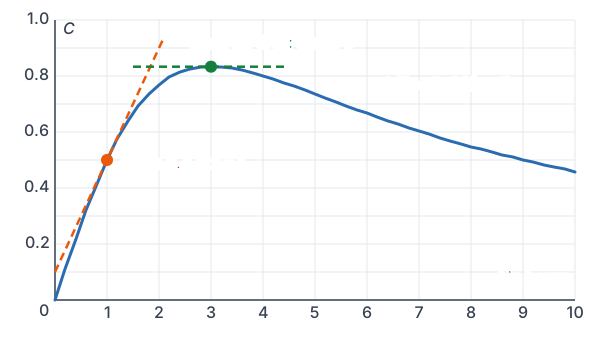
The concentration of a medicine in the blood t hours after a dose is C(t) = \frac{5t}{t^2 + 9} milligrams per liter. Find how fast the concentration is changing at t = 1 and at t = 5, and find when it is highest.
C'(t) = \frac{5(t^2 + 9) - 5t(2t)}{(t^2 + 9)^2}Quotient rule: the top has derivative 5 and the bottom has derivative 2t.
C'(t) = \frac{5t^2 + 45 - 10t^2}{(t^2 + 9)^2}Distribute.
C'(t) = \frac{45 - 5t^2}{(t^2 + 9)^2}Combine like terms.
C'(1) = \frac{45 - 5}{10^2} = \frac{40}{100} = 0.4Substitute t = 1.
C'(5) = \frac{45 - 125}{34^2} = \frac{-80}{1156} \approx -0.069Substitute t = 5.
45 - 5t^2 = 0
The peak is where the rate of change is 0, so set the numerator equal to 0.
t^2 = 9
Add 5t² to both sides, then divide by 5.
t = 3
Take the positive square root, since time can’t be negative.
C(3) = \frac{15}{18} = \frac{5}{6} \approx 0.83Substitute t = 3 into C(t).
Answer: at 1 hour the concentration rises by about 0.4 mg/L per hour. At 5 hours it falls by about 0.069 mg/L per hour. It peaks at 3 hours, at about 0.83 mg/L.
Common mistakes
| Mistake | Example of the error | Fix |
|---|---|---|
| Switching the order of the numerator | \frac{fg' - f'g}{g^2} gives +5 instead of −5 in Example 1 | Start with the bottom times the derivative of the top: f′g − fg′. |
| Dividing the derivatives | For \frac{x^2}{x^2 + 4}: “y' = \frac{2x}{2x} = 1“ | Use the full rule: \frac{8x}{(x^2 + 4)^2}. |
| Forgetting to square the denominator | \frac{-5}{x - 1} | The bottom is g²: \frac{-5}{(x - 1)^2}. |
| Not distributing the minus sign | 3x - 3 - 3x + 2 | Subtract every term: -(3x + 2) = -3x - 2. |
| Using the quotient rule on a constant bottom | Quotient rule for \frac{x^3}{6} | It works, but \frac{1}{6}x^3 and the power rule are faster: \frac{1}{2}x^2. |
Related methods
Simplify before you differentiate
Sometimes you can divide first. For \frac{x^2 - 1}{x}, split it into x - x^{-1}, so the derivative is 1 + x^{-2}. That matches the quotient rule’s answer, \frac{x^2 + 1}{x^2}, after you split that fraction too.
Rewrite as a product
Any quotient is a product: \frac{f}{g} = f \cdot g^{-1}. Later, the chain rule lets you differentiate g^{-1} directly, and then the product rule gives the same result as the quotient rule. Use whichever is easier.
Where the formula comes from
Let q = \frac{f}{g}, so f = qg. The product rule gives f' = q'g + qg'. Solve for q′: q' = \frac{f' - qg'}{g}. Replace q with \frac{f}{g} and multiply the top and bottom by g to get \frac{f'g - fg'}{g^2}.
Practice problems
- Differentiate y = \frac{x}{x + 1}.
- Differentiate y = \frac{2x - 5}{3x + 1}.
- Differentiate y = \frac{x^2 - 1}{x} with the quotient rule.
- Differentiate y = \frac{5}{x^2 + 1}.
- Differentiate y = \frac{x^2 + 3x}{x - 2}.
- Find f′(2) for f(x) = \frac{x^3}{x + 1}.
- If f(0) = 6, f′(0) = −3, g(0) = 2 and g′(0) = 1, find the derivative of f/g at x = 0.
- Find the tangent line to y = \frac{x + 3}{x - 1} at x = 3.
- Find every x where y = \frac{x}{x^2 + 16} has a horizontal tangent line.
- Making x phone cases costs $2,000 in setup plus $15 per case, so the average cost per case is A(x) = \frac{2000 + 15x}{x} dollars. Find A′(100) and say what it means.
Show answers
1.
y' = \frac{1(x + 1) - x(1)}{(x + 1)^2}Quotient rule: top and bottom both have derivative 1.
y' = \frac{x + 1 - x}{(x + 1)^2}Distribute.
y' = \frac{1}{(x + 1)^2}Combine like terms.
Answer: y' = \frac{1}{(x + 1)^2}
2.
y' = \frac{2(3x + 1) - (2x - 5)(3)}{(3x + 1)^2}Quotient rule: f′ = 2 and g′ = 3.
y' = \frac{6x + 2 - 6x + 15}{(3x + 1)^2}Distribute, including the minus sign.
y' = \frac{17}{(3x + 1)^2}Combine like terms.
Answer: y' = \frac{17}{(3x + 1)^2}
3.
y' = \frac{2x \cdot x - (x^2 - 1)(1)}{x^2}Quotient rule: f′ = 2x and g′ = 1.
y' = \frac{2x^2 - x^2 + 1}{x^2}Distribute.
y' = \frac{x^2 + 1}{x^2}Combine like terms.
Answer: y' = \frac{x^2 + 1}{x^2}
4.
y' = \frac{0(x^2 + 1) - 5(2x)}{(x^2 + 1)^2}Quotient rule: the top is a constant, so f′ = 0.
y' = \frac{-10x}{(x^2 + 1)^2}Simplify.
Answer: y' = -\frac{10x}{(x^2 + 1)^2}
5.
y' = \frac{(2x + 3)(x - 2) - (x^2 + 3x)(1)}{(x - 2)^2}Quotient rule.
y' = \frac{2x^2 - x - 6 - x^2 - 3x}{(x - 2)^2}Multiply the binomials and distribute the minus sign.
y' = \frac{x^2 - 4x - 6}{(x - 2)^2}Combine like terms.
Answer: y' = \frac{x^2 - 4x - 6}{(x - 2)^2}
6.
f'(x) = \frac{3x^2(x + 1) - x^3(1)}{(x + 1)^2}Quotient rule.
f'(x) = \frac{2x^3 + 3x^2}{(x + 1)^2}Distribute and combine like terms.
f'(2) = \frac{16 + 12}{9} = \frac{28}{9}Substitute x = 2.
Answer: f'(2) = \frac{28}{9}
7.
\left(\frac{f}{g}\right)'(0) = \frac{(-3)(2) - (6)(1)}{2^2}Substitute into the quotient rule.
\left(\frac{f}{g}\right)'(0) = \frac{-6 - 6}{4} = -3Multiply, subtract, then divide.
Answer: −3
8.
y(3) = \frac{6}{2} = 3Find the point (3, 3).
y' = \frac{(x - 1) - (x + 3)}{(x - 1)^2} = \frac{-4}{(x - 1)^2}Quotient rule, then combine like terms.
y'(3) = \frac{-4}{4} = -1Substitute x = 3. The slope is −1.
y - 3 = -1(x - 3)
Point-slope form.
y = -x + 6
Distribute, then add 3 to both sides.
Answer: y = -x + 6
9.
y' = \frac{(x^2 + 16) - x(2x)}{(x^2 + 16)^2}Quotient rule.
y' = \frac{16 - x^2}{(x^2 + 16)^2}Combine like terms.
16 - x^2 = 0
A horizontal tangent needs y′ = 0, so set the numerator equal to 0.
x^2 = 16
Add x² to both sides.
x = \pm 4
Take the square root of both sides (see solving quadratics with square roots).
Answer: x = −4 and x = 4
10.
A'(x) = \frac{15x - (2000 + 15x)(1)}{x^2}Quotient rule: the top has derivative 15 and the bottom has derivative 1.
A'(x) = \frac{-2000}{x^2}Distribute and combine like terms.
A'(100) = \frac{-2000}{10000} = -0.2Substitute x = 100.
Answer: A′(100) = −0.2. At 100 cases, each extra case lowers the average cost by about 20 cents.
Quotient rule FAQ
What is the quotient rule formula?
\frac{d}{dx}\left[\frac{f}{g}\right] = \frac{f'g - fg'}{g^2}. Take the bottom times the derivative of the top, subtract the top times the derivative of the bottom, and divide by the bottom squared.
Does the order matter in the quotient rule?
Yes. Switching the two terms in the numerator changes the sign of the answer. Always start with f′g, the derivative of the top times the bottom.
Should I expand the denominator?
Usually not. Leaving it as g², like (x - 1)^2, keeps the answer simpler and makes it easy to see where the derivative is undefined.
Can I use the product rule instead of the quotient rule?
Yes. Write \frac{f}{g} as f \cdot g^{-1} and use the product rule with the chain rule. Both methods give the same derivative.
Summary
- The quotient rule: \left(\frac{f}{g}\right)' = \frac{f'g - fg'}{g^2}.
- Order matters: derivative of the top times the bottom comes first.
- Distribute the minus sign to every term, then combine like terms.
- Leave the denominator squared.
- If the bottom is a constant, or the fraction splits easily, simplify first and use the power rule.
Previous lesson: Product Rule
Next lesson: Chain Rule
Back to the Calculus 1 Index