
Chain Rule
The chain rule finds the derivative of a composite function, one function inside another. For y = f(g(x)), the derivative is f'(g(x)) \cdot g'(x): take the derivative of the outside function, keep the inside the same, then multiply by the derivative of the inside.
Before this lesson: Power Rule, Product Rule and Composition of Functions
What the chain rule means
Many functions are built in layers. In y = (3x^2 + 1)^5, the inside layer is u = 3x^2 + 1, and the outside layer raises u to the 5th power. The chain rule handles each layer separately and then multiplies.
Rates of change multiply when they are chained together. If u changes 3 times as fast as x, and y changes 2 times as fast as u, then y changes 2 × 3 = 6 times as fast as x. That is the chain rule in Leibniz notation: \frac{dy}{dx} = \frac{dy}{du} \cdot \frac{du}{dx}.
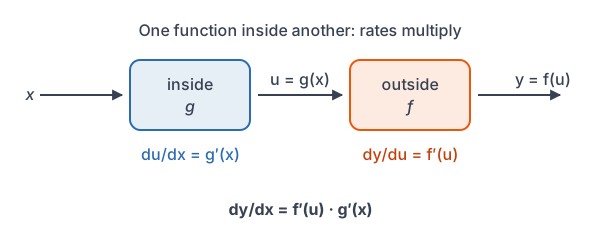
The chain rule formula
\frac{d}{dx}\left[f(g(x))\right] = f'(g(x)) \cdot g'(x) \qquad \text{or} \qquad \frac{dy}{dx} = \frac{dy}{du} \cdot \frac{du}{dx}The most common use is the general power rule, the chain rule applied to a power of a function:
\frac{d}{dx}\left[u^n\right] = n\,u^{n-1} \cdot u'- Find the inside function u = g(x) and the outside function f(u).
- Differentiate the outside, leaving the inside unchanged: f′(u).
- Multiply by the derivative of the inside: u′ = g′(x).
- Substitute u back in terms of x and simplify.
Chain rule examples
Example 1: A power of a polynomial
Differentiate y = (3x^2 + 1)^5.
u = 3x^2 + 1
The inside function is the expression in the parentheses.
y = u^5
The outside function is the 5th power.
\frac{dy}{du} = 5u^4Differentiate the outside with the power rule.
\frac{du}{dx} = 6xDifferentiate the inside.
y' = 5(3x^2 + 1)^4 \cdot 6x
Multiply the two rates and put u back as 3x² + 1.
y' = 30x(3x^2 + 1)^4
Multiply 5 · 6x and write the factor in front.
Answer: y' = 30x(3x^2 + 1)^4. Expanding (3x^2 + 1)^5 first would take much longer.
Example 2: A square root
Differentiate y = \sqrt{x^2 + 9}. Then find the slope at x = 4.
y = (x^2 + 9)^{1/2}Write the root as a power (see rational exponents).
y' = \frac{1}{2}(x^2 + 9)^{-1/2} \cdot 2xGeneral power rule: bring down ½, subtract 1 from the exponent, multiply by the inside’s derivative 2x.
y' = x(x^2 + 9)^{-1/2}Multiply ½ · 2x.
y' = \frac{x}{\sqrt{x^2 + 9}}Rewrite the negative power as a root in the denominator.
y'(4) = \frac{4}{\sqrt{25}} = \frac{4}{5}Substitute x = 4: 16 + 9 = 25.
Answer: y' = \frac{x}{\sqrt{x^2 + 9}}, and the slope at x = 4 is \frac{4}{5}.
Example 3: A power in the denominator
Differentiate y = \frac{1}{(2x - 3)^4}.
y = (2x - 3)^{-4}Move the power up with a negative exponent (see negative exponents).
y' = -4(2x - 3)^{-5} \cdot 2General power rule. The inside 2x − 3 has derivative 2.
y' = -8(2x - 3)^{-5}Multiply −4 · 2.
y' = \frac{-8}{(2x - 3)^5}Rewrite with a positive exponent.
Answer: y' = -\frac{8}{(2x - 3)^5}. Rewriting first is faster than the quotient rule here.
Example 4: Using a table of values
Let h(x) = f(g(x)). You know g(1) = 3, g′(1) = −2, f′(1) = 7 and f′(3) = 5. Find h′(1).
h'(1) = f'(g(1)) \cdot g'(1)
Write the chain rule at x = 1.
h'(1) = f'(3) \cdot g'(1)
Replace g(1) with 3. The outside derivative is taken at 3, not at 1.
h'(1) = 5 \cdot (-2)
Substitute f′(3) = 5 and g′(1) = −2.
h'(1) = -10
Multiply.
Answer: h′(1) = −10. The value f′(1) = 7 is a trap. The outside derivative is evaluated at the inside’s output, g(1) = 3.
Example 5: Word problem with a factory’s cost
A factory’s daily cost is C(q) = 200 + 3q + 0.01q^2 dollars for q items. Its daily output grows with time: q(t) = 50 + 5t items, t weeks from now. How fast is the daily cost rising at t = 10 weeks?
\frac{dC}{dt} = \frac{dC}{dq} \cdot \frac{dq}{dt}Cost depends on q, and q depends on t, so chain the rates.
\frac{dC}{dq} = 3 + 0.02qDifferentiate C(q).
\frac{dq}{dt} = 5Differentiate q(t).
q(10) = 50 + 5(10) = 100
Find the output at t = 10.
\frac{dC}{dq} = 3 + 0.02(100) = 5Substitute q = 100. Each extra item costs about $5.
\frac{dC}{dt} = 5 \cdot 5 = 25Multiply the two rates.
Answer: at 10 weeks, the daily cost is rising by about $25 per week. Each week brings 5 more items a day, and each costs about $5.
Common mistakes
| Mistake | Example of the error | Fix |
|---|---|---|
| Forgetting the inside derivative | For (3x^2 + 1)^5: “y' = 5(3x^2 + 1)^4“ | Multiply by the inside’s derivative: \cdot 6x. |
| Differentiating the inside inside the parentheses | “y' = 5(6x)^4“ | Keep the inside the same in f′: 5(3x^2 + 1)^4 \cdot 6x. |
| Evaluating the outside derivative at the wrong point | Using f′(1) for h′(1) in Example 4 | Use f′(g(1)) = f′(3). |
| Missing a layer in a triple composition | For \sqrt{(x^2 + 1)^3}, stopping after two layers | Work from the outside in, one layer at a time, and multiply every derivative. |
| Using the chain rule when the inside is just x | Multiplying by 1 again and again for x^5 | When the inside is x, its derivative is 1. The power rule is enough. |
Related methods
The chain rule with the product and quotient rules
Many problems need two rules. For y = x(x^2 + 1)^3, use the product rule first, and the chain rule to differentiate (x^2 + 1)^3. Practice Problem 8 works through this.
Three or more layers
For y = f(g(h(x))), multiply three derivatives: y' = f'(g(h(x))) \cdot g'(h(x)) \cdot h'(x). Peel the layers from the outside in.
Coming next
The chain rule is the key step in implicit differentiation and in related rates. It also gives the derivatives of functions like \sin(3x) and e^{x^2} in the next unit.
Practice problems
- Differentiate y = (4x - 1)^3.
- Differentiate y = (x^2 - 5x)^4.
- Differentiate y = \sqrt{6x + 1}.
- Differentiate y = \frac{1}{(x^3 + 2)^2}.
- Find y′(1) for y = \sqrt[3]{x^2 + 7}.
- Let h(x) = f(g(x)). If g(2) = 0, g′(2) = 4 and f′(0) = −3, find h′(2).
- Find the tangent line to y = \sqrt{x^2 + 16} at x = 3.
- Differentiate y = x(x^2 + 1)^3 and factor the answer.
- Differentiate y = \left(\frac{x + 1}{x - 1}\right)^2.
- A balloon’s radius is r(t) = 2 + 0.5t cm after t seconds. Its volume is V = \frac{4}{3}\pi r^3. How fast is the volume growing at t = 4?
Show answers
1.
y' = 3(4x - 1)^2 \cdot 4
General power rule. The inside has derivative 4.
y' = 12(4x - 1)^2
Multiply 3 · 4.
Answer: y' = 12(4x - 1)^2
2.
y' = 4(x^2 - 5x)^3 \cdot (2x - 5)
General power rule. The inside has derivative 2x − 5.
Answer: y' = 4(2x - 5)(x^2 - 5x)^3
3.
y = (6x + 1)^{1/2}Write the root as a power.
y' = \frac{1}{2}(6x + 1)^{-1/2} \cdot 6General power rule.
y' = \frac{3}{\sqrt{6x + 1}}Multiply ½ · 6 and rewrite as a root.
Answer: y' = \frac{3}{\sqrt{6x + 1}}
4.
y = (x^3 + 2)^{-2}Rewrite with a negative exponent.
y' = -2(x^3 + 2)^{-3} \cdot 3x^2General power rule. The inside has derivative 3x².
y' = \frac{-6x^2}{(x^3 + 2)^3}Multiply and rewrite with a positive exponent.
Answer: y' = -\frac{6x^2}{(x^3 + 2)^3}
5.
y = (x^2 + 7)^{1/3}Write the cube root as a power.
y' = \frac{1}{3}(x^2 + 7)^{-2/3} \cdot 2xGeneral power rule: ⅓ − 1 = −⅔.
y'(1) = \frac{1}{3} \cdot 8^{-2/3} \cdot 2Substitute x = 1: 1 + 7 = 8.
8^{-2/3} = \frac{1}{(\sqrt[3]{8})^2} = \frac{1}{4}Take the cube root, square it, then flip it.
y'(1) = \frac{1}{3} \cdot \frac{1}{4} \cdot 2 = \frac{1}{6}Multiply.
Answer: y'(1) = \frac{1}{6}
6.
h'(2) = f'(g(2)) \cdot g'(2)
Chain rule at x = 2.
h'(2) = f'(0) \cdot 4 = -3 \cdot 4
Replace g(2) with 0, then substitute.
h'(2) = -12
Multiply.
Answer: −12
7.
y(3) = \sqrt{9 + 16} = 5Find the point (3, 5).
y' = \frac{x}{\sqrt{x^2 + 16}}General power rule, as in Example 2.
y'(3) = \frac{3}{5}Substitute x = 3.
y - 5 = \frac{3}{5}(x - 3)Point-slope form (see point-slope form).
y = \frac{3}{5}x + \frac{16}{5}Distribute, then add 5 = 25/5 to both sides.
Answer: y = \frac{3}{5}x + \frac{16}{5}
8.
y' = 1 \cdot (x^2 + 1)^3 + x \cdot 3(x^2 + 1)^2 \cdot 2x
Product rule, with the chain rule for the second factor.
y' = (x^2 + 1)^3 + 6x^2(x^2 + 1)^2
Simplify the second term.
y' = (x^2 + 1)^2\left[(x^2 + 1) + 6x^2\right]
Factor out the common factor (x² + 1)² (see factoring out the GCF).
y' = (x^2 + 1)^2(7x^2 + 1)
Combine like terms in the brackets.
Answer: y' = (x^2 + 1)^2(7x^2 + 1)
9.
y' = 2\left(\frac{x + 1}{x - 1}\right) \cdot \frac{d}{dx}\left[\frac{x + 1}{x - 1}\right]General power rule: the inside is the fraction.
\frac{d}{dx}\left[\frac{x + 1}{x - 1}\right] = \frac{(x - 1) - (x + 1)}{(x - 1)^2} = \frac{-2}{(x - 1)^2}Quotient rule for the inside.
y' = 2 \cdot \frac{x + 1}{x - 1} \cdot \frac{-2}{(x - 1)^2}Substitute the inside derivative.
y' = \frac{-4(x + 1)}{(x - 1)^3}Multiply the fractions.
Answer: y' = -\frac{4(x + 1)}{(x - 1)^3}
10.
\frac{dV}{dt} = 4\pi r^2 \cdot \frac{dr}{dt}Chain rule: dV/dr = 4πr², times dr/dt.
\frac{dr}{dt} = 0.5, \; r(4) = 2 + 0.5(4) = 4Differentiate r(t) and find r at t = 4.
\frac{dV}{dt} = 4\pi(4)^2(0.5) = 32\piSubstitute r = 4 and dr/dt = 0.5.
32\pi \approx 100.5
Multiply by π ≈ 3.14159.
Answer: about 100.5 cm³ per second
Chain rule FAQ
What is the chain rule in simple terms?
Differentiate the outside function, leave the inside alone, then multiply by the derivative of the inside. It is how you differentiate a function inside another function.
How do you know when to use the chain rule?
Use it whenever something more than plain x sits inside another function, like a power of a polynomial or a square root of an expression. If the inside is just x, you don’t need it.
What is the general power rule?
It is the chain rule for powers: \frac{d}{dx}[u^n] = n u^{n-1} \cdot u'. For example, the derivative of (2x + 1)^3 is 3(2x + 1)^2 \cdot 2.
How is the chain rule written in Leibniz notation?
\frac{dy}{dx} = \frac{dy}{du} \cdot \frac{du}{dx}. It looks like fractions canceling, which is a handy way to remember it, even though derivatives are not really fractions.
Summary
- Chain rule: \frac{d}{dx}[f(g(x))] = f'(g(x)) \cdot g'(x).
- Outside derivative first, inside unchanged, then times the inside’s derivative.
- General power rule: \frac{d}{dx}[u^n] = n u^{n-1} u'.
- With a table, evaluate the outside derivative at g(a), not at a.
- In word problems, chained rates multiply: \frac{dC}{dt} = \frac{dC}{dq} \cdot \frac{dq}{dt}.
Previous lesson: Quotient Rule
Next lesson: Implicit Differentiation
Back to the Calculus 1 Index