
Rational Exponents
Rational exponents are exponents written as fractions. The denominator is a root and the numerator is a power: a^{\frac{m}{n}} = \left(\sqrt[n]{a}\right)^m. For example, 8^{\frac{2}{3}} = \left(\sqrt[3]{8}\right)^2 = 4. All the usual exponent rules still work with fraction exponents, so you can simplify radicals by switching to exponent form.
Before this lesson: You should know nth Roots, Exponent Rules, Zero and Negative Exponents and Adding and Subtracting Fractions.
Why a Fraction Exponent Means a Root
Exponent rules say (a^m)^n = a^{mn}. Suppose that rule still works for fractions. Then \left(9^{\frac{1}{2}}\right)^2 = 9^1 = 9. So 9^{\frac{1}{2}} is a number whose square is 9. That number is 3, the square root of 9.
The same idea works for any root. a^{\frac{1}{n}} is the nth root of a. A numerator other than 1 raises that root to a power.
The Rules
a^{\frac{1}{n}} = \sqrt[n]{a} \qquad a^{\frac{m}{n}} = \left(\sqrt[n]{a}\right)^m = \sqrt[n]{a^m} \qquad a^{-\frac{m}{n}} = \frac{1}{a^{\frac{m}{n}}}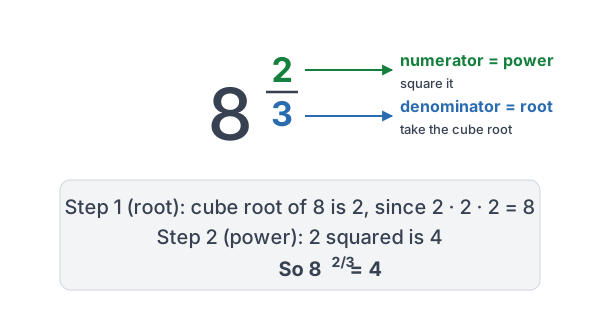
Taking the root first usually keeps the numbers small. When a is negative, use these rules only with odd roots, like cube roots.
Worked Examples
Example 1: Unit fraction exponents
Evaluate (a) 25^{\frac{1}{2}}, (b) 27^{\frac{1}{3}} and (c) 16^{\frac{1}{4}}.
- (a) Rewrite as a square root: 25^{\frac{1}{2}} = \sqrt{25}
- Evaluate: 5
- (b) Rewrite as a cube root (see nth roots): 27^{\frac{1}{3}} = \sqrt[3]{27}
- Evaluate: 3
- (c) Rewrite as a 4th root: 16^{\frac{1}{4}} = \sqrt[4]{16}
- Evaluate: 2
Answer: (a) 5 (b) 3 (c) 2
Example 2: Numerators other than 1
Evaluate (a) 8^{\frac{2}{3}} and (b) 32^{\frac{3}{5}}.
- (a) Write as a root, then a power: 8^{\frac{2}{3}} = \left(\sqrt[3]{8}\right)^2
- Take the cube root: 2^2
- Square: 4
- (b) Write as a root, then a power: 32^{\frac{3}{5}} = \left(\sqrt[5]{32}\right)^3
- Take the 5th root: 2^3
- Cube: 8
Answer: (a) 4 (b) 8
Example 3: A negative rational exponent
Evaluate 81^{-\frac{3}{4}}.
- A negative exponent means a reciprocal (see zero and negative exponents): 81^{-\frac{3}{4}} = \frac{1}{81^{\frac{3}{4}}}
- Write the bottom as a root, then a power: \frac{1}{\left(\sqrt[4]{81}\right)^3}
- Take the 4th root: \frac{1}{3^3}
- Cube: \frac{1}{27}
Answer: \frac{1}{27}. The negative sign makes a reciprocal, not a negative number.
Example 4: Simplify with variables
Simplify (a) x^{\frac{1}{2}} \cdot x^{\frac{1}{3}} and (b) \left(16x^8\right)^{\frac{3}{4}}. Assume x is positive.
- (a) Same base, so add the exponents (see exponent rules): x^{\frac{1}{2} + \frac{1}{3}}
- Use a common denominator (see adding fractions): \frac{1}{2} + \frac{1}{3} = \frac{3}{6} + \frac{2}{6}
- Add: \frac{5}{6}, so the answer is x^{\frac{5}{6}}
- (b) Apply the power to each factor: 16^{\frac{3}{4}} \cdot \left(x^8\right)^{\frac{3}{4}}
- Write 16^{\frac{3}{4}} as a root, then a power: \left(\sqrt[4]{16}\right)^3 \cdot \left(x^8\right)^{\frac{3}{4}}
- Take the 4th root: 2^3 \cdot \left(x^8\right)^{\frac{3}{4}}
- Cube: 8 \cdot \left(x^8\right)^{\frac{3}{4}}
- Multiply the exponents (see multiplying fractions): 8 \cdot \frac{3}{4} = 6, so 8x^6
Answer: (a) x^{\frac{5}{6}}, which is \sqrt[6]{x^5} (b) 8x^6
Example 5: Word problem with energy use
A common biology model, Kleiber’s law, says an animal’s resting energy use is about proportional to M^{\frac{3}{4}}, where M is its mass. How many times more energy does a 16 kg dog use at rest than a 1 kg rabbit?
- Write the ratio of the two energy uses: \frac{16^{\frac{3}{4}}}{1^{\frac{3}{4}}}
- Any power of 1 is 1: \frac{16^{\frac{3}{4}}}{1}
- Write as a root, then a power: \left(\sqrt[4]{16}\right)^3
- Take the 4th root: 2^3
- Cube: 8
Answer: The dog uses about 8 times as much energy, even though it is 16 times as heavy.
Common Mistakes
| Mistake | Example of the error | Fix |
|---|---|---|
| Multiplying the base by the fraction | 8^{\frac{2}{3}} = 8 \cdot \frac{2}{3} | The exponent means root and power: \left(\sqrt[3]{8}\right)^2 = 4. |
| Making a negative exponent negative | 81^{-\frac{3}{4}} = -27 | A negative exponent means a reciprocal: \frac{1}{27}. |
| Swapping the root and the power | 8^{\frac{2}{3}} = \left(\sqrt{8}\right)^3 | The denominator is the root: cube root, then square. |
| Multiplying exponents instead of adding | x^{\frac{1}{2}} \cdot x^{\frac{1}{3}} = x^{\frac{1}{6}} | Same base when multiplying: add the exponents, x^{\frac{5}{6}}. |
| Forgetting the coefficient | \left(16x^8\right)^{\frac{3}{4}} = 16x^6 | Raise 16 to the \frac{3}{4} power too: 8x^6. |
Practice Problems
- Evaluate 49^{\frac{1}{2}}.
- Evaluate 125^{\frac{2}{3}}.
- Evaluate 16^{-\frac{3}{2}}.
- Evaluate (-27)^{\frac{1}{3}}.
- Write \sqrt[5]{x^3} with a rational exponent.
- Write y^{\frac{4}{3}} in radical form.
- Simplify x^{\frac{2}{3}} \cdot x^{\frac{1}{6}}.
- Simplify \left(27x^6\right)^{\frac{2}{3}}. Assume x is positive.
- Simplify \frac{x^{\frac{3}{4}}}{x^{\frac{1}{2}}}.
- Using Kleiber’s law (energy proportional to M^{\frac{3}{4}}), how many times more energy does an 81 kg animal use at rest than a 1 kg animal?
Show answers
- Square root: \sqrt{49}
Answer: 7 - Root, then power: \left(\sqrt[3]{125}\right)^2
Cube root: 5^2
Square: 25 - Reciprocal: \frac{1}{16^{\frac{3}{2}}}
Root, then power: \frac{1}{\left(\sqrt{16}\right)^3}
Square root: \frac{1}{4^3}
Cube: \frac{1}{64} - Cube root of a negative: \sqrt[3]{-27}
Answer: −3 - The index 5 is the denominator and the power 3 is the numerator
Answer: x^{\frac{3}{5}} - The denominator 3 is the root; the numerator 4 is the power
Answer: \sqrt[3]{y^4}, or \left(\sqrt[3]{y}\right)^4 - Add the exponents: \frac{2}{3} + \frac{1}{6}
Common denominator: \frac{4}{6} + \frac{1}{6}
Add: \frac{5}{6}
Answer: x^{\frac{5}{6}} - Apply the power to each factor: 27^{\frac{2}{3}} \cdot \left(x^6\right)^{\frac{2}{3}}
Root, then power: \left(\sqrt[3]{27}\right)^2
Cube root: 3^2
Square: 9
Multiply exponents: 6 \cdot \frac{2}{3} = 4
Answer: 9x^4 - Subtract the exponents: \frac{3}{4} - \frac{1}{2}
Common denominator: \frac{3}{4} - \frac{2}{4}
Subtract: \frac{1}{4}
Answer: x^{\frac{1}{4}}, or \sqrt[4]{x} - Ratio: \frac{81^{\frac{3}{4}}}{1^{\frac{3}{4}}} = 81^{\frac{3}{4}}
Root, then power: \left(\sqrt[4]{81}\right)^3
4th root: 3^3
Cube: 27
Answer: about 27 times as much
FAQ
What is a rational exponent?
It is an exponent that is a fraction, like \frac{2}{3}. The denominator tells you which root to take, and the numerator tells you which power to raise it to.
How do you convert a radical to a rational exponent?
Put the power over the index: \sqrt[n]{a^m} = a^{\frac{m}{n}}. For example, \sqrt[4]{x^3} = x^{\frac{3}{4}}.
What does a negative rational exponent mean?
It means take the reciprocal: a^{-\frac{m}{n}} = \frac{1}{a^{\frac{m}{n}}}. So 8^{-\frac{1}{3}} = \frac{1}{2}.
Do the exponent rules work with fractions?
Yes. Add exponents when you multiply the same base, subtract when you divide, and multiply when you raise a power to a power. You just do fraction arithmetic on the exponents.
Summary
- a^{\frac{1}{n}} = \sqrt[n]{a}: the denominator is the root.
- a^{\frac{m}{n}} = \left(\sqrt[n]{a}\right)^m: the numerator is the power.
- A negative exponent means a reciprocal, not a negative number.
- All exponent rules work, using fraction arithmetic on the exponents.
- Take the root first to keep numbers small.
Previous lesson: nth Roots
Next lesson: Radical Functions
Back to the Algebra 2 Index