
Radical Functions
Radical functions have the variable inside a root, like f(x) = \sqrt{x} or g(x) = \sqrt[3]{x}. A square root graph starts at a point and curves to one side. A cube root graph is an S shape through a center point. To graph y = a\sqrt{x - h} + k, start at (h, k) and use a few easy points.
Before this lesson: You should know Parent Functions, Transformations of Functions, Domain and Range and nth Roots.
The Two Parent Graphs
The square root function y = \sqrt{x} starts at (0, 0) and rises slowly to the right. It has no graph for negative x, because the square root of a negative number is not real. Easy points to plot are (0, 0), (1, 1), (4, 2) and (9, 3).
The cube root function y = \sqrt[3]{x} works for every x, since negative numbers have cube roots. Its graph passes through (-8, -2), (-1, -1), (0, 0), (1, 1) and (8, 2).
| Function | Domain | Range | Key point |
|---|---|---|---|
| y = \sqrt{x} | x \ge 0 | y \ge 0 | Starts at (0, 0) |
| y = \sqrt[3]{x} | All real numbers | All real numbers | Center at (0, 0) |
Transformations of Radical Functions
y = a\sqrt{x - h} + k \qquad y = a\sqrt[3]{x - h} + kThese follow the same rules as other functions (see transformations of functions). The graph moves right h and up k. If |a| \gt 1 it stretches, and if a \lt 0 it flips over the x-axis. For a square root, (h, k) is the starting point.
Worked Examples
Example 1: Domain and range
Find the domain and range of f(x) = \sqrt{x + 4}.
- The radicand must not be negative: x + 4 \ge 0
- Subtract 4 from both sides (see solving inequalities): x \ge -4
- A principal square root is never negative, so f(x) \ge 0.
Answer: Domain x \ge -4, or [-4, \infty). Range y \ge 0, or [0, \infty) (see domain and range).
Example 2: A shifted square root
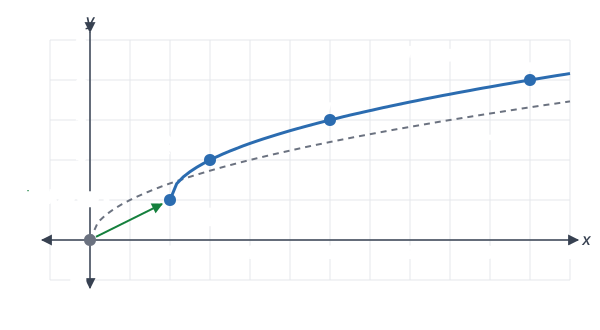
Graph g(x) = \sqrt{x - 2} + 1 and give its domain and range.
- Compare with y = a\sqrt{x - h} + k: h = 2 and k = 1, so the graph starts at (2, 1).
- Pick x-values that make x - 2 a perfect square: 2, 3, 6 and 11.
- g(3) = \sqrt{3 - 2} + 1 = \sqrt{1} + 1 = 2
- g(6) = \sqrt{6 - 2} + 1 = \sqrt{4} + 1 = 3
- g(11) = \sqrt{11 - 2} + 1 = \sqrt{9} + 1 = 4
- Plot (2, 1), (3, 2), (6, 3) and (11, 4), then draw a smooth curve to the right.
Answer: The graph above. Domain x \ge 2; range y \ge 1.
Example 3: A reflection and a stretch
Graph h(x) = -2\sqrt{x} + 3.
- The start point is (0, 3), since h = 0 and k = 3.
- The −2 stretches by 2 and flips the curve downward.
- h(1) = -2\sqrt{1} + 3 = -2 + 3 = 1
- h(4) = -2\sqrt{4} + 3 = -4 + 3 = -1
- h(9) = -2\sqrt{9} + 3 = -6 + 3 = -3
- Plot (0, 3), (1, 1), (4, -1) and (9, -3), and draw a curve falling to the right.
Answer: Domain x \ge 0; range y \le 3, because the curve starts at height 3 and goes down.
Example 4: A cube root function
Graph f(x) = \sqrt[3]{x + 1} - 2.
- The center point moves from (0, 0) to (-1, -2): left 1, down 2.
- Pick x-values that make x + 1 a perfect cube: −9, −2, −1, 0 and 7.
- f(-9) = \sqrt[3]{-8} - 2 = -2 - 2 = -4
- f(-2) = \sqrt[3]{-1} - 2 = -1 - 2 = -3
- f(-1) = \sqrt[3]{0} - 2 = -2
- f(0) = \sqrt[3]{1} - 2 = 1 - 2 = -1
- f(7) = \sqrt[3]{8} - 2 = 2 - 2 = 0
Answer: An S-shaped curve through (-9, -4), (-2, -3), (-1, -2), (0, -1) and (7, 0). Domain and range are all real numbers.
Example 5: Word problem with falling time
If an object is dropped from a height of h feet, the time it takes to hit the ground is about t = \frac{\sqrt{h}}{4} seconds. How long does it take to fall 100 feet? Why is the domain h \ge 0?
- Substitute h = 100: t = \frac{\sqrt{100}}{4}
- Take the square root (see square root): t = \frac{10}{4}
- Divide: t = 2.5
- A height can’t be negative, and \sqrt{h} is not real for negative h, so the domain is h \ge 0.
Answer: About 2.5 seconds. Notice that 4 times the height (400 feet) only doubles the time, to 5 seconds. That is the slow growth of a square root.
Common Mistakes
| Mistake | Example of the error | Fix |
|---|---|---|
| Shifting the wrong way | \sqrt{x - 2} starts at x = -2 | x - 2 = 0 at x = 2, so it starts at x = 2. |
| Giving a square root graph a left side | Drawing \sqrt{x} for negative x | \sqrt{x} is not real for x \lt 0. The graph starts at the origin. |
| Limiting the cube root’s domain | Domain of \sqrt[3]{x} is x \ge 0 | Cube roots of negatives are real, so the domain is all real numbers. |
| Wrong range after a flip | Range of -2\sqrt{x} + 3 is y \ge 3 | The flip makes the curve go down from 3: y \le 3. |
| Picking hard x-values | Using x = 5 for \sqrt{x - 2} | Pick values that make the radicand a perfect square, like 3, 6 and 11. |
Practice Problems
- Find the domain of f(x) = \sqrt{x - 5}.
- Find the domain and range of f(x) = \sqrt{3 - x}.
- Find the domain of f(x) = \sqrt[3]{x - 7}.
- Describe how g(x) = \sqrt{x + 3} - 4 is shifted from y = \sqrt{x}, and give its starting point.
- Make a table for f(x) = 3\sqrt{x} at x = 0, 1, 4, 9.
- Graph f(x) = -\sqrt{x - 1} using three points, and give its range.
- Find f(-8), f(0) and f(8) for f(x) = \sqrt[3]{x} + 2.
- Write the equation of y = \sqrt{x} shifted right 4 and up 2.
- Find the range of f(x) = 2\sqrt{x + 1} - 5.
- Use t = \frac{\sqrt{h}}{4} to find the falling time from 256 feet and from 36 feet.
Show answers
- Radicand not negative: x - 5 \ge 0
Add 5: x \ge 5
Answer: [5, \infty) - Radicand not negative: 3 - x \ge 0
Add x: 3 \ge x, so x \le 3
A square root is never negative: y \ge 0
Answer: domain (-\infty, 3], range [0, \infty) - A cube root works for any real number
Answer: all real numbers - x + 3 means left 3; -4 means down 4
Answer: left 3, down 4, starting at (-3, -4) - f(0) = 3\sqrt{0} = 0
f(1) = 3\sqrt{1} = 3
f(4) = 3\sqrt{4} = 3 \cdot 2 = 6
f(9) = 3\sqrt{9} = 3 \cdot 3 = 9
Answer: (0, 0), (1, 3), (4, 6), (9, 9) - Start: (1, 0)
f(2) = -\sqrt{1} = -1
f(5) = -\sqrt{4} = -2
Points (1, 0), (2, -1), (5, -2); the curve falls to the right
Answer: range y \le 0 - f(-8) = \sqrt[3]{-8} + 2 = -2 + 2 = 0
f(0) = \sqrt[3]{0} + 2 = 2
f(8) = \sqrt[3]{8} + 2 = 2 + 2 = 4 - Right 4 replaces x with x - 4; up 2 adds 2
Answer: f(x) = \sqrt{x - 4} + 2 - 2\sqrt{x + 1} is never negative, so it is at least 0
Subtract 5: 2\sqrt{x + 1} - 5 \ge -5
Answer: y \ge -5 - t = \frac{\sqrt{256}}{4} = \frac{16}{4}
Divide: 4 seconds
t = \frac{\sqrt{36}}{4} = \frac{6}{4}
Divide: 1.5 seconds
FAQ
What is a radical function?
It is a function with the variable inside a root, such as f(x) = \sqrt{x - 3} or g(x) = \sqrt[3]{2x}.
How do you find the domain of a square root function?
Set the radicand greater than or equal to 0 and solve. For \sqrt{x + 4}, x + 4 \ge 0, so x \ge -4.
What is the domain of a cube root function?
All real numbers. You can take the cube root of any number, positive, negative or zero.
How do you graph y = √(x − h) + k?
Start at the point (h, k). Then add 1, 4 and 9 to h to get easy x-values, find their y-values, and connect the points with a smooth curve.
Summary
- y = \sqrt{x} starts at (0, 0), has domain x \ge 0 and range y \ge 0.
- y = \sqrt[3]{x} is an S shape with domain and range all real numbers.
- In y = a\sqrt{x - h} + k, (h, k) is the start point; a stretches and, if negative, flips the graph.
- For a square root, set the radicand \ge 0 to find the domain.
- Choose x-values that make the radicand a perfect square or cube.
Previous lesson: Rational Exponents
Next lesson: Solving Radical Equations
Back to the Algebra 2 Index