
Solving Radical Equations
Solving radical equations takes three steps: isolate the radical, raise both sides to the power of the index to remove it, and solve the equation that is left. Then check every answer in the original equation. Squaring can create extraneous solutions, answers that don’t actually work, so the check is required.
Before this lesson: You should know Radical Functions, nth Roots, Multi-Step Equations and Solving Quadratic Equations by Factoring.
Why You Must Check Your Answers
Squaring both sides is allowed, but it can add answers. For example, x = 3 has one solution. Square both sides and you get x^2 = 9, which has two: 3 and −3. The −3 sneaked in.
The same thing happens with radical equations. A square root is never negative, so any answer that makes a square root equal a negative number is extraneous. Checking in the original equation catches it.
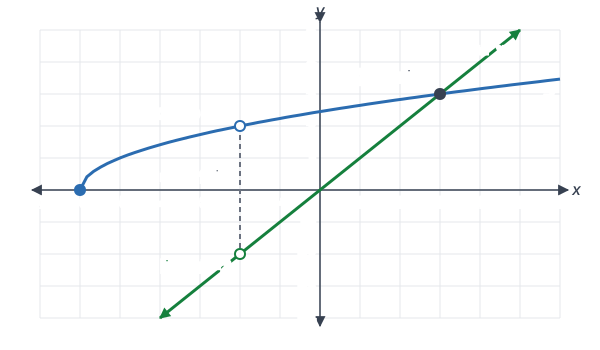
Steps for Solving a Radical Equation
- Isolate the radical on one side.
- Raise both sides to the power of the index: square for a square root, cube for a cube root.
- Solve the new equation.
- Check each answer in the original equation and cross out any extraneous ones.
Worked Examples
Example 1: A basic square root equation
Solve \sqrt{x - 3} = 5.
- The radical is already alone. Square both sides: \left(\sqrt{x - 3}\right)^2 = 5^2
- Simplify: x - 3 = 25
- Add 3 to both sides: x = 28
- Check: \sqrt{28 - 3} = \sqrt{25} = 5. It works.
Answer: x = 28
Example 2: Isolate the radical first
Solve \sqrt{2x + 1} + 4 = 7.
- Subtract 4 from both sides: \sqrt{2x + 1} = 3
- Square both sides: 2x + 1 = 9
- Subtract 1 from both sides (see two-step equations): 2x = 8
- Divide both sides by 2: x = 4
- Check: \sqrt{2(4) + 1} + 4 = \sqrt{9} + 4 = 3 + 4 = 7. It works.
Answer: x = 4
Example 3: An extraneous solution
Solve \sqrt{x + 6} = x.
- Square both sides: x + 6 = x^2
- Subtract x + 6 from both sides: 0 = x^2 - x - 6
- Factor the trinomial (see factoring trinomials): 0 = (x - 3)(x + 2)
- Set each factor equal to zero (see solving quadratic equations by factoring): x = 3 or x = -2
- Check x = 3: \sqrt{3 + 6} = \sqrt{9} = 3, and the right side is 3. It works.
- Check x = -2: \sqrt{-2 + 6} = \sqrt{4} = 2, but the right side is −2. Since 2 \ne -2, it is extraneous.
Answer: x = 3 only. The graph above shows why: the curve and the line meet once.
Example 4: A cube root equation
Solve \sqrt[3]{x - 4} = -2.
- Cube both sides (see nth roots): \left(\sqrt[3]{x - 4}\right)^3 = (-2)^3
- Simplify: x - 4 = -8
- Add 4 to both sides: x = -4
- Check: \sqrt[3]{-4 - 4} = \sqrt[3]{-8} = -2. It works.
Answer: x = -4. A cube root can be negative, so a negative right side is fine here.
Example 5: Word problem with a falling object
The time for a dropped object to fall h feet is about t = \frac{\sqrt{h}}{4} seconds. From what height does an object take 3 seconds to fall?
- Substitute t = 3: 3 = \frac{\sqrt{h}}{4}
- Multiply both sides by 4 to isolate the radical: 12 = \sqrt{h}
- Square both sides: 144 = h
- Check: \frac{\sqrt{144}}{4} = \frac{12}{4} = 3. It works.
Answer: 144 feet
Common Mistakes
| Mistake | Example of the error | Fix |
|---|---|---|
| Squaring before isolating | \sqrt{2x + 1} + 4 = 7 becomes 2x + 1 + 16 = 49 | Subtract 4 first: \sqrt{2x + 1} = 3, then square. |
| Skipping the check | Keeping x = -2 in \sqrt{x + 6} = x | Check every answer. \sqrt{4} = 2, not −2. |
| Squaring a binomial wrong | (x + 2)^2 = x^2 + 4 | Use the pattern: (x + 2)^2 = x^2 + 4x + 4. |
| Solving when the radical equals a negative | \sqrt{x} = -4, so x = 16 | A square root can’t be negative. There is no solution. |
| Squaring a cube root | \sqrt[3]{x - 4} = -2, so x - 4 = 4 | Raise to the power of the index: cube both sides. |
Practice Problems
- Solve \sqrt{x} = 9.
- Solve \sqrt{x + 7} = 4.
- Solve \sqrt{3x - 2} - 1 = 4.
- Solve \sqrt[3]{2x + 3} = 3.
- Solve \sqrt{x + 5} = \sqrt{2x - 1}.
- Solve \sqrt{x} + 6 = 2.
- Solve \sqrt{x + 2} = x.
- Solve \sqrt{2x + 7} = x + 2.
- Solve 2\sqrt{x - 1} = 8.
- Use t = \frac{\sqrt{h}}{4} to find the height that gives a falling time of 3.5 seconds.
Show answers
- Square both sides: x = 81
Check: \sqrt{81} = 9
Answer: x = 81 - Square both sides: x + 7 = 16
Subtract 7: x = 9
Check: \sqrt{16} = 4
Answer: x = 9 - Add 1: \sqrt{3x - 2} = 5
Square: 3x - 2 = 25
Add 2: 3x = 27
Divide by 3: x = 9
Check: \sqrt{25} - 1 = 4
Answer: x = 9 - Cube both sides: 2x + 3 = 27
Subtract 3: 2x = 24
Divide by 2: x = 12
Check: \sqrt[3]{27} = 3
Answer: x = 12 - Square both sides: x + 5 = 2x - 1
Subtract x: 5 = x - 1
Add 1: x = 6
Check: \sqrt{11} = \sqrt{11}
Answer: x = 6 - Subtract 6: \sqrt{x} = -4
A square root can’t be negative
Answer: no solution - Square: x + 2 = x^2
Rearrange: 0 = x^2 - x - 2
Factor: 0 = (x - 2)(x + 1)
Solve: x = 2 or x = -1
Check 2: \sqrt{4} = 2, works
Check −1: \sqrt{1} = 1 \ne -1, extraneous
Answer: x = 2 - Square (see special products of binomials): 2x + 7 = x^2 + 4x + 4
Rearrange: 0 = x^2 + 2x - 3
Factor: 0 = (x + 3)(x - 1)
Solve: x = -3 or x = 1
Check 1: \sqrt{9} = 3 and 1 + 2 = 3, works
Check −3: \sqrt{1} = 1 but -3 + 2 = -1, extraneous
Answer: x = 1 - Divide by 2: \sqrt{x - 1} = 4
Square: x - 1 = 16
Add 1: x = 17
Check: 2\sqrt{16} = 8
Answer: x = 17 - Substitute: 3.5 = \frac{\sqrt{h}}{4}
Multiply by 4: 14 = \sqrt{h}
Square: h = 196
Answer: 196 feet
FAQ
How do you solve a radical equation?
Isolate the radical, then raise both sides to the power of the index. Solve the resulting equation and check each answer in the original equation.
What is an extraneous solution?
It is an answer you get from the algebra that doesn’t work in the original equation. Squaring both sides can create one, which is why you must check.
Can a square root equal a negative number?
No. The principal square root is never negative, so an equation like \sqrt{x} = -4 has no real solution.
Do cube root equations have extraneous solutions?
Not usually. Cubing keeps signs, so it doesn’t create new answers the way squaring does. It is still smart to check.
Summary
- Isolate the radical before you raise both sides to a power.
- Square for a square root; cube for a cube root.
- Solve the new equation, which may be linear or quadratic.
- Always check answers in the original equation; cross out extraneous ones.
- A square root equal to a negative number has no solution.
Previous lesson: Radical Functions
Next lesson: Inverse Variation
Back to the Algebra 2 Index