
nth Roots
nth roots undo raising to the nth power. The nth root of a, written \sqrt[n]{a}, is a number whose nth power is a. For example, \sqrt[3]{8} = 2 because 2^3 = 8. Odd roots exist for every real number, but even roots of negative numbers are not real.
Before this lesson: You should know Square Root, Cube Roots, Simplifying Square Roots and Exponent Rules.
What an nth Root Is
A square root undoes squaring, and a cube root undoes cubing. An nth root undoes raising to any power n. If b^n = a, then b is an nth root of a.
In \sqrt[n]{a}, the small number n is the index and a is the radicand. A square root has index 2, which we usually don’t write.
Rules for Real nth Roots
| Index | Radicand | Real nth roots | Example |
|---|---|---|---|
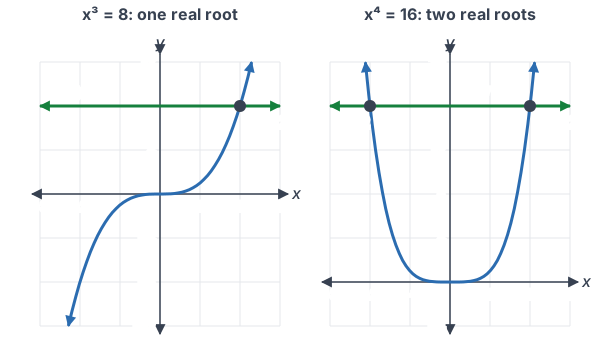
| Odd | Any real number | Exactly one | \sqrt[3]{-27} = -3 |
| Even | Positive | Two, \pm; the symbol means the positive one | \sqrt[4]{16} = 2, and −2 is also a 4th root of 16 |
| Even | Negative | None | \sqrt[4]{-16} is not a real number |
The positive root is called the principal root. The radical symbol always means the principal root.
Two rules help you simplify, when the roots are real:
\sqrt[n]{ab} = \sqrt[n]{a} \cdot \sqrt[n]{b} \qquad \sqrt[n]{\frac{a}{b}} = \frac{\sqrt[n]{a}}{\sqrt[n]{b}}Also, \sqrt[n]{a^n} = a when n is odd, and \sqrt[n]{a^n} = |a| when n is even.
Worked Examples
Example 1: Evaluate nth roots
Evaluate (a) \sqrt[3]{-64}, (b) \sqrt[4]{81}, (c) \sqrt[5]{32} and (d) \sqrt[4]{-16}.
- (a) Ask what cubed is −64: (-4)^3 = -64, so \sqrt[3]{-64} = -4
- (b) Ask what positive number to the 4th is 81: 3^4 = 81, so \sqrt[4]{81} = 3
- (c) Ask what to the 5th is 32: 2^5 = 32, so \sqrt[5]{32} = 2
- (d) Any real number to the 4th power is 0 or positive, so it can’t be −16.
Answer: (a) −4 (b) 3 (c) 2 (d) not a real number
Example 2: Simplify by pulling out perfect powers
Simplify (a) \sqrt[3]{54} and (b) \sqrt[4]{48}.
- (a) Find the largest perfect cube factor of 54 (see prime factorization): 54 = 27 \cdot 2
- Split the root (see simplifying square roots for the same idea): \sqrt[3]{27} \cdot \sqrt[3]{2}
- Take the cube root of 27: 3\sqrt[3]{2}
- (b) Find the largest perfect 4th power factor of 48: 48 = 16 \cdot 3
- Split the root: \sqrt[4]{16} \cdot \sqrt[4]{3}
- Take the 4th root of 16: 2\sqrt[4]{3}
Answer: (a) 3\sqrt[3]{2} (b) 2\sqrt[4]{3}
Example 3: Variables under an nth root
Simplify \sqrt[3]{16x^5y^6}.
- Split each factor into a perfect cube and a leftover: 16 = 8 \cdot 2, x^5 = x^3 \cdot x^2, y^6 = (y^2)^3
- Group the perfect cubes: \sqrt[3]{8x^3y^6} \cdot \sqrt[3]{2x^2}
- Take the cube root of each perfect cube (see exponent rules): 2xy^2 \cdot \sqrt[3]{2x^2}
Answer: 2xy^2\sqrt[3]{2x^2}
With an even index, watch the sign. \sqrt[4]{81x^4} = 3|x|, because x could be negative but the 4th root can’t be (see absolute value).
Example 4: Solve equations with powers
Solve (a) x^3 = -125, (b) x^4 = 625 and (c) 2x^5 + 3 = 67.
- (a) Take the cube root of both sides: x = \sqrt[3]{-125}
- Evaluate: x = -5
- (b) Take the 4th root of both sides. An even power needs \pm (see solving quadratics with square roots): x = \pm\sqrt[4]{625}
- Evaluate: x = \pm 5
- (c) Subtract 3 from both sides: 2x^5 = 64
- Divide both sides by 2: x^5 = 32
- Take the 5th root: x = 2
Answer: (a) x = -5 (b) x = 5 or x = -5 (c) x = 2
Example 5: Word problem with average growth
An investment grew from $1,000 to $1,331 in 3 years. It grew by the same percent each year. Find that yearly growth rate.
- Let the yearly growth factor be g. After 3 years: 1000g^3 = 1331
- Divide both sides by 1000: g^3 = 1.331
- Take the cube root: g = \sqrt[3]{1.331}
- Evaluate, since 1.1^3 = 1.331: g = 1.1
- The growth factor 1.1 means 1.1 - 1 = 0.1 growth each year (see percentages).
Answer: The investment grew 10% per year. Check: 1000 \cdot 1.1 = 1100, 1100 \cdot 1.1 = 1210, 1210 \cdot 1.1 = 1331.
Common Mistakes
| Mistake | Example of the error | Fix |
|---|---|---|
| Taking an even root of a negative | \sqrt[4]{-16} = -2 | (-2)^4 = 16, not −16. The 4th root of −16 is not real. |
| Thinking odd roots of negatives don’t exist | \sqrt[3]{-27} is undefined | (-3)^3 = -27, so \sqrt[3]{-27} = -3. |
| Forgetting ± when solving | x^4 = 16, so x = 2 | Even powers give two real solutions: x = \pm 2. |
| Dividing the radicand by the index | \sqrt[3]{27} = 9 | The cube root asks what cubed is 27: 3^3 = 27, so the answer is 3. |
| Pulling out a non-perfect power | \sqrt[3]{54} = 2\sqrt[3]{27} | Pull out the perfect cube: \sqrt[3]{27 \cdot 2} = 3\sqrt[3]{2}. |
Practice Problems
- Evaluate \sqrt[4]{625}.
- Evaluate \sqrt[3]{-216}.
- Evaluate \sqrt[5]{-243}.
- Is \sqrt[6]{-64} a real number? Explain.
- Simplify \sqrt[3]{40}.
- Simplify \sqrt[4]{162}.
- Simplify \sqrt[3]{-54a^4}. Assume a is positive.
- Simplify \sqrt[4]{16x^8y^5}. Assume all variables are positive.
- Solve x^4 - 7 = 74.
- A town’s population grew from 2,000 to 3,456 in 3 years, by the same percent each year. Find the yearly growth rate.
Show answers
- Ask what to the 4th is 625: 5^4 = 625
Answer: 5 - Ask what cubed is −216: (-6)^3 = -216
Answer: −6 - Ask what to the 5th is −243: (-3)^5 = -243
Answer: −3 - The index 6 is even, and no real number to an even power is negative
Answer: no, it is not real - Perfect cube factor: 40 = 8 \cdot 5
Split: \sqrt[3]{8} \cdot \sqrt[3]{5}
Answer: 2\sqrt[3]{5} - Perfect 4th power factor: 162 = 81 \cdot 2
Split: \sqrt[4]{81} \cdot \sqrt[4]{2}
Answer: 3\sqrt[4]{2} - Perfect cubes: -54a^4 = (-27a^3)(2a)
Split: \sqrt[3]{-27a^3} \cdot \sqrt[3]{2a}
Answer: -3a\sqrt[3]{2a} - Perfect 4th powers: 16x^8y^5 = (16x^8y^4)(y)
Split: \sqrt[4]{16x^8y^4} \cdot \sqrt[4]{y}
Answer: 2x^2y\sqrt[4]{y} - Add 7: x^4 = 81
Take the 4th root with \pm: x = \pm\sqrt[4]{81}
Answer: x = \pm 3 - Growth factor equation: 2000g^3 = 3456
Divide by 2000: g^3 = 1.728
Cube root, since 1.2^3 = 1.728: g = 1.2
Subtract 1: 1.2 - 1 = 0.2
Answer: 20% per year
FAQ
What is an nth root?
The nth root of a is a number that gives a when raised to the nth power. For example, \sqrt[4]{81} = 3 because 3^4 = 81.
Can you take the nth root of a negative number?
Yes, if n is odd: \sqrt[5]{-32} = -2. If n is even, the root of a negative number is not a real number.
How do you simplify an nth root?
Write the radicand as a product with the largest perfect nth power you can find. Take the root of that part, and leave the rest under the radical.
What is the principal nth root?
When n is even and a is positive, a has two real nth roots, one positive and one negative. The principal root is the positive one, and it is what \sqrt[n]{a} means.
Summary
- \sqrt[n]{a} = b means b^n = a; n is the index.
- Odd roots exist for every real number and keep its sign.
- Even roots of negative numbers are not real; even roots of positive numbers mean the positive root.
- Simplify by pulling out perfect nth powers.
- When solving x^n = k with n even and k positive, include \pm.
Previous lesson: Graphing Polynomial Functions
Next lesson: Rational Exponents
Back to the Algebra 2 Index