
Graphing Polynomial Functions
Graphing polynomial functions by hand uses a few key features instead of plotting dozens of points. Find the zeros and their multiplicities, the y-intercept and the end behavior. Then check the sign between zeros and connect everything with one smooth curve that has at most n - 1 turns.
Before this lesson: You should know End Behavior of Polynomials, Fundamental Theorem of Algebra, Solving Polynomial Equations and X-Intercepts and Y-Intercepts.
What Shapes a Polynomial Graph
Polynomial graphs are smooth and unbroken, with no corners or gaps. Four features tell you almost everything about the shape.
| Feature | How to find it | What it shows |
|---|---|---|
| Zeros | Set each factor equal to 0 | Where the graph meets the x-axis |
| Multiplicity | Count how many times each factor appears | Odd: crosses the axis. Even: touches and turns back. |
| y-intercept | Find f(0) | Where the graph meets the y-axis |
| End behavior | Degree and sign of the leading coefficient | Where the two ends point |
A polynomial of degree n has at most n - 1 turning points, where the graph changes from rising to falling or the other way.
Steps for Graphing a Polynomial
- Factor the polynomial completely.
- Find the zeros and their multiplicities.
- Find the y-intercept, f(0).
- Find the end behavior from the leading term.
- Test one x-value between each pair of zeros to see if the graph is above or below the axis.
- Plot the points and draw one smooth curve that matches the ends, crosses or touches at each zero, and turns at most n - 1 times.
Worked Examples
Example 1: A cubic
Graph f(x) = x^3 - x^2 - 6x.
- Factor out x (see factoring out the GCF): f(x) = x(x^2 - x - 6)
- Factor the trinomial (see factoring trinomials): f(x) = x(x - 3)(x + 2)
- Zeros: −2, 0 and 3, each with multiplicity 1, so the graph crosses at each one.
- y-intercept: f(0) = 0, the point (0, 0)
- End behavior (see end behavior of polynomials): leading term x^3 means down on the left, up on the right.
- Test x = -1: f(-1) = (-1)(-4)(1) = 4, above the axis
- Test x = 1: f(1) = (1)(-2)(3) = -6, below the axis
- Sketch: rise from the lower left, cross at −2, peak near x = -1, cross at 0, dip near x = 2, cross at 3, then rise.
Answer: An S-shaped curve through (-2, 0), (0, 0) and (3, 0), with 2 turning points (degree 3 allows at most 2).
Example 2: A quartic with a touching zero
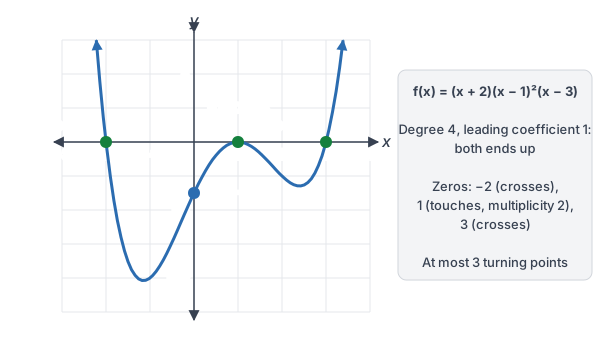
Graph f(x) = (x + 2)(x - 1)^2(x - 3). This is the graph above.
- Zeros: −2 (multiplicity 1), 1 (multiplicity 2) and 3 (multiplicity 1) (see fundamental theorem of algebra).
- The graph crosses at −2 and 3 and touches at 1.
- y-intercept: f(0) = (2)(-1)^2(-3)
- Evaluate: (2)(1)(-3) = -6, the point (0, -6)
- Degree: 1 + 2 + 1 = 4. The leading coefficient is 1 \cdot 1 \cdot 1 = 1, positive. So both ends point up.
- Test x = -1: f(-1) = (1)(-2)^2(-4) = (1)(4)(-4) = -16, below the axis
- Test x = 2: f(2) = (4)(1)^2(-1) = -4, below the axis
- Sketch: come down from the upper left, cross at −2, dip near −16, rise to touch at 1, dip near −4, cross at 3, rise to the upper right.
Answer: A W-shaped curve with 3 turning points (degree 4 allows at most 3).
Example 3: A negative leading coefficient
Graph f(x) = -x^3 + 4x.
- Factor out -x: f(x) = -x(x^2 - 4)
- Factor the difference of squares (see factoring the difference of squares): f(x) = -x(x - 2)(x + 2)
- Zeros: −2, 0 and 2, each crossing.
- y-intercept: f(0) = 0
- End behavior: leading term -x^3 means up on the left, down on the right.
- Test x = -1: f(-1) = -(-1)^3 + 4(-1) = 1 - 4 = -3, below
- Test x = 1: f(1) = -(1)^3 + 4(1) = -1 + 4 = 3, above
Answer: The curve falls from the upper left, crosses at −2, dips to about −3, rises through the origin to about 3, and falls through 2 to the lower right.
Example 4: Write the equation from a graph
A degree-3 graph crosses the x-axis at −3, touches it at 2, and has y-intercept −24. Write its equation.
- Crossing at −3 gives the factor x + 3. Touching at 2 gives (x - 2)^2.
- Write the form with an unknown leading coefficient a: f(x) = a(x + 3)(x - 2)^2
- Use the y-intercept: f(0) = a(3)(-2)^2 = -24
- Simplify: 12a = -24
- Divide both sides by 12: a = -2
Answer: f(x) = -2(x + 3)(x - 2)^2
Example 5: Word problem with an open box
An open box is made from a 20-inch by 12-inch sheet by cutting x-inch squares from each corner. Its volume is V(x) = x(20 - 2x)(12 - 2x). Sketch the graph, decide which part makes sense, and find the best whole-inch cut.
- Zeros: x = 0, 20 - 2x = 0 gives x = 10, and 12 - 2x = 0 gives x = 6.
- Leading term: x(-2x)(-2x) = 4x^3, so down on the left and up on the right.
- A cut must be positive and leave a bottom, so only 0 \lt x \lt 6 makes sense.
- V(1) = 1 \cdot 18 \cdot 10 = 180
- V(2) = 2 \cdot 16 \cdot 8 = 256
- V(3) = 3 \cdot 14 \cdot 6 = 252
- V(4) = 4 \cdot 12 \cdot 4 = 192
- V(5) = 5 \cdot 10 \cdot 2 = 100
Answer: On 0 \lt x \lt 6 the graph rises to a peak and falls back to 0. The best whole-inch cut is 2 inches, which gives 256 cubic inches. The true peak is between 2 and 3 inches.
Common Mistakes
| Mistake | Example of the error | Fix |
|---|---|---|
| Crossing at an even zero | Drawing (x - 1)^2 crossing the axis at 1 | Even multiplicity touches the axis and turns back. |
| Wrong end behavior | Using +5x for 5x - 3x^4 | Use the highest-degree term, -3x^4: both ends down. |
| Wrong y-intercept from factored form | f(x) = -2(x + 3)(x - 2)^2 has y-intercept 12 | Include the −2: f(0) = -2(3)(4) = -24. |
| Too many turns | A cubic drawn with 3 turns | A degree-n graph has at most n - 1 turning points. |
| Guessing the sign between zeros | Drawing the curve above the axis between −2 and 0 without checking | Test a point, like f(-1), to see if it is above or below. |
Practice Problems
- For f(x) = (x - 4)(x + 1)^2, give the zeros, how the graph behaves at each, the y-intercept and the end behavior.
- For f(x) = x^3 - 4x^2, give the zeros with multiplicities and the end behavior.
- Find the y-intercept and end behavior of f(x) = -(x - 1)(x + 3)(x - 2).
- What is the greatest number of turning points of f(x) = 5x^4 - x + 2?
- Find the zeros and y-intercept of f(x) = x^4 - 5x^2 + 4.
- For f(x) = (x + 1)(x - 2)(x - 5), is the graph above or below the x-axis between −1 and 2? Between 2 and 5?
- A cubic has zeros −1 (multiplicity 1) and 3 (multiplicity 2) and passes through (0, 18). Write its equation.
- A cubic touches the x-axis at −2, crosses at 1, and falls to the right. Write a possible equation.
- For f(x) = x(x - 2)(x + 3), find f(-1) and f(1).
- An open box is made from a 16-inch by 10-inch sheet by cutting x-inch corner squares: V(x) = x(16 - 2x)(10 - 2x). Find the zeros, the sensible domain and the best whole-inch cut.
Show answers
- Zeros: 4 (multiplicity 1, crosses) and −1 (multiplicity 2, touches)
y-intercept: f(0) = (-4)(1)^2 = -4
Leading term x^3: down on the left, up on the right - Factor out x^2: f(x) = x^2(x - 4)
Zeros: 0 (multiplicity 2, touches) and 4 (multiplicity 1, crosses)
Leading term x^3: down on the left, up on the right - y-intercept: f(0) = -(-1)(3)(-2)
Multiply: -(6) = -6
Leading term -x^3: up on the left, down on the right - The degree is 4
Answer: at most 4 - 1 = 3 turning points - Factor: (x^2 - 1)(x^2 - 4)
Factor again: (x - 1)(x + 1)(x - 2)(x + 2)
Zeros: \pm 1, \pm 2, each crossing
y-intercept: f(0) = 4 - Test x = 0: (1)(-2)(-5) = 10, so above the axis between −1 and 2
Test x = 3: (4)(1)(-2) = -8, so below the axis between 2 and 5 - Form: f(x) = a(x + 1)(x - 3)^2
Use (0, 18): a(1)(-3)^2 = 18
Simplify: 9a = 18
Divide by 9: a = 2
Answer: f(x) = 2(x + 1)(x - 3)^2 - Touching at −2 needs (x + 2)^2; crossing at 1 needs (x - 1)
Falling to the right with odd degree needs a negative leading coefficient
Answer: f(x) = -(x + 2)^2(x - 1) (any negative a works) - f(-1) = (-1)(-3)(2) = 6
f(1) = (1)(-1)(4) = -4 - Zeros: x = 0, x = 8 and x = 5
Sensible domain: 0 \lt x \lt 5
V(1) = 1 \cdot 14 \cdot 8 = 112
V(2) = 2 \cdot 12 \cdot 6 = 144
V(3) = 3 \cdot 10 \cdot 4 = 120
V(4) = 4 \cdot 8 \cdot 2 = 64
Answer: the best whole-inch cut is 2 inches, for 144 cubic inches
FAQ
How do you graph a polynomial function?
Factor it to find the zeros and multiplicities, find the y-intercept, and use the leading term for end behavior. Test points between zeros, then draw a smooth curve through everything.
How does multiplicity change the graph?
At a zero with odd multiplicity, the graph crosses the x-axis. At a zero with even multiplicity, it touches the axis and turns around. Higher multiplicities also flatten the graph near the zero.
How many turning points can a polynomial have?
A polynomial of degree n has at most n - 1 turning points. A cubic can have 0 or 2, and a quartic can have 1 or 3.
Can you find the exact high and low points by hand?
Not with Algebra 2 tools, except in special cases. Use a table of values or a graphing calculator to estimate them. Calculus gives exact answers.
Summary
- Factor to find the zeros and their multiplicities.
- Odd multiplicity crosses the x-axis; even multiplicity touches it.
- Find the y-intercept with f(0) and the end behavior from the leading term.
- Test a point between zeros to see whether the graph is above or below.
- A degree-n graph has at most n - 1 turning points.
Previous lesson: Fundamental Theorem of Algebra
Next lesson: nth Roots
Back to the Algebra 2 Index