
Fundamental Theorem of Algebra
The fundamental theorem of algebra says that every polynomial of degree n \ge 1 has at least one complex zero. As a result, a degree-n polynomial has exactly n complex zeros when you count repeated zeros by their multiplicity. Some of those zeros may be real, and nonreal ones come in conjugate pairs when the coefficients are real.
Before this lesson: You should know Complex Numbers, Complex Solutions of Quadratic Equations, Solving Polynomial Equations and Rational Root Theorem.
What the Theorem Promises
A quadratic like x^2 + 1 = 0 has no real solutions. Once you allow complex numbers, it has two: i and -i. The fundamental theorem of algebra says this always works. With complex numbers, you never run out of zeros.
Each time you find a zero c, you can divide out the factor x - c and get a polynomial one degree lower. Keep going, and a degree-n polynomial splits into exactly n linear factors.
f(x) = a(x - c_1)(x - c_2)\cdots(x - c_n)
Counting Zeros: Multiplicity and Conjugates
A zero can repeat. In f(x) = (x - 1)^2(x + 2), the factor x - 1 appears twice, so 1 is a zero of multiplicity 2. The zeros are 1, 1 and −2, which is three zeros for degree 3.
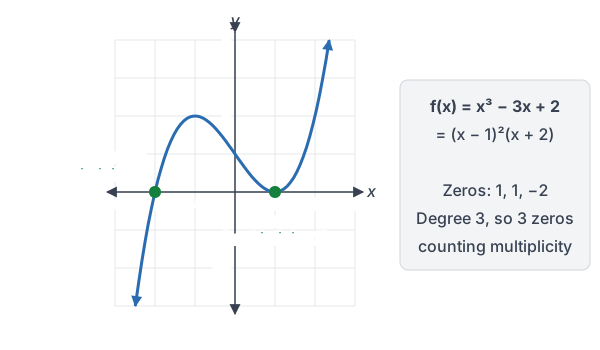
| Fact | What it means |
|---|---|
| Degree n gives n zeros | Count complex zeros and repeats. x^3 - 3x + 2 has degree 3 and zeros 1, 1, −2. |
| At most n real zeros | The graph of a degree-n polynomial crosses or touches the x-axis at most n times. |
| Complex conjugate pairs | With real coefficients, if a + bi is a zero, so is a - bi. |
| Irrational conjugate pairs | With rational coefficients, if a + \sqrt{b} is a zero, so is a - \sqrt{b}. |
Because nonreal zeros come in pairs, an odd-degree polynomial with real coefficients always has at least one real zero.
Worked Examples
Example 1: Count the zeros
How many zeros does f(x) = x^5 - 3x^2 + 7 have? How many can be real?
- The leading term is x^5, so the degree is 5.
- By the fundamental theorem of algebra, there are exactly 5 complex zeros, counting multiplicity.
- At most 5 of them are real. Since the degree is odd, at least 1 is real.
Answer: 5 zeros in all; between 1 and 5 of them are real.
Example 2: Zeros with multiplicity
Find all zeros of f(x) = x^3 - 3x + 2 and give their multiplicities.
- List the candidates (see rational root theorem): \pm 1, \pm 2
- Test x = 1: 1 - 3 + 2 = 0. So x - 1 is a factor.
- Synthetic division by x - 1 (see synthetic division), coefficients 1, 0, −3, 2. Bring down 1.
- Multiply: 1(1) = 1
- Add: 0 + 1 = 1
- Multiply: 1(1) = 1
- Add: -3 + 1 = -2
- Multiply: -2(1) = -2
- Add: 2 + (-2) = 0. The quotient is x^2 + x - 2.
- Factor the quotient (see factoring trinomials): (x + 2)(x - 1)
- Write f in factored form: f(x) = (x - 1)(x + 2)(x - 1) = (x - 1)^2(x + 2)
Answer: 1 with multiplicity 2, and −2 with multiplicity 1. That is 3 zeros for degree 3. The graph above shows it touching at 1 and crossing at −2.
Example 3: Real and complex zeros
Find all zeros of f(x) = x^4 + x^3 + 2x^2 + 4x - 8.
- Test x = 1: 1 + 1 + 2 + 4 - 8 = 0. So x - 1 is a factor.
- Synthetic division, coefficients 1, 1, 2, 4, −8. Bring down 1.
- Multiply: 1(1) = 1
- Add: 1 + 1 = 2
- Multiply: 2(1) = 2
- Add: 2 + 2 = 4
- Multiply: 4(1) = 4
- Add: 4 + 4 = 8
- Multiply: 8(1) = 8
- Add: -8 + 8 = 0. The quotient is x^3 + 2x^2 + 4x + 8.
- Factor the quotient by grouping (see factoring by grouping): x^2(x + 2) + 4(x + 2)
- Factor out x + 2: (x^2 + 4)(x + 2)
- Solve x + 2 = 0: x = -2
- Solve x^2 + 4 = 0: x^2 = -4
- Take the square root (see complex numbers): x = \pm 2i
Answer: x = 1, -2, 2i, -2i. Degree 4, four zeros: two real and one conjugate pair.
Example 4: Use the conjugate rule to build a polynomial
Write a polynomial of least degree with real coefficients and leading coefficient 1 that has zeros 2 and 3 + i.
- Real coefficients need the conjugate too, so the zeros are 2, 3 + i and 3 - i.
- Write the factors: (x - 2)(x - (3 + i))(x - (3 - i))
- Regroup the conjugate factors: (x - 3 - i)(x - 3 + i) = ((x - 3) - i)((x - 3) + i)
- Use the difference of squares (see special products of binomials): (x - 3)^2 - i^2
- Square and use i^2 = -1: x^2 - 6x + 9 + 1
- Add: x^2 - 6x + 10
- Multiply by the last factor (see multiplying polynomials): (x - 2)(x^2 - 6x + 10) = x^3 - 6x^2 + 10x - 2x^2 + 12x - 20
- Combine like terms: x^3 - 8x^2 + 22x - 20
Answer: f(x) = x^3 - 8x^2 + 22x - 20
Example 5: Word problem with a roller coaster
A designer models a section of roller coaster track with a polynomial. The track crosses ground level at x = -1 and x = 4 (in hundreds of feet) and just touches ground level at x = 3. Write a polynomial of least degree with leading coefficient 1.
- Crossing points have odd multiplicity; use 1: factors (x + 1) and (x - 4)
- A touching point needs even multiplicity; use 2: factor (x - 3)^2
- Write the product: f(x) = (x + 1)(x - 3)^2(x - 4)
- Square the binomial: (x - 3)^2 = x^2 - 6x + 9
- Multiply the other two factors: (x + 1)(x - 4) = x^2 - 3x - 4
- Multiply the two quadratics: (x^2 - 6x + 9)(x^2 - 3x - 4)
- Distribute: x^4 - 3x^3 - 4x^2 - 6x^3 + 18x^2 + 24x + 9x^2 - 27x - 36
- Combine like terms: x^4 - 9x^3 + 23x^2 - 3x - 36
Answer: f(x) = x^4 - 9x^3 + 23x^2 - 3x - 36, degree 4 with zeros −1, 3, 3 and 4. Check at x = 0: (1)(9)(-4) = -36, which matches the constant term.
Common Mistakes
| Mistake | Example of the error | Fix |
|---|---|---|
| Counting only real zeros | “x^3 - x^2 + 4x - 4 has only 1 zero” | It has 3: 1, 2i and -2i. Only 1 is real. |
| Forgetting the conjugate partner | Zeros 2 and 3 + i give a quadratic | With real coefficients, 3 - i is a zero too, so the least degree is 3. |
| Ignoring multiplicity | (x - 1)^2(x + 2) has 2 zeros | Count 1 twice: three zeros, 1, 1 and −2. |
| Expecting n x-intercepts | A degree-4 graph must cross the x-axis 4 times | Some zeros may be complex or repeated, so there can be fewer intercepts. |
| Sign error with a complex zero | Factor for 3 + i written x - 3 + i | Use parentheses: x - (3 + i) = x - 3 - i. |
Practice Problems
- How many complex zeros does 4x^6 - x + 9 have?
- Give the zeros and multiplicities of f(x) = (x - 4)^3(x + 1)^2.
- Find all zeros of x^3 - x^2 + 4x - 4.
- Find all zeros of x^3 + 3x^2 - 4 with their multiplicities.
- Find all zeros of x^4 - 81.
- A polynomial with real coefficients has zeros 5 and 2i. Name another zero.
- A polynomial with rational coefficients has the zero 1 + \sqrt{3}. Name another zero.
- Write a polynomial of least degree with real coefficients, leading coefficient 1, and zeros −3 and 2i.
- Write a polynomial of least degree with real coefficients, leading coefficient 1, and zeros 1 and 2 - i.
- A cubic graph touches the x-axis at 2 and crosses it at −3. Write it with leading coefficient 1.
Show answers
- The degree is 6
Answer: 6 complex zeros, counting multiplicity - x - 4 appears 3 times; x + 1 appears 2 times
Answer: 4 (multiplicity 3) and −1 (multiplicity 2), five zeros for degree 5 - Group: x^2(x - 1) + 4(x - 1)
Factor out x - 1: (x^2 + 4)(x - 1)
Solve x - 1 = 0: x = 1
Solve x^2 = -4: x = \pm 2i
Answer: 1, 2i, -2i - Test x = 1: 1 + 3 - 4 = 0, a zero
Synthetic division, coefficients 1, 3, 0, −4: bring down 1
Multiply: 1(1) = 1
Add: 3 + 1 = 4
Multiply: 4(1) = 4
Add: 0 + 4 = 4
Multiply: 4(1) = 4
Add: -4 + 4 = 0
Quotient: x^2 + 4x + 4 = (x + 2)^2
Answer: 1 (multiplicity 1) and −2 (multiplicity 2) - Difference of squares (see factoring the difference of squares): (x^2 - 9)(x^2 + 9)
Solve x^2 = 9: x = \pm 3
Solve x^2 = -9: x = \pm 3i
Answer: 3, -3, 3i, -3i - Real coefficients mean nonreal zeros come in conjugate pairs
Answer: -2i - Rational coefficients mean a + \sqrt{b} pairs with a - \sqrt{b}
Answer: 1 - \sqrt{3} - Add the conjugate: zeros −3, 2i, -2i
Conjugate factors: (x - 2i)(x + 2i) = x^2 - 4i^2
Use i^2 = -1: x^2 + 4
Multiply: (x + 3)(x^2 + 4) = x^3 + 4x + 3x^2 + 12
Write in standard form: x^3 + 3x^2 + 4x + 12 - Add the conjugate: zeros 1, 2 - i, 2 + i
Conjugate factors: ((x - 2) + i)((x - 2) - i) = (x - 2)^2 - i^2
Square and use i^2 = -1: x^2 - 4x + 4 + 1
Add: x^2 - 4x + 5
Multiply: (x - 1)(x^2 - 4x + 5) = x^3 - 4x^2 + 5x - x^2 + 4x - 5
Combine like terms: x^3 - 5x^2 + 9x - 5 - Touching at 2 means multiplicity 2; crossing at −3 means multiplicity 1
Write the product: (x + 3)(x - 2)^2
Square: (x + 3)(x^2 - 4x + 4)
Distribute: x^3 - 4x^2 + 4x + 3x^2 - 12x + 12
Combine like terms: x^3 - x^2 - 8x + 12
FAQ
What does the fundamental theorem of algebra say?
Every polynomial of degree 1 or more has at least one complex zero. As a result, a degree-n polynomial has exactly n complex zeros, counting multiplicity.
How many real zeros can a polynomial have?
At most as many as its degree. Nonreal zeros come in conjugate pairs, so a cubic has 1 or 3 real zeros, and a quartic has 0, 2 or 4, counting multiplicity.
What is the multiplicity of a zero?
It is the number of times its factor appears. In (x - 5)^3, the zero 5 has multiplicity 3. Odd multiplicity crosses the x-axis; even multiplicity touches and turns around.
Why do complex zeros come in conjugate pairs?
When the coefficients are real, taking the conjugate of f(a + bi) = 0 gives f(a - bi) = 0. So if a + bi is a zero, a - bi is one too.
Summary
- Every polynomial of degree n \ge 1 has exactly n complex zeros, counting multiplicity.
- A zero’s multiplicity is how many times its factor appears.
- With real coefficients, nonreal zeros come in conjugate pairs a \pm bi.
- Odd multiplicity crosses the x-axis; even multiplicity touches it.
- To build a polynomial from zeros, include every conjugate, then multiply the factors.
Previous lesson: Rational Root Theorem
Next lesson: Graphing Polynomial Functions
Back to the Algebra 2 Index