
Complex Numbers
Complex numbers are numbers written in the form a + bi, where a and b are real numbers and i is the imaginary unit, with i^2 = -1. The number a is the real part and b is the imaginary part. Complex numbers let you take square roots of negative numbers, such as \sqrt{-9} = 3i.
Before this lesson: You should know Square Roots, Simplifying Square Roots, Exponent Rules and the Coordinate Plane.
Why We Need the Imaginary Unit
Any real number squared is zero or positive. So the equation x^2 = -1 has no real solution. To solve equations like this, mathematicians defined a new number, i.
i = \sqrt{-1} \qquad i^2 = -1The number i is called the imaginary unit. “Imaginary” is just a name. These numbers are as useful as real numbers, and engineers use them every day to study electric circuits.
Square Roots of Negative Numbers
To take the square root of a negative number, pull out \sqrt{-1} and write it as i.
\sqrt{-a} = i\sqrt{a} \quad \text{for } a \gt 0Write the i in front of a radical, as in i\sqrt{7} or 3i\sqrt{2}. This keeps it from looking like it is under the square root sign.
Standard Form of a Complex Number
A complex number in standard form is written a + bi. The real part is a, and the imaginary part is b. Note that the imaginary part is the number b, not bi.
| Number | Real part | Imaginary part | Type |
|---|---|---|---|
| 4 + 3i | 4 | 3 | Complex |
| 2 - 5i | 2 | −5 | Complex |
| 7i | 0 | 7 | Pure imaginary |
| -6 | −6 | 0 | Real |
Every real number is also a complex number, with imaginary part 0. Two complex numbers are equal only when their real parts are equal and their imaginary parts are equal.
Powers of i
Powers of i repeat in a cycle of four.
i^1 = i, \quad i^2 = -1, \quad i^3 = -i, \quad i^4 = 1
After i^4 = 1, the pattern starts over: i^5 = i, i^6 = -1, and so on. To find i^n, divide n by 4 and use the remainder. A remainder of 0 means the answer is 1.
The Complex Plane
You can graph a complex number in the complex plane. The horizontal axis is the real axis. The vertical axis is the imaginary axis. The number a + bi is plotted at the point (a, b).
The absolute value of a complex number is its distance from 0 in the complex plane.
|a + bi| = \sqrt{a^2 + b^2}Worked Examples
Example 1: Simplify square roots of negative numbers
Simplify \sqrt{-25}, \sqrt{-7} and \sqrt{-18}.
- Write \sqrt{-25} using i: \sqrt{-25} = i\sqrt{25}
- Take the square root: i\sqrt{25} = 5i
- Write \sqrt{-7} using i: \sqrt{-7} = i\sqrt{7}. 7 has no square factor, so this is simplified.
- Write \sqrt{-18} using i: \sqrt{-18} = i\sqrt{18}
- Factor out a perfect square (see simplifying square roots): \sqrt{18} = \sqrt{9}\cdot\sqrt{2} = 3\sqrt{2}
- Put it together: \sqrt{-18} = 3i\sqrt{2}
Answer: 5i, i\sqrt{7} and 3i\sqrt{2}
Example 2: Write in standard form
Write each number in the form a + bi, and name the real and imaginary parts: (a) 4 - \sqrt{-49} (b) \dfrac{6 + \sqrt{-12}}{2}
- (a) Rewrite the radical: \sqrt{-49} = i\sqrt{49} = 7i
- Substitute: 4 - \sqrt{-49} = 4 - 7i
- The real part is 4 and the imaginary part is −7.
- (b) Rewrite the radical: \sqrt{-12} = i\sqrt{12}
- Simplify the root: \sqrt{12} = \sqrt{4}\cdot\sqrt{3} = 2\sqrt{3}, so \sqrt{-12} = 2i\sqrt{3}
- Substitute: \dfrac{6 + 2i\sqrt{3}}{2}
- Divide each term by 2: 3 + i\sqrt{3}
- The real part is 3 and the imaginary part is \sqrt{3}.
Answer: (a) 4 - 7i (b) 3 + i\sqrt{3}
Example 3: Powers of i
Simplify i^{23}, i^{50} and i^{100}.
- Divide 23 by 4: 23 = 4 \cdot 5 + 3, so the remainder is 3
- Use the cycle: i^{23} = i^3 = -i
- Divide 50 by 4: 50 = 4 \cdot 12 + 2, so the remainder is 2
- Use the cycle: i^{50} = i^2 = -1
- Divide 100 by 4: 100 = 4 \cdot 25 + 0, so the remainder is 0
- A remainder of 0 means i^{100} = i^4 = 1
Answer: i^{23} = -i, i^{50} = -1, i^{100} = 1
This works because i^4 = 1. For example, i^{23} = (i^4)^5 \cdot i^3 = 1^5 \cdot i^3 = -i.
Example 4: Plot complex numbers and find an absolute value
Plot 3 + 4i, -4 + 2i, -2 - 3i and 5 in the complex plane. Then find |3 + 4i|.
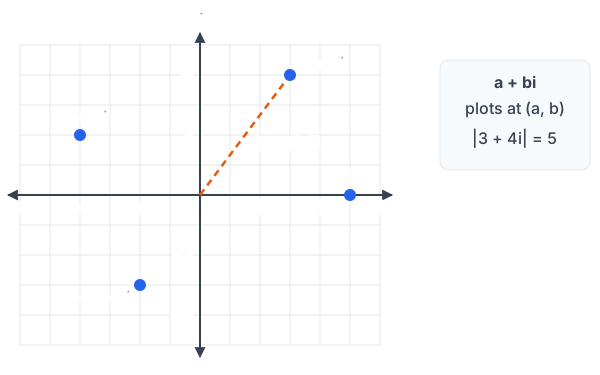
- Plot 3 + 4i at (3, 4): 3 right, 4 up
- Plot -4 + 2i at (-4, 2): 4 left, 2 up
- Plot -2 - 3i at (-2, -3): 2 left, 3 down
- Plot 5 at (5, 0), on the real axis, since its imaginary part is 0
- Use the formula (it comes from the Pythagorean theorem): |3 + 4i| = \sqrt{3^2 + 4^2}
- Square each part: \sqrt{9 + 16}
- Add: \sqrt{25}
- Take the square root: 5
Answer: |3 + 4i| = 5
Example 5: Word problem with an electric circuit
In an AC circuit, engineers describe the total opposition to current, called impedance, as a complex number. A circuit has a resistance of 5 ohms (the real part) and a reactance of 12 ohms (the imaginary part). Write the impedance Z in standard form, and find its size, |Z|.
- Real part is the resistance and imaginary part is the reactance: Z = 5 + 12i
- Use the absolute value formula: |Z| = \sqrt{5^2 + 12^2}
- Square each part: \sqrt{25 + 144}
- Add: \sqrt{169}
- Take the square root: 13
Answer: Z = 5 + 12i ohms, and its size is 13 ohms. (Engineers often write j instead of i, because i already stands for current.)
Common Mistakes
| Mistake | Example of the error | Fix |
|---|---|---|
| Taking the root of a negative as a negative | \sqrt{-9} = -3 | \sqrt{-9} = 3i. Check: (-3)^2 = 9, not −9. |
| Thinking i^2 = 1 | i^2 = i \cdot i = 1 | By definition, i^2 = -1. |
| Including i in the imaginary part | Saying the imaginary part of 3 - 5i is -5i | The imaginary part is the real number −5. |
| Multiplying roots of negatives under one radical | \sqrt{-4}\cdot\sqrt{-9} = \sqrt{36} = 6 | Write each with i first: 2i \cdot 3i = 6i^2 = -6. |
| Using the quotient for powers of i | i^{18}: 18 ÷ 4 is about 4, so i^4 = 1 | Use the remainder: 18 = 4 \cdot 4 + 2, so i^{18} = -1. |
Practice Problems
- Simplify \sqrt{-36}.
- Simplify \sqrt{-20}.
- Simplify \sqrt{-50}.
- Write 7 + \sqrt{-81} in standard form. Name the real and imaginary parts.
- Write \dfrac{10 - \sqrt{-8}}{2} in standard form.
- Simplify i^{14}.
- Simplify i^{33}.
- Simplify i^{99}.
- Find the real numbers x and y that make 3x + (y - 2)i = 12 + 5i true.
- A circuit has impedance Z = 9 - 12i ohms. Find its size, |Z|.
Show answers
- Write with i: \sqrt{-36} = i\sqrt{36}
Take the root: 6i - Write with i: \sqrt{-20} = i\sqrt{20}
Factor: \sqrt{20} = \sqrt{4}\cdot\sqrt{5} = 2\sqrt{5}
Answer: 2i\sqrt{5} - Write with i: \sqrt{-50} = i\sqrt{50}
Factor: \sqrt{50} = \sqrt{25}\cdot\sqrt{2} = 5\sqrt{2}
Answer: 5i\sqrt{2} - Rewrite the radical: \sqrt{-81} = 9i
Standard form: 7 + 9i
Real part 7, imaginary part 9 - Rewrite the radical: \sqrt{-8} = i\sqrt{8} = 2i\sqrt{2}
Substitute: \dfrac{10 - 2i\sqrt{2}}{2}
Divide each term by 2: 5 - i\sqrt{2} - Divide by 4: 14 = 4 \cdot 3 + 2, remainder 2
i^{14} = i^2 = -1 - Divide by 4: 33 = 4 \cdot 8 + 1, remainder 1
i^{33} = i^1 = i - Divide by 4: 99 = 4 \cdot 24 + 3, remainder 3
i^{99} = i^3 = -i - Set the real parts equal: 3x = 12
Divide both sides by 3: x = 4
Set the imaginary parts equal: y - 2 = 5
Add 2 to both sides: y = 7 - Use the formula: |Z| = \sqrt{9^2 + (-12)^2}
Square each part: \sqrt{81 + 144}
Add: \sqrt{225}
Take the root: 15 ohms
FAQ
What is i in math?
i is the imaginary unit. It is defined so that i^2 = -1, which means i = \sqrt{-1}.
Is a real number a complex number?
Yes. A real number like 6 is the complex number 6 + 0i. Its imaginary part is 0.
What is the difference between imaginary and complex numbers?
A pure imaginary number has the form bi, with real part 0, like 7i. A complex number a + bi can have both parts, like 4 + 3i.
How do you find a large power of i?
Divide the exponent by 4 and keep the remainder. Remainders 1, 2, 3 and 0 give i, -1, -i and 1.
Summary
- Complex numbers have the form a + bi, with real part a and imaginary part b.
- The imaginary unit i is defined by i^2 = -1, so \sqrt{-a} = i\sqrt{a} for a \gt 0.
- Powers of i repeat every four: i, -1, -i, 1.
- The number a + bi is plotted at (a, b) in the complex plane, and |a + bi| = \sqrt{a^2 + b^2}.
Previous lesson: Linear Programming
Next lesson: Operations with Complex Numbers
Back to the Algebra 2 Index