
Pythagorean Theorem
The Pythagorean theorem says that in a right triangle, the squares of the two legs add up to the square of the hypotenuse: a^2 + b^2 = c^2. The hypotenuse c is the longest side, across from the right angle. Use the theorem to find any missing side of a right triangle when you know the other two.
Before this lesson: You should know Exponents, Square Root and Simplifying Square Roots.
What the Pythagorean Theorem Means
A right triangle has one 90° angle. The two sides that form the right angle are the legs. The side across from the right angle is the hypotenuse. It is always the longest side.
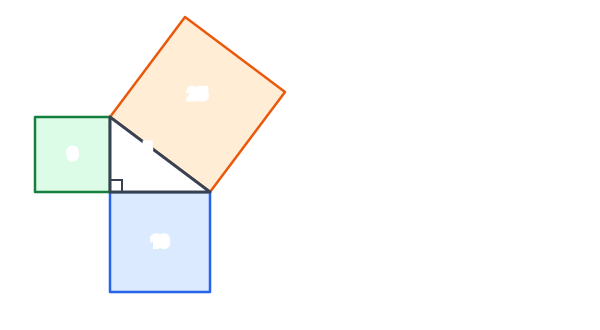
Draw a square on each side of a right triangle. The areas of the two smaller squares always add up to the area of the biggest square. For a triangle with legs 3 and 4, the squares have areas 9 and 16, and the square on the hypotenuse has area 25.
The Pythagorean Theorem Formula
a^2 + b^2 = c^2
- a and b are the legs, and c is the hypotenuse.
- To find the hypotenuse: c = \sqrt{a^2 + b^2}
- To find a leg: a = \sqrt{c^2 - b^2}
- The theorem works only for right triangles.
How to Use the Pythagorean Theorem
- Find the right angle. The side across from it is c.
- Write a^2 + b^2 = c^2.
- Substitute the two sides you know.
- Square the numbers, then add or subtract to get the missing side squared by itself.
- Take the square root. Simplify or round if needed.
Worked Examples
Example 1: Find the hypotenuse
A right triangle has legs of 6 and 8. Find the hypotenuse.
- Write the formula: a^2 + b^2 = c^2
- Substitute the legs: 6^2 + 8^2 = c^2
- Square each number (see exponents): 36 + 64 = c^2
- Add: 100 = c^2
- Take the square root of both sides (see square root): c = 10
Answer: The hypotenuse is 10.
Example 2: Find a missing leg
A right triangle has a hypotenuse of 13 and one leg of 5. Find the other leg.
- Write the formula: a^2 + b^2 = c^2
- Substitute the leg and the hypotenuse: 5^2 + b^2 = 13^2
- Square each number: 25 + b^2 = 169
- Subtract 25 from both sides: b^2 = 144
- Take the square root of both sides: b = 12
Answer: The other leg is 12.
Example 3: An answer that is not a whole number
A right triangle has legs of 2 and 6. Find the hypotenuse in simplest radical form and as a decimal.
- Write the formula: a^2 + b^2 = c^2
- Substitute the legs: 2^2 + 6^2 = c^2
- Square each number: 4 + 36 = c^2
- Add: 40 = c^2
- Take the square root of both sides: c = \sqrt{40}
- Write 40 as a perfect square times another number: \sqrt{40} = \sqrt{4 \cdot 10}
- Simplify (see simplifying square roots): \sqrt{4 \cdot 10} = 2\sqrt{10}
- Use a calculator and round: 2\sqrt{10} \approx 6.32
Answer: c = 2\sqrt{10} \approx 6.32.
Example 4: Word problem with a ladder
A 15-foot ladder leans against a wall. The bottom of the ladder is 9 feet from the wall. How high up the wall does the ladder reach?
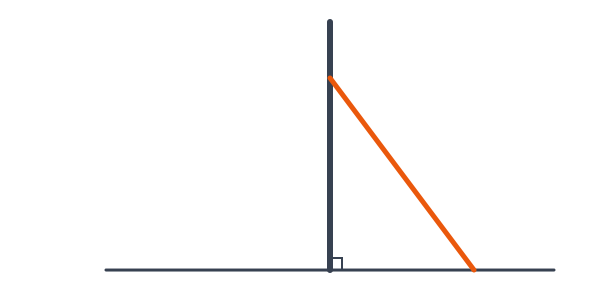
- The wall and the ground meet at a right angle, so the ladder is the hypotenuse: c = 15.
- The distance along the ground is one leg: a = 9.
- Substitute: 9^2 + h^2 = 15^2
- Square each number: 81 + h^2 = 225
- Subtract 81 from both sides: h^2 = 144
- Take the square root of both sides: h = 12
Answer: The ladder reaches 12 feet up the wall.
Example 5: Word problem with a TV screen
A TV screen is 48 inches wide and 27 inches tall. TV sizes are measured along the diagonal. What is the diagonal, to the nearest inch?
- The width, height and diagonal form a right triangle. The diagonal is the hypotenuse.
- Substitute: 48^2 + 27^2 = c^2
- Square each number: 2304 + 729 = c^2
- Add: 3033 = c^2
- Take the square root of both sides: c = \sqrt{3033}
- Use a calculator: c \approx 55.07
- Round to the nearest inch: c \approx 55
Answer: The diagonal is about 55 inches, so it is sold as a 55-inch TV.
Why the Pythagorean Theorem Works
Put four copies of a right triangle inside a big square, as shown below. Each side of the big square is a + b long. The empty space in the middle is a tilted square with side c.
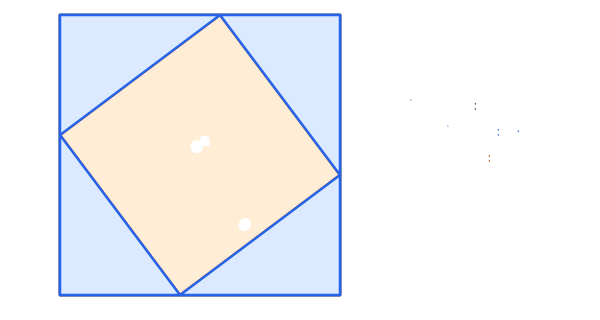
- Write the big square’s area two ways: (a + b)^2 = 4 \cdot \tfrac{1}{2}ab + c^2
- Simplify the triangles’ area: (a + b)^2 = 2ab + c^2
- Expand the left side (see multiplying binomials): a^2 + 2ab + b^2 = 2ab + c^2
- Subtract 2ab from both sides: a^2 + b^2 = c^2
Common Mistakes
| Mistake | Example of the error | Fix |
|---|---|---|
| Putting the hypotenuse in for a leg | Leg 5 and hypotenuse 13: 5^2 + 13^2 = c^2 | The hypotenuse is always c, across from the right angle: 5^2 + b^2 = 13^2. |
| Forgetting the square root | c^2 = 100, so c = 100 | Take the square root at the end: c = 10. |
| Adding before squaring | (6 + 8)^2 = c^2 | Square each leg first, then add: 6^2 + 8^2 = c^2. |
| Splitting the square root | \sqrt{36 + 64} = 6 + 8 = 14 | Add inside first: \sqrt{100} = 10. |
| Using it on a triangle with no right angle | Using a^2 + b^2 = c^2 on a triangle with sides 4, 5 and 7 | The theorem only works for right triangles. |
Pythagorean Triples
A Pythagorean triple is a set of three whole numbers that fit a^2 + b^2 = c^2. Knowing the common ones saves time on tests.
| Triple | Check | Multiples |
|---|---|---|
| 3, 4, 5 | 9 + 16 = 25 | 6, 8, 10 and 9, 12, 15 |
| 5, 12, 13 | 25 + 144 = 169 | 10, 24, 26 |
| 8, 15, 17 | 64 + 225 = 289 | 16, 30, 34 |
| 7, 24, 25 | 49 + 576 = 625 | 14, 48, 50 |
The distance formula is the Pythagorean theorem used on a coordinate grid. It is also why the HL shortcut in ASA, AAS and HL congruence works: the hypotenuse and one leg fix the length of the other leg.
Practice Problems
- A right triangle has legs of 9 and 12. Find the hypotenuse.
- A right triangle has legs of 5 and 12. Find the hypotenuse.
- A right triangle has a hypotenuse of 17 and one leg of 8. Find the other leg.
- A right triangle has a hypotenuse of 25 and one leg of 7. Find the other leg.
- A right triangle has legs of 3 and 5. Find the hypotenuse in simplest radical form and to the nearest hundredth.
- A right triangle has a hypotenuse of 10 and one leg of 4. Find the other leg in simplest radical form and to the nearest hundredth.
- A rectangle is 20 cm long and 21 cm wide. How long is its diagonal?
- A kite’s string is 100 ft long and pulled straight. The kite is directly above a point 60 ft away from the person holding the string. How high is the kite? Ignore the person’s height.
- A baseball diamond is a square with 90-foot sides. How far is it from home plate straight across to second base? Give the exact answer and round to the nearest tenth.
- Complete the proof from the “Why the Pythagorean Theorem Works” figure. Statements: (1) Area of the big square = (a + b)^2. (2) Area of the big square = 4 \cdot \tfrac{1}{2}ab + c^2. (3) (a + b)^2 = 2ab + c^2. (4) a^2 + 2ab + b^2 = 2ab + c^2. (5) a^2 + b^2 = c^2. Give a reason for each statement.
Show answers
- Substitute: 9^2 + 12^2 = c^2
Square: 81 + 144 = c^2
Add: 225 = c^2
Square root: c = 15 - Substitute: 5^2 + 12^2 = c^2
Square: 25 + 144 = c^2
Add: 169 = c^2
Square root: c = 13 - Substitute: 8^2 + b^2 = 17^2
Square: 64 + b^2 = 289
Subtract 64: b^2 = 225
Square root: b = 15 - Substitute: 7^2 + b^2 = 25^2
Square: 49 + b^2 = 625
Subtract 49: b^2 = 576
Square root: b = 24 - Substitute: 3^2 + 5^2 = c^2
Square: 9 + 25 = c^2
Add: 34 = c^2
Square root: c = \sqrt{34}
34 has no perfect square factor, so \sqrt{34} is simplest form.
Round: c \approx 5.83 - Substitute: 4^2 + b^2 = 10^2
Square: 16 + b^2 = 100
Subtract 16: b^2 = 84
Square root: b = \sqrt{84}
Factor: \sqrt{84} = \sqrt{4 \cdot 21}
Simplify: b = 2\sqrt{21}
Round: b \approx 9.17 - The diagonal is the hypotenuse: 20^2 + 21^2 = d^2
Square: 400 + 441 = d^2
Add: 841 = d^2
Square root: d = 29
The diagonal is 29 cm. - The string is the hypotenuse: 60^2 + h^2 = 100^2
Square: 3600 + h^2 = 10{,}000
Subtract 3600: h^2 = 6400
Square root: h = 80
The kite is 80 ft high. - The path from home to second base is the diagonal of the square: 90^2 + 90^2 = d^2
Square: 8100 + 8100 = d^2
Add: 16{,}200 = d^2
Square root: d = \sqrt{16{,}200}
Factor: \sqrt{16{,}200} = \sqrt{8100 \cdot 2}
Simplify: d = 90\sqrt{2}
Round: d \approx 127.3 ft - (1) Area of a square is side squared
(2) The big square is made of four triangles, each with area \tfrac{1}{2}ab, and the inner square, with area c^2
(3) Substitution and simplifying: 4 \cdot \tfrac{1}{2}ab = 2ab
(4) Multiplying binomials: (a + b)^2 = a^2 + 2ab + b^2
(5) Subtraction property of equality: subtract 2ab from both sides
FAQ
What is the Pythagorean theorem?
In any right triangle, the sum of the squares of the legs equals the square of the hypotenuse: a^2 + b^2 = c^2.
How do you find the hypotenuse?
Square both legs, add the results, then take the square root of the sum.
How do you find a missing leg?
Square the hypotenuse and the known leg. Subtract the leg’s square from the hypotenuse’s square, then take the square root.
Does the Pythagorean theorem work for all triangles?
No. It works only for right triangles. To test whether a triangle is right from its sides, use the converse of the Pythagorean theorem.
Summary
- In a right triangle, a^2 + b^2 = c^2.
- c is the hypotenuse: the longest side, across from the right angle.
- To find c, add the squares of the legs and take the square root.
- To find a leg, subtract the known leg’s square from c^2 and take the square root.
- Learn the common triples: 3-4-5, 5-12-13, 8-15-17 and 7-24-25.
Previous lesson: Triangle Angle Bisector Theorem
Next lesson: Converse of the Pythagorean Theorem
Back to the Geometry Index