
ASA, AAS and HL Congruence
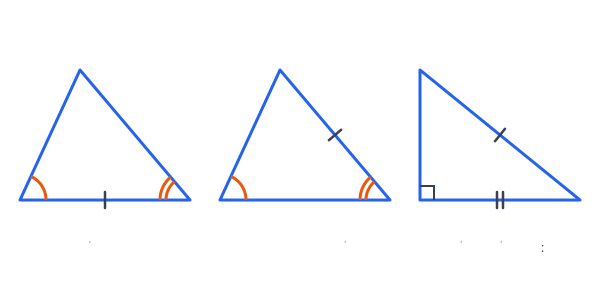
ASA, AAS and HL congruence are three more ways to prove triangles congruent. ASA uses two angles and the side between them. AAS uses two angles and a side that is not between them. HL works only for right triangles: a congruent hypotenuse and one congruent leg are enough.
Before this lesson: You should know SSS and SAS Congruence, the Triangle Angle Sum Theorem and Parallel Lines and Transversals.
Why Two Angles and a Side Are Enough
Draw a segment. At each end, draw a ray at a fixed angle. The two rays can cross at only one point. So the whole triangle is fixed. That is the idea behind ASA.
What if the side is not between the angles? Two angles still fix the third angle, because the three angles add to 180°. Once you know all three angles, the known side sits between two of them. So AAS works too.
Right triangles get their own shortcut. If you know the hypotenuse and one leg, the other leg has only one possible length. You can find it with the Pythagorean theorem. That is why HL works.
The ASA, AAS and HL Congruence Tests
- ASA congruence postulate: If two angles and the included side of one triangle are congruent to two angles and the included side of another triangle, then the triangles are congruent.
- AAS congruence theorem: If two angles and a non-included side of one triangle are congruent to two angles and the matching non-included side of another triangle, then the triangles are congruent.
- HL congruence theorem: If the hypotenuse and a leg of one right triangle are congruent to the hypotenuse and a leg of another right triangle, then the triangles are congruent.
The included side is the side between two angles. In \triangle ABC, the side included between \angle A and \angle B is \overline{AB}. In a right triangle, the hypotenuse is the side across from the right angle, and the other two sides are the legs.
How to Choose a Congruence Test
- Mark everything you are given on the figure.
- Add what you can see: shared sides, vertical angles, and angles from parallel lines.
- If you have two angles, find where the known side is. Between the angles means ASA. Outside them means AAS.
- If the triangles are right triangles, check for the hypotenuse and a leg. That means HL.
- If you have only sides, or two sides and an angle, use SSS or SAS.
- Write the congruence statement with matching vertices in the same order.
Worked Examples
Example 1: Which test works?
For each set of facts, decide whether \triangle ABC \cong \triangle DEF by ASA, AAS or HL, or whether there is not enough information.
- (a) \angle A \cong \angle D, \overline{AB} \cong \overline{DE} and \angle B \cong \angle E. Side AB is between angles A and B, so this is ASA.
- (b) \angle A \cong \angle D, \angle B \cong \angle E and \overline{BC} \cong \overline{EF}. Side BC is not between angles A and B, so this is AAS.
- (c) Angles B and E are right angles, \overline{AC} \cong \overline{DF} and \overline{BC} \cong \overline{EF}. AC and DF are across from the right angles, so they are the hypotenuses. BC and EF are legs. This is HL.
- (d) \angle A \cong \angle D, \angle B \cong \angle E and \angle C \cong \angle F. No sides are known. This is AAA, which is not a test. There is not enough information.
Answer: (a) ASA, (b) AAS, (c) HL, (d) not enough information.
Example 2: Word problem across a river
Maya wants the distance AB across a river without crossing it. Point A is a tree on the far bank. Point B is straight across on her bank. She walks 24 m along the bank to point C and puts in a stake. She walks 24 m more to point D. Then she turns 90° away from the river and walks until the stake at C lines up with the tree. She stops at point E. DE measures 38 m. How wide is the river?
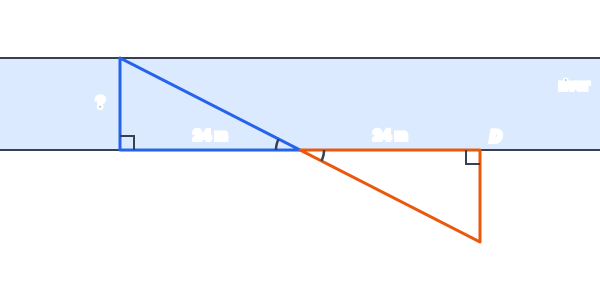
- Angle B and angle D are both right angles, so \angle B \cong \angle D.
- Maya walked the same distance twice, so \overline{BC} \cong \overline{DC}. Both are 24 m.
- Angles ACB and ECD are vertical angles, so \angle ACB \cong \angle ECD (see proving angle relationships).
- Side BC is between angle B and angle ACB. Side DC is between angle D and angle ECD. So the side is included.
- By ASA, \triangle ABC \cong \triangle EDC.
- Side AB matches side ED, so AB = DE = 38 m.
Answer: The river is 38 m wide.
Example 3: AAS with algebra
In \triangle PQR and \triangle STU, \angle P \cong \angle S and \angle Q \cong \angle T. Side QR = 3x - 2 and side TU = x + 10. Find x so the triangles are congruent by AAS. If m\angle P = 40^\circ and m\angle Q = 75^\circ, also find m\angle U.
- QR is not between angles P and Q, and TU is not between angles S and T. So the test is AAS, and QR must equal TU: 3x - 2 = x + 10
- Subtract x from both sides (see equations with variables on both sides): 2x - 2 = 10
- Add 2 to both sides: 2x = 12
- Divide both sides by 2: x = 6
- Find QR: 3(6) - 2 = 18 - 2 = 16
- Check with TU: 6 + 10 = 16
- Add the two known angles of \triangle PQR: 40^\circ + 75^\circ = 115^\circ
- Subtract from 180° (see triangle angle sum theorem): 180^\circ - 115^\circ = 65^\circ, so m\angle R = 65^\circ.
- \angle U matches \angle R, so m\angle U = 65^\circ.
Answer: x = 6, so QR = TU = 16, and m\angle U = 65^\circ.
Example 4: Two-column proof with ASA
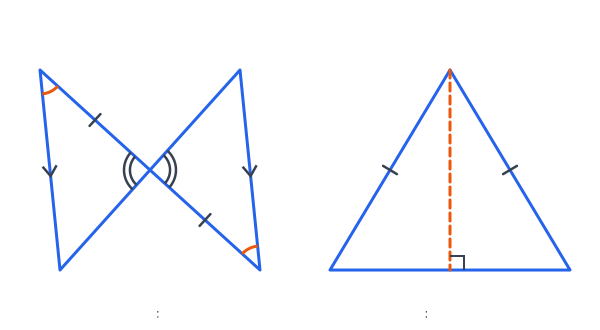
Given: \overline{AB} \parallel \overline{DE}, and C is the midpoint of \overline{AE}
Prove: \triangle ABC \cong \triangle EDC
| Statements | Reasons |
|---|---|
| 1. \overline{AB} \parallel \overline{DE} | Given |
| 2. \angle A \cong \angle E | Alternate interior angles theorem |
| 3. C is the midpoint of \overline{AE} | Given |
| 4. \overline{AC} \cong \overline{EC} | Definition of midpoint |
| 5. \angle ACB \cong \angle ECD | Vertical angles theorem |
| 6. \triangle ABC \cong \triangle EDC | ASA (steps 2, 4 and 5) |
Check the order: side AC is between angle A and angle ACB. Side EC is between angle E and angle ECD. So the side is included, and ASA applies.
Example 5: Two-column proof with HL
Given: \overline{BD} \perp \overline{AC} and \overline{AB} \cong \overline{CB}
Prove: \triangle ABD \cong \triangle CBD
| Statements | Reasons |
|---|---|
| 1. \overline{BD} \perp \overline{AC} | Given |
| 2. \angle ADB and \angle CDB are right angles | Definition of perpendicular lines |
| 3. \triangle ABD and \triangle CBD are right triangles | Definition of a right triangle |
| 4. \overline{AB} \cong \overline{CB} | Given |
| 5. \overline{BD} \cong \overline{BD} | Reflexive property of congruence |
| 6. \triangle ABD \cong \triangle CBD | HL (steps 3, 4 and 5) |
AB and CB are across from the right angles, so they are the hypotenuses. BD is a leg of both triangles. That is exactly what HL needs.
Common Mistakes
| Mistake | Example of the error | Fix |
|---|---|---|
| Using AAA as a test | “All three angles match, so the triangles are congruent” | Same angles only means same shape. You need at least one pair of sides. |
| Calling AAS by the name ASA | Using \angle A, \angle B and \overline{BC} and writing ASA | The side between angles A and B is AB. With BC, the test is AAS. |
| Using HL on triangles that aren’t right | Two sides match in two acute triangles, and the proof says HL | HL needs a right angle in each triangle. Prove the right angles first. |
| Matching a hypotenuse with a leg | Pairing the hypotenuse of one triangle with a leg of the other | The hypotenuse is always across from the right angle. Match hypotenuse with hypotenuse. |
| Matching the wrong sides in AAS | Using the side across from \angle A in one triangle and across from \angle B in the other | The sides must match too: each one is across from the same congruent angle. |
All Five Triangle Congruence Tests
| What you know | Test |
|---|---|
| Three pairs of sides | SSS |
| Two pairs of sides and the angle between them | SAS |
| Two pairs of angles and the side between them | ASA |
| Two pairs of angles and a side not between them | AAS |
| Right triangles with the hypotenuse and a leg | HL |
| Three pairs of angles (AAA) or SSA | Not a test |
Once two triangles are congruent, all their matching parts are congruent too. The next lesson, CPCTC, uses that idea to prove that segments and angles are equal.
Practice Problems
- \angle G \cong \angle S, \overline{GH} \cong \overline{ST} and \angle H \cong \angle T. Which test proves the triangles congruent? Write the congruence statement.
- \angle J \cong \angle M, \angle K \cong \angle N and \overline{LJ} \cong \overline{OM}. Which test proves the triangles congruent? Write the congruence statement.
- \triangle ABC and \triangle DEF have right angles at C and F. \overline{AB} \cong \overline{DE} and \overline{AC} \cong \overline{DF}. Which test proves them congruent?
- \angle A \cong \angle D, \angle B \cong \angle E and \angle C \cong \angle F. Are the triangles congruent? Explain.
- Name the side included between \angle P and \angle Q in \triangle PQR.
- \angle A \cong \angle D and \angle B \cong \angle E. Also AB = 5x - 4 and DE = 3x + 6. Find x so the triangles are congruent by ASA, and find AB.
- Right triangles ABC and DEF have right angles at B and E. Legs BC and EF are both 8. The hypotenuses are AC = 3x - 4 and DF = 2x + 3. Find x so the triangles are congruent by HL, and find AC.
- Complete the proof. Given: \angle B \cong \angle D, and \overline{AC} bisects \angle BAD. Prove: \triangle ABC \cong \triangle ADC. Statements: (1) \angle B \cong \angle D. (2) \overline{AC} bisects \angle BAD. (3) \angle BAC \cong \angle DAC. (4) \overline{AC} \cong \overline{AC}. (5) \triangle ABC \cong \triangle ADC. Give a reason for each statement.
- Two ladders, each 13 ft long, lean against the same vertical wall. The bottom of each ladder is 5 ft from the wall on level ground. Which test shows that the two triangles are congruent? What does that tell you about how high the ladders reach?
- Explain why AAS works, using ASA. Suppose \angle A \cong \angle D, \angle B \cong \angle E and \overline{BC} \cong \overline{EF}.
Show answers
- ASA, because GH is between angles G and H
\triangle GHI \cong \triangle STU - AAS, because LJ is not between angles J and K (the side between them is JK)
\triangle JKL \cong \triangle MNO - HL. AB and DE are across from the right angles, so they are the hypotenuses. AC and DF are legs.
- Not necessarily. AAA only shows the triangles have the same shape. One could be larger.
- \overline{PQ}, because it joins the two vertices P and Q.
- AB is between angles A and B, so it must equal DE: 5x - 4 = 3x + 6
Subtract 3x: 2x - 4 = 6
Add 4: 2x = 10
Divide by 2: x = 5
Find AB: 5(5) - 4 = 25 - 4 = 21
Check: 3(5) + 6 = 15 + 6 = 21 - The legs already match, so the hypotenuses must be equal: 3x - 4 = 2x + 3
Subtract 2x: x - 4 = 3
Add 4: x = 7
Find AC: 3(7) - 4 = 21 - 4 = 17
Check: 2(7) + 3 = 14 + 3 = 17 - (1) Given
(2) Given
(3) Definition of angle bisector
(4) Reflexive property of congruence
(5) AAS (steps 1, 3 and 4) - The wall and the ground form a right angle, so both triangles are right triangles
The ladders are the hypotenuses: both 13 ft
The distances from the wall are legs: both 5 ft
By HL, the triangles are congruent
So the other legs match too: both ladders reach the same height on the wall. - The angles of a triangle add to 180°, so m\angle C = 180^\circ - m\angle A - m\angle B
In the same way, m\angle F = 180^\circ - m\angle D - m\angle E
The right sides are equal, so \angle C \cong \angle F (the third angles theorem)
Now BC is between angles B and C, and EF is between angles E and F
By ASA, \triangle ABC \cong \triangle DEF
FAQ
What is the difference between ASA and AAS?
Both use two angles and one side. In ASA, the side is between the two angles. In AAS, the side is outside them, across from one of the angles.
What is the HL theorem?
HL stands for hypotenuse-leg. If two right triangles have congruent hypotenuses and one pair of congruent legs, the triangles are congruent.
Is AAA a way to prove triangles congruent?
No. Triangles with the same three angles have the same shape, but they can be different sizes. AAA shows triangles are similar, not congruent.
How many ways are there to prove triangles congruent?
There are five tests: SSS, SAS, ASA, AAS and HL. HL works only for right triangles.
Summary
- ASA: two angles and the included side prove two triangles congruent.
- AAS: two angles and a non-included side also prove congruence.
- HL: for right triangles, the hypotenuse and one leg are enough.
- Look for vertical angles, shared sides and angles from parallel lines to complete a proof.
- AAA and SSA are not congruence tests.
- Match vertices in the same order in the congruence statement.
Previous lesson: SSS and SAS Congruence
Next lesson: CPCTC
Back to the Geometry Index