
Ambiguous Case of the Law of Sines
The ambiguous case of the law of sines happens when you know two sides and an angle that is not between them (SSA). That information can make no triangle, one triangle or two different triangles. To decide, compare the side across from the angle with the height h = b \sin A, or check whether \sin B is more than 1.
Before this lesson: You should know the Law of Sines, Inverse Trig Functions and Reference Angles.
Why SSA Is Ambiguous
With two angles and a side, the triangle is fixed. With SSA, it is not. Picture angle A with side b along one ray, ending at point C. Side a hangs from C and swings like a gate until it hits the other ray.
If a is too short, it never reaches the ray: no triangle. If it just touches, it makes one right triangle. If it is a bit longer, it can land in two places, as in the picture. If it is longer than b, only one landing spot works.
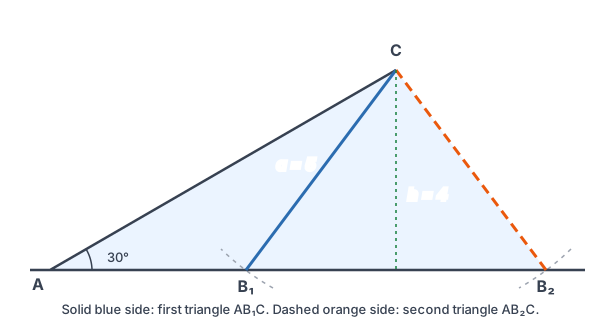
How Many Triangles? The Rules
Suppose you know angle A, the side a across from it and one more side b. First find the height h = b \sin A.
| Angle A | Condition | Number of triangles |
|---|---|---|
| Acute | a \lt h | 0 |
| Acute | a = h | 1 (a right triangle) |
| Acute | h \lt a \lt b | 2 |
| Acute | a \ge b | 1 |
| Right or obtuse | a \le b | 0 |
| Right or obtuse | a \gt b | 1 |
The sine test
You can also let the algebra decide. Solve \sin B = \frac{b \sin A}{a}.
- If \sin B \gt 1, there is no triangle, because sine is never more than 1.
- If \sin B = 1, then B = 90^\circ and there is one right triangle.
- If \sin B \lt 1, find B_1 = \sin^{-1}(\sin B), an acute angle. The second choice is B_2 = 180^\circ - B_1, because sine is positive in Quadrant II too.
- Keep B_2 only if A + B_2 \lt 180^\circ. Otherwise there is only one triangle.
Worked Examples
Use a calculator in degree mode. Round angles and sides to the nearest tenth.
Example 1: No triangle
Solve the triangle with A = 50^\circ, a = 6 and b = 10.
h = 10 \sin 50^\circ \approx 10(0.7660) = 7.66
Find the height.
Compare: a = 6 is less than h \approx 7.66, so side a is too short
\sin B = \frac{10 \sin 50^\circ}{6} \approx \frac{7.66}{6} \approx 1.277Confirm with the sine test.
Sine can’t be more than 1, so no angle B works
Answer: No triangle has these measurements.
Example 2: One triangle
Solve the triangle with A = 42^\circ, a = 15 and b = 11.
Here a \ge b with A acute, so expect one triangle
\sin B = \frac{11 \sin 42^\circ}{15} \approx \frac{11(0.6691)}{15} \approx 0.4907Use the law of sines for \sin B.
B_1 = \sin^{-1}(0.4907) \approx 29.4^\circFind the acute angle.
B_2 = 180^\circ - 29.4^\circ = 150.6^\circ
Try the second angle.
Test it: 42^\circ + 150.6^\circ = 192.6^\circ, which is more than 180^\circ, so reject B_2
C = 180^\circ - 42^\circ - 29.4^\circ = 108.6^\circ
Find C.
c = \frac{15 \sin 108.6^\circ}{\sin 42^\circ} \approx \frac{15(0.9478)}{0.6691} \approx 21.2Find c with the law of sines.
Answer: One triangle: B \approx 29.4^\circ, C \approx 108.6^\circ, c \approx 21.2.
Example 3: Two triangles
Solve the triangle with A = 35^\circ, a = 7 and b = 11.
h = 11 \sin 35^\circ \approx 11(0.5736) \approx 6.31
Find the height.
Compare: 6.31 \lt 7 \lt 11, so h \lt a \lt b and there are two triangles
\sin B = \frac{11 \sin 35^\circ}{7} \approx \frac{6.309}{7} \approx 0.9013Use the law of sines.
B_1 = \sin^{-1}(0.9013) \approx 64.3^\circTake the inverse sine for the first angle.
B_2 = 180^\circ - 64.3^\circ = 115.7^\circ
Find the second angle: subtract from 180°.
C_1 = 180^\circ - 35^\circ - 64.3^\circ = 80.7^\circ
Triangle 1, angle C.
c_1 = \frac{7 \sin 80.7^\circ}{\sin 35^\circ} \approx \frac{7(0.9869)}{0.5736} \approx 12.0Triangle 1, side c.
C_2 = 180^\circ - 35^\circ - 115.7^\circ = 29.3^\circ
Triangle 2, angle C.
c_2 = \frac{7 \sin 29.3^\circ}{\sin 35^\circ} \approx \frac{7(0.4894)}{0.5736} \approx 6.0Triangle 2, side c.
Answer: Triangle 1: B \approx 64.3^\circ, C \approx 80.7^\circ, c \approx 12.0. Triangle 2: B \approx 115.7^\circ, C \approx 29.3^\circ, c \approx 6.0.
Example 4: Exactly one right triangle
How many triangles have A = 30^\circ, a = 10 and b = 20?
h = 20 \sin 30^\circ = 20 \cdot \frac{1}{2} = 10Find the height.
Compare: a = 10 = h, so side a just touches the base
Check with the sine test: \sin B = \frac{20 \sin 30^\circ}{10} = \frac{10}{10} = 1, so B = 90^\circ
Answer: Exactly one triangle, and it is a right triangle with B = 90^\circ.
Example 5: Word problem with a cell tower
A straight road starts at point A. A cell tower C is 8 km from A, and the road makes a 30^\circ angle with the line from A to the tower. The tower’s signal reaches 5 km. Between which distances along the road does a driver have signal?
Set up SSA: A = 30^\circ, b = 8 (from A to the tower) and a = 5 (from the tower to a point B on the road)
Find the height: h = 8 \sin 30^\circ = 4. Since 4 \lt 5 \lt 8, the signal edge crosses the road at two points
\sin B = \frac{8 \sin 30^\circ}{5} = \frac{4}{5} = 0.8Use the law of sines.
B_1 = \sin^{-1}(0.8) \approx 53.1^\circTake the inverse sine for the first angle.
C_1 = 180^\circ - 30^\circ - 53.1^\circ = 96.9^\circ
Use the angle sum to find the third angle.
c_1 = \frac{5 \sin 96.9^\circ}{\sin 30^\circ} = 10 \sin 96.9^\circ \approx 9.9Distance to that point.
B_2 = 180^\circ - 53.1^\circ = 126.9^\circ
Find the second angle: subtract from 180°.
C_2 = 180^\circ - 30^\circ - 126.9^\circ = 23.1^\circ
Use the angle sum to find the third angle.
c_2 = \frac{5 \sin 23.1^\circ}{\sin 30^\circ} = 10 \sin 23.1^\circ \approx 3.9Distance to that point.
Answer: The driver has signal from about 3.9 km to about 9.9 km along the road. Here both triangles are real places on the road, so both answers matter.
Common Mistakes
| Mistake | Example of the error | Fix |
|---|---|---|
| Stopping after the calculator angle | Giving only B \approx 64.3^\circ in Example 3 | Always test B_2 = 180^\circ - B_1. |
| Keeping an impossible second angle | Keeping B_2 = 150.6^\circ when A = 42^\circ | Check that A + B_2 \lt 180^\circ. |
| Ignoring an error message | \sin^{-1}(1.277) gives an error, so you guess | The error means \sin B \gt 1: there is no triangle. |
| Using the height test with the wrong side | Using h = a \sin A | The height uses the other side: h = b \sin A. |
| Calling SAS ambiguous | Checking for two triangles when the angle is between the sides | Only SSA can be ambiguous. SAS always gives one triangle. |
Related Methods
Use the law of cosines
You can also set up the law of cosines with the unknown side c. You get a quadratic in c. Two positive roots mean two triangles, one means one, and none means no triangle.
Draw it first
A quick sketch like the one above often shows the answer. Draw angle A and side b, then swing side a from the end of b and see where it can land.
Practice Problems
Round angles and sides to the nearest tenth.
- How many triangles have A = 40^\circ, a = 4 and b = 9?
- Solve the triangle with A = 60^\circ, a = 12 and b = 10.
- Solve the triangle with A = 28^\circ, a = 6 and b = 10. Find both possible values of B.
- How many triangles have A = 30^\circ, a = 3 and b = 6?
- How many triangles have A = 105^\circ, a = 8 and b = 10?
- Solve the triangle with A = 105^\circ, a = 14 and b = 10.
- Solve the triangle with A = 50^\circ, a = 9 and b = 11. Find both triangles.
- With A = 45^\circ and b = 8, what exact value of a gives exactly one triangle with a \lt b?
- With A = 30^\circ and b = 12, for what values of a are there two triangles?
- A road makes a 40^\circ angle with the line from its start to a tower 10 km away. The signal reaches 8 km. Between which distances along the road is there signal?
Show answers
1.
h = 9 \sin 40^\circ \approx 9(0.6428) \approx 5.79
Find the height: b times the sine of A.
Compare: a = 4 is less than 5.79
Answer: no triangle
2.
a \ge b with A acute, so expect one triangle
\sin B = \frac{10 \sin 60^\circ}{12} \approx \frac{8.660}{12} \approx 0.7217Law of sines.
B_1 = \sin^{-1}(0.7217) \approx 46.2^\circ; B_2 = 133.8^\circ fails, since 60^\circ + 133.8^\circ \gt 180^\circ
C = 180^\circ - 60^\circ - 46.2^\circ = 73.8^\circ
Use the angle sum to find the third angle.
c = \frac{12 \sin 73.8^\circ}{\sin 60^\circ} \approx \frac{12(0.9603)}{0.8660} \approx 13.3Find side c with the law of sines.
Answer: B \approx 46.2^\circ, C \approx 73.8^\circ, c \approx 13.3
3.
Height: h = 10 \sin 28^\circ \approx 4.69, and 4.69 \lt 6 \lt 10, so two triangles
\sin B = \frac{10 \sin 28^\circ}{6} \approx \frac{4.695}{6} \approx 0.7825Law of sines.
B_1 = \sin^{-1}(0.7825) \approx 51.5^\circTake the inverse sine for the first angle.
B_2 = 180^\circ - 51.5^\circ = 128.5^\circ, and 28^\circ + 128.5^\circ \lt 180^\circ, so it works
Answer: B \approx 51.5^\circ or B \approx 128.5^\circ
4.
h = 6 \sin 30^\circ = 6 \cdot \frac{1}{2} = 3Find the height: b times the sine of A.
a = 3 = h
Compare.
Answer: exactly one triangle, a right triangle with B = 90^\circ
5.
A is obtuse, so a must be the longest side
Compare: a = 8 is not more than b = 10
Answer: no triangle
6.
A is obtuse and a \gt b, so there is one triangle
\sin B = \frac{10 \sin 105^\circ}{14} \approx \frac{9.659}{14} \approx 0.6899Law of sines.
B = \sin^{-1}(0.6899) \approx 43.6^\circTake the inverse sine.
C = 180^\circ - 105^\circ - 43.6^\circ = 31.4^\circ
Use the angle sum to find the third angle.
c = \frac{14 \sin 31.37^\circ}{\sin 105^\circ} \approx \frac{14(0.5206)}{0.9659} \approx 7.5Use the unrounded C \approx 31.37^\circ for c.
Answer: B \approx 43.6^\circ, C \approx 31.4^\circ, c \approx 7.5
7.
Height: h = 11 \sin 50^\circ \approx 8.43, and 8.43 \lt 9 \lt 11, so two triangles
\sin B = \frac{11 \sin 50^\circ}{9} \approx \frac{8.426}{9} \approx 0.9363, so B_1 \approx 69.4^\circ and B_2 \approx 110.6^\circ
Triangle 1: C_1 = 180^\circ - 50^\circ - 69.4^\circ = 60.6^\circ; c_1 = \frac{9 \sin 60.6^\circ}{\sin 50^\circ} \approx 10.2
Triangle 2: C_2 = 180^\circ - 50^\circ - 110.6^\circ = 19.4^\circ; c_2 = \frac{9 \sin 19.4^\circ}{\sin 50^\circ} \approx 3.9
Answer: B \approx 69.4^\circ, C \approx 60.6^\circ, c \approx 10.2 or B \approx 110.6^\circ, C \approx 19.4^\circ, c \approx 3.9
8.
One triangle with a \lt b happens when a = h
h = 8 \sin 45^\circ = 8 \cdot \frac{\sqrt{2}}{2} = 4\sqrt{2}Find the height: b times the sine of A.
Answer: a = 4\sqrt{2} \approx 5.66
9.
Two triangles need h \lt a \lt b
h = 12 \sin 30^\circ = 6
Find the height: b times the sine of A.
Answer: 6 \lt a \lt 12
10.
SSA: A = 40^\circ, b = 10, a = 8. Height: h = 10 \sin 40^\circ \approx 6.43, and 6.43 \lt 8 \lt 10, so two points
\sin B = \frac{10 \sin 40^\circ}{8} \approx \frac{6.428}{8} \approx 0.8035, so B_1 \approx 53.5^\circ and B_2 \approx 126.5^\circ
C_1 = 180^\circ - 40^\circ - 53.5^\circ = 86.5^\circ; c_1 = \frac{8 \sin 86.5^\circ}{\sin 40^\circ} \approx 12.4
C_2 = 180^\circ - 40^\circ - 126.5^\circ = 13.5^\circ; c_2 = \frac{8 \sin 13.5^\circ}{\sin 40^\circ} \approx 2.9
Answer: from about 2.9 km to about 12.4 km
FAQ
What is the ambiguous case in trigonometry?
It is the SSA case: two sides and an angle that is not between them. The data might fit zero, one or two triangles, so you have to check.
How do you know if there are two triangles?
For an acute angle A, find h = b \sin A. If h \lt a \lt b, there are two triangles.
Why does sin B give two angles?
Sine is positive in Quadrants I and II, so an acute angle and 180^\circ minus it have the same sine. Both can be triangle angles.
Is SSA a congruence rule?
No. Because SSA can make two different triangles, it does not prove triangles congruent. That is why it is missing from the congruence rules, except for the right-triangle case HL.
Summary
- SSA (two sides and an angle not between them) can give 0, 1 or 2 triangles.
- For acute A, compare a with h = b \sin A and with b.
- If \sin B \gt 1, there is no triangle.
- Always test B_2 = 180^\circ - B_1, and keep it only if A + B_2 \lt 180^\circ.
- If A is right or obtuse, there is one triangle only when a \gt b.
Previous lesson: Law of Sines
Next lesson: Law of Cosines
Back to the Trigonometry Index